
ปัจจัยที่สนับสนุนความสำเร็จของโรงเรียนในพื้นที่นวัตกรรมการศึกษา: กรณีศึกษาจังหวัดยะลา
คำสำคัญ:
ปัจจัยความสำเร็จ, พื้นที่นวัตกรรมการศึกษา, โรงเรียนประถมศึกษา, จังหวัดยะลาบทคัดย่อ
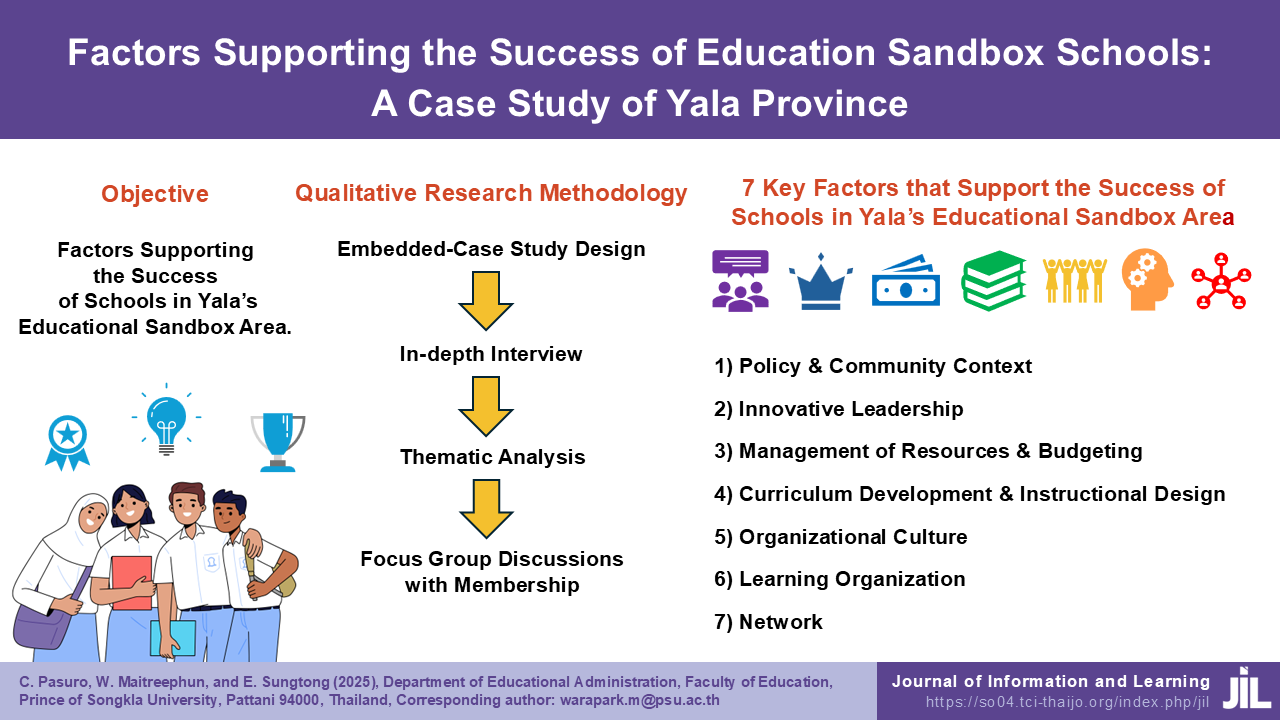
การวิจัยนี้มีวัตถุประสงค์เพื่อศึกษาปัจจัยที่สนับสนุนความสำเร็จของโรงเรียนในพื้นที่นวัตกรรมการศึกษาจังหวัดยะลา เป็นการวิจัยเชิงคุณภาพแบบกรณีศึกษา โดยมีโรงเรียนเป็นหน่วยการวิจัยที่ฝังตัวอยู่ในกรณีศึกษาจังหวัดยะลา เรียกรูปแบบนี้ว่า ‘Embedded-case study’ คณะผู้วิจัยเลือกโรงเรียนที่ประสบความสำเร็จในการนำนโยบายพื้นที่นวัตกรรมการศึกษาสู่การปฏิบัติ จำนวน 6 โรง จากโรงเรียนพื้นที่นวัตกรรม จำนวน 28 โรง เก็บข้อมูลด้วยการสัมภาษณ์โดยใช้แบบสัมภาษณ์กึ่งโครงสร้าง พร้อมกับการสังเกตและศึกษาเอกสาร มีผู้ให้ข้อมูลสำคัญโรงเรียนละ 3 คน คือ ผู้อำนวยการโรงเรียน ครูหัวหน้ากลุ่มบริหารงานวิชาการ และตัวแทนคณะกรรมการสถานศึกษา วิเคราะห์ข้อมูลโดยใช้การวิเคราะห์แก่นสาระ สร้างความน่าเชื่อถือของข้อมูลโดยใช้การตรวจสอบสามเส้าและการสนทนากลุ่มกับผู้มีส่วนร่วมในการวิจัยเพื่อยืนยันองค์ประกอบ ผลการวิจัยพบว่า ปัจจัยที่สนับสนุนความสำเร็จของโรงเรียนในพื้นที่นวัตกรรมการศึกษาจังหวัดยะลา มี 7 ปัจจัย ดังนี้ 1) ความเข้าใจเกี่ยวกับนโยบายและบริบทชุมชน 2) ภาวะผู้นำเชิงนวัตกรรมของผู้บริหารโรงเรียน 3) การบริหารทรัพยากรและงบประมาณที่มีประสิทธิภาพ 4) ศักยภาพในการพัฒนาหลักสูตรและการจัดการเรียนรู้ 5) วัฒนธรรมองค์กรที่มุ่งเน้นนวัตกรรม 6) การขับเคลื่อนองค์กรแห่งการเรียนรู้ และ 7) การสร้างเครือข่ายเพื่อยกระดับคุณภาพการศึกษา ข้อค้นพบดังกล่าวสามารถนำไปใช้เป็นกรอบแนวคิดในการพัฒนาแผนกลยุทธ์ของสถานศึกษาเพื่อยกระดับคุณภาพทางการศึกษาให้ประสบความสำเร็จตามเจตนารมณ์ของนโยบายพื้นที่นวัตกรรมการศึกษาต่อไป
เอกสารอ้างอิง
Arpha, K., Phonyiam, N., Sutthiprapa, P., Khumdinphithak, S., & Thawinkarn, D. (2020). Policy recommendation to develop innovative organization of secondary school in Khon Kaen Province. KKU Research Journal of Humanities and Social Sciences (Graduate Studies), 8(3), 32–41. https://so04.tci-thaijo.org/index.php/gskkuhs/article/view/247807
Canadian International Development Agency. (1999). Results-based management in CIDA: An introductory guide to the concepts and principles. Canadian International Development Agency, Hull, Quebec.
Chuenban, C., Warabanrungkul, T., Sripanomtanakorn, S., & Nilkote, R. (2024). A model of school administrations for excellence in schools under the education sandbox Rayong Province. Journal of Roi Kaensarn Academi, 9(8), 558–574. https://so02.tci-thaijo.org/index.php/JRKSA/article/view/273116
Committee for Driving the Yala Education Sandbox. (2024). Krop laksut sathansueksa radap kansueksa khanphuenthan changwat Yala phutthasakkarat B.E. 2567 tam laksutkaenklang kansueksakhan phuenthan phutthasakkarat B.E. 2551 [School curriculum framework basic education level, Yala Province, A.D. 2024 according to the basic education core curriculum A.D. 2008]. Yala Rajabhat University.
Creswell, J.W. (1998). Qualitative inquiry and research design: Choosing among five traditions. Sage.
David, M. H., & Jonathan, V. (2012). Becoming a leader who fosters innovation. Center Creative Leadership.
Giles, C., & Hargreaves, A. (2006). The sustainability of innovative schools as learning organizations and professional learning communities during standardized reform. Educational Administration Quarterly Journal, 42(1), 124–156. https://doi.org/10.1177/0013161X05278189
Hirunsathit, S., & Chaemchoy, S. (2019). The priority needs of Watsongtham school management based on concept of innovation organization. Academic Journal Phranakhon Rajabhat University, 10(2), 252–267. https://so01.tci-thaijo.org/index.php/AJPU/article/view/183285
Junkrapor, M., & Chienwattanasook, K. (2019). Establishing an innovative organization to drive towards the organizational excellence. Executive Journal, 39(1), 52–66. https://so01.tci-thaijo.org/index.php/executivejournal/article/view/171521
Kamhom, P., Kammantakun, W., & Srisombut, K. (2019). A structural equation model of factors influencing for innovative secondary schools in the office of the basic education commission. Journal of Education and Innovation, 21(3), 180–195. https://so06.tci-thaijo.org/index.php/edujournal_nu/article/view/88061
Kongsri, S., & Kerdtip, C. (2023). The development of learners’ standards and indicators for the internal quality assurance of education sandbox pilot schools in Yala Province. Journal of Education, Prince of Songkla University, Pattani Campus, 35(1), 165–180. https://so02.tci-thaijo.org/index.php/edupsu/article/view/263108
Law, M., Stewart, D., Letts, L., Pollock, N., Bosch, J., & Westmorland, M. (1998). Guidelines from critical review form: Qualitative studies. McMaster University Occupational Therapy Evidence-Based Practice Research Group.
Lincoln, Y.S. & Guba, E.G. (1985). Naturalistic inquiry. Sage.
Maitreephun, W. (2019). From a new paradigm of leadership theories to the roles of school leaders in building school-community relations. Journal of Education, Prince of Songkla University, Pattani Campus, 30(3), 17–29. https://so02.tci-thaijo.org/index.php/edupsu/article/view/233626
Masniyom, P., & Chanetiyang, D. (2017). Strategy in developing of private schools to an educational innovative organization. Journal of MCU Social Science Review, 6(2), 809–822. https://so03.tci-thaijo.org/index.php/jssr/article/view/243686
Merriam, S. B., & Tisdell, E. J. (2016). Qualitative research: A guide to design and implementation (4th ed.). Jossey Bass.
Morakul, R., Chanasid, D., Booncherdchoo, N., & Toujinda, O. (2017). A factor analysis of innovative organization of school in the basic education. Veridian E-Journal, Silpakorn University, 10(2), 2341–2355. https://he02.tci-thaijo.org/index.php/Veridian-E-Journal/article/view/103480
Office of Educational Innovation Area. (2022). Prakāt samnak nāyokratthamontrī rư̄ang kānkamnot phư̄nthī nawattakam kānsưksā (Announcement of the Prime Minister's Office on the designation of educational innovation areas) Education Sandbox. https://www.edusandbox.com/21st_dec_2022_new_area
Office of the Education Council. (2019). Model of resource mobilization for education. Prikwarn Graphic.
On-Ay, W., Chanbanchong, C., Jansila, V., & Mejang, S. (2015). A model for the development of a private school towards an innovative organization. Journal of Education Naresuan University, 17(2), 74–84. https://so06.tci-thaijo.org/index.php/edujournal_nu/article/view/33351
Panich, W. (2020). A world-class education. The Siam Commercial Foundation.
Phabua, T. (2021). Communication skill of the school administrator which affect the teacher performance motivation in international standard school under the Office of the Secondary Educational Service Area 3, Phra Nakhon Si Ayutthaya Province. Journal of Educational Review Faculty of Educational in MCU, 8(1), 55–68. https://so02.tci-thaijo.org/index.php/EDMCU/article/view/247049
Phonmanee, W., & Ariratana, W. (2019). The development of administration model for creating learning management innovations in secondary school under the Office of the Basic Education Commission. Journal of Educational Administration, Khon Kaen University, 15(1), 36–50. https://so02.tci-thaijo.org/index.php/EDMKKU/article/view/199013
Pimmas, S. (2018). Strategic area-based education. Bodhi Research Journal, 2(2), 16–37. https://ejournals.swu.ac.th/index.php/Bodhi/article/view/10998
Poonsub, W., & Ruttanasiraprapa, N. (2021). The factors of school administration in the education sandbox. Journal of Innovation and Management, 6(2), 65–77. https://so03.tci-thaijo.org/index.php/journalcim/article/view/251389
Prajankett, O. (2014). An educational innovative organization: A new choice of educational administration. Journal of The Royal Thai Army Nurses, 15(1), 45-51. https://he01.tci-thaijo.org/index.php/JRTAN/article/view/18430
Ramachandran, R. (2021). Leading in a VUCA world. Journal of Business Management, 20(1), 89–111. https://doi.org/10.12725/ujbm.54.5
Royal Thai Government Gazette. (2019, April 30). Phrarātchabanyat phư̄nthī nawattakam kānsưksā B. E. 2562 [Education Sandbox A.D. 2019]. https://www.ratchakitcha.soc.go.th/DATA/PDF/2562/A/056/T_0102.PDF
Saengloetuthai, J. (2021). Development of learning management innovation: Online lesson. Journal of Research and Curriculum Development, 11(2), 1–7. https://so03.tci-thaijo.org/index.php/jrcd/article/view/246494
Stake, R. E. (1995). The art of case study research. Sage Publications.
Tidd, J., & Bessant, J. (2018). Managing innovation: Integrating technological, market and organizational change (6th ed.). Willey.
Trairat, C., & Sinjindawong, S. (2020). The development of school to innovation organization: A case study of vibhavadi academic group under the Secondary Educational Service Area Office 2. The 15th RSU National Graduate Research Conference (pp. 1903–1914). Rangsit University. https://dspace.spu.ac.th/server/api/core/bitstreams/8193600b-3289-45e8-851e-3e8b67f5742d/content
Tucker, M. S. (2014). Chinese Lessons: Shanghai's Rise to the top of the PISA League Tables. National Center on Education and the Economy.
Wannapairo, S., & Palachai, S. (2023). Driving educational sandbox innovation by areas-based approaches. Interdisciplinary Academic and Research Journal, 3(6), 367–384. https://doi.org/10.60027/iarj.2023.271503
Yama, I., & Rorbkorb, N. (2024). Factors affecting the competency-based curriculum administration process in education sandbox pilot schools: A case study of Yala Primary Educational Service Area 2. Silpakorn Educational Research Journal, 16(2), 317–331. https://so05.tci-thaijo.org/index.php/suedureasearchjournal/article/view/275514
Yin, R. K. (2003). Case study research: Design and methods (3rd ed.). Sage.
ดาวน์โหลด
ไฟล์ประกอบ
เผยแพร่แล้ว
รูปแบบการอ้างอิง
ฉบับ
ประเภทบทความ
หมวดหมู่
สัญญาอนุญาต
ลิขสิทธิ์ (c) 2025 Journal of Information and Learning [JIL]

อนุญาตภายใต้เงื่อนไข Creative Commons Attribution-NonCommercial-NoDerivatives 4.0 International License.
Journal of Information and Learning ดำเนินการโดยสำนักวิทยบริการ มหาวิทยาลัยสงขลานครินทร์ วิทยาเขตปัตตานี บทความที่ได้รับการตีพิมพ์ในวารสารได้รับความคุ้มครองตามกฎหมายลิขสิทธิ์ โดยเจ้าของลิขสิทธิ์จะมีสิทธิในการทำซ้ำ ดัดแปลง และเผยแพร่งานบทความ ทั้งรูปแบบอิเล็กทรอนิกส์ การทำฉบับสำเนา การแปล และการผลิตซ้ำในรูปแบบต่างๆ ลิขสิทธิ์บทความเป็นของผู้เขียนและสำนักวิทยบริการ มหาวิทยาลัยสงขลานครินทร์ วิทยาเขตปัตตานี วารสารฯ ขอสงวนสิทธิ์ในการพิจารณาตีพิมพ์ตามความเหมาะสม รวมทั้งการตรวจทานแก้ไข การปรับข้อความ หรือขัดเกลาภาษาให้ถูกต้องตามเกณฑ์ที่กำหนด สำหรับผลการวิจัยและความคิดเห็นที่ปรากฏในบทความถือเป็นความคิดเห็นและอยู่ในความรับผิดชอบของผู้เขียน


