
การพัฒนาชุดการเรียนการสอนตามทฤษฎีการเรียนรู้เชิงสถานการณ์เพื่อเสริมสร้างความสามารถทางการเงินของนักเรียนมัธยมศึกษาตอนปลาย
คำสำคัญ:
ชุดการเรียนการสอน, ทฤษฎีการเรียนรู้เชิงสถานการณ์, ความสามารถทางการเงินบทคัดย่อ
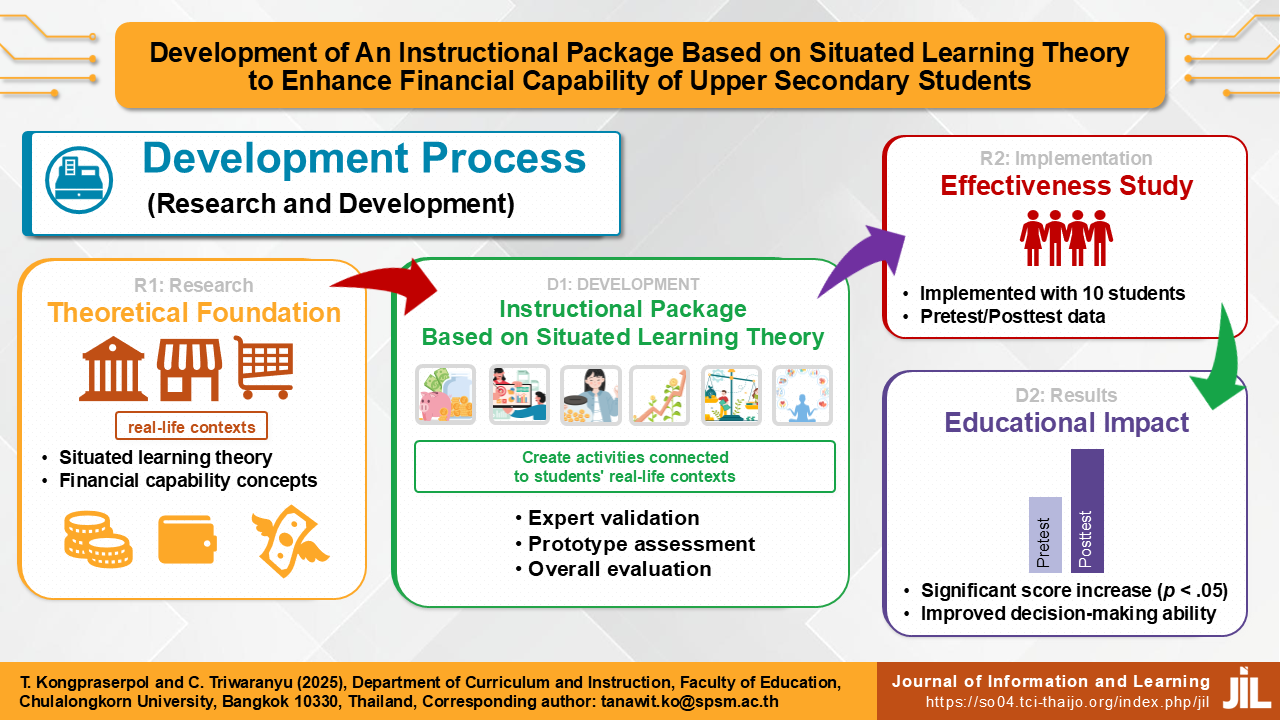
การวิจัยและพัฒนานี้มีวัตถุประสงค์เพื่อ 1) พัฒนาชุดการเรียนการสอนตามทฤษฎีการเรียนรู้เชิงสถานการณ์เพื่อเสริมสร้างความสามารถทางการเงินของนักเรียนมัธยมศึกษตอนปลาย และ 2) ศึกษาประสิทธิผลของชุดการเรียนการสอนที่พัฒนาขึ้น กลุ่มเป้าหมาย คือ นักเรียนมัธยมศึกษาตอนปลาย โรงเรียนสาธิตแห่งหนึ่ง โดยใช้การเลือกแบบสมัครใจจำนวน 10 คน เครื่องมือในการทดลอง คือ ชุดการเรียนการสอนที่พัฒนาขึ้น เครื่องมือในการเก็บรวบรวมข้อมูล คือ แบบวัดและแบบบันทึกข้อมูลเชิงคุณภาพของความสามารถทางการเงิน วิเคราะห์ข้อมูลโดยใช้สถิติ Wilcoxon Signed Rank Test คะแนนพัฒนาการสัมพัทธ์ และการวิเคราะห์เนื้อหา ผลการวิจัยปรากฏว่า 1) ชุดการเรียนการสอนที่พัฒนาขึ้น เป็นการรวมกิจกรรม สื่อ ขั้นตอนการจัดการเรียนการสอน และแนวทางการใช้งานอย่างเป็นระบบ มีองค์ประกอบ ได้แก่ (1) หลักการ (2) วัตถุประสงค์ (3) คำชี้แจง (4) กิจกรรมการเรียนการสอน 8 กิจกรรม ที่เรียงลำดับจากขอบเขตทางการเงินใกล้ตัวผู้เรียนไปสู่ระดับซับซ้อน (5) สื่อ เนื้อหา ทรัพยากร และระยะเวลา และ (6) การวัดและประเมินผล โดยผู้สอนออกแบบสถานการณ์ให้เหมาะสมกับบริบททางการเงินของผู้เรียน และจัดกิจกรรมให้ผู้เรียนได้กำหนดเป้าหมาย เผชิญสถานการณ์ สะท้อนผลของการตัดสินใจและดำเนินการทางการเงินของตน 2) ผู้เรียนมีค่าเฉลี่ยของคะแนนความสามารถทางการเงินสูงกว่าก่อนใช้ชุดการเรียนการสอนอย่างมีนัยสำคัญทางสถิติที่ระดับ .05 โดยเฉพาะความสามารถในการตัดสินใจและกำกับการดำเนินการทางการเงินของตนที่พัฒนาเด่นชัดที่สุด และการวิเคราะห์ข้อมูลเชิงคุณภาพสะท้อนให้เห็นว่าการออกแบบสถานการณ์ที่เชื่อมโยงกับบริบทชีวิตของผู้เรียนช่วยให้ผู้เรียนสามารถแสดงพฤติกรรมทางการเงินได้อย่างเหมาะสมและเป็นรูปธรรม
เอกสารอ้างอิง
Apisuksakul, K. (2021). Development of an online testing system for measure and reported financial literacy of upper secondary school students: an application of construct map approach and user experience research [Unpublished master’s thesis]. Srinakharinwirot University.
Atkinson, A., & Messy, F. (2012). Measuring financial literacy: Results of the OECD/International Network on Financial Education (INFE) Pilot study”. OECD Working papers on finance, insurance and private pensions, No. 15, OECD Publishing, Paris. https://doi.org/10.1787/5k9csfs90fr4-en
Australian Government. (2022). National financial capability strategy. Moneysmart. https://files.moneysmart.gov.au/media/vyfbpg4x/national-financial-capability-strategy-2022.pdf
Bank of Thailand. (2013a). Household financial access survey reports. Bank of Thailand.
Bank of Thailand. (2013b). Thai financial literacy survey reports. Bank of Thailand.
Bank of Thailand. (2016a). Household financial access survey reports. Bank of Thailand.
Bank of Thailand. (2016b). Thai financial literacy survey reports. Bank of Thailand.
Bank of Thailand. (2018a). Household financial access survey reports. Bank of Thailand.
Bank of Thailand. (2018b). Thai financial literacy survey reports. Bank of Thailand.
Bank of Thailand. (2020a). Household financial access survey reports. Bank of Thailand.
Bank of Thailand. (2020b). Thai financial literacy survey reports. Bank of Thailand.
Bank of Thailand. (2022a). Household financial access survey reports. Bank of Thailand.
Bank of Thailand. (2022b). Thai financial literacy survey reports. Bank of Thailand.
Çera, G., Khan, K. A., Mlouk, A., & Brabenec, T. (2020). Improving financial capability: The mediating role of financial behaviour. Economic Research-Ekonomska Istraživanja, 34(1), 1265–1282. https://doi.org/10.1080/1331677X.2020.1820362
ChanChang, J. (2019). The effects of using a tablet-based learning package with gamification approach to enhance mathematics learning achievement of Grade 4 students with different learning abilities. Journal of Education Studies, Chulalongkorn University, 47(2), 18–30. https://so02.tci-thaijo.org/index.php/EDUCU/article/view/195855
Kraitzek, A., Förster, M., & Walstad, W. B. (2022). Comparison of financial education and knowledge in the United States and Germany: Curriculum and assessment. Research in Comparative and International Education, 17(2), 153–173. https://doi.org/10.1177/17454999221081333
Lave, J., & Wenger, E. (1991). Situated learning: Legitimate peripheral participation. Cambridge University Press.
Neamphoka, G. (2021). Development of physical education instructional model using active learning and creativity-based learning to enhance physical fitness through system thinking of upper primary school students [Dissertations’s thesis, Chulalongkorn University]. CUIR. https://cuir.car.chula.ac.th/handle/123456789/80381
Nuamyoo, W., & Nasongkhla, J. (2020). A development of instructional package of mechanical with design process to enhance system thinking of elementary school students. ECT Education and Communication Technology Journal, 15(18), 1–11. https://so01.tci-thaijo.org/index.php/ectstou/article/view/228394
OECD. (2015). Survey on measuring financial literacy and financial inclusion. France.
OECD. (2022). OECD/INFE toolkit for measuring financial literacy and financial inclusion 2022. www.oecd.org/financial/education/2022-INFE-Toolkit-Measuring-Finlit-Financial-Inclusion.pdf
Phromwong, C. (2013). Testing the effectiveness of instructional media or packages. Silpakorn Educational Research Journal, 5(1), 7–20. https://so05.tci-thaijo.org/index.php/suedureasearchjournal/article/view/28419
Sakondhawat, K. (2019). Development of economic learning activity package sing scenario-based learning to promote financial literacy of lower secondary school students [Unpublished master’s thesis]. Chulalongkorn University.
Serido, J., Shim, S., & Tang, C. (2013). A developmental model of financial capability: A framework for promoting a successful transition to adulthood. International Journal of Behavioral Development, 37(4), 287–297. https://doi.org/10.1177/0165025413479476
Thongphuak, P. (2018). Effects of economics instruction by using simulation games on financial literacy of upper secondary school students [Unpublished master’s thesis]. Chulalongkorn University.
Xiao, J. J., Huang, J., Goyal, K. & Kumar, S. (2022). Financial capability: A systematic conceptual review, extension and synthesis. International Journal of Bank Marketing, 40(7), 1680–1717. https://doi.org/10.1108/IJBM-05-2022-0185
ดาวน์โหลด
ไฟล์ประกอบ
เผยแพร่แล้ว
รูปแบบการอ้างอิง
ฉบับ
ประเภทบทความ
หมวดหมู่
สัญญาอนุญาต
ลิขสิทธิ์ (c) 2025 Journal of Information and Learning [JIL]

อนุญาตภายใต้เงื่อนไข Creative Commons Attribution-NonCommercial-NoDerivatives 4.0 International License.
Journal of Information and Learning ดำเนินการโดยสำนักวิทยบริการ มหาวิทยาลัยสงขลานครินทร์ วิทยาเขตปัตตานี บทความที่ได้รับการตีพิมพ์ในวารสารได้รับความคุ้มครองตามกฎหมายลิขสิทธิ์ โดยเจ้าของลิขสิทธิ์จะมีสิทธิในการทำซ้ำ ดัดแปลง และเผยแพร่งานบทความ ทั้งรูปแบบอิเล็กทรอนิกส์ การทำฉบับสำเนา การแปล และการผลิตซ้ำในรูปแบบต่างๆ ลิขสิทธิ์บทความเป็นของผู้เขียนและสำนักวิทยบริการ มหาวิทยาลัยสงขลานครินทร์ วิทยาเขตปัตตานี วารสารฯ ขอสงวนสิทธิ์ในการพิจารณาตีพิมพ์ตามความเหมาะสม รวมทั้งการตรวจทานแก้ไข การปรับข้อความ หรือขัดเกลาภาษาให้ถูกต้องตามเกณฑ์ที่กำหนด สำหรับผลการวิจัยและความคิดเห็นที่ปรากฏในบทความถือเป็นความคิดเห็นและอยู่ในความรับผิดชอบของผู้เขียน


