
Development of an Instructional Model Based on Realistic Mathematics Education With Theory of Cognitive Development Approach to Enhance Mathematical Literacy of Primary School Students
Keywords:
mathematical literacy, mathematics instruction model, realistic mathematics education, primary education, cognitive development theoryAbstract
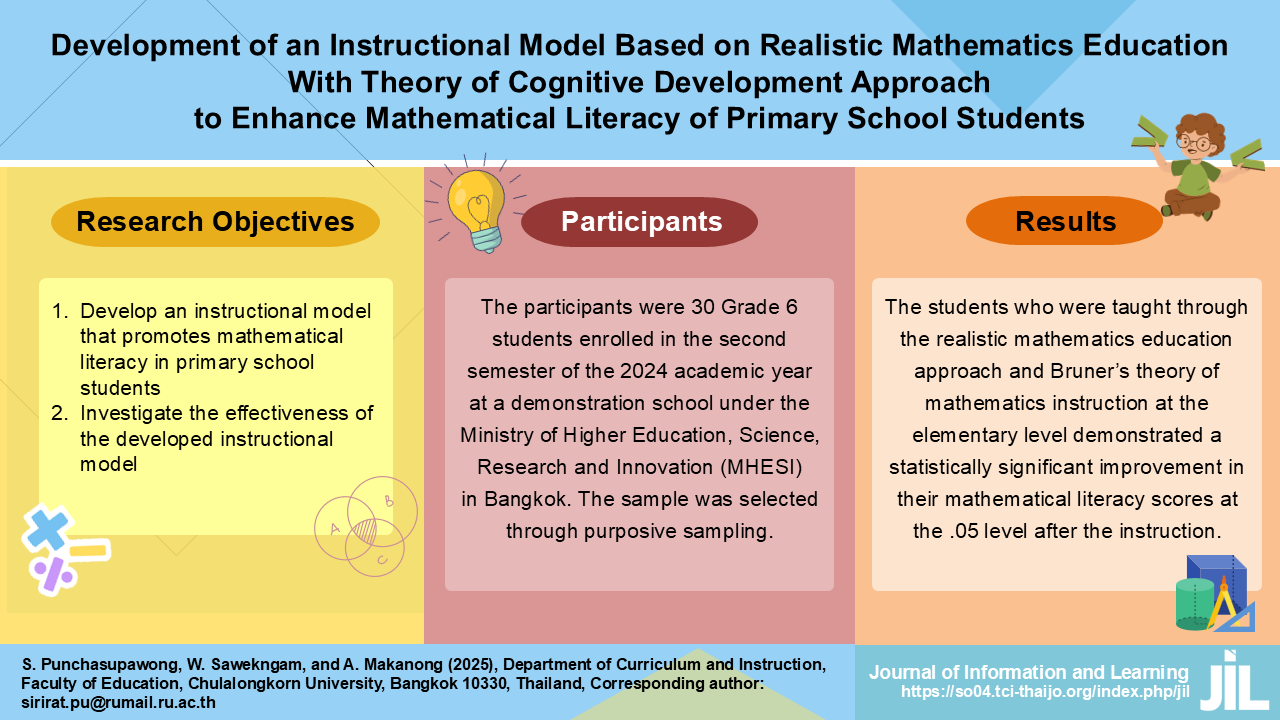
This research aimed to 1) develop an instructional model that promotes mathematical literacy in primary school students, and 2) investigate the effectiveness of the developed instructional model. The sample group consisted of 6th-grade students from a demonstration school under the Ministry of Higher Education, Science, Research and Innovation (MHESI) in Bangkok. This research employed a quasi-experimental design using a one-group pretest-posttest approach. The research instrument was a constructed-response mathematical literacy test, and the collected data were analyzed using descriptive statistics and paired-samples t-tests. The first finding revealed that the developed instructional model comprising four steps: 1) understanding real-life problem situations, 2) devising approaches and planning solutions, 3) solving mathematical problems, and 4) concluding and interpreting answers. This model was designed in alignment with the concept of mathematics education emphasizing real-life applications and theories of cognitive development. Secondly, the students' posttest scores on mathematical literacy (M = 8.90, SD = 3.63) were significantly higher than those pretest scores (M = 4.93, SD = 4.30) at the .05 level (t = 13.70, p < .001), with a large effect size (Cohen's d = 2.50). These findings indicated that the developed instructional model is clearly effective in promoting mathematical literacy among primary school students, particularly in helping them apply mathematical knowledge to solve real-life problems more effectively, which fostered a concrete and meaningful understanding of mathematics in their lives. This led to learners’ to appreciation of the value and application of mathematics in daily life, whether for calculation, planning, data-driven decision making, or critical thinking in various situations in life.
References
Bruner, J. S. (1960). The process of education. Harvard University Press.
Bruner, J. S. (1966). Toward a theory of instruction. Harvard University Press.
Chaodee, J., & Lincharoen, U. (2023). The development of learning activities using realistic mathematics education (RME) to promote mathematical literacy for Grade 6 students. Journal of Academic Studies, Mahasarakham Rajabhat University, 18(2), 1–15. https://so06.tci-thaijo.org/index.php/mcjou/article/view/273329
Ekowati, D. W., Azzahra, F. Z., Saputra, S. Y., & Suwandayani, B. I. (2021). Realistic mathematics education (RME) approach for primary school students’ reasoning ability. Premiere Educandum: Jurnal Pendidikan Dasar Dan Pembelajaran, 11(2), Article 269. https://doi.org/10.25273/pe.v11i2.8397
Freudenthal, H. (1991). Revisiting mathematics education: China lectures. Springer.
Gravemeijer, K. (1994). Developing realistic mathematics education. CD-β Press.
Gravemeijer, K., & Doorman, M. (1999). Context problems in realistic mathematics education: A calculus course as an example. Educational Studies in Mathematics, 39, 111–129. https://doi.org/10.1023/A:1003749919816
Johnson, F., & Erasmus, C. J. (2024). Equipping educators for learning support: A systematic review. British Journal of Special Education, 51(3), 296–316. https://doi.org/10.1111/1467-8578.12522
Lee, J., & Paul, N. (2021). A review of pedagogical approaches for improved engagement and learning outcomes in mathematics. Journal of Student Research, 12(3), 1–9. https://doi.org/10.47611/jsrhs.v12i3.5021
OECD. (2012). PISA 2012 assessment and analytical framework: Mathematics, reading, science, problem solving and financial literacy. OECD Publishing. http://dx.doi.org/10.1787/9789264190511-en
OECD (2013). Education at a glance 2013: OECD indicators. OECD Publishing. http://dx.doi.org/10.1787/eag-2013-en
OECD. (2018). PISA 2021 mathematics framework (draft). OECD Publishing. https://pisa2022-maths.oecd.org/files/PISA%202021%20Mathematics%20Framework%20Draft.pdf
OECD. (2021, September 16). Education at a glance 2021: OECD indicators. OECD Publishing. https://doi.org/10.1787/b35a14e5-en
OECD. (2023, December 5). PISA 2022 results (Volume I): The state of learning and equity in education. OECD Publishing. https://doi.org/10.1787/53f23881-en
Office of the Education Council. (2022). Education in Thailand 2022 edition: Learning recovery and education opportunities effectiveness accelerations situation. Office of the Education Council, Ministry of Education, Thailand. https://backoffice.onec.go.th/uploads/Book/2078-file.pdf
Pantanontaka, K., Sewakngam, W., & Makanong, A. (2020). The development of an instructional model based on mathematical thinking processes and realistic mathematics education to enhance lower secondary students’ mathematical problem-solving and reasoning abilities. Journal of Education Studies, 48(3), Article 2. https://doi.org/10.58837/CHULA.EDUCU.48.3.2
Patai, S & Chamraspun, U. (2023). The effects of problem–based learning and cognitive structure of Bruner on learning achievement and ability of solving math problems of 10th grade secondary school students. Udon Thani Rajabhat University Journal of Guru Education, 5(2), 87–101. https://so06.tci-thaijo.org/index.php/edudru/article/view/265173
Phienukrochon, K., & Yamrung, R. . (2023). Drafting the curriculum to enhance the mathematical literacy for grade 9 students. Journal of Liberal Art of Rajamangala University of Technology Suvarnabhumi, 5(3), 590–606. https://so03.tci-thaijo.org/index.php/art/article/view/271540
Phimpho, P., & Lincharoen, A. (2024). A development of mathematical literacy test for grade 10 students. Journal of MCU Ubon Review, 9(2), 1299–1310. https://so06.tci-thaijo.org/index.php/mcjou/article/view/273975
Purnamatati, A. M. M., Usman, H., & Yunianingsih, E. (2023). Influence a realistic mathematics education approach and motivation on students’ mathematical reasoning ability. Journal of Instructional Mathematics, 4(1), 13–20. https://doi.org/10.37640/jim.v4i1.1618
Putra, R. W. Y., Sutiarso, S., & Nurhanurawati, N. (2024). Using the realistic mathematics education (RME) approach with scaffolding to enhance mathematical representation ability. Al-Jabar: Jurnal Pendidikan Matematika, 15(2), 535–546. https://doi.org/10.24042/ajpm.v15i2.24560
Putri, A. D., Juandi, D., & Turnudi. (2024). Realistic mathematics education and mathematical literacy: A meta-analysis conducted on studies in Indonesia. Journal of Education and Learning, 18(4), 1468–1476. https://doi.org/10.11591/edulearn.v18i4.21650
Rizki, L. M., & Priatna, N. (2019). Mathematical literacy as the 21st century skill. Journal of Physics: Conference Series, 1157(4), Article 042088. https://doi.org/10.1088/1742-6596/1157/4/042088
Sievertsen, H. H. (2022). Assessments in education [Preprint]. arXiv. https://doi.org/10.48550/arXiv.2208.05826
Sutama, M., Novitasari, M., & Narimo, D. S. (2023). Numerical literacy ability in learning mathematics based on 21st century skills in primary school. Elementary Education Online, 19(4), 194–201. https://ilkogretim-online.org/index.php/pub/article/view/7128
Thapingkae, P. (2022). The development of an instructional model based on contextual inquiry project-based learning to enhance computational thinking for grade 7 students. Journal of Education Khon Kaen University, 46(3), 28–46. https://so02.tci-thaijo.org/index.php/EDKKUJ/article/view/260428
Thongmuang, P., & Jantakoon, J. (2023). The development of blended learning activities between realistic mathematics with online learning to enhance problem-solving ability and mathematical reasoning for grade 5 students. Journal of Humanities and Social Sciences, Rajapruk University, 9(3), 339–353. https://so03.tci-thaijo.org/index.php/rpu/article/download/274263/181686/1109804
Van den Heuvel-Panhuizen, M. (2003). The didactical use of models in realistic mathematics education: An example from a longitudinal trajectory on percentage. Educational Studies in Mathematics, 54, 9–35. https://doi.org/10.1023/B:EDUC.0000005212.03219.dc
Van den Heuvel-Panhuizen, M. (Ed.). (2020). National reflections on the Netherlands didactics of mathematics: Teaching and learning in the context of realistic mathematics education [ICME 13 Monographs]. Springer. https://doi.org/10.1007/978-3-030-33824-4
Yuanita, P., Zulnaidi, H., & Zakaria, E. (2018). The effectiveness of realistic mathematics education approach: The role of mathematical representation as mediator between mathematical belief and problem solving. PLoS ONE, 13(9), Article e0204847. https://doi.org/10.1371/journal.pone.0204847
Downloads
Additional Files
Published
How to Cite
Issue
Section
Categories
License
Copyright (c) 2025 Journal of Information and Learning [JIL]

This work is licensed under a Creative Commons Attribution-NonCommercial-NoDerivatives 4.0 International License.
The Journal of Information and Learning is operated by the Office of Academic Resources, Prince of Songkla University. All articles published in the journal are protected by Thailand copyright law. This copyright covers the exclusive rights to share, reproduce and distribute the article, including in electronic forms, reprints, translations, photographic reproductions, or similar. Authors own copyrights in the works they have created as well as the Office of Academic Resources. The Journal reserves the right to edit the language of papers accepted for publication for clarity and correctness, as well as to make formal changes to ensure compliance with the journal's guidelines. All authors must take public responsibility for the content of their paper.


