แนวทางการพัฒนากรอบแนวคิดเติบโตของครูเพื่อส่งเสริมการเรียนรู้ของผู้เรียนระดับประถมศึกษา
คำสำคัญ:
กรอบแนวคิดเติบโต, การพัฒนาครู, การส่งเสริมการเรียนรู้, ระดับประถมศึกษาบทคัดย่อ
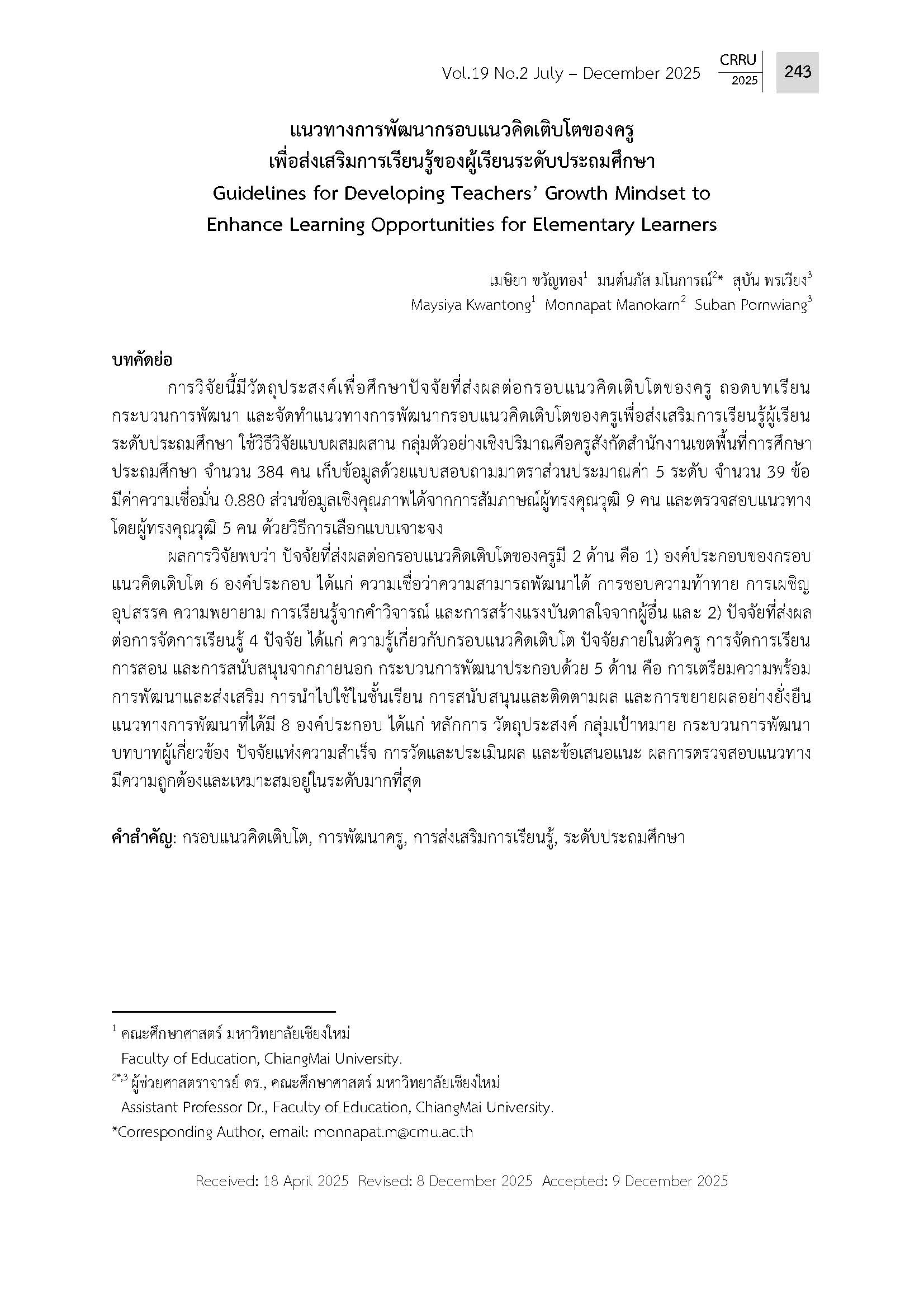
การวิจัยนี้มีวัตถุประสงค์เพื่อศึกษาปัจจัยที่ส่งผลต่อกรอบแนวคิดเติบโตของครู ถอดบทเรียนกระบวนการพัฒนา และจัดทำแนวทางการพัฒนากรอบแนวคิดเติบโตของครูเพื่อส่งเสริมการเรียนรู้ผู้เรียนระดับประถมศึกษา ใช้วิธีวิจัยแบบผสมผสาน กลุ่มตัวอย่างเชิงปริมาณคือครูสังกัดสำนักงานเขตพื้นที่การศึกษาประถมศึกษา จำนวน 384 คน เก็บข้อมูลด้วยแบบสอบถามมาตราส่วนประมาณค่า 5 ระดับ จำนวน 39 ข้อ มีค่าความเชื่อมั่น 0.880 ส่วนข้อมูลเชิงคุณภาพได้จากการสัมภาษณ์ผู้ทรงคุณวุฒิ 9 คน และตรวจสอบแนวทางโดยผู้ทรงคุณวุฒิ 5 คน ด้วยวิธีการเลือกแบบเจาะจง
ผลการวิจัยพบว่า ปัจจัยที่ส่งผลต่อกรอบแนวคิดเติบโตของครูมี 2 ด้าน คือ 1) องค์ประกอบของกรอบแนวคิดเติบโต 6 องค์ประกอบ ได้แก่ ความเชื่อว่าความสามารถพัฒนาได้ การชอบความท้าทาย การเผชิญอุปสรรค ความพยายาม การเรียนรู้จากคำวิจารณ์ และการสร้างแรงบันดาลใจจากผู้อื่น และ 2) ปัจจัยที่ส่งผลต่อการจัดการเรียนรู้ 4 ปัจจัย ได้แก่ ความรู้เกี่ยวกับกรอบแนวคิดเติบโต ปัจจัยภายในตัวครู การจัดการเรียนการสอน และการสนับสนุนจากภายนอก กระบวนการพัฒนาประกอบด้วย 5 ด้าน คือ การเตรียมความพร้อม การพัฒนาและส่งเสริม การนำไปใช้ในชั้นเรียน การสนับสนุนและติดตามผล และการขยายผลอย่างยั่งยืน แนวทางการพัฒนาที่ได้มี 8 องค์ประกอบ ได้แก่ หลักการ วัตถุประสงค์ กลุ่มเป้าหมาย กระบวนการพัฒนา บทบาทผู้เกี่ยวข้อง ปัจจัยแห่งความสำเร็จ การวัดและประเมินผล และข้อเสนอแนะ ผลการตรวจสอบแนวทางมีความถูกต้องและเหมาะสมอยู่ในระดับมากที่สุด
เอกสารอ้างอิง
Achattham, T. (2022). Transformational leadership of administrators and teachers' growth mindset development. University Press. (in Thai)
Blackwell, L. S., Trzesniewski, K. H., & Dweck, C. S. (2007). Implicit theories of intelligence predict achievement across an adolescent transition: A longitudinal study and an intervention. Child Development, 78(1), 246–263.
Chaloeysap, S. (2023). Primary school children's development in attitudes and learning dimensions. Educational Research Center. (in Thai)
Charoensuk, Y. (2019). Relationship between teachers' mindset and primary students' learning outcomes. Educational Research Journal, 27(2), 145–162. (in Thai)
Chawalittham, S. (2024). Supporting factors for human resource development in educational institutions. Journal of Educational Administration, 35(1), 78–95. (in Thai)
Desimone, L. M. (2009). Improving impact studies of teachers’ professional development: Toward better conceptualizations and measures. Educational Researcher, 38(3), 181–199.
Duangkaew, R. (2017). Teacher development model using the PDCA quality cycle. Office of the Basic Education Commission. (in Thai)
Duangkaew, R., & Charoenkul, N. (2018). Developing organizational culture to promote growth mindset in educational institutions. Journal of Education, Naresuan University, 20(4), 108-121. (in Thai)
Dweck, C. S. (2006). Mindset: The new psychology of success. Random House.
Erikson, E. H. (1963). Childhood and society (2nd ed.). Norton.
Esparza, J., Shumow, L., & Schmidt, J. A. (2014). Growth mindset in the classroom: Motivating learners to persist. Journal of Educational Psychology, 106(3), 1–14.
Faikhamta, C., et al. (2018). Trends of fixed mindset among Thai teachers and related factors. Journal of Education. (in Thai)
Faikhamta, C. (2018). Thai teachers' mindset in Education 4.0 era. Journal of Education, Naresuan University, 20(2), 1-14 (in Thai)
Gero, A. (2013). Growth mindset in teachers: A study of challenges in adopting new beliefs. Journal of Educational Change, 14(2), 123–139.
Haimovitz, K., & Dweck, C. S. (2017). The origins of children’s growth and fixed mindsets: New research and a new proposal. Child Development, 88(6), 1849–1859.
Hattie, J., & Timperley, H. (2007). The power of feedback. Review of Educational Research, 77(1), 81–112.
Kingkaew, S. (2023). Building professional learning communities (PLC) for modern teachers. University Press. (in Thai)
Krejcie, R. V., & Morgan, D. W. (1970). Determining sample size for research activities. Educational and Psychological Measurement, 30(3), 607–610.
Maneerat, I. (2018). Teachers' mindset and students' learning outcomes. Journal of Educational Studies, 42(3), 201–218. (in Thai)
Office of the Education Council Secretariat. (2023). Thai education report in the 21st century. Office of the Education Council Secretariat. (in Thai)
Office of the National Economic and Social Development Council. (2018). National Strategy 2018–2037. Office of the National Economic and Social Development Council. (in Thai)
Organization for Economic Cooperation and Development. (2019). PISA 2018 results. OECD Publishing.
Panich, W. (2015). Learning towards change: Transformative learning. Siam Commercial Foundation. (in Thai)
Phisut, P. (2021). Teacher development through lifelong learning approach. Educational Research Institute. (in Thai)
Phongsriwat, S. (2017). School leadership and organizational development success. University Press. (in Thai)
Phuthongngen, K. (2018). Instructional supervision for developing 21st century teachers. University Press. (in Thai)
Piaget, J. (1952). The origins of intelligence in children. International Universities Press.
Prasertsan, S. (2018). Systemic factors in Thai teacher development. Institute for Teacher Development. (in Thai)
Saenchaiprom, S. (2021). Applying PDCA to develop teacher quality in educational institutions. Journal of Educational Quality, 28(2), 156–173. (in Thai)
Sawaschat, P. (2023). Leadership and organizational culture in Thai educational institutions. University Press. (in Thai)
Schmidt, S., Shumow, L., & Kackar, H. (2015). Growth mindset and student motivation: A study of elementary school learners. Journal of Educational Psychology, 107(3), 579–592.
Sinlarat, P., et al. (2020). Teacher development based on growth mindset concepts. Educational Research Institute. (in Thai)
Siritharangsi, P. (2014). Collaborative learning processes in professional teacher communities. Publishing House. (in Thai)
Sitthipan, N. (2021). The effects of growth mindset on student competencies and teaching quality. University Press. (in Thai)
Sombatcharoen, P. (2024). Multi-level factors affecting human resource development in educational institutions. Journal of Human Resource Development, 18(1), 34–52. (in Thai)
Srirat, P. (2018). Preparing teachers for growth mindset development. Educational Institute. (in Thai)
Srisapirak, S., & Chaiso, P. (2021). Learning management to enhance growth mindset in primary students. Journal of Education, 48(3), 234–251. (in Thai)
Sukwong, C. (2023). Teachers’ growth mindset concepts in the 21st century. Educational Institute. (in Thai)
Sutthirat, C. (2021). Assessment to promote students’ growth mindset. Journal of Educational Studies, 45(2), 112–128. (in Thai)
Thewanarumitkul, P. (2021). Growth mindset development in the Thai teacher context: A systematic literature review. Thammasat University. (in Thai)
Thongdee, L. (2020). Policy guidelines for sustainable teacher development. Ministry of Education. (in Thai)
Wongyai, W., & Patphol, M. (2019). Development of organizational climate to promote teacher learning. Journal of Science and Technology, King Mongkut's University of Technology North Bangkok, 13(1), 112-125. (in Thai)
ดาวน์โหลด
เผยแพร่แล้ว
รูปแบบการอ้างอิง
ฉบับ
ประเภทบทความ
สัญญาอนุญาต
ลิขสิทธิ์ (c) 2025 วารสารการวิจัยกาสะลองคำ มหาวิทยาลัยราชภัฏเชียงราย

อนุญาตภายใต้เงื่อนไข Creative Commons Attribution-NonCommercial-NoDerivatives 4.0 International License.