
Development of Teaching Model Using Phenomenon-Based Learning in Volleyball Skills and Instruction to Enhance Students' Creativity at Faculty of Education, Thailand National Sports University
Keywords:
volleyball skill and instruction, phenomenon-based learningAbstract
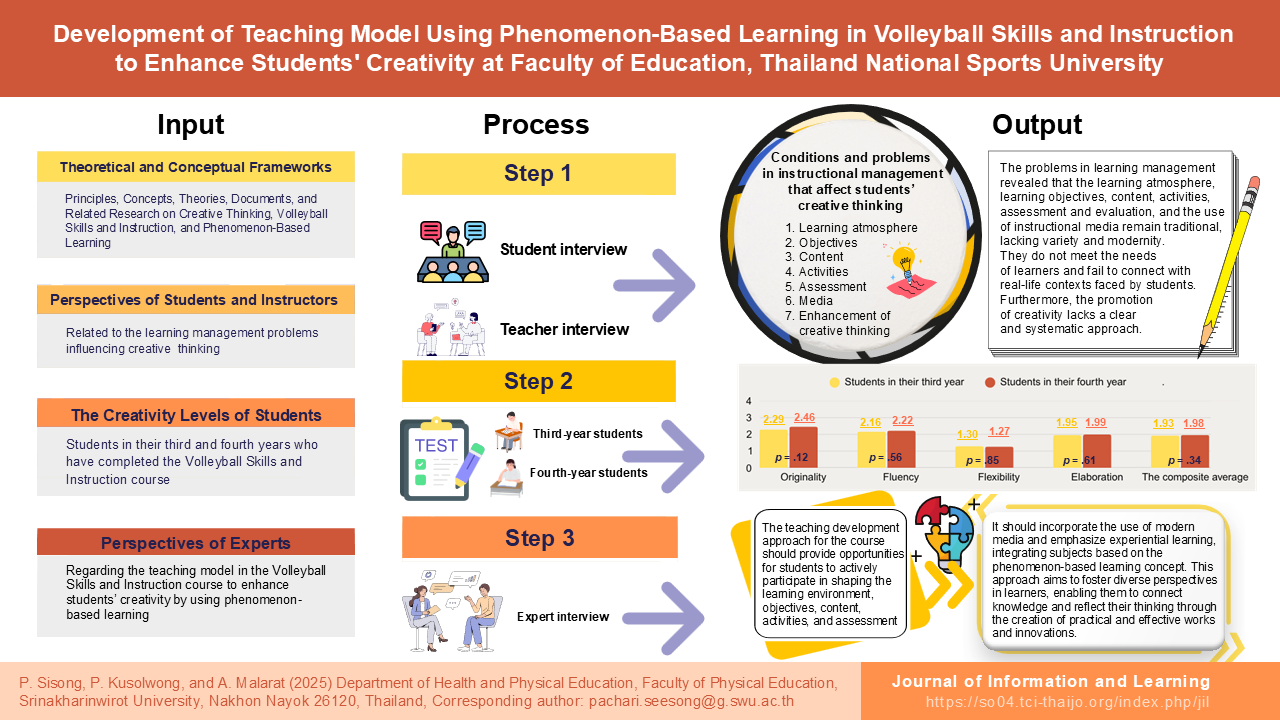
This research aimed to 1) study the problems in learning management, 2) examine the level of creativity, and 3) explore guidelines for developing a teaching model in the course Volleyball Skill and Instruction to enhance students’ creativity using phenomenon-based learning. The mixed methods were employed in this study. The key informants included 18 students and 6 teachers. The population and sample groups consisted of 96 third-year and fourth-year students out of 128 students enrolling in the course offered by the Faculty of Education, which was determined using the sample size formula of Krejcie and Morgan (1970), and 5 experts. The research instruments were 1) an interview form on the problems in learning management, 2) a creativity test and creativity assessment form, and 3) an interview form on guidelines for developing the teaching model in the volleyball course. Data were analyzed using mean, standard deviation, independent t-test, and content analysis with inductive conclusion. The results were showed as follows: 1) The problems in learning management involved repetitive, outdated, and limited approaches in fostering learning atmosphere, objectives, contents, activities, assessment, and media use, which did not meet students’ needs and did not relate to real-life contexts, as well as an unclear, unsystematic approach to fostering creativity. 2) The overall creativity levels of both third-year and fourth-year was at a moderate level, with no significant difference between the two groups. 3) Regarding the guidelines for developing the teaching model, the students should allow to participate in creating learning atmosphere, objectives, contents, activities, and assessment. That is to broaden students’ perspectives, foster knowledge integration, and lead to the creation of practical, innovative works.
References
Borodina, T., Sibgatullina, A., & Gizatullina, A. (2019). Developing creative thinking in future teachers as a topical issue of higher education. Journal of Social Studies Education Research, 10(4), 226–245. https://files.eric.ed.gov/fulltext/EJ1241711.pdf
Bubpamas, C., & Songserm, U. (2024). The development of instructional model based on phenomenon based learning to student teachers’ learning experiences management ability. Social Sciences Research and Academic Journal, 19(2), 187–202. https://so05.tci-thaijo.org/index.php/JSSRA/article/view/270546
Butgatanyu, A. (2018). Phenomenon-based learning to create a holistic perspective and access the real world of learners. Journal of Education Studies, 46(2), 348–365. https://so02.tci-thaijo.org/index.php/EDUCU/article/view/131909
Chaiwon, T., & Nugultham, K. (2021). Phenomenon-based learning: Integrated learning for enhancing learners’ knowledge in the real world. Journal of Graduate Studies, Valaya Alongkorn Rajabhat University, 15(2), 251–263. https://so02.tci-thaijo.org/index.php/JournalGradVRU/article/view/246642
Charoenwongsak, K. (2021). Creative thinking (12th ed.). Success Media
Chuysawat, T., Chauvatcharin, N., & Thongsorn, P. (2021). The enhancing of learning achievement and critical thinking skill for eleventh grade students using the phenomenon-based learning. Journal of Educational Studies, 22(1), 1–17. https://ejournals.swu.ac.th/index.php/jedu/article/view/13336
Craft, A. (2005). Creativity in schools: Tensions and dilemmas. Routledge. https://doi.org/10.4324/9780203357965
Cromwell, J. R. (2024). How combinations of constraint affect creativity: A new typology of creative problem solving in organizations. Organizational Psychology Review, 14(1), 3–24. https://journals.sagepub.com/doi/abs/10.1177/20413866231202031
Garrison, D. R., & Kanuka, H. (2004). Blended learning: Uncovering its transformative potential in higher education. The Internet and Higher Education, 7(2), 95–105. https://doi.org/10.1016/j.iheduc.2004.02.001
Hennessey, B. A., & Amabile, T. M. (2010). Creativity. Annual Review of Psychology, 61(1), 569–598. https://doi.org/10.1146/annurev.psych.093008.100416
Jindanurak, T. (2016). Creative thinking development and evaluation in schools. Journal of Education, 27(1). 1–14. https://ojs.lib.buu.ac.th/index.php/education2/article/view/4043
Khaopratoom, W., Duangwiset, B., & Wuthichumpoo, N. (2023). The development of creative thinking by phenomenon based learning. The Golden Teak: Humanity and Social Science Journal, 29(1), 162–179. https://research.kpru.ac.th/research2/pages/filere/2262023-07-12.pdf
Kongrat, C. (2024). Phenomenon-based learning: Developing higher order thinking competencies toward sustainable learning. Journal of Multidisciplinary in Humanities and Social Sciences, 7(3), 1701–1720. https://so04.tci-thaijo.org/index.php/jmhs1_s/article/view/270281
Krejcie, R. V., & Morgan, D. W. (1970). Determining sample size for research activities. Educational and Psychological Measurement, 30(3), 607–610. https://doi.org/10.1177/001316447003000308
Larraz-Rábanos, N. (2021). Development of creative thinking skills in the teaching-learning process. IntechOpen. https://doi.org/10.5772/intechopen.97780
Maslow, A. H. (1943). A theory of human motivation. Psychological Review, 50(4), 370–396. https://doi.org/10.1037/h0054346
Ministry of Education. (2018). National education standards B.E. 2018. 21Century.
National Strategy Secretariat Office. (2018). National strategy 2018–2037 (Summary). http://bic.moe.go.th/images/stories/pdf/National_Strategy_Summary.pdf
Office of the National Economic and Social Development Council. (2023). The thirteenth national economic and social development plan (2023–2027). https://www.nesdc.go.th/article_attach/article_file_20230615134223.pdf
Pengsantia, H., Tulmethakaan, M., & Suwathanpornkul, I. (2021). Effect of learning management by using phenomenon-based learning on critical thinking and creative thinking of grade 12 students. Silpakorn Educational Research Journal, 13(2), 240–257. https://so05.tci-thaijo.org/index.php/suedureasearchjournal/article/view/251771
Phoyen, P. (2019). Creativity and education in the 21st century. Journal of Educational Administration, 15(2), 23–34. https://so02.tci-thaijo.org/index.php/suedujournal/article/view/176939
Pianchob, W. (2018). Rūam botkhwām kīeokap pratyā lakkān withī sō̜n læ kān wat phư̄a pramœ̄nphon kānsưksā [Collection of articles on philosophy, principles, teaching methods and measurement for evaluation in physical education] (2nd ed.). Chulalongkorn University Press.
Pibool, O., & Suthasinobol, K. (2021). Phenomenon-based learning for the development of transversal competencies: A case study from Finland. Journal of Liberal Art of Rajamangala University of Technology Suvarnabhumi, 3(3), 414–427. https://so03.tci-thaijo.org/index.php/art/article/view/254981
Pinta, P., & Bongkotphet, T. (2024). Phenomenon-based learning to develop critical thinking skills and problem solving skills on climate change for 6th grade students. Journal of Rangsit University: Teaching & Learning, 18(2), 78–92. https://jrtl.rsu.ac.th/volume/18/number/2/article/377
Promma, N., & Songserm, U. (2024). Concept of phenomenon-based learning management and its appropriateness in the educational context of Thai society. Journal of Education, Chiang Mai Rajabhat University, 3(2), 1–15. https://so07.tci-thaijo.org/index.php/cmredujo/article/view/3530
Sabugal, B. T., & Apellido Jr., E. (2025). Effectiveness of the phenomenon-based approach in enhancing senior high school students’ mathematical achievement and problem-solving skills. ASEAN Journal of Educational Research and Technology, 4(2), 153–160. https://ejournal.bumipublikasinusantara.id/index.php/ajert/article/view/667
Samaniego, M., Usca, N., Salguero, J., & Quevedo, W. (2024). Creative thinking in art and design education: A systematic review. Education Sciences, 14(2), Article 192. https://www.mdpi.com/2227-7102/14/2/192
Sawyer, R. K. (2017). The creative classroom: Innovative teaching for 21st century learners. Teachers College Press.
Setiamurti, A., & Kurniawati, F. (2024). Fostering creativity in higher education Institution: A systematic review (2018–2022). Open Education Studies, 6(1), Article 20220221. https://doi.org/10.1515/edu-2022-0221
Sirila, P. (2022). Effects of using the combination of phenomenon-based learning and STEM education for developing applicative thinking of elementary students [Master's thesis, Chulalongkorn University]. Chula Digital Collections. https://digital.car.chula.ac.th/chulaetd/6389
Suwancharoen, J. (2019). Development of a learning model that promotes creativity for nursing students at Boromarajonani College of Nursing, Surat Thani. Journal of Health Research and Innovation, 2(1), 37–47. https://he02.tci-thaijo.org/index.php/jhri/article/view/243251
Sweller, J. (1988). Cognitive load during problem solving: Effects on learning. Cognitive Science, 12(2), 257–285. https://doi.org/10.1207/s15516709cog1202_4
Talvio, M., & Rainio, A. P. (2023, March). Teacher-students’ learning to teach phenomenon-based learning projects [Conference presentation]. 17th International Technology, Education and Development Conference, Valencia, Spain. https://doi.org/10.21125/inted.2023.0313
Thavonrattanavanit, S. (2019). Development of creativity assessment model through innovation project of lower secondary school students [Doctoral dissertation, Chulalongkorn University]. Chula DigiVerse. https://doi.org/10.58837/CHULA.THE.2020.600
Tongsoong, S., & Jermtaisong, R. (2021, February). Learning management through the combination of steam education and phenomenon-based learning to develop creative thinking of secondary 6 (grade 12) students [Conference presentation]. 6th UPI International Conference on TVET 2020 (TVET 2020). https://doi.org/10.2991/assehr.k.210203.145
Trilling, B., & Fadel, C. (2009). 21st century skills: Learning for life in our times. Jossey-Bass.
Ualikhanova , B., Ormanova, G., Berdaliyev, D., Mussakhan, N., Anas, B., & Güdekli, E. (2024). Impact of phenomenon-based learning on high school physics education in Shymkent, Kazakhstan. Qubahan Academic Journal, 4(4), 225–236. https://doi.org/10.48161/qaj.v4n4a1203
Vorawattanachai, P. (2022). Fundamental knowledge in creative thinking. Journal of Educational Studies, 16(1), 14–31. https://edujournal.bsru.ac.th/publishes/20/articles/381
Wongyai, W., & Patthanaphon, N. (2021). Developing creativity in students. Innovative Leaders Center In Curriculum & Learning (LCCL). http://www.curriculumandlearning.com/upload/Books/Develop%20Creativity_1615683966.pdf
Zhong, X., Qu, K., & Zhang, D. (2024). Examining influencing factors of teacher education students’ creativity in Chongqing Municipality. Cogent Education, 11(1), Article 2351268. https://www.tandfonline.com/doi/full/10.1080/2331186X.2024.2351268
Downloads
Additional Files
Published
How to Cite
Issue
Section
Categories
License
Copyright (c) 2025 Journal of Information and Learning [JIL]

This work is licensed under a Creative Commons Attribution-NonCommercial-NoDerivatives 4.0 International License.
The Journal of Information and Learning is operated by the Office of Academic Resources, Prince of Songkla University. All articles published in the journal are protected by Thailand copyright law. This copyright covers the exclusive rights to share, reproduce and distribute the article, including in electronic forms, reprints, translations, photographic reproductions, or similar. Authors own copyrights in the works they have created as well as the Office of Academic Resources. The Journal reserves the right to edit the language of papers accepted for publication for clarity and correctness, as well as to make formal changes to ensure compliance with the journal's guidelines. All authors must take public responsibility for the content of their paper.


