
การพัฒนารูปแบบการสอนโดยใช้การจัดการเรียนรู้ปรากฏการณ์เป็นฐานในรายวิชาทักษะและการสอนกีฬาวอลเลย์บอลเพื่อเสริมสร้างความคิดสร้างสรรค์ของนักศึกษาคณะศึกษาศาสตร์ มหาวิทยาลัยการกีฬาแห่งชาติ
คำสำคัญ:
ทักษะและการสอนกีฬาวอลเลย์บอล, การเรียนรู้ปรากฏการณ์เป็นฐานบทคัดย่อ
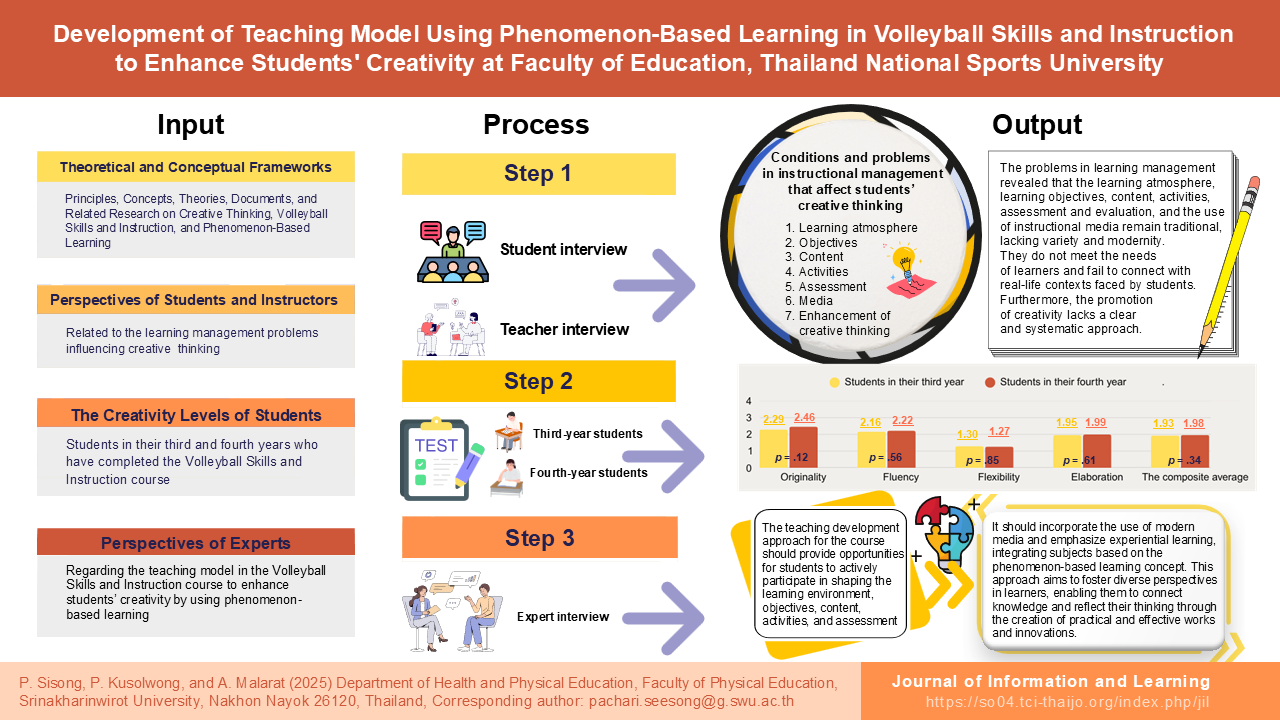
การวิจัยครั้งนี้มีวัตถุประสงค์เพื่อ 1) ศึกษาสภาพปัญหาการจัดการเรียนรู้ 2) ศึกษาระดับความคิดสร้างสรรค์ 3) ศึกษาแนวทางการพัฒนารูปแบบการสอนในรายวิชาทักษะและการสอนกีฬาวอลเลย์บอลเพื่อเสริมสร้างความคิดสร้างสรรค์ของนักศึกษา โดยใช้การจัดการเรียนรู้ปรากฏการณ์เป็นฐาน การวิจัยเป็นแบบผสานวิธี ผู้ให้ข้อมูล ได้แก่ นักศึกษาจำนวน 18 คน อาจารย์ จำนวน 6 คน ประชากรและกลุ่มตัวอย่างในการวิจัยครั้งนี้ ได้แก่ นักศึกษาชั้นปีที่ 3 และชั้นปีที่ 4 จำนวน 96 คน ซึ่งคำนวณจากสูตรการกำหนดขนาดกลุ่มตัวอย่างของ Krejcie and Morgan (1970) จากนักศึกษา จำนวน 128 คน ที่ได้ผ่านลงทะเบียนในรายวิชาทักษะและการสอนกีฬาวอลเลย์บอล คณะศึกษาศาสตร์ มหาวิทยาลัยการกีฬาแห่งชาติ วิทยาเขตอ่างทอง และผู้เชี่ยวชาญ จำนวน 5 คน เครื่องมือที่ใช้ในการวิจัย คือ 1) แบบสัมภาษณ์สภาพปัญหาการจัดการเรียนรู้ 2) แบบทดสอบความคิดสร้างสรรค์ และแบบประเมินความคิดสร้างสรรค์ 3) แบบสัมภาษณ์แนวทางการพัฒนารูปแบบการสอนในรายวิชาทักษะและการสอนกีฬาวอลเลย์บอลฯ วิเคราะห์ข้อมูลโดยใช้สถิติค่าเฉลี่ย ส่วนเบี่ยงเบนมาตรฐาน และสถิติ t-test Independent วิเคราะห์เนื้อหา ร่วมกับการสรุปอุปนัย ผลการวิจัยพบว่า 1) สภาพปัญหาการจัดการเรียนรู้ พบว่า บรรยากาศการเรียนรู้ จุดประสงค์การเรียนรู้ เนื้อหา กิจกรรม การวัดและประเมินผล การใช้สื่อการเรียนรู้เป็นแบบเดิม ๆ ไม่หลากหลาย ไม่ทันสมัย ไม่ตอบสนองความต้องการของผู้เรียน ขาดการเชื่อมโยงกับบริบทที่ผู้เรียนเผชิญจริง การส่งเสริมความคิดสร้างสรรค์ที่ไม่มีรูปแบบชัดเจนและเป็นระบบ 2) ความคิดสร้างสรรค์ของนักศึกษาชั้นปีที่ 3 และชั้นปีที่ 4 โดยรวมเฉลี่ยทุกด้านอยู่ในระดับพอใช้ เมื่อเปรียบเทียบคะแนนความคิดสร้างสรรค์ พบว่า ทั้ง 2 ชั้นปี ไม่แตกต่างกัน 3) แนวทางการพัฒนาการสอนในรายวิชาฯ ควรเปิดโอกาสให้นักศึกษามีส่วนร่วมในบรรยากาศ จุดประสงค์ เนื้อหา กิจกรรม และการประเมินผล โดยใช้สื่อทันสมัยเน้นการเรียนรู้ผ่านประสบการณ์จริง พร้อมบูรณาการรายวิชาตามแนวคิดการเรียนรู้แบบปรากฏการณ์ เพื่อให้ผู้เรียนเกิดมุมมองที่หลากหลายสามารถเชื่อมโยงองค์ความรู้ นำไปสู่การสะท้อนความคิดผ่านการผลิตชิ้นงานและนวัตกรรมที่นำไปใช้ได้จริงอย่างมีประสิทธิภาพ
เอกสารอ้างอิง
Borodina, T., Sibgatullina, A., & Gizatullina, A. (2019). Developing creative thinking in future teachers as a topical issue of higher education. Journal of Social Studies Education Research, 10(4), 226–245. https://files.eric.ed.gov/fulltext/EJ1241711.pdf
Bubpamas, C., & Songserm, U. (2024). The development of instructional model based on phenomenon based learning to student teachers’ learning experiences management ability. Social Sciences Research and Academic Journal, 19(2), 187–202. https://so05.tci-thaijo.org/index.php/JSSRA/article/view/270546
Butgatanyu, A. (2018). Phenomenon-based learning to create a holistic perspective and access the real world of learners. Journal of Education Studies, 46(2), 348–365. https://so02.tci-thaijo.org/index.php/EDUCU/article/view/131909
Chaiwon, T., & Nugultham, K. (2021). Phenomenon-based learning: Integrated learning for enhancing learners’ knowledge in the real world. Journal of Graduate Studies, Valaya Alongkorn Rajabhat University, 15(2), 251–263. https://so02.tci-thaijo.org/index.php/JournalGradVRU/article/view/246642
Charoenwongsak, K. (2021). Creative thinking (12th ed.). Success Media
Chuysawat, T., Chauvatcharin, N., & Thongsorn, P. (2021). The enhancing of learning achievement and critical thinking skill for eleventh grade students using the phenomenon-based learning. Journal of Educational Studies, 22(1), 1–17. https://ejournals.swu.ac.th/index.php/jedu/article/view/13336
Craft, A. (2005). Creativity in schools: Tensions and dilemmas. Routledge. https://doi.org/10.4324/9780203357965
Cromwell, J. R. (2024). How combinations of constraint affect creativity: A new typology of creative problem solving in organizations. Organizational Psychology Review, 14(1), 3–24. https://journals.sagepub.com/doi/abs/10.1177/20413866231202031
Garrison, D. R., & Kanuka, H. (2004). Blended learning: Uncovering its transformative potential in higher education. The Internet and Higher Education, 7(2), 95–105. https://doi.org/10.1016/j.iheduc.2004.02.001
Hennessey, B. A., & Amabile, T. M. (2010). Creativity. Annual Review of Psychology, 61(1), 569–598. https://doi.org/10.1146/annurev.psych.093008.100416
Jindanurak, T. (2016). Creative thinking development and evaluation in schools. Journal of Education, 27(1). 1–14. https://ojs.lib.buu.ac.th/index.php/education2/article/view/4043
Khaopratoom, W., Duangwiset, B., & Wuthichumpoo, N. (2023). The development of creative thinking by phenomenon based learning. The Golden Teak: Humanity and Social Science Journal, 29(1), 162–179. https://research.kpru.ac.th/research2/pages/filere/2262023-07-12.pdf
Kongrat, C. (2024). Phenomenon-based learning: Developing higher order thinking competencies toward sustainable learning. Journal of Multidisciplinary in Humanities and Social Sciences, 7(3), 1701–1720. https://so04.tci-thaijo.org/index.php/jmhs1_s/article/view/270281
Krejcie, R. V., & Morgan, D. W. (1970). Determining sample size for research activities. Educational and Psychological Measurement, 30(3), 607–610. https://doi.org/10.1177/001316447003000308
Larraz-Rábanos, N. (2021). Development of creative thinking skills in the teaching-learning process. IntechOpen. https://doi.org/10.5772/intechopen.97780
Maslow, A. H. (1943). A theory of human motivation. Psychological Review, 50(4), 370–396. https://doi.org/10.1037/h0054346
Ministry of Education. (2018). National education standards B.E. 2018. 21Century.
National Strategy Secretariat Office. (2018). National strategy 2018–2037 (Summary). http://bic.moe.go.th/images/stories/pdf/National_Strategy_Summary.pdf
Office of the National Economic and Social Development Council. (2023). The thirteenth national economic and social development plan (2023–2027). https://www.nesdc.go.th/article_attach/article_file_20230615134223.pdf
Pengsantia, H., Tulmethakaan, M., & Suwathanpornkul, I. (2021). Effect of learning management by using phenomenon-based learning on critical thinking and creative thinking of grade 12 students. Silpakorn Educational Research Journal, 13(2), 240–257. https://so05.tci-thaijo.org/index.php/suedureasearchjournal/article/view/251771
Phoyen, P. (2019). Creativity and education in the 21st century. Journal of Educational Administration, 15(2), 23–34. https://so02.tci-thaijo.org/index.php/suedujournal/article/view/176939
Pianchob, W. (2018). Rūam botkhwām kīeokap pratyā lakkān withī sō̜n læ kān wat phư̄a pramœ̄nphon kānsưksā [Collection of articles on philosophy, principles, teaching methods and measurement for evaluation in physical education] (2nd ed.). Chulalongkorn University Press.
Pibool, O., & Suthasinobol, K. (2021). Phenomenon-based learning for the development of transversal competencies: A case study from Finland. Journal of Liberal Art of Rajamangala University of Technology Suvarnabhumi, 3(3), 414–427. https://so03.tci-thaijo.org/index.php/art/article/view/254981
Pinta, P., & Bongkotphet, T. (2024). Phenomenon-based learning to develop critical thinking skills and problem solving skills on climate change for 6th grade students. Journal of Rangsit University: Teaching & Learning, 18(2), 78–92. https://jrtl.rsu.ac.th/volume/18/number/2/article/377
Promma, N., & Songserm, U. (2024). Concept of phenomenon-based learning management and its appropriateness in the educational context of Thai society. Journal of Education, Chiang Mai Rajabhat University, 3(2), 1–15. https://so07.tci-thaijo.org/index.php/cmredujo/article/view/3530
Sabugal, B. T., & Apellido Jr., E. (2025). Effectiveness of the phenomenon-based approach in enhancing senior high school students’ mathematical achievement and problem-solving skills. ASEAN Journal of Educational Research and Technology, 4(2), 153–160. https://ejournal.bumipublikasinusantara.id/index.php/ajert/article/view/667
Samaniego, M., Usca, N., Salguero, J., & Quevedo, W. (2024). Creative thinking in art and design education: A systematic review. Education Sciences, 14(2), Article 192. https://www.mdpi.com/2227-7102/14/2/192
Sawyer, R. K. (2017). The creative classroom: Innovative teaching for 21st century learners. Teachers College Press.
Setiamurti, A., & Kurniawati, F. (2024). Fostering creativity in higher education Institution: A systematic review (2018–2022). Open Education Studies, 6(1), Article 20220221. https://doi.org/10.1515/edu-2022-0221
Sirila, P. (2022). Effects of using the combination of phenomenon-based learning and STEM education for developing applicative thinking of elementary students [Master's thesis, Chulalongkorn University]. Chula Digital Collections. https://digital.car.chula.ac.th/chulaetd/6389
Suwancharoen, J. (2019). Development of a learning model that promotes creativity for nursing students at Boromarajonani College of Nursing, Surat Thani. Journal of Health Research and Innovation, 2(1), 37–47. https://he02.tci-thaijo.org/index.php/jhri/article/view/243251
Sweller, J. (1988). Cognitive load during problem solving: Effects on learning. Cognitive Science, 12(2), 257–285. https://doi.org/10.1207/s15516709cog1202_4
Talvio, M., & Rainio, A. P. (2023, March). Teacher-students’ learning to teach phenomenon-based learning projects [Conference presentation]. 17th International Technology, Education and Development Conference, Valencia, Spain. https://doi.org/10.21125/inted.2023.0313
Thavonrattanavanit, S. (2019). Development of creativity assessment model through innovation project of lower secondary school students [Doctoral dissertation, Chulalongkorn University]. Chula DigiVerse. https://doi.org/10.58837/CHULA.THE.2020.600
Tongsoong, S., & Jermtaisong, R. (2021, February). Learning management through the combination of steam education and phenomenon-based learning to develop creative thinking of secondary 6 (grade 12) students [Conference presentation]. 6th UPI International Conference on TVET 2020 (TVET 2020). https://doi.org/10.2991/assehr.k.210203.145
Trilling, B., & Fadel, C. (2009). 21st century skills: Learning for life in our times. Jossey-Bass.
Ualikhanova , B., Ormanova, G., Berdaliyev, D., Mussakhan, N., Anas, B., & Güdekli, E. (2024). Impact of phenomenon-based learning on high school physics education in Shymkent, Kazakhstan. Qubahan Academic Journal, 4(4), 225–236. https://doi.org/10.48161/qaj.v4n4a1203
Vorawattanachai, P. (2022). Fundamental knowledge in creative thinking. Journal of Educational Studies, 16(1), 14–31. https://edujournal.bsru.ac.th/publishes/20/articles/381
Wongyai, W., & Patthanaphon, N. (2021). Developing creativity in students. Innovative Leaders Center In Curriculum & Learning (LCCL). http://www.curriculumandlearning.com/upload/Books/Develop%20Creativity_1615683966.pdf
Zhong, X., Qu, K., & Zhang, D. (2024). Examining influencing factors of teacher education students’ creativity in Chongqing Municipality. Cogent Education, 11(1), Article 2351268. https://www.tandfonline.com/doi/full/10.1080/2331186X.2024.2351268
ดาวน์โหลด
ไฟล์ประกอบ
เผยแพร่แล้ว
รูปแบบการอ้างอิง
ฉบับ
ประเภทบทความ
หมวดหมู่
สัญญาอนุญาต
ลิขสิทธิ์ (c) 2025 Journal of Information and Learning [JIL]

อนุญาตภายใต้เงื่อนไข Creative Commons Attribution-NonCommercial-NoDerivatives 4.0 International License.
Journal of Information and Learning ดำเนินการโดยสำนักวิทยบริการ มหาวิทยาลัยสงขลานครินทร์ วิทยาเขตปัตตานี บทความที่ได้รับการตีพิมพ์ในวารสารได้รับความคุ้มครองตามกฎหมายลิขสิทธิ์ โดยเจ้าของลิขสิทธิ์จะมีสิทธิในการทำซ้ำ ดัดแปลง และเผยแพร่งานบทความ ทั้งรูปแบบอิเล็กทรอนิกส์ การทำฉบับสำเนา การแปล และการผลิตซ้ำในรูปแบบต่างๆ ลิขสิทธิ์บทความเป็นของผู้เขียนและสำนักวิทยบริการ มหาวิทยาลัยสงขลานครินทร์ วิทยาเขตปัตตานี วารสารฯ ขอสงวนสิทธิ์ในการพิจารณาตีพิมพ์ตามความเหมาะสม รวมทั้งการตรวจทานแก้ไข การปรับข้อความ หรือขัดเกลาภาษาให้ถูกต้องตามเกณฑ์ที่กำหนด สำหรับผลการวิจัยและความคิดเห็นที่ปรากฏในบทความถือเป็นความคิดเห็นและอยู่ในความรับผิดชอบของผู้เขียน


