
Developing the Creative Thinking Ability of Grade 5 Students Through A Constructivist Learning Approach Together With Animation Media
Keywords:
creative thinking ability, constructivist learning approach, animation mediaAbstract
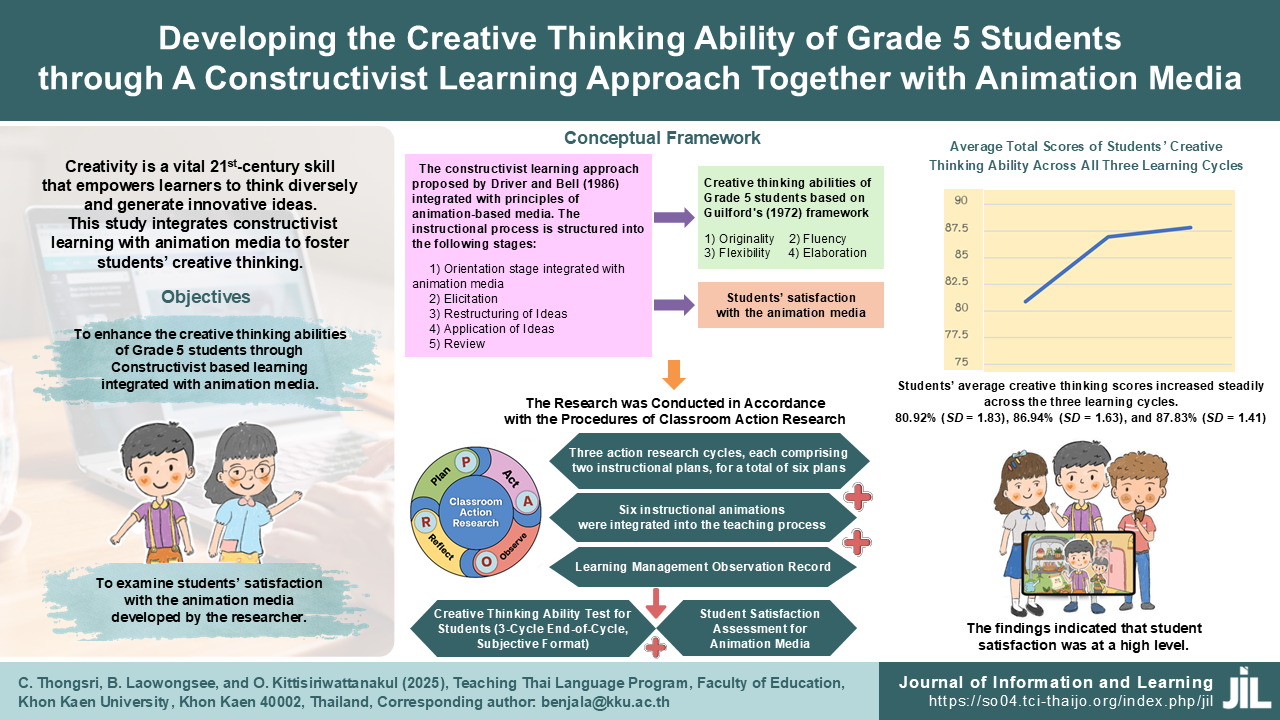
Creativity is a cognitive process that enables individuals to think diversely and innovatively, allowing for the application of ideas that lead to the invention of new products or novel concepts. This research aims to enhance students' creative thinking abilities through a constructivist-based instructional approach integrated with animation media. Additionally, it seeks to examine students' satisfaction with animation media. The target group consisted of 38 fifth-grade students from the Demonstration School of Khon Kaen University (Elementary Education Division), selected through purposive sampling. A classroom action research approach was employed in this study. The research instruments included six lesson plans, six instructional animations were integrated into the teaching process, learning management observation record structured into three cycles with two plans per cycle, three sets of post-cycle tests, and three sets of a student satisfaction assessment form. Quantitative data were analyzed using statistical methods, including mean, percentage, and standard deviation. Additionally, qualitative data were analyzed through descriptive analysis based on Guilford's concept of creativity. The research findings revealed that students' average creative thinking ability scores at the end of each cycle were 80.92% (SD = 1.83), 86.94% (SD = 1.63), and 87.83% (SD = 1.41), respectively. It was also found that student satisfaction was at a high level. The findings indicate that implementing a constructivist learning approach integrated with animation media can enhance students' creative thinking while simultaneously stimulating their interest in learning.
References
Aupara, C., Tadong, P., & Kankhat, S. (2023). The development of 2D animation instructional media entitled Mae Hong Son Mueng Sam Mohk. Journal of Science and Technology for Community, 1(1), 48–59. https://doi.org/10.57260/stc.2023.497
Beghetto, R. A., & Kaufman, J. C. (2021). Nurturing creativity in the classroom. Cambridge University Press. https://doi.org/10.1017/CBO9780511781629
Chanchusakun, S. (2018). A meta-analysis research on creative thinking development innovations of the elementary school students. Veridian E-Journal, Silpakorn University (Humanities, Social Sciences and Arts), 11(1), 2353–2367. https://he02.tci-thaijo.org/index.php/Veridian-E-Journal/article/view/121565
Damjub, W. (2023). Design of animation media for enhancing teaching and learning. Interdisciplinary Sripatum Chonburi Journal, 9(1),1–20. https://so04.tci-thaijo.org/index.php/ISCJ/article/view/262303
Driver, R., & Bell, B. (1986). Students’ thinking and the learning of science: A constructivist view. School Science Review, 67(240), 443–456. https://eric.ed.gov/?id=EJ338119
Gale, J. (2021). A mixed methods study of self-efficacy, the sources of self-efficacy, and teacher characteristics. Frontiers in Education, 6, 1–13. https://doi.org/10.3389/feduc.2021.750599
Guilford, J. P. (1967). The nature of human intelligence. McGraw-Hill.
Hakim, A. L., Darmawan, D., Fathurohman, A., Abdullah, G., & Arafat, Y. (2024). Building 21st-century skills: Focusing on creative thinking capability and critical thinking ability. Edumaspul: Jurnal Pendidikan, 8(1), 678–689. https://ummaspul.e-journal.id/maspuljr/article/view/7703
Kemmis, S., & McTaggart, R. (1988). The action research planner (3rd ed.). Deakin University Press.
Kongchuay, P. (2024). The development of learning innovation on digital platform based on constructivist theory with animated cartoons to promote critical thinking skills and learning achievement of Grade 3 students. Journal of Innovation and Learning Sciences, 17(1), 89–111. https://so02.tci-thaijo.org/index.php/EDGKKUJ/article/view/271139
Likert, R. (1967). The human organization: Its management and value. McGraw-Hill.
Micheli, P., Wilner, S. J. S., Bhatti, S. H., Mura, M., & Beverland, M. B. (2019). Doing design thinking: Conceptual review, synthesis, and research agenda. Journal of Production Innovation Management, 36(2), 124–148. https://doi.org/10.1111/jpim.12466
Office of the Basic Education Commission. (2021). (Rāng) khūmư̄ kānchai krō̜p laksūt kānsưksā naphư̄n thān B.E. ... samrap chūang nathī 1 [Handbook for the use of the competency-based curriculum framework] (Revised edition). Ministry of Education, Thailand. https://cbethailand.com/wp-content/uploads/2021/11/รวมเล่ม-คู่มือการใช้กรอบหลักสูตรฯ-ชช.1.pdf
Office of the Education Council. (2015). Rāingān phon kānčhatkān rīanrū dūai nawattakam kānrīanrū phư̄a sāngsan dūai panyā (Constructionism) khō̜ng sathān sưksā [Instructional model based on the application of learning innovation for creativity with wisdom (constructionism)]. Ministry of Education. https://www.onec.go.th/th.php/book/BookView/1440
Pande, M., & Bharathi, S. V. (2020). Theoretical foundations of design thinking – A constructivism learning approach to design thinking. Thinking Skills and Creativity, 36, Article 100637. https://doi.org/10.1016/j.tsc.2020.100637
Panmanee, A. (2014). Fưk hai khit pen khit hai sāngsan [Training to think critically and creatively]. Chulalongkorn University Press.
Phongphuangphet, P., Sitthi, S., & Piyakun, A. (2018). The development of a science instructional model based on constructivist theory to enhance knowledge construction ability and learning desire of Grade 4 students. Yala Rajabhat University Journal of Humanities and Social Sciences, 8(1), 93–106. https://so04.tci-thaijo.org/index.php/yru_human/article/view/113246
Pratiwi, M., & Rofii, A. (2023). Learning media of animation in elementary school: How to improve students’ narrative writing skills. Journal of Innovation and Research in Primary Education, 2(1), 22–28. https://doi.org/10.56916/jirpe.v2i1.461
Promrin, N., Rungsoongnern, P., Vatanapakorn, P., & Kittisut, W. (2020). The study of perception and satisfaction of high School Grade 7 student per 2D animation cartoon "The Rage". Journal of Applied Informatics and Technology, 2(2), 88-103. https://ph01.tci-thaijo.org/index.php/jait/article/view/243645
Rueangnupapkhajon, J. (2024). The development of 2D animation media to promote physical exercise. Journal of Communication and Social Innovation, 12(1), 36–48. https://so06.tci-thaijo.org/index.php/jcosci/article/view/271286
Saenboonsong, S., & Poonsawad, A. (2024). The development of students’ creative problem solving skills through learning model in gamification environment together with cartoon animation media. Journal of Education and Learning, 13(2), 138–152. https://doi.org/10.5539/jel.v13n2p138
Saithong, A., Niramol, K., & Topithak, K. (2017). The development of 2D animation comic on the process of plant life in the science subject area of Mattayomsuksa 1 students. Humanities and Social Sciences Journal of Pibulsongkram Rajabhat University, 11(1), 159–171. https://so01.tci-thaijo.org/index.php/GraduatePSRU/article/view/69418
Thirakot, S. (2017). Attitudes and motivations of learners to use animation for learning. Journal of Communication Innovation, 5(2), 92–101. https://so06.tci-thaijo.org/index.php/jcosci/article/view/111529
Thirasinangkul, S. (2011). Phư̄n thān kā wok ra dōt phư̄a pen animator mư̄ pō [The fundamental leap to becoming a professional animator]. Witty Group.
Torrance, E. P. (1972). Predictive validity of the Torrance tests of creative thinking. The Journal of Creative Behavior, 6(4), 236–252. https://doi.org/10.1002/j.2162-6057.1972.tb00936.x
Tsai, C. A., Song, M. W., Lo, Y. F., & Lo, C. C. (2023). Design thinking with constructivist learning increases the learning motivation and wicked problem solving capability-An empirical research in Taiwan. Thinking Skills and Creativity, 50, Article 101385. https://doi.org/10.1016/j.tsc.2023.101385
Watayotha, K., & Chaijaroen, S. (2019). Creative thinking of learners with a constructivist multimedia learning environment and augmented reality to promote creative thinking on the topic of product creation by technological process for Grade 8 students. Veridian E-Journal of Humanities, Social Sciences and Arts, 12(2), 499–518. https://he02.tci-thaijo.org/index.php/Veridian-E-Journal/article/view/152727
Downloads
Additional Files
Published
How to Cite
Issue
Section
Categories
License
Copyright (c) 2025 Journal of Information and Learning [JIL]

This work is licensed under a Creative Commons Attribution-NonCommercial-NoDerivatives 4.0 International License.
The Journal of Information and Learning is operated by the Office of Academic Resources, Prince of Songkla University. All articles published in the journal are protected by Thailand copyright law. This copyright covers the exclusive rights to share, reproduce and distribute the article, including in electronic forms, reprints, translations, photographic reproductions, or similar. Authors own copyrights in the works they have created as well as the Office of Academic Resources. The Journal reserves the right to edit the language of papers accepted for publication for clarity and correctness, as well as to make formal changes to ensure compliance with the journal's guidelines. All authors must take public responsibility for the content of their paper.


