
การพัฒนาความสามารถด้านการคิดสร้างสรรค์ของนักเรียนชั้นประถมศึกษาปีที่ 5 โดยการจัดการเรียนรู้ตามแนวคอนสตรัคติวิสต์ร่วมกับสื่อแอนิเมชัน
คำสำคัญ:
ความสามารถการคิดสร้างสรรค์, การจัดการเรียนรู้ตามแนวคอนสตรัคติวิสต์, สื่อแอนิเมชันบทคัดย่อ
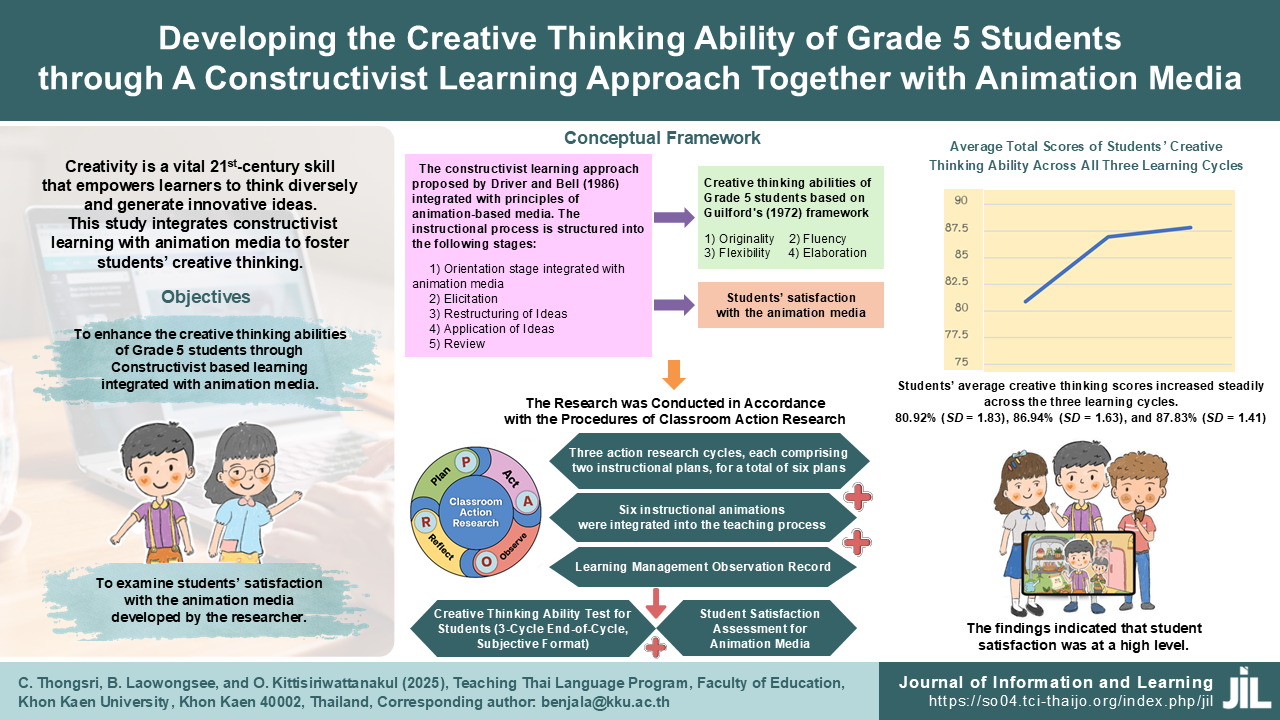
ความคิดสร้างสรรค์ คือ กระบวนของสมองซึ่งมีความสามารถในการคิดได้หลากหลาย แปลกใหม่ นำไปประยุกต์ใช้ได้จนนำไปสู่การคิดค้นสร้างสิ่งประดิษฐ์ หรือรูปแบบความคิดที่แปลกใหม่ การวิจัยนี้จึงมีวัตถุประสงค์เพื่อ 1) พัฒนาความสามารถด้านการคิดสร้างสรรค์ของนักเรียนโดยใช้กระบวนการจัดการเรียนรู้ตามแนวคอนสตรัคติวิสต์ร่วมกับสื่อแอนิเมชัน และ 2) ศึกษาความพึงพอใจของนักเรียนต่อสื่อแอนิเมชัน กลุ่มเป้าหมาย คือ นักเรียนชั้นประถมศึกษาปีที่ 5 โรงเรียนสาธิตมหาวิทยาลัยขอนแก่น ฝ่ายประถมศึกษา (ศึกษาศาสตร์) จำนวน 38 คน โดยวิธีเลือกแบบเฉพาะเจาะจง ใช้กระบวนการวิจัยเชิงปฏิบัติการในชั้นเรียน เครื่องมือที่ใช้ ได้แก่ แผนการจัดการเรียนรู้ จำนวน 3 วงจร วงจรละ 2 แผนฯ รวม 6 แผนฯ คือ สื่อแอนิเมชัน จำนวน 6 เรื่อง แบบบันทึกการสังเกตการจัดการเรียนรู้ แบบวัดความสามารถการคิดสร้างสรรค์ของนักเรียน จำนวน 3 ชุด และแบบประเมินความพึงพอใจฯ จำนวน 3 ชุด วิเคราะห์ข้อมูลเชิงปริมาณโดยใช้สถิติ ค่าเฉลี่ย ค่าร้อยละ และค่าเบี่ยงเบนมาตรฐาน ร่วมกับการพรรณนาวิเคราะห์เชิงคุณภาพตามกรอบแนวคิดความคิดสร้างสรรค์ของกิลฟอร์ด ผลการวิจัยพบว่า นักเรียนมีคะแนนเฉลี่ยความสามารถด้านการคิดสร้างสรรค์ท้ายวงจร คิดเป็นร้อยละ 80.92 (SD = 1.83), 86.94 (SD = 1.63), 87.83 (SD = 1.41) ตามลำดับ ผลการศึกษาความพึงพอใจของนักเรียน พบว่า อยู่ในระดับมาก แสดงให้เห็นว่า การจัดการเรียนรู้ตามแนวคอนสตรัคติวิสต์ร่วมกับสื่อแอนิเมชันสามารถพัฒนาความคิดสร้างสรรค์ของนักเรียนได้พร้อม ๆ กับกระตุ้นให้ผู้เรียนมีความสนใจในการเรียนรู้มากยิ่งขึ้น
เอกสารอ้างอิง
Aupara, C., Tadong, P., & Kankhat, S. (2023). The development of 2D animation instructional media entitled Mae Hong Son Mueng Sam Mohk. Journal of Science and Technology for Community, 1(1), 48–59. https://doi.org/10.57260/stc.2023.497
Beghetto, R. A., & Kaufman, J. C. (2021). Nurturing creativity in the classroom. Cambridge University Press. https://doi.org/10.1017/CBO9780511781629
Chanchusakun, S. (2018). A meta-analysis research on creative thinking development innovations of the elementary school students. Veridian E-Journal, Silpakorn University (Humanities, Social Sciences and Arts), 11(1), 2353–2367. https://he02.tci-thaijo.org/index.php/Veridian-E-Journal/article/view/121565
Damjub, W. (2023). Design of animation media for enhancing teaching and learning. Interdisciplinary Sripatum Chonburi Journal, 9(1),1–20. https://so04.tci-thaijo.org/index.php/ISCJ/article/view/262303
Driver, R., & Bell, B. (1986). Students’ thinking and the learning of science: A constructivist view. School Science Review, 67(240), 443–456. https://eric.ed.gov/?id=EJ338119
Gale, J. (2021). A mixed methods study of self-efficacy, the sources of self-efficacy, and teacher characteristics. Frontiers in Education, 6, 1–13. https://doi.org/10.3389/feduc.2021.750599
Guilford, J. P. (1967). The nature of human intelligence. McGraw-Hill.
Hakim, A. L., Darmawan, D., Fathurohman, A., Abdullah, G., & Arafat, Y. (2024). Building 21st-century skills: Focusing on creative thinking capability and critical thinking ability. Edumaspul: Jurnal Pendidikan, 8(1), 678–689. https://ummaspul.e-journal.id/maspuljr/article/view/7703
Kemmis, S., & McTaggart, R. (1988). The action research planner (3rd ed.). Deakin University Press.
Kongchuay, P. (2024). The development of learning innovation on digital platform based on constructivist theory with animated cartoons to promote critical thinking skills and learning achievement of Grade 3 students. Journal of Innovation and Learning Sciences, 17(1), 89–111. https://so02.tci-thaijo.org/index.php/EDGKKUJ/article/view/271139
Likert, R. (1967). The human organization: Its management and value. McGraw-Hill.
Micheli, P., Wilner, S. J. S., Bhatti, S. H., Mura, M., & Beverland, M. B. (2019). Doing design thinking: Conceptual review, synthesis, and research agenda. Journal of Production Innovation Management, 36(2), 124–148. https://doi.org/10.1111/jpim.12466
Office of the Basic Education Commission. (2021). (Rāng) khūmư̄ kānchai krō̜p laksūt kānsưksā naphư̄n thān B.E. ... samrap chūang nathī 1 [Handbook for the use of the competency-based curriculum framework] (Revised edition). Ministry of Education, Thailand. https://cbethailand.com/wp-content/uploads/2021/11/รวมเล่ม-คู่มือการใช้กรอบหลักสูตรฯ-ชช.1.pdf
Office of the Education Council. (2015). Rāingān phon kānčhatkān rīanrū dūai nawattakam kānrīanrū phư̄a sāngsan dūai panyā (Constructionism) khō̜ng sathān sưksā [Instructional model based on the application of learning innovation for creativity with wisdom (constructionism)]. Ministry of Education. https://www.onec.go.th/th.php/book/BookView/1440
Pande, M., & Bharathi, S. V. (2020). Theoretical foundations of design thinking – A constructivism learning approach to design thinking. Thinking Skills and Creativity, 36, Article 100637. https://doi.org/10.1016/j.tsc.2020.100637
Panmanee, A. (2014). Fưk hai khit pen khit hai sāngsan [Training to think critically and creatively]. Chulalongkorn University Press.
Phongphuangphet, P., Sitthi, S., & Piyakun, A. (2018). The development of a science instructional model based on constructivist theory to enhance knowledge construction ability and learning desire of Grade 4 students. Yala Rajabhat University Journal of Humanities and Social Sciences, 8(1), 93–106. https://so04.tci-thaijo.org/index.php/yru_human/article/view/113246
Pratiwi, M., & Rofii, A. (2023). Learning media of animation in elementary school: How to improve students’ narrative writing skills. Journal of Innovation and Research in Primary Education, 2(1), 22–28. https://doi.org/10.56916/jirpe.v2i1.461
Promrin, N., Rungsoongnern, P., Vatanapakorn, P., & Kittisut, W. (2020). The study of perception and satisfaction of high School Grade 7 student per 2D animation cartoon "The Rage". Journal of Applied Informatics and Technology, 2(2), 88-103. https://ph01.tci-thaijo.org/index.php/jait/article/view/243645
Rueangnupapkhajon, J. (2024). The development of 2D animation media to promote physical exercise. Journal of Communication and Social Innovation, 12(1), 36–48. https://so06.tci-thaijo.org/index.php/jcosci/article/view/271286
Saenboonsong, S., & Poonsawad, A. (2024). The development of students’ creative problem solving skills through learning model in gamification environment together with cartoon animation media. Journal of Education and Learning, 13(2), 138–152. https://doi.org/10.5539/jel.v13n2p138
Saithong, A., Niramol, K., & Topithak, K. (2017). The development of 2D animation comic on the process of plant life in the science subject area of Mattayomsuksa 1 students. Humanities and Social Sciences Journal of Pibulsongkram Rajabhat University, 11(1), 159–171. https://so01.tci-thaijo.org/index.php/GraduatePSRU/article/view/69418
Thirakot, S. (2017). Attitudes and motivations of learners to use animation for learning. Journal of Communication Innovation, 5(2), 92–101. https://so06.tci-thaijo.org/index.php/jcosci/article/view/111529
Thirasinangkul, S. (2011). Phư̄n thān kā wok ra dōt phư̄a pen animator mư̄ pō [The fundamental leap to becoming a professional animator]. Witty Group.
Torrance, E. P. (1972). Predictive validity of the Torrance tests of creative thinking. The Journal of Creative Behavior, 6(4), 236–252. https://doi.org/10.1002/j.2162-6057.1972.tb00936.x
Tsai, C. A., Song, M. W., Lo, Y. F., & Lo, C. C. (2023). Design thinking with constructivist learning increases the learning motivation and wicked problem solving capability-An empirical research in Taiwan. Thinking Skills and Creativity, 50, Article 101385. https://doi.org/10.1016/j.tsc.2023.101385
Watayotha, K., & Chaijaroen, S. (2019). Creative thinking of learners with a constructivist multimedia learning environment and augmented reality to promote creative thinking on the topic of product creation by technological process for Grade 8 students. Veridian E-Journal of Humanities, Social Sciences and Arts, 12(2), 499–518. https://he02.tci-thaijo.org/index.php/Veridian-E-Journal/article/view/152727
ดาวน์โหลด
ไฟล์ประกอบ
เผยแพร่แล้ว
รูปแบบการอ้างอิง
ฉบับ
ประเภทบทความ
หมวดหมู่
สัญญาอนุญาต
ลิขสิทธิ์ (c) 2025 Journal of Information and Learning [JIL]

อนุญาตภายใต้เงื่อนไข Creative Commons Attribution-NonCommercial-NoDerivatives 4.0 International License.
Journal of Information and Learning ดำเนินการโดยสำนักวิทยบริการ มหาวิทยาลัยสงขลานครินทร์ วิทยาเขตปัตตานี บทความที่ได้รับการตีพิมพ์ในวารสารได้รับความคุ้มครองตามกฎหมายลิขสิทธิ์ โดยเจ้าของลิขสิทธิ์จะมีสิทธิในการทำซ้ำ ดัดแปลง และเผยแพร่งานบทความ ทั้งรูปแบบอิเล็กทรอนิกส์ การทำฉบับสำเนา การแปล และการผลิตซ้ำในรูปแบบต่างๆ ลิขสิทธิ์บทความเป็นของผู้เขียนและสำนักวิทยบริการ มหาวิทยาลัยสงขลานครินทร์ วิทยาเขตปัตตานี วารสารฯ ขอสงวนสิทธิ์ในการพิจารณาตีพิมพ์ตามความเหมาะสม รวมทั้งการตรวจทานแก้ไข การปรับข้อความ หรือขัดเกลาภาษาให้ถูกต้องตามเกณฑ์ที่กำหนด สำหรับผลการวิจัยและความคิดเห็นที่ปรากฏในบทความถือเป็นความคิดเห็นและอยู่ในความรับผิดชอบของผู้เขียน


