
Flexible Education in Thai Higher Education: A Learning System Design Framework for Lifelong Learning
Keywords:
flexible education, learning system, lifelong learning, learning design, Thai higher educationAbstract
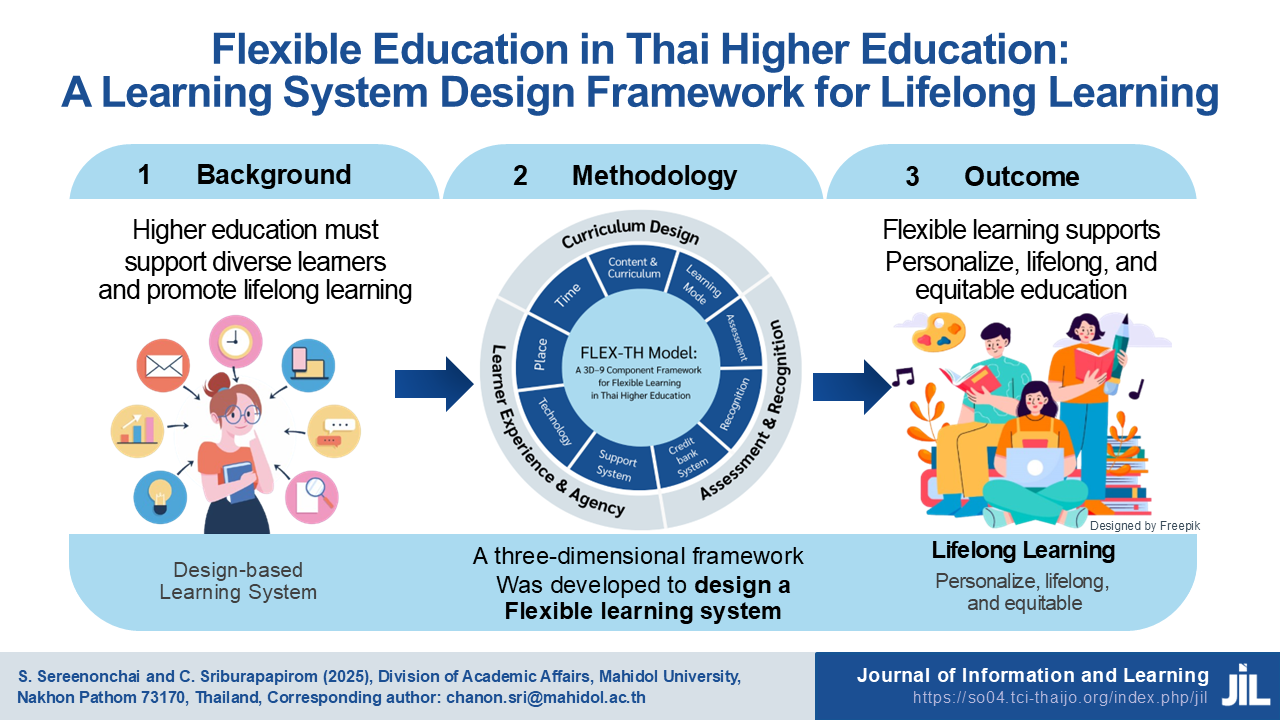
This article proposes a conceptual framework for designing a flexible learning system in Thai higher education, with the goal of promoting lifelong learning and accommodating learner diversity in an era of technological and societal change. The proposed framework comprises three key dimensions: 1) curriculum and content design, which includes time, content, and learning modes; 2) learner experience and agency, which encompasses place, learning technologies, and learner support systems; and 3) assessment and recognition of learning, covering assessment strategies, recognition of prior learning, and the implementation of a credit bank system. The framework is grounded in theoretical foundations, including andragogy, constructivism, self-directed learning, and learning design. Practical recommendations are also provided to guide institutional development, such as modular curriculum design, micro-credentials, and enhancing instructors’ capabilities to design personalized learning experiences.
References
Akwareesakul, A., & Sriburapapirom, C. (2024). Factors affecting flexible education management according to the definition of Mahidol University. Mahidol R2R e-Journal, 11(2), 100–114. https://he01.tci-thaijo.org/index.php/mur2r/article/view/260621
Boyadjieva, P., & Ilieva-Trichkova, P. (2022). Does participation in non-formal adult education matter for individual subjective well-being as a multidimensional functioning? European Educational Research Journal, 23(1), 125–144. https://doi.org/10.1177/14749041221116261
Cachero–Paderog, J. (2023). Flexible learning in higher education institution: Experiences of instructors in a private higher institution. JPAIR Multidisciplinary Research, 53(1), 1–28. https://doi.org/10.7719/jpair.v53i1.624
Chulalongkorn University. (n.d.) Learning innovation center (CHULA MOOC). Learning Innovation Center. https://www.chula.ac.th/en/academics/life-at-cu/learning-innovation-center
Conole, G. (2013). Designing for learning in an open world. Springer. https://doi.org/10.1007/978-1-4419-8517-0
Czerkawski, B. (2014). Designing deeper learning experiences for online instruction. Journal of Interactive Online Learning, 13(2), 29–40. https://www.ncolr.org/issues/jiol/v13/n2/1.html
El Galad, A., Betts, D. H., & Campbell, N. (2024). Flexible learning dimensions in higher education: Aligning students’ and educators’ perspectives for more inclusive practices. Frontiers in Education, 9, Article 1347432. https://doi.org/10.3389/feduc.2024.1347432
Equitable Education Fund. (2024, September 21). Flexible learning nǣothāng kānčhatkān rīanrū thī yư̄tyun [Flexible learning: An approach to adaptable and learner-centered education]. https://www.eef.or.th/infographic-flexible-learning-2
Garrison, D. R. (1997). Self-directed learning: Toward a comprehensive model. Adult Education Quarterly, 48(1), 18–33. https://doi.org/10.1177/074171369704800103
Goodyear, P. (2005). Educational design and networked learning: Patterns, pattern languages and design practice. Australasian Journal of Educational Technology, 21(1), 82–101. https://doi.org/10.14742/ajet.1344
Kajulsri, M. (2022). Guidance of flexible education for undergraduate level [Master’s thesis, Srinakharinwirot University]. iThesis Srinakharinwirot University. https://ir-ithesis.swu.ac.th/items/0414c331-0f11-419c-ae5d-fca795c33f83
Khoochonthara, P., Lohitwisas, S., Chanachai, R., & On-ming, R. (2014). Evaluate the effectiveness of blended learning and flexible learning model to promote lifelong learning for working-age adult. Valaya Alongkorn Research and Development Journal, 9(1), 55–61. https://so06.tci-thaijo.org/index.php/vrurdistjournal/article/view/25417
Knowles, M. S. (1984). Andragogy in action: Applying modern principles of adult learning. Jossey-Bass.
Laurillard, D. (2012). Teaching as a design science: Building pedagogical patterns for learning and technology. Routledge. https://doi.org/10.4324/9780203125083
Mahidol University. (2020). Mahidol University regulation on flexible education and credit bank system B.E. 2563 (2020). Division of Academic Affairs, Mahidol University. https://op.mahidol.ac.th/ea/wp-content/uploads/2021/07/role-credit-bank-en.pdf
Mahidol University. (2022). Prakāt mahāwitthayālai Mahidon rư̄ang nǣo patibatkān čhatkān sưksā bǣp yư̄tyun læ rabop khlang nūaikit ra dap tamkwā parinyā trī læ parinyā trī Mahāwitthayālai Mahidon B.E. 2565 [Announcement of Mahidol University on guidelines for flexible education management and credit bank system at undergraduate and lower levels, B.E. 2565]. Division of Academic Affairs. https://op.mahidol.ac.th/ea/wp-content/uploads/2022/03/P124-mufe.pdf
McGowan, M. K., & Graham, C. R. (2023). Micro-credentials in US higher education: An empirical analysis. Information Systems Education Journal, 21(1), 4–16. https://isedj.org/2023-21/n1/ISEDJv21n1p04.html
Müller, C., & Mildenberger, T. (2022). Learning effectiveness of a flexible learning study programme in a blended learning design. International Journal of Educational Technology in Higher Education, 19(1), 1–20. https://doi.org/10.1186/s41239-022-00379-x
Ryan, A., & Tilbury, D. (2014). Flexible pedagogies: New pedagogical ideas. Higher Education Academy.
Sakulprahmne, S., & Prasertsaruay, S. (2015). Development of a flexible learning model for undergraduate students. Journal of Humanities and Social Sciences Valaya Alongkorn, 10(1), 27–35. https://so06.tci-thaijo.org/index.php/vrurdihsjournal/article/view/33435
Schleicher, A. (2020). The impact of COVID-19 on education: Insights from Education at a Glance 2020. OECD Publishing. https://www.voced.edu.au/content/ngv%3A87789
Selvaratnam, R. M., & Sankey, M. (2021). An integrative literature review of the implementation of micro-credentials in higher education: Implications for practice in Australasia. Journal of Teaching and Learning for Graduate Employability, 12(1), 1–17. https://doi.org/10.21153/jtlge2021vol12no1art942
Siemens, G. (2005). Connectivism: A learning theory for the digital age. International Journal of Instructional Technology and Distance Learning, 2(1). http://www.itdl.org/Journal/Jan_05/article01.htm
Sosutthi, C., Wijakkanalun, S., & Nuengchalerm, P. (2021). The results of implementing a flexible learning-based instructional model for undergraduate students in teacher education. Journal of MCU Peace Studies Review, 9(7), 2878–2886. https://so03.tci-thaijo.org/index.php/journal-peace/article/view/248208
Sukhothai Thammathirat Open University. (n.d.). STOU distance learning system. https://www.stou.ac.th/main/en/distance.html
Thwe, W. P., & Kálmán, A. (2023). Lifelong learning in the educational setting: A systematic literature review. The Asia-Pacific Education Researcher, 33(2), 407–417. https://doi.org/10.1007/s40299-023-00738-w
UNESCO. (2021). Reimagining our futures together: A new social contract for education. UNESCO Publishing. https://unesdoc.unesco.org/ark:/48223/pf0000379707
Varadarajan, S., Koh, J. H. L., & Daniel, B. K. (2023). A systematic review of the opportunities and challenges of micro-credentials for multiple stakeholders: Learners, employers, higher education institutions and government. International Journal of Educational Technology in Higher Education, 20, Article 13. https://doi.org/10.1186/s41239-023-00381-x
Vygotsky, L. S. (1978). Mind in society: The development of higher psychological processes. Harvard University Press.
Walkington, C., & Sherman, M. (2012). Using adaptive learning technologies to personalize instruction: The impact of interest-based scenarios on performance in algebra. In J. van Aalst, K. Thompson, M. J. Jacobson, & P. Reimann (Eds.), The future of learning: Proceedings of the 10th International Conference of the Learning Sciences (ICLS 2012), 1, 80–87. International Society of the Learning Sciences. https://doi.org/10.13140/2.1.4276.6084
Downloads
Additional Files
Published
How to Cite
Issue
Section
Categories
License
Copyright (c) 2025 Journal of Information and Learning [JIL]

This work is licensed under a Creative Commons Attribution-NonCommercial-NoDerivatives 4.0 International License.
The Journal of Information and Learning is operated by the Office of Academic Resources, Prince of Songkla University. All articles published in the journal are protected by Thailand copyright law. This copyright covers the exclusive rights to share, reproduce and distribute the article, including in electronic forms, reprints, translations, photographic reproductions, or similar. Authors own copyrights in the works they have created as well as the Office of Academic Resources. The Journal reserves the right to edit the language of papers accepted for publication for clarity and correctness, as well as to make formal changes to ensure compliance with the journal's guidelines. All authors must take public responsibility for the content of their paper.


