
การจัดการศึกษาแบบยืดหยุ่นในสถาบันอุดมศึกษาไทย: กรอบการออกแบบระบบการเรียนรู้เพื่อการเรียนรู้ตลอดชีวิต
คำสำคัญ:
การศึกษาแบบยืดหยุ่น, ระบบการเรียนรู้, การเรียนรู้ตลอดชีวิต, การออกแบบการเรียนรู้, อุดมศึกษาไทยบทคัดย่อ
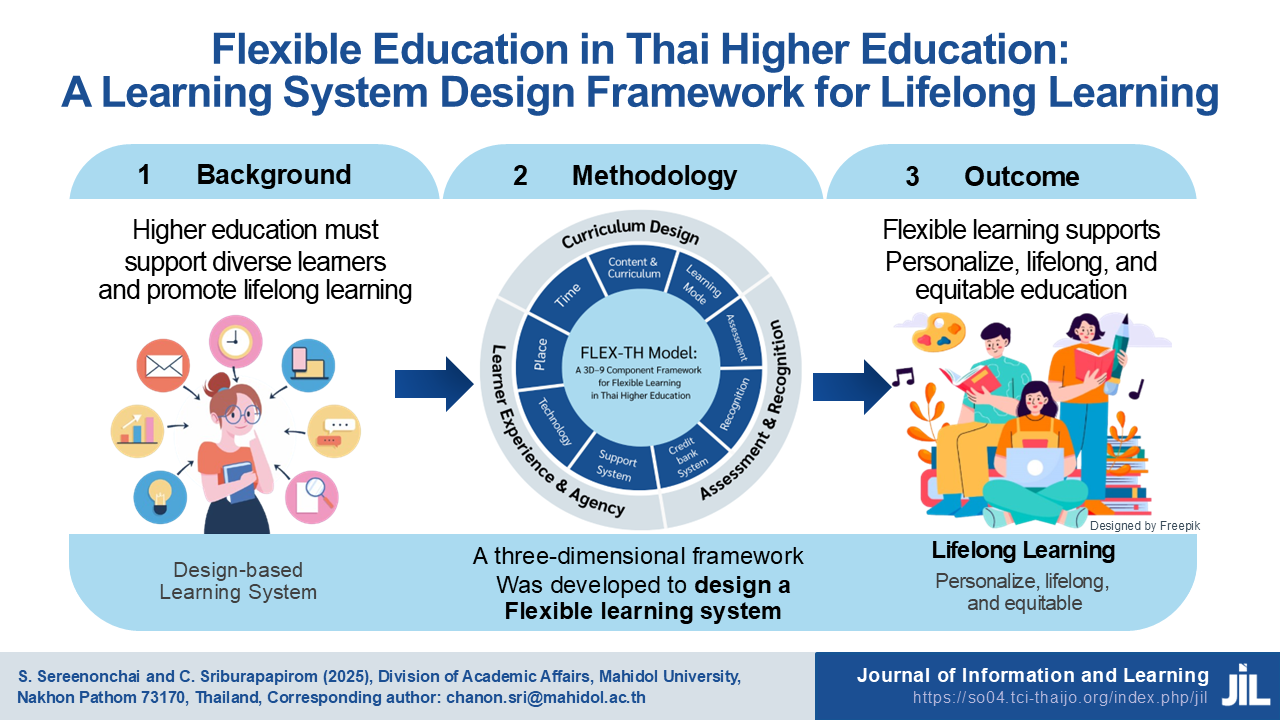
บทความนี้มีวัตถุประสงค์เพื่อเสนอกรอบแนวคิดการออกแบบระบบการศึกษาแบบยืดหยุ่นสำหรับสถาบันอุดมศึกษาไทย โดยมีเป้าหมายเพื่อส่งเสริมการเรียนรู้ตลอดชีวิต และรองรับความหลากหลายของผู้เรียนในยุคเปลี่ยนผ่านทางเทคโนโลยีและสังคม กรอบแนวคิดที่เสนอ ประกอบด้วย 3 มิติหลัก ได้แก่ 1) การออกแบบหลักสูตรและเนื้อหา ซึ่งครอบคลุมองค์ประกอบด้านเวลา เนื้อหา และรูปแบบการเรียนรู้ 2) ประสบการณ์และเส้นทางของผู้เรียน ประกอบด้วย สถานที่ เทคโนโลยี และระบบสนับสนุนการเรียนรู้ และ 3) การประเมินผลและการรับรองผลการเรียนรู้ ครอบคลุมการประเมินผล การเทียบโอนผลการเรียนรู้ และระบบคลังหน่วยกิต โดยเชื่อมโยงกับแนวคิดทางทฤษฎี ได้แก่ ทฤษฎีการเรียนรู้แบบผู้ใหญ่ ทฤษฎีสร้างองค์ความรู้ การเรียนรู้แบบกำกับตนเอง และแนวคิดการออกแบบการเรียนรู้ ทั้งนี้บทความยังเสนอแนวทางปฏิบัติและข้อเสนอแนะที่สามารถประยุกต์ใช้ในการพัฒนาระบบการศึกษาแบบยืดหยุ่นในระดับมหาวิทยาลัย เช่น การออกแบบหลักสูตรแบบโมดูล การพัฒนา Micro-credentials และการยกระดับสมรรถนะของอาจารย์ให้สามารถออกแบบการเรียนรู้ที่เหมาะสมกับผู้เรียนแต่ละราย
เอกสารอ้างอิง
Akwareesakul, A., & Sriburapapirom, C. (2024). Factors affecting flexible education management according to the definition of Mahidol University. Mahidol R2R e-Journal, 11(2), 100–114. https://he01.tci-thaijo.org/index.php/mur2r/article/view/260621
Boyadjieva, P., & Ilieva-Trichkova, P. (2022). Does participation in non-formal adult education matter for individual subjective well-being as a multidimensional functioning? European Educational Research Journal, 23(1), 125–144. https://doi.org/10.1177/14749041221116261
Cachero–Paderog, J. (2023). Flexible learning in higher education institution: Experiences of instructors in a private higher institution. JPAIR Multidisciplinary Research, 53(1), 1–28. https://doi.org/10.7719/jpair.v53i1.624
Chulalongkorn University. (n.d.) Learning innovation center (CHULA MOOC). Learning Innovation Center. https://www.chula.ac.th/en/academics/life-at-cu/learning-innovation-center
Conole, G. (2013). Designing for learning in an open world. Springer. https://doi.org/10.1007/978-1-4419-8517-0
Czerkawski, B. (2014). Designing deeper learning experiences for online instruction. Journal of Interactive Online Learning, 13(2), 29–40. https://www.ncolr.org/issues/jiol/v13/n2/1.html
El Galad, A., Betts, D. H., & Campbell, N. (2024). Flexible learning dimensions in higher education: Aligning students’ and educators’ perspectives for more inclusive practices. Frontiers in Education, 9, Article 1347432. https://doi.org/10.3389/feduc.2024.1347432
Equitable Education Fund. (2024, September 21). Flexible learning nǣothāng kānčhatkān rīanrū thī yư̄tyun [Flexible learning: An approach to adaptable and learner-centered education]. https://www.eef.or.th/infographic-flexible-learning-2
Garrison, D. R. (1997). Self-directed learning: Toward a comprehensive model. Adult Education Quarterly, 48(1), 18–33. https://doi.org/10.1177/074171369704800103
Goodyear, P. (2005). Educational design and networked learning: Patterns, pattern languages and design practice. Australasian Journal of Educational Technology, 21(1), 82–101. https://doi.org/10.14742/ajet.1344
Kajulsri, M. (2022). Guidance of flexible education for undergraduate level [Master’s thesis, Srinakharinwirot University]. iThesis Srinakharinwirot University. https://ir-ithesis.swu.ac.th/items/0414c331-0f11-419c-ae5d-fca795c33f83
Khoochonthara, P., Lohitwisas, S., Chanachai, R., & On-ming, R. (2014). Evaluate the effectiveness of blended learning and flexible learning model to promote lifelong learning for working-age adult. Valaya Alongkorn Research and Development Journal, 9(1), 55–61. https://so06.tci-thaijo.org/index.php/vrurdistjournal/article/view/25417
Knowles, M. S. (1984). Andragogy in action: Applying modern principles of adult learning. Jossey-Bass.
Laurillard, D. (2012). Teaching as a design science: Building pedagogical patterns for learning and technology. Routledge. https://doi.org/10.4324/9780203125083
Mahidol University. (2020). Mahidol University regulation on flexible education and credit bank system B.E. 2563 (2020). Division of Academic Affairs, Mahidol University. https://op.mahidol.ac.th/ea/wp-content/uploads/2021/07/role-credit-bank-en.pdf
Mahidol University. (2022). Prakāt mahāwitthayālai Mahidon rư̄ang nǣo patibatkān čhatkān sưksā bǣp yư̄tyun læ rabop khlang nūaikit ra dap tamkwā parinyā trī læ parinyā trī Mahāwitthayālai Mahidon B.E. 2565 [Announcement of Mahidol University on guidelines for flexible education management and credit bank system at undergraduate and lower levels, B.E. 2565]. Division of Academic Affairs. https://op.mahidol.ac.th/ea/wp-content/uploads/2022/03/P124-mufe.pdf
McGowan, M. K., & Graham, C. R. (2023). Micro-credentials in US higher education: An empirical analysis. Information Systems Education Journal, 21(1), 4–16. https://isedj.org/2023-21/n1/ISEDJv21n1p04.html
Müller, C., & Mildenberger, T. (2022). Learning effectiveness of a flexible learning study programme in a blended learning design. International Journal of Educational Technology in Higher Education, 19(1), 1–20. https://doi.org/10.1186/s41239-022-00379-x
Ryan, A., & Tilbury, D. (2014). Flexible pedagogies: New pedagogical ideas. Higher Education Academy.
Sakulprahmne, S., & Prasertsaruay, S. (2015). Development of a flexible learning model for undergraduate students. Journal of Humanities and Social Sciences Valaya Alongkorn, 10(1), 27–35. https://so06.tci-thaijo.org/index.php/vrurdihsjournal/article/view/33435
Schleicher, A. (2020). The impact of COVID-19 on education: Insights from Education at a Glance 2020. OECD Publishing. https://www.voced.edu.au/content/ngv%3A87789
Selvaratnam, R. M., & Sankey, M. (2021). An integrative literature review of the implementation of micro-credentials in higher education: Implications for practice in Australasia. Journal of Teaching and Learning for Graduate Employability, 12(1), 1–17. https://doi.org/10.21153/jtlge2021vol12no1art942
Siemens, G. (2005). Connectivism: A learning theory for the digital age. International Journal of Instructional Technology and Distance Learning, 2(1). http://www.itdl.org/Journal/Jan_05/article01.htm
Sosutthi, C., Wijakkanalun, S., & Nuengchalerm, P. (2021). The results of implementing a flexible learning-based instructional model for undergraduate students in teacher education. Journal of MCU Peace Studies Review, 9(7), 2878–2886. https://so03.tci-thaijo.org/index.php/journal-peace/article/view/248208
Sukhothai Thammathirat Open University. (n.d.). STOU distance learning system. https://www.stou.ac.th/main/en/distance.html
Thwe, W. P., & Kálmán, A. (2023). Lifelong learning in the educational setting: A systematic literature review. The Asia-Pacific Education Researcher, 33(2), 407–417. https://doi.org/10.1007/s40299-023-00738-w
UNESCO. (2021). Reimagining our futures together: A new social contract for education. UNESCO Publishing. https://unesdoc.unesco.org/ark:/48223/pf0000379707
Varadarajan, S., Koh, J. H. L., & Daniel, B. K. (2023). A systematic review of the opportunities and challenges of micro-credentials for multiple stakeholders: Learners, employers, higher education institutions and government. International Journal of Educational Technology in Higher Education, 20, Article 13. https://doi.org/10.1186/s41239-023-00381-x
Vygotsky, L. S. (1978). Mind in society: The development of higher psychological processes. Harvard University Press.
Walkington, C., & Sherman, M. (2012). Using adaptive learning technologies to personalize instruction: The impact of interest-based scenarios on performance in algebra. In J. van Aalst, K. Thompson, M. J. Jacobson, & P. Reimann (Eds.), The future of learning: Proceedings of the 10th International Conference of the Learning Sciences (ICLS 2012), 1, 80–87. International Society of the Learning Sciences. https://doi.org/10.13140/2.1.4276.6084
ดาวน์โหลด
ไฟล์ประกอบ
เผยแพร่แล้ว
รูปแบบการอ้างอิง
ฉบับ
ประเภทบทความ
หมวดหมู่
สัญญาอนุญาต
ลิขสิทธิ์ (c) 2025 Journal of Information and Learning [JIL]

อนุญาตภายใต้เงื่อนไข Creative Commons Attribution-NonCommercial-NoDerivatives 4.0 International License.
Journal of Information and Learning ดำเนินการโดยสำนักวิทยบริการ มหาวิทยาลัยสงขลานครินทร์ วิทยาเขตปัตตานี บทความที่ได้รับการตีพิมพ์ในวารสารได้รับความคุ้มครองตามกฎหมายลิขสิทธิ์ โดยเจ้าของลิขสิทธิ์จะมีสิทธิในการทำซ้ำ ดัดแปลง และเผยแพร่งานบทความ ทั้งรูปแบบอิเล็กทรอนิกส์ การทำฉบับสำเนา การแปล และการผลิตซ้ำในรูปแบบต่างๆ ลิขสิทธิ์บทความเป็นของผู้เขียนและสำนักวิทยบริการ มหาวิทยาลัยสงขลานครินทร์ วิทยาเขตปัตตานี วารสารฯ ขอสงวนสิทธิ์ในการพิจารณาตีพิมพ์ตามความเหมาะสม รวมทั้งการตรวจทานแก้ไข การปรับข้อความ หรือขัดเกลาภาษาให้ถูกต้องตามเกณฑ์ที่กำหนด สำหรับผลการวิจัยและความคิดเห็นที่ปรากฏในบทความถือเป็นความคิดเห็นและอยู่ในความรับผิดชอบของผู้เขียน


