
การวิเคราะห์โมเดลสมการโครงสร้างของปัจจัยที่ส่งผลต่อการเป็นเมืองแห่งการเรียนรู้ตลอดชีวิต
คำสำคัญ:
ปัจจัยเชิงสาเหตุ, เทศบาลนครเชียงราย, เมืองแห่งการเรียนรู้ตลอดชีวิต, โมเดลสมการโครงสร้างบทคัดย่อ
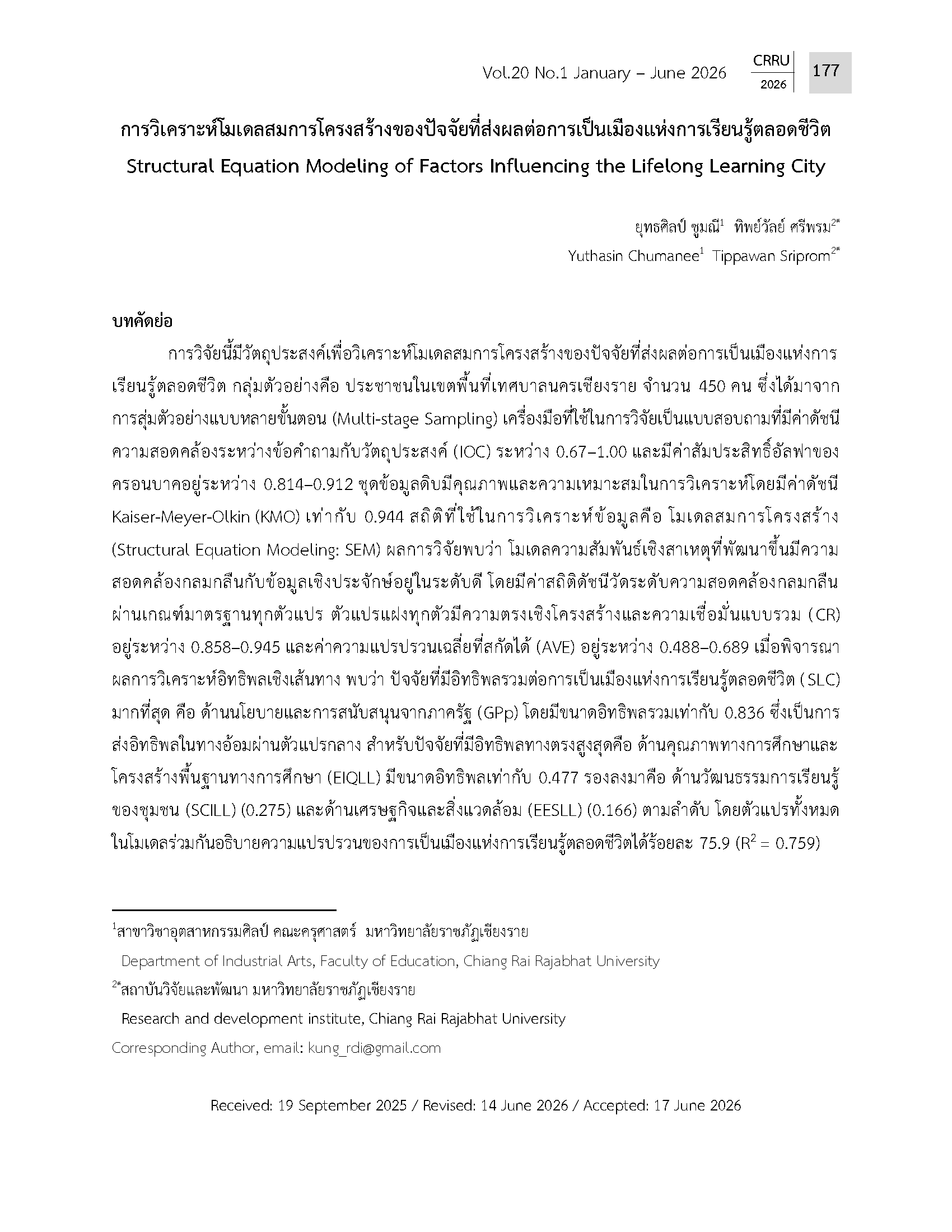
การวิจัยนี้มีวัตถุประสงค์เพื่อวิเคราะห์โมเดลสมการโครงสร้างของปัจจัยที่ส่งผลต่อการเป็นเมืองแห่งการเรียนรู้ตลอดชีวิต กลุ่มตัวอย่างคือ ประชาชนในเขตพื้นที่เทศบาลนครเชียงราย จำนวน 450 คน ซึ่งได้มาจากการสุ่มตัวอย่างแบบหลายขั้นตอน (Multi-stage Sampling) เครื่องมือที่ใช้ในการวิจัยเป็นแบบสอบถามที่มีค่าดัชนีความสอดคล้องระหว่างข้อคำถามกับวัตถุประสงค์ (IOC) ระหว่าง 0.67–1.00 และมีค่าสัมประสิทธิ์อัลฟาของครอนบาคอยู่ระหว่าง 0.814–0.912 ชุดข้อมูลดิบมีคุณภาพและความเหมาะสมในการวิเคราะห์โดยมีค่าดัชนี Kaiser-Meyer-Olkin (KMO) เท่ากับ 0.944 สถิติที่ใช้ในการวิเคราะห์ข้อมูลคือ โมเดลสมการโครงสร้าง (Structural Equation Modeling: SEM) ผลการวิจัยพบว่า โมเดลความสัมพันธ์เชิงสาเหตุที่พัฒนาขึ้นมีความสอดคล้องกลมกลืนกับข้อมูลเชิงประจักษ์อยู่ในระดับดี โดยมีค่าสถิติดัชนีวัดระดับความสอดคล้องกลมกลืน ผ่านเกณฑ์มาตรฐานทุกตัวแปร ตัวแปรแฝงทุกตัวมีความตรงเชิงโครงสร้างและความเชื่อมั่นแบบรวม (CR) อยู่ระหว่าง 0.858–0.945 และค่าความแปรปรวนเฉลี่ยที่สกัดได้ (AVE) อยู่ระหว่าง 0.488–0.689 เมื่อพิจารณาผลการวิเคราะห์อิทธิพลเชิงเส้นทาง พบว่า ปัจจัยที่มีอิทธิพลรวมต่อการเป็นเมืองแห่งการเรียนรู้ตลอดชีวิต (SLC) มากที่สุด คือ ด้านนโยบายและการสนับสนุนจากภาครัฐ (GPp) โดยมีขนาดอิทธิพลรวมเท่ากับ 0.836 ซึ่งเป็นการส่งอิทธิพลในทางอ้อมผ่านตัวแปรกลาง สำหรับปัจจัยที่มีอิทธิพลทางตรงสูงสุดคือ ด้านคุณภาพทางการศึกษาและโครงสร้างพื้นฐานทางการศึกษา (EIQLL) มีขนาดอิทธิพลเท่ากับ 0.477 รองลงมาคือ ด้านวัฒนธรรมการเรียนรู้ของชุมชน (SCILL) (0.275) และด้านเศรษฐกิจและสิ่งแวดล้อม (EESLL) (0.166) ตามลำดับ โดยตัวแปรทั้งหมดในโมเดลร่วมกันอธิบายความแปรปรวนของการเป็นเมืองแห่งการเรียนรู้ตลอดชีวิตได้ร้อยละ 75.9 (R2 = 0.759)
เอกสารอ้างอิง
Al-Adwan, A. S., Al-Shehabat, M., & Al-Hajri, S. (2023). Factors affecting the building of a learning city. International Journal of Evaluation and Research in Education, 12(3), 1543–1552. https://ijere.iaescore.com/index.php/IJERE/article/download/24715/13578
Charoenruen, Y., Prasongkiat, N., & Photchanaprapan, K. (2022). Social network analysis in driving the learning city concept of Bangkok: A case study of Kadi Chin-Khlong San neighborhood. King Prajadhipok's Institute Journal, 20(2), 52–75. https://so06.tci-thaijo.org/index.php/kpi_journal/article/view/255548
Chen, L., & Wang, X. (2025). Investigating the structural pathways of digital infrastructure in shaping sustainable learning cities: A structural equation modeling approach. International Journal of Educational Development, 112, 103–115.
Digital Economy Promotion Agency. (2024). Smart City Data Platform Thailand (Chiang Rai Municipality). Ministry of Digital Economy and Society. https://www.citydata.in.th/chiangraicity/
Fornell, C., & Larcker, D. F. (1981). Evaluating structural equation models with unobservable variables and measurement error. Journal of Marketing Research, 18(1), 39–50. https://doi.org/10.1177/002224378101800104
Fund for Educational Equality. (2023). EFE joins in creating a city of learning: Towards a society of equality decentralize education for a variety of choices. https://www.eef.or.th/infographic-learning-city/
Fund for Educational Equality. (2024). What is Learning City?. https://www.eef.or.th/infographic-learning-city/
Hair, J. F., Black, W. C., Babin, B. J., & Anderson, R. E. (2019). Multivariate data analysis (8th ed.). Cengage Learning.
Janmaimool, P., Phdungsilp, A., & Chontanawat, J. (2020). A structural equation model of factors relating to smart cities that affect the management of the world heritage site. Humanities, Arts and Social Sciences Studies, 20(2), 345–368. https://so02.tci-thaijo.org/index.php/hasss/article/view/209475
Kim, S., & Lee, H. (2026). Socio-economic ecosystems and community learning cultures in modern learning cities: Empirical evidence from regional networks. Lifelong Education Quarterly, 47(1), 55-72.
Martinez, J. A. (2024). Government policy, community culture, and the development of lifelong learning spaces: A mediated structural model. Sustainability, 16(4), 1845-1862.
Office of the National Economic and Social Development Board. (2016). National Economic and Social Development Plan, No. 12, 2017 – 2021. Government Gazette, 133(115 A), 1–215. https://www.nesdc.go.th/ewt_dl_link.php?nid=6420
Preisinger, M., & Schubert, T. (2023). Citizen engagement and collaboration: The key to promoting learning city. International Journal of Lifelong Education, 42(4), 411–427. https://files.eric.ed.gov/fulltext/EJ1381164.pdf
Schumacher, R. E., & Lomax, R. G. (2016). A beginner's guide to structural equation modeling (4th ed.). Routledge.
UNESCO. (2020). Global education monitoring report 2020: Inclusion and education. UNESCO Publishing. https://doi.org/10.1787/89b99293-en
World Bank. (2018). World development report 2018: Learning to realize education's
promise. World Bank. https://doi.org/10.1596/978-1-4648-1096-1
ดาวน์โหลด
เผยแพร่แล้ว
รูปแบบการอ้างอิง
ฉบับ
ประเภทบทความ
สัญญาอนุญาต
ลิขสิทธิ์ (c) 2026 วารสารการวิจัยกาสะลองคำ มหาวิทยาลัยราชภัฏเชียงราย

อนุญาตภายใต้เงื่อนไข Creative Commons Attribution-NonCommercial-NoDerivatives 4.0 International License.