
Structural Equation Modeling of Factors Influencing the Lifelong Learning City
Keywords:
Causal Factors, Chiang Rai Municipality, Structural Equation Modeling, The Lifelong Learning CityAbstract
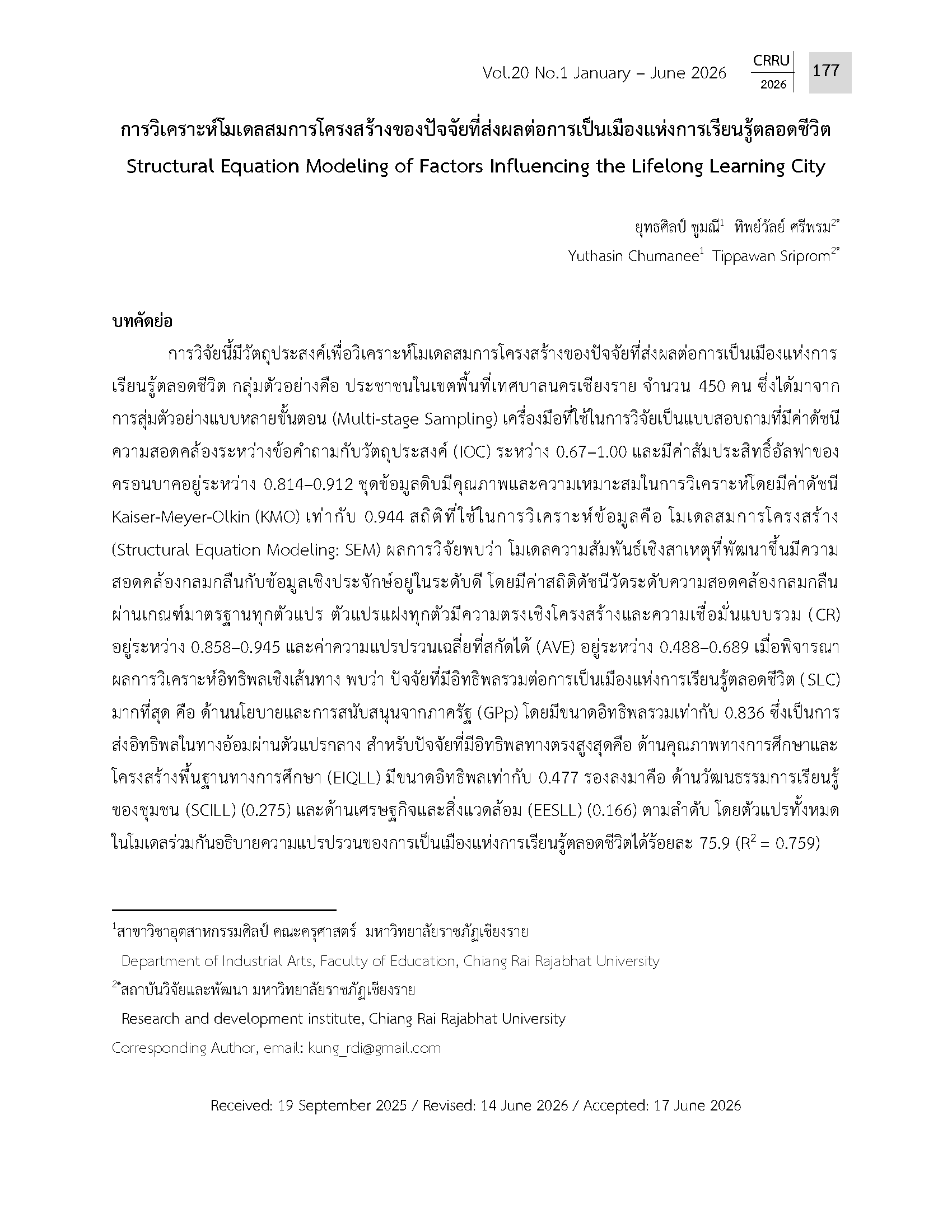
This research aimed to analyze the Structural Equation Modeling of Factors Influencing the Lifelong Learning City. The sample consisted of 450 residents in the Chiang Rai Municipality, obtained through multi-stage sampling. The research instrument was a questionnaire with a content validity (IOC) ranging from 0.67 to 1.00 and Cronbach’s alpha coefficients between 0.814 and 0.912. The dataset demonstrated exceptional sampling adequacy with a Kaiser-Meyer-Olkin (KMO) index of 0.944. Data were analyzed using Structural Equation Modeling (SEM). The results indicated that the developed causal relationship model was in good agreement with the empirical data, meeting all statistical fit indices. All latent variables demonstrated strong construct validity, with Composite Reliability (CR) ranging from 0.858 to 0.945 and Average Variance Extracted (AVE) between 0.488 and 0.689. Path analysis revealed that Government Policy and Support (GPp) exerted the highest total effect on the Lifelong Learning City (SLC) at 0.836, operating entirely through indirect causal pathways. Regarding direct effects, Educational Quality and Infrastructure (EIQLL) had the highest direct impact (0.477), followed by Community Learning Culture (SCILL) (0.275) and Economy and Environment (EESLL) (0.166), respectively. Collectively, the hypothesized variables explained 75.9% of the variance in the Lifelong Learning City (R2 = 0.759).
References
Al-Adwan, A. S., Al-Shehabat, M., & Al-Hajri, S. (2023). Factors affecting the building of a learning city. International Journal of Evaluation and Research in Education, 12(3), 1543–1552. https://ijere.iaescore.com/index.php/IJERE/article/download/24715/13578
Charoenruen, Y., Prasongkiat, N., & Photchanaprapan, K. (2022). Social network analysis in driving the learning city concept of Bangkok: A case study of Kadi Chin-Khlong San neighborhood. King Prajadhipok's Institute Journal, 20(2), 52–75. https://so06.tci-thaijo.org/index.php/kpi_journal/article/view/255548
Chen, L., & Wang, X. (2025). Investigating the structural pathways of digital infrastructure in shaping sustainable learning cities: A structural equation modeling approach. International Journal of Educational Development, 112, 103–115.
Digital Economy Promotion Agency. (2024). Smart City Data Platform Thailand (Chiang Rai Municipality). Ministry of Digital Economy and Society. https://www.citydata.in.th/chiangraicity/
Fornell, C., & Larcker, D. F. (1981). Evaluating structural equation models with unobservable variables and measurement error. Journal of Marketing Research, 18(1), 39–50. https://doi.org/10.1177/002224378101800104
Fund for Educational Equality. (2023). EFE joins in creating a city of learning: Towards a society of equality decentralize education for a variety of choices. https://www.eef.or.th/infographic-learning-city/
Fund for Educational Equality. (2024). What is Learning City?. https://www.eef.or.th/infographic-learning-city/
Hair, J. F., Black, W. C., Babin, B. J., & Anderson, R. E. (2019). Multivariate data analysis (8th ed.). Cengage Learning.
Janmaimool, P., Phdungsilp, A., & Chontanawat, J. (2020). A structural equation model of factors relating to smart cities that affect the management of the world heritage site. Humanities, Arts and Social Sciences Studies, 20(2), 345–368. https://so02.tci-thaijo.org/index.php/hasss/article/view/209475
Kim, S., & Lee, H. (2026). Socio-economic ecosystems and community learning cultures in modern learning cities: Empirical evidence from regional networks. Lifelong Education Quarterly, 47(1), 55-72.
Martinez, J. A. (2024). Government policy, community culture, and the development of lifelong learning spaces: A mediated structural model. Sustainability, 16(4), 1845-1862.
Office of the National Economic and Social Development Board. (2016). National Economic and Social Development Plan, No. 12, 2017 – 2021. Government Gazette, 133(115 A), 1–215. https://www.nesdc.go.th/ewt_dl_link.php?nid=6420
Preisinger, M., & Schubert, T. (2023). Citizen engagement and collaboration: The key to promoting learning city. International Journal of Lifelong Education, 42(4), 411–427. https://files.eric.ed.gov/fulltext/EJ1381164.pdf
Schumacher, R. E., & Lomax, R. G. (2016). A beginner's guide to structural equation modeling (4th ed.). Routledge.
UNESCO. (2020). Global education monitoring report 2020: Inclusion and education. UNESCO Publishing. https://doi.org/10.1787/89b99293-en
World Bank. (2018). World development report 2018: Learning to realize education's
promise. World Bank. https://doi.org/10.1596/978-1-4648-1096-1
Downloads
Published
How to Cite
Issue
Section
License
Copyright (c) 2026 KASALONGKHAM RESEARCH JOURNAL, Chiang Rai Rajabhat University

This work is licensed under a Creative Commons Attribution-NonCommercial-NoDerivatives 4.0 International License.