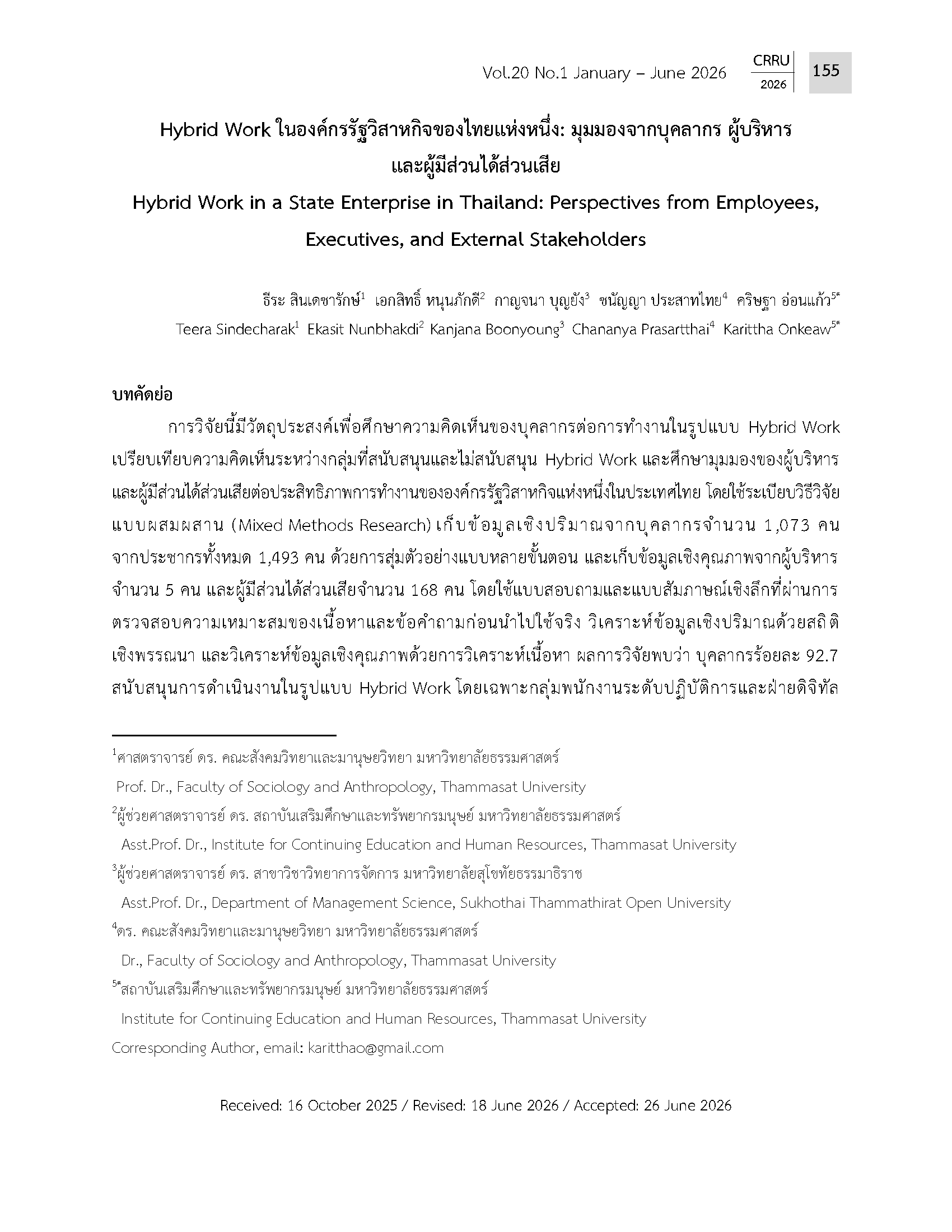
Hybrid Work ในองค์กรรัฐวิสาหกิจของไทยแห่งหนึ่ง: มุมมองจากบุคลากร ผู้บริหาร และผู้มีส่วนได้ส่วนเสีย
คำสำคัญ:
การทำงานแบบผสมผสาน, ความยั่งยืนขององค์กร, ทัศนคติของบุคลากร, ผู้มีส่วนได้ส่วนเสีย, รัฐวิสาหกิจบทคัดย่อ
การวิจัยนี้มีวัตถุประสงค์เพื่อศึกษาความคิดเห็นของบุคลากรต่อการทำงานในรูปแบบ Hybrid Work เปรียบเทียบความคิดเห็นระหว่างกลุ่มที่สนับสนุนและไม่สนับสนุน Hybrid Work และศึกษามุมมองของผู้บริหารและผู้มีส่วนได้ส่วนเสียต่อประสิทธิภาพการทำงานขององค์กรรัฐวิสาหกิจแห่งหนึ่งในประเทศไทย โดยใช้ระเบียบวิธีวิจัยแบบผสมผสาน (Mixed Methods Research) เก็บข้อมูลเชิงปริมาณจากบุคลากรจำนวน 1,073 คน จากประชากรทั้งหมด 1,493 คน ด้วยการสุ่มตัวอย่างแบบหลายขั้นตอน และเก็บข้อมูลเชิงคุณภาพจากผู้บริหารจำนวน 5 คน และผู้มีส่วนได้ส่วนเสียจำนวน 168 คน โดยใช้แบบสอบถามและแบบสัมภาษณ์เชิงลึกที่ผ่านการตรวจสอบความเหมาะสมของเนื้อหาและข้อคำถามก่อนนำไปใช้จริง วิเคราะห์ข้อมูลเชิงปริมาณด้วยสถิติเชิงพรรณนา และวิเคราะห์ข้อมูลเชิงคุณภาพด้วยการวิเคราะห์เนื้อหา ผลการวิจัยพบว่า บุคลากรร้อยละ 92.7 สนับสนุนการดำเนินงานในรูปแบบ Hybrid Work โดยเฉพาะกลุ่มพนักงานระดับปฏิบัติการและฝ่ายดิจิทัลวิจัยและพัฒนา มีความคิดเห็นต่อการทำงานอยู่ในระดับมากที่สุด โดยด้านสิ่งแวดล้อมในการทำงานมีค่าเฉลี่ยสูงสุด (9.39) รองลงมาคือด้านความพึงพอใจในการทำงานและด้านสมดุลระหว่างชีวิตกับการทำงาน (9.36 เท่ากัน) ขณะที่ด้านความทุ่มเทในการทำงานมีค่าเฉลี่ยต่ำที่สุด (8.48) กลุ่มที่สนับสนุน Hybrid Work มีค่าเฉลี่ยความคิดเห็นสูงกว่ากลุ่มที่ไม่สนับสนุนในทุกด้านที่ศึกษา ผู้บริหารและผู้มีส่วนได้ส่วนเสียส่วนใหญ่เห็นว่า Hybrid Work ไม่ส่งผลกระทบต่อประสิทธิภาพการทำงานและควรดำเนินการต่อไป ผลการศึกษาสะท้อนว่า Hybrid Work เป็นแนวทางที่ช่วยส่งเสริมประสิทธิภาพการทำงาน คุณภาพชีวิตของบุคลากร และความยั่งยืนขององค์กร
เอกสารอ้างอิง
Alexander, A., De Smet, A., Langstaff, M., & Ravid, D. (2021, April 1). What employees are saying about the future of remote work. McKinsey & Company. https://www.mckinsey.com/capabilities/people-and-organizational-performance/our-insights/what-employees-are-saying-about-the-future-of-remote-work
Aprilina, R., & Martdianty, F. (2023). The role of hybrid-working in improving employees' satisfaction, perceived productivity, and organizations' capabilities. Journal of Theoretical and Applied Management, 16(2), 206–222. https://doi.org/10.20473/jmtt.v16i2.45632
Bloom, N., Han, R., & Liang, J. (2024). Hybrid working from home improves retention without damaging performance. Nature, 630, 920–925. https://doi.org/10.1038/s41586-024-07500-2
Bolino, M. C., & Phelps, C. (2024, May 30). 3 challenges to hybrid work — and how to overcome them. Harvard Business Review. https://hbr.org/2024/05/3-challenges-to-hybrid-work-and-how-to-overcome-them
Cappelli, P., & Nehmeh, R. (2025, July–August). Hybrid still isn't working. Harvard Business Review. https://hbsp.harvard.edu/product/R2504L-PDF-ENG
CBRE Thailand. (2021, August 16). The next normal: How hybrid work will transform commercial real estate. https://www.cbre.co.th/th-th/insights/reports/the-next-normal-how-hybrid-work-will-transform-commercial-real-estate
Choudhury, P., Foroughi, C., & Larson, B. (2021). Work-from-anywhere: The productivity effects of geographical flexibility. Strategic Management Journal, 42(4), 655–683. https://doi.org/10.1002/smj.3251
Choudhury, P., Khanna, T., Makridis, C. A., & Schirmann, K. (2022). Is Hybrid Work the Best of Both Worlds? Evidence from a Field Experiment. Harvard Business School Working Paper, No. 22-063.
Cisco. (2022). Your employees are ready for hybrid work - are you?: Cisco Global Hybrid Work Study 2022. https://www.cisco.com/c/dam/m/en_us/solutions/global-hybrid-work-study/reports/cisco-global-hybrid-work-study-2022.pdf
Clegg, C. W. (2000). Sociotechnical principles for system design. Applied Ergonomics, 31(5), 463–477. https://doi.org/10.1016/S0003-6870(00)00009-0
Ditto Thailand. (2024, February 23). Hybrid working: A new work trend in 2024 for better mental health in organizations. https://www.dittothailand.com/th/dittonews/hybrid-working/
Doherty, L. (2023, January 20). Leading in a hybrid world. Harvard Business. https://www.harvardbusiness.org/insight/leading-in-a-hybrid-world/
Finzi, B., Molacek, E., & Mann, B. (2023). CEO perspectives on hybrid work from recent Fortune/Deloitte survey: Embracing the opportunities as well as the challenges. Deloitte. https://www2.deloitte.com/us/en/pages/chief-executive-officer/articles/benefits-challenges-of-hybrid-working.html
Gartner. (2020). The IT roadmap for digital business transformation (Excerpt). Scribd. https://www.scribd.com/document/811545207/The-Gartner-It-Roadmap-for-Digital-Buisness-Transformation-Excerpt
Government Property Agency. (2022). Government workplace design guide (Version 3.0). https://assets.publishing.service.gov.uk/media/6297a70ee90e070397a00fdc/Government_Workplace_Design_Guide_V3.0_Government_Workplace_Design_Guide_-_Current_version__uploaded_05_05_22__A_Accepted_as_Stage_Complete_4.pdf
Kniffin, K. M., Narayanan, J., Anseel, F., Antonakis, J., Ashford, S. P., Bakker, A. B., Bamberger, P., Bapuji, H., Bhave, D. P., Choi, V. K., Creary, S. J., Demerouti, E., Flynn, F. J., Gelfand, M. J., Greer, L. L., Johns, G., Kesebir, S., Klein, P. G., Lee, S. Y., Ozcelik, H., Petriglieri, J. L., Rothbard, N. P., Rudolph, C. W., Shaw, J. D., Sirola, N., Wanberg, C. R., Whillans, A., Wilmot, M. P., & van Vugt, M. (2021). COVID-19 and the workplace: Implications, issues, and insights for future research and action. American Psychologist, 76(1), 63–77. https://doi.org/10.1037/amp0000716
Kosayodom, P., Panhomya Kanjanapabu, K., & Kuakob, V. (2024). Hybrid working in Thai public organizations: Impact study on efficiency and job satisfaction. Academic Journal for the Humanities and Social Sciences, Dhonburi Rajabhat University, 7(3), 43–56.
Kossek, E. E., & Thompson, R. J. (2015). Workplace flexibility: Integrating employer and employee perspectives to close the research–practice implementation gap. In T. D. Allen & L. T. Eby (Eds.), The Oxford handbook of work and family (pp. 255–270). Oxford University Press. https://doi.org/10.1093/oxfordhb/9780199337538.013.19
Hirankasi, P. (2022, January 31). Lessons learned from work-from-home during COVID-19 toward future flexible work. https://www.krungsri.com/th/research/research-intelligence/work-from-home-22
Meesith, N., & Aujirapongpan, S. (2024). Satisfactions regarding the hybrid working model of the supporting staff of the Electricity Generating Authority of Thailand in the southern region. GSC Advanced Research and Reviews, 18(3), 200–207. https://doi.org/10.30574/gscarr.2024.18.3.0099
OECD. (2023). Public employment and management 2023: Towards a more flexible public service. OECD Publishing. https://www.oecd.org/content/dam/oecd/en/publications/reports/2023/05/public-employment-and-management-2023_a8f17605/5b378e11-en.pdf
Public Service Division. (2024, November 11). Flexible work arrangements in the Civil Service. https://www.psd.gov.sg/newsroom/flexible-work-arrangements-in-the-civil-service/
Ten Kate, P. (2022, July 22). Thai businesses must move HR to the cloud to stay relevant. https://www.pwc.com/th/en/press-room/press-release/2022/press-release-22-07-22-en.html
Sasin School of Management. (2022, February 16). The hybrid work model is the future in Thailand, but leaders need to reimagine and rethink their role as a leader. https://www.sasin.edu/content/news/the-hybrid-work-model-is-the-future-in-thailand-but-leaders-need-to-reimagine-and-rethink-their-role-as-a-leader
Sittirit, T. (2022). Relationship between organizational culture and offices implementing hybrid workplace concept [Unpublished Master’ thesis]. Thammasat University.
Tahlyan, D., Mahmassani, H., Stathopoulos, A., Said, M., Shaheen, S., Walker, J., & Johnson, B. (2024). In-person, hybrid or remote? Employers' perspectives on the future of work post-pandemic (arXiv:2402.18459). arXiv. https://doi.org/10.48550/arXiv.2402.18459
Tanpipat, W., Lim, H. W., & Deng, X. (2021). Implementing remote working policy in corporate offices in Thailand: Strategic facility management perspective. Sustainability, 13(3), 1284. https://doi.org/10.3390/su13031284
Teevan, J., Hecht, B., & Jaffe, S. (Eds.). (2021). The new future of work: Research from Microsoft on the impact of the pandemic on work practices (1st ed.). Microsoft. http://teevan.org/publications/papers/msr21-nfw.pdf
Wang, B., Liu, Y., Qian, J., & Parker, S. K. (2021). Achieving effective remote working during the COVID-19 pandemic: A work design perspective. Applied Psychology, 70(1), 16–59. https://doi.org/10.1111/apps.12290
Phuttharaksa N., & Luekitinan, W. (2025). Hybrid work support factors toward work–life balance by employees of a power plant company in Thailand. Journal of MCU Phetchaburi Review, 8(1), 272–284.
Ward, N. (2021, March 4). Designing ECC’s hybrid working exploration framework. Service Transformation – Essex County Council. https://essexdigitalservice.blog.essex.gov.uk/2021/03/04/designing-eccs-hybrid-working-exploration-framework/
Westerman, G., Bonnet, D., & McAfee, A. (2014). The nine elements of digital transformation. MIT Sloan Management Review. https://sloanreview.mit.edu/article/the-nine-elements-of-digital-transformation
ดาวน์โหลด
เผยแพร่แล้ว
รูปแบบการอ้างอิง
ฉบับ
ประเภทบทความ
สัญญาอนุญาต
ลิขสิทธิ์ (c) 2026 วารสารการวิจัยกาสะลองคำ มหาวิทยาลัยราชภัฏเชียงราย

อนุญาตภายใต้เงื่อนไข Creative Commons Attribution-NonCommercial-NoDerivatives 4.0 International License.