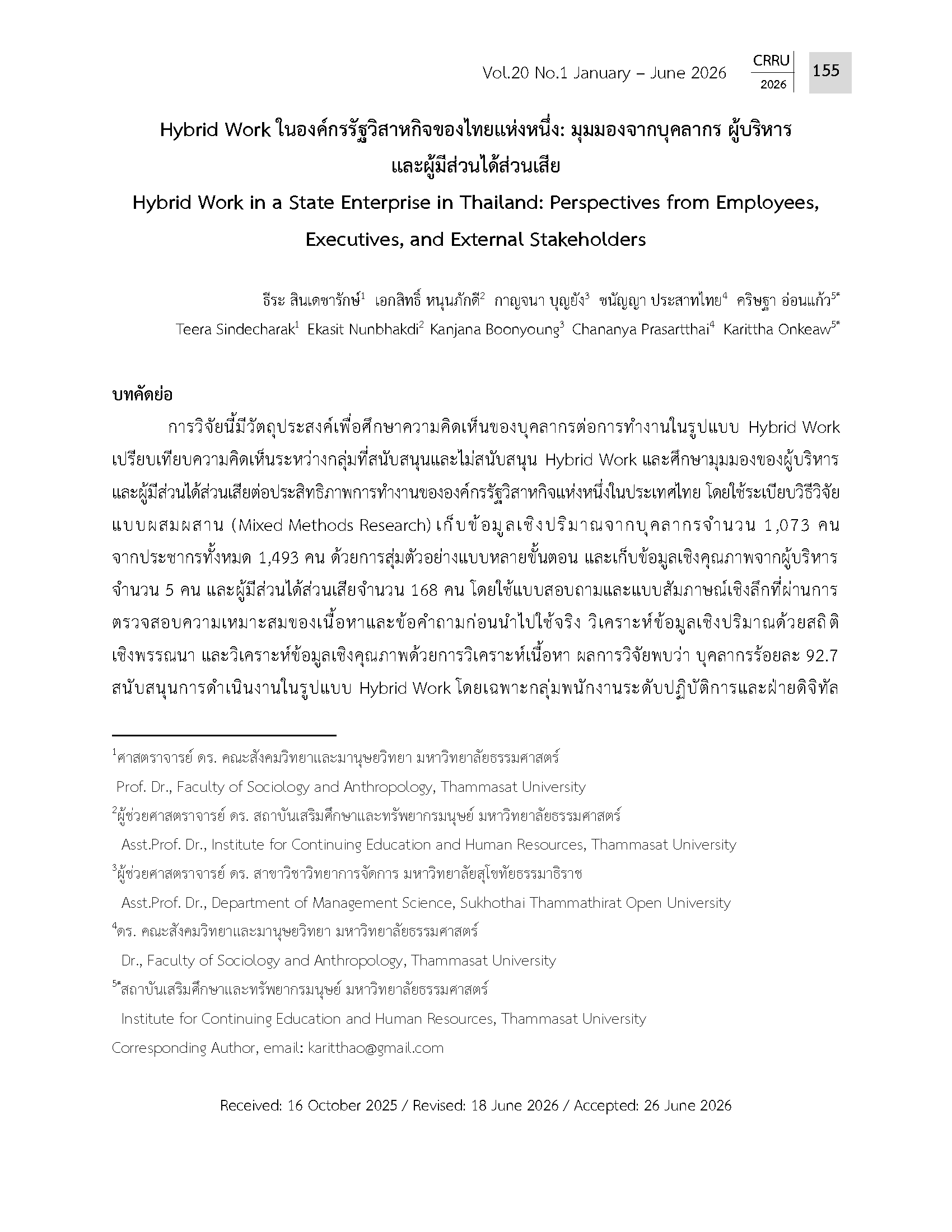
Hybrid Work in a State Enterprise in Thailand: Perspectives from Employees, Executives, and External Stakeholders
Keywords:
Employee Attitudes, Hybrid Work, Organizational Sustainability, Stakeholders, State EnterpriseAbstract
This study aimed to examine employees’ perceptions of Hybrid Work, compare the perceptions of employees who supported and did not support Hybrid Work, and investigate the perspectives of executives and external stakeholders regarding organizational performance in a state-owned enterprise in Thailand. A mixed-methods research design was employed. Quantitative data were collected from 1,073 employees, selected through multi-stage sampling from a population of 1,493 employees. Qualitative data were collected from five executives through in-depth interviews, while questionnaire data were obtained from 168 external stakeholders. The research instruments consisted of questionnaires and interview guides that were reviewed for content validity and the appropriateness of the questions prior to data collection. Quantitative data were analyzed using descriptive statistics, whereas qualitative data were analyzed using content analysis. The findings revealed that 92.7% of employees supported the continuation of Hybrid Work, particularly operational staff and employees in the Digital, Research, and Development division. Employees reported highly positive perceptions of Hybrid Work across all dimensions. The highest mean score was found for the working environment (9.39), followed by job satisfaction and work–life balance (both 9.36), whereas work commitment had the lowest mean score (8.48). Employees who supported Hybrid Work reported higher mean scores than those who did not support it across all dimensions examined. Most executives and external stakeholders agreed that Hybrid Work did not adversely affect organizational performance and should be continued. Overall, the findings suggest that Hybrid Work enhances organizational performance, improves employees’ quality of life, and contributes to long-term organizational sustainability.
References
Alexander, A., De Smet, A., Langstaff, M., & Ravid, D. (2021, April 1). What employees are saying about the future of remote work. McKinsey & Company. https://www.mckinsey.com/capabilities/people-and-organizational-performance/our-insights/what-employees-are-saying-about-the-future-of-remote-work
Aprilina, R., & Martdianty, F. (2023). The role of hybrid-working in improving employees' satisfaction, perceived productivity, and organizations' capabilities. Journal of Theoretical and Applied Management, 16(2), 206–222. https://doi.org/10.20473/jmtt.v16i2.45632
Bloom, N., Han, R., & Liang, J. (2024). Hybrid working from home improves retention without damaging performance. Nature, 630, 920–925. https://doi.org/10.1038/s41586-024-07500-2
Bolino, M. C., & Phelps, C. (2024, May 30). 3 challenges to hybrid work — and how to overcome them. Harvard Business Review. https://hbr.org/2024/05/3-challenges-to-hybrid-work-and-how-to-overcome-them
Cappelli, P., & Nehmeh, R. (2025, July–August). Hybrid still isn't working. Harvard Business Review. https://hbsp.harvard.edu/product/R2504L-PDF-ENG
CBRE Thailand. (2021, August 16). The next normal: How hybrid work will transform commercial real estate. https://www.cbre.co.th/th-th/insights/reports/the-next-normal-how-hybrid-work-will-transform-commercial-real-estate
Choudhury, P., Foroughi, C., & Larson, B. (2021). Work-from-anywhere: The productivity effects of geographical flexibility. Strategic Management Journal, 42(4), 655–683. https://doi.org/10.1002/smj.3251
Choudhury, P., Khanna, T., Makridis, C. A., & Schirmann, K. (2022). Is Hybrid Work the Best of Both Worlds? Evidence from a Field Experiment. Harvard Business School Working Paper, No. 22-063.
Cisco. (2022). Your employees are ready for hybrid work - are you?: Cisco Global Hybrid Work Study 2022. https://www.cisco.com/c/dam/m/en_us/solutions/global-hybrid-work-study/reports/cisco-global-hybrid-work-study-2022.pdf
Clegg, C. W. (2000). Sociotechnical principles for system design. Applied Ergonomics, 31(5), 463–477. https://doi.org/10.1016/S0003-6870(00)00009-0
Ditto Thailand. (2024, February 23). Hybrid working: A new work trend in 2024 for better mental health in organizations. https://www.dittothailand.com/th/dittonews/hybrid-working/
Doherty, L. (2023, January 20). Leading in a hybrid world. Harvard Business. https://www.harvardbusiness.org/insight/leading-in-a-hybrid-world/
Finzi, B., Molacek, E., & Mann, B. (2023). CEO perspectives on hybrid work from recent Fortune/Deloitte survey: Embracing the opportunities as well as the challenges. Deloitte. https://www2.deloitte.com/us/en/pages/chief-executive-officer/articles/benefits-challenges-of-hybrid-working.html
Gartner. (2020). The IT roadmap for digital business transformation (Excerpt). Scribd. https://www.scribd.com/document/811545207/The-Gartner-It-Roadmap-for-Digital-Buisness-Transformation-Excerpt
Government Property Agency. (2022). Government workplace design guide (Version 3.0). https://assets.publishing.service.gov.uk/media/6297a70ee90e070397a00fdc/Government_Workplace_Design_Guide_V3.0_Government_Workplace_Design_Guide_-_Current_version__uploaded_05_05_22__A_Accepted_as_Stage_Complete_4.pdf
Kniffin, K. M., Narayanan, J., Anseel, F., Antonakis, J., Ashford, S. P., Bakker, A. B., Bamberger, P., Bapuji, H., Bhave, D. P., Choi, V. K., Creary, S. J., Demerouti, E., Flynn, F. J., Gelfand, M. J., Greer, L. L., Johns, G., Kesebir, S., Klein, P. G., Lee, S. Y., Ozcelik, H., Petriglieri, J. L., Rothbard, N. P., Rudolph, C. W., Shaw, J. D., Sirola, N., Wanberg, C. R., Whillans, A., Wilmot, M. P., & van Vugt, M. (2021). COVID-19 and the workplace: Implications, issues, and insights for future research and action. American Psychologist, 76(1), 63–77. https://doi.org/10.1037/amp0000716
Kosayodom, P., Panhomya Kanjanapabu, K., & Kuakob, V. (2024). Hybrid working in Thai public organizations: Impact study on efficiency and job satisfaction. Academic Journal for the Humanities and Social Sciences, Dhonburi Rajabhat University, 7(3), 43–56.
Kossek, E. E., & Thompson, R. J. (2015). Workplace flexibility: Integrating employer and employee perspectives to close the research–practice implementation gap. In T. D. Allen & L. T. Eby (Eds.), The Oxford handbook of work and family (pp. 255–270). Oxford University Press. https://doi.org/10.1093/oxfordhb/9780199337538.013.19
Hirankasi, P. (2022, January 31). Lessons learned from work-from-home during COVID-19 toward future flexible work. https://www.krungsri.com/th/research/research-intelligence/work-from-home-22
Meesith, N., & Aujirapongpan, S. (2024). Satisfactions regarding the hybrid working model of the supporting staff of the Electricity Generating Authority of Thailand in the southern region. GSC Advanced Research and Reviews, 18(3), 200–207. https://doi.org/10.30574/gscarr.2024.18.3.0099
OECD. (2023). Public employment and management 2023: Towards a more flexible public service. OECD Publishing. https://www.oecd.org/content/dam/oecd/en/publications/reports/2023/05/public-employment-and-management-2023_a8f17605/5b378e11-en.pdf
Public Service Division. (2024, November 11). Flexible work arrangements in the Civil Service. https://www.psd.gov.sg/newsroom/flexible-work-arrangements-in-the-civil-service/
Ten Kate, P. (2022, July 22). Thai businesses must move HR to the cloud to stay relevant. https://www.pwc.com/th/en/press-room/press-release/2022/press-release-22-07-22-en.html
Sasin School of Management. (2022, February 16). The hybrid work model is the future in Thailand, but leaders need to reimagine and rethink their role as a leader. https://www.sasin.edu/content/news/the-hybrid-work-model-is-the-future-in-thailand-but-leaders-need-to-reimagine-and-rethink-their-role-as-a-leader
Sittirit, T. (2022). Relationship between organizational culture and offices implementing hybrid workplace concept [Unpublished Master’ thesis]. Thammasat University.
Tahlyan, D., Mahmassani, H., Stathopoulos, A., Said, M., Shaheen, S., Walker, J., & Johnson, B. (2024). In-person, hybrid or remote? Employers' perspectives on the future of work post-pandemic (arXiv:2402.18459). arXiv. https://doi.org/10.48550/arXiv.2402.18459
Tanpipat, W., Lim, H. W., & Deng, X. (2021). Implementing remote working policy in corporate offices in Thailand: Strategic facility management perspective. Sustainability, 13(3), 1284. https://doi.org/10.3390/su13031284
Teevan, J., Hecht, B., & Jaffe, S. (Eds.). (2021). The new future of work: Research from Microsoft on the impact of the pandemic on work practices (1st ed.). Microsoft. http://teevan.org/publications/papers/msr21-nfw.pdf
Wang, B., Liu, Y., Qian, J., & Parker, S. K. (2021). Achieving effective remote working during the COVID-19 pandemic: A work design perspective. Applied Psychology, 70(1), 16–59. https://doi.org/10.1111/apps.12290
Phuttharaksa N., & Luekitinan, W. (2025). Hybrid work support factors toward work–life balance by employees of a power plant company in Thailand. Journal of MCU Phetchaburi Review, 8(1), 272–284.
Ward, N. (2021, March 4). Designing ECC’s hybrid working exploration framework. Service Transformation – Essex County Council. https://essexdigitalservice.blog.essex.gov.uk/2021/03/04/designing-eccs-hybrid-working-exploration-framework/
Westerman, G., Bonnet, D., & McAfee, A. (2014). The nine elements of digital transformation. MIT Sloan Management Review. https://sloanreview.mit.edu/article/the-nine-elements-of-digital-transformation
Downloads
Published
How to Cite
Issue
Section
License
Copyright (c) 2026 KASALONGKHAM RESEARCH JOURNAL, Chiang Rai Rajabhat University

This work is licensed under a Creative Commons Attribution-NonCommercial-NoDerivatives 4.0 International License.