
A Study of Gamification-Based Learning Management to Develop English Learning Achievement of Undergraduate Students at a University in Thailand
Keywords:
Gamification-based Learning Management, English Learning Achievement, Undergraduate StudentsAbstract
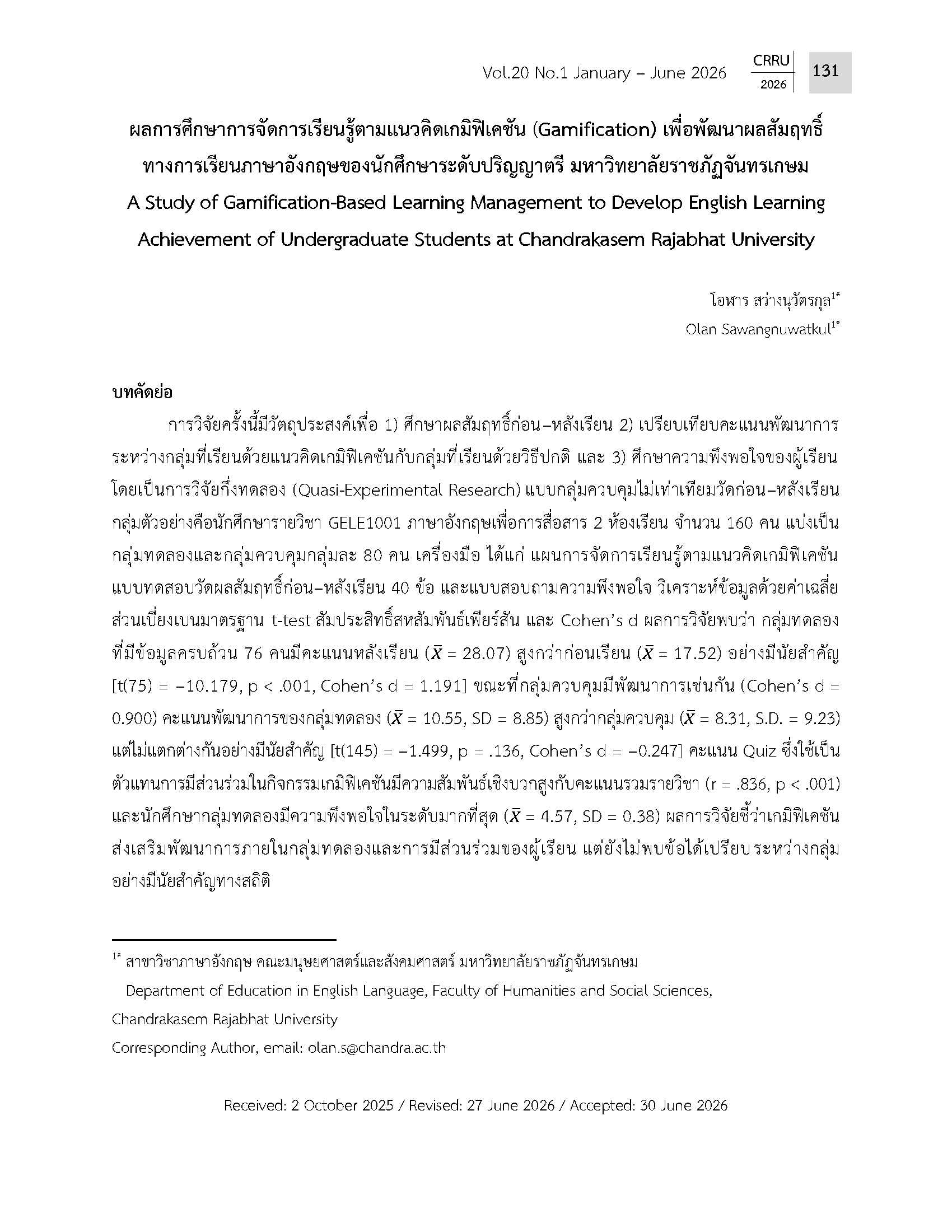
This study aimed to: 1) examine students’ English learning achievement before and after instruction; 2) compare gain scores between students receiving gamification-based learning management and those receiving conventional instruction; and 3) investigate students’ satisfaction. The study employed a quasi-experimental research design with a nonequivalent control-group pretest-posttest design. The sample consisted of 160 students enrolled in GELE1001 English for Communication from two classes, with 80 students assigned to the experimental group and 80 students assigned to the control group. The research instruments included gamification-based lesson plans, a 40-item pretest-posttest English achievement test, and a satisfaction questionnaire. Data were analyzed using mean, standard deviation, t-tests, Pearson’s product-moment correlation coefficient, and Cohen’s d. The findings indicated that, among the 76 experimental-group students with complete data, the posttest mean score ( = 28.07) was significantly higher than the pretest mean score (
= 17.52), t(75) = −10.179, p < .001, Cohen’s d = 1.191. The control group also demonstrated improvement, with a Cohen’s d of 0.900. Although the experimental group obtained a higher mean gain score (
= 10.55, SD = 8.85) than the control group (
= 8.31, SD = 9.23), the difference was not statistically significant, t(145) = −1.499, p = .136, Cohen’s d = −0.247. Quiz scores, used as an indicator of participation in gamification activities, showed a strong positive correlation with total course scores (r = .836, p < .001). Students in the experimental group reported the highest level of satisfaction (
= 4.57, SD = 0.38). The findings suggest that gamification promotes within-group learning improvement and student engagement; however, no statistically significant advantage over conventional instruction was found between the two groups.
References
Bandura, A. (1977). Social learning theory. Prentice Hall.
Bloom, B. S. (1976). Human characteristics and school learning. McGraw-hill.
Csikszentmihalyi, M. (1990). Flow: The psychology of optimal experience. Harper & Row.
Cohen, J. (1988). Statistical power analysis for the behavioral sciences (2nd ed.). Lawrence Erlbaum Associates. https://doi.org/10.4324/9780203771587
Creswell, J. W., & Creswell, J. D. (2023). Research design: Qualitative, quantitative, and mixed methods approaches (6th ed.). SAGE Publications.
Deci, E. L., & Ryan, R. M. (2012). Self-determination theory. In P. A. M. Van Lange, A. W. Kruglanski, & E. T. Higgins (Eds.), Handbook of theories of social psychology (Vol. 1, pp. 416-436). SAGE Publications.
EF Education First. (2024). EF English Proficiency Index 2024: A Ranking of 116 Countries and Regions by English Skills. Signum International AG. https://www.ef.com/assetscdn/WIBIwq6RdJvcD9bc8RMd/cefcom-epi-site/reports/2024/ef-epi-2024-english.pdf
Hamari, J., Koivisto, J., & Sarsa, H. (2014, January). Does gamification work?--a literature review of empirical studies on gamification. In 2014 47th Hawaii international conference on system sciences (pp. 3025-3034). IEEE.
Hattie, J. (2008). Visible learning: A synthesis of over 800 meta-analyses relating to achievement. Routledge.
Horwitz, E. K., Horwitz, M. B., & Cope, J. (1986). Foreign language classroom anxiety. The Modern Language Journal, 70(2), 125–132. https://doi.org/10.1111/j.1540-4781.1986.tb05256.x
Hsieh, M. L., & Turner, M. (2022). Discovering relation population: The gamification design for digital placemaking in the neighbourhood. SPACE International Journal of Conference Proceedings, 2(2), 22–29.
Huang, B., & Hew, K. F. (2018). Implementing a theory-driven gamification model in higher education flipped courses: Effects on out-of-class activity completion and quality of artifacts. Computers & Education, 125, 254-272.
Kapp, K. M. (2012). The gamification of learning and instruction: game-based methods and strategies for training and education. John Wiley & Sons.
Keller, J. M. (1987). Development and use of the ARCS model of instructional design. Journal of instructional development, 10(3), 2-10.
Krashen, S. D. (1985). The input hypothesis: Issues and implications. Longman.
Lam, S. L. (2014). Use of gamification in vocabulary learning: A case study in Macau. In X. Deng & R. Seow (Eds.), Alternative pedagogies in the English language and communication classroom (pp. 90–97). Centre for English Language Communication, National University of Singapore.
Ministry of Higher Education, Science, Research and Innovation. (2023). Higher education development strategy 2023-2027. MHESI.
Office of the National Economic and Social Development Council. (2022). National strategy 2018-2037. NESDC.
Podsakoff, P. M., MacKenzie, S. B., Lee, J. Y., & Podsakoff, N. P. (2003). Common method biases in behavioral research: a critical review of the literature and recommended remedies. Journal of applied psychology, 88(5), 879.
Saengprasert, W. (2019). The effects of teaching reading using gamification on English reading comprehension achievement and attitudes toward reading instruction of upper secondary school students. In Proceedings of the 10th National Research Conference, Sukhothai Thammathirat Open University (pp. 85–94). Sukhothai Thammathirat Open University.
Saroj, N. (2022). Learning management using gamification technique to enhance English reading comprehension ability for grade 8 students at Uthaiwittayakom School, Uthai Thani Province [Unpublished Master’s thesis]. Naresuan University.
Seemiller, C., & Grace, M. (2018). Generation Z: A century in the making. Routledge.
Skinner, B. F. (1965). Science and human behavior (No. 92904). Simon and Schuster.
Smiderle, R., Rigo, S. J., Marques, L. B., Peçanha de Miranda Coelho, J. A., & Jaques, P. A. (2020). The impact of gamification on students’ learning, engagement and behavior based on their personality traits. Smart Learning Environments, 7(1), 3.
Thapphan, P. (2025). The development of English reading comprehension achievement using 5W1H technique worksheets for grade 2 students. MCU Ubon Review, 10(1), 899–910.
UNESCO. (2024). Education for Sustainable Development (ESD) for 2030 Global Network. UNESCO. https://www.unesco.org/en/sustainable-development/education/esd-net
Downloads
Published
How to Cite
Issue
Section
License
Copyright (c) 2026 KASALONGKHAM RESEARCH JOURNAL, Chiang Rai Rajabhat University

This work is licensed under a Creative Commons Attribution-NonCommercial-NoDerivatives 4.0 International License.