
The Effect of Learning Management Using a Design Thinking Approach on Enhancing Innovative Thinking Skills of Pre-service Teachers: A Case Study of Islamic Studies Teaching Students
Keywords:
learning management, design thinking, innovative thinking skills, pre-service teacher, Islamic studiesAbstract
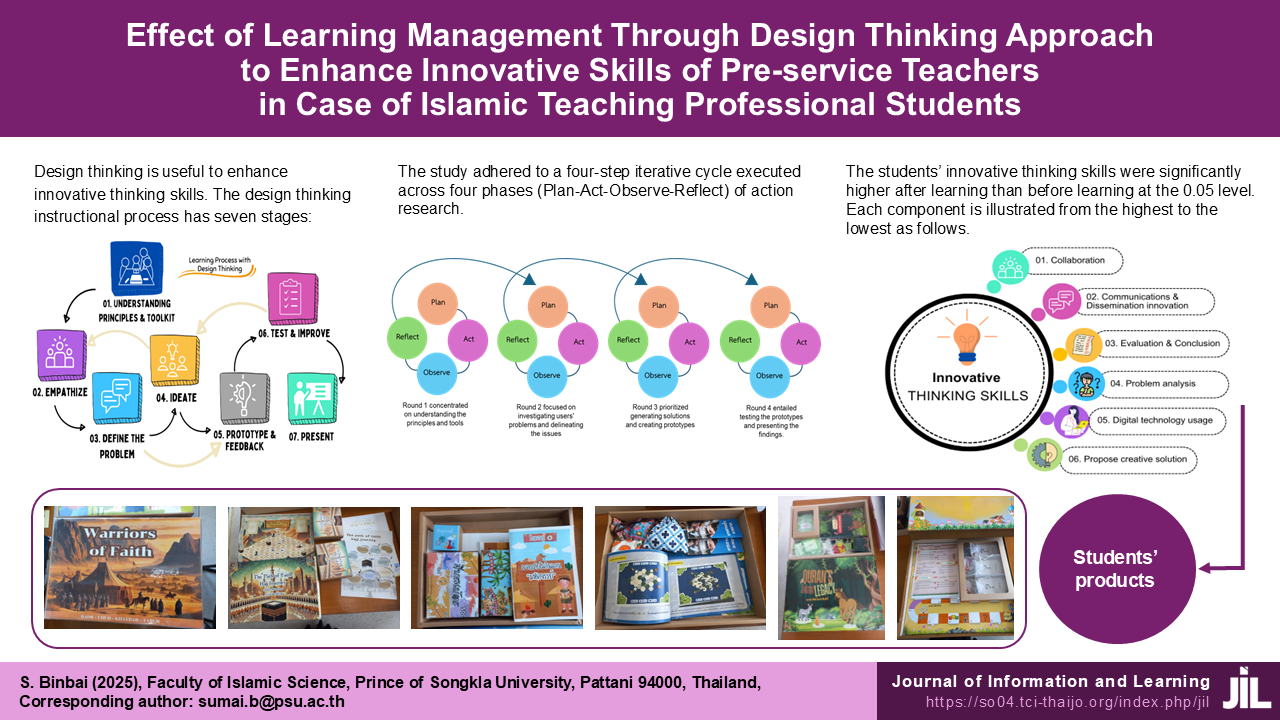
This action research aimed to enhance innovative thinking skills among pre-service teachers majoring in Teaching Islamic Studies. The study had three objectives: 1) to examine students’ innovative thinking skills after engaging in design thinking-based learning activities, 2) to evaluate the quality of student-created learning innovations, and 3) to assess user satisfaction with those innovations. The participants were 40 undergraduate pre-service teachers enrolled in the course 762-205 Learning Management Science. The research instruments included a lesson plan based on the seven-step design thinking process, an innovative thinking skills assessment, an innovative product evaluation form, and a satisfaction questionnaire. Data were analyzed using mean, standard deviation, and a dependent samples t-test. Findings revealed that students’ innovative thinking skills were significantly higher after the intervention than before, at the .05 level. Among the assessed components, the highest mean score was in collaboration, followed by communication and dissemination, evaluation and conclusion, problem analysis, use of digital technology, and proposing creative solutions. The quality of student-created learning innovations was rated very high across all criteria. Creativity received the highest score, followed by value and usefulness, and the development process. User satisfaction with the innovations was also high. The highest-rated aspects were content quality, followed by usefulness, visual appeal, modernity, assessment, design, and usability, respectively. Overall, the study supports the effectiveness of the design thinking process in fostering innovative thinking and producing high-quality, user-approved educational innovations among pre-service teachers.
References
Bender-Salazar, R. (2023). Design Thinking as an effective method for problem-setting and need finding for entrepreneurial teams addressing wicked problems. Journal of Innovation and Entrepreneurship, 12, Article 24, 1–23. https://doi.org/10.1186/s13731-023-00291-2
Brown, T. (2008). Design thinking. Harvard Business Review. https://readings.design/PDF/Tim%20Brown,%20Design%20Thinking.pdf
Butsai, S., Sakuntanak, P., & Langka, W. (2023). A comparison of the learning results through the design thinking process and inquiry-based learning (5E) to scientific competencies of grade 8 students. Academic MCU Buriram Journal, 8(2), 118–130. https://so06.tci-thaijo.org/index.php/ambj/article/view/265269
Chaichuai, K., Somnate, K., & Intanam, N. (2022). The development of innovative thinking skills by using research-based learning management for innovation of Mathayom Suksa 4 students at Somdejphrayansangworn school in Patriarchal Patronage. Ubon Ratchathani Journal of Research and Evaluation, 11(2), 10–20. https://so06.tci-thaijo.org/index.php/ubonreseva/article/view/258106
Dam, R. F. (2025). The 5 stages in the design thinking process. Interaction Design Foundation-IxDF. https://www.interaction-design.org/literature/article/5-stages-in-the-design-thinking-process
Diaz, I, T. (2025, January 17). Innovative thinking: A future-proof skill. GLOBIS Insights. https://globisinsights.com/career-skills/innovation/innovative-thinking-future-proof-skill/?utm_source=chatgpt.com
Fullan, M., & Langworthy, M. (2014). A rich seam: How new pedagogies find deep learning. Pearson. https://www.michaelfullan.ca/wp-content/uploads/2014/01/3897.Rich_Seam_web.pdf
Heydarabadi, S., Shahbazi, A., and Eradatifam, M. (2019). Design thinking: A new phenomenon in creating innovation (Persian & English). https://www.researchgate.net/publication/333670705_Design_Thinking_A_New_Phenomenon_in_Creating_Innovation_Persian_English
HREX.asia. (2019, July 2). Design Thinking khư̄ ʻarai ? Samkhan yāng rai tō̜ ʻakān tœ̄ptō khō̜ng ʻongkō̜n [Design thinking process: A key tool for creating organizational success]. https://th.hrnote.asia/orgdevelopment/190702-design-thinking
Israsena Na Ayudhya, P., &Treerattanaphan, C. (2017). Design thinking: Learning by doing. Thailand Creative & Design. https://resource.tcdc.or.th/ebook/Design.Thingking.Learning.by.Doing.pdf
James, M. (2015). Design thinking and the internal: A case study. In Zande, R. Vande, E. Bohemia, & I. Digranes (Eds.). Proceedings of the 3rd International Conference for Design Education Researchers (pp. 485–499). https://pdxscholar.library.pdx.edu/artdesign_fac/2
Karnchanasubsin, T. (2021). Kānchai kān khit chœ̄ng ʻō̜k bǣp design thinking mā chai nai kānʻō̜kbǣp kānsō̜n [Using design thinking in instructional design]. BRU Personnel. http://blog.bru.ac.th/2021/05/20/การใช้การคิดเชิงออกแบบ-d
Katenarai, S., & Jantakoon, J. (2022). The effect of learning activities based on design thinking process to cope with the Covid-19 pandamic for promoting citizenship education of grade 12 students. Valaya Alongkorn Review (Humanities and Social Science), 12(2), 205–217. https://so06.tci-thaijo.org/index.php/var/article/view/256384
Kelley, T., & Kelley, D. (2013, November 6). Creative confidence: Unleashing the creative potential within us all. Stanford Social Innovation Review. https://ssir.org/books/excerpts/entry/creative_confidence_unleashing_the_creative_potential_within_us_all
Kongcharoen, P., & Kaewurai, W. (2023). The implementation of learning activities based on design thinking process with family and community engagement to enhance the development of learning and innovation skills for senior high school students. Journal of Roi Kaensarn Academi, 8(12), 146–162. https://so02.tci-thaijo.org/index.php/JRKSA/article/view/264505
Lieu, T. T. B., Duc, N. H., Gleason, N. W., Hai, D. T., & Tam, N. D. (2018). Approaches in developing undergraduate IT engineering curriculum for the fourth industrial revolution in Malaysia and Vietnam. Creative Education, 9(16), 2752–2772. https://doi.org/10.4236/ce.2018.916207
Mongkolyos, S., & Supannopaph, P. (2024). Development of innovative thinking skills indicators for secondary school teachers under the office of the Basic Education Commission in the central region: Testing measurement invariance by working experience. The journal of Sirindhornparithat, 25(2), 2142–2154. https://so06.tci-thaijo.org/index.php/jsrc/article/view/263791
Netchang, S., Tantalanukul, S., Mapiw, P., Kaewkhong, N., & Phomma, A. (2024). The effect of learning approach based on design thinking process to enhance innovative thinking skills of nursing students for promoting health among persons with health problem related to skeletal and muscle system. Journal of Nursing and Health Science Research, 16(2), 2–20. https://he01.tci-thaijo.org/index.php/unc/article/view/e270211
Paul, J. (2024, July 31). 16/100-Design thinking process explained with stages and toolkit. Program Strategy HQ. https://www.programstrategyhq.com/post/design-thinking-process
Phitthayasenee, M., & Yuangsoi, P. (2021). Design thinking: New era innovator teachers. Lampang Rajaphat University Journal, 10(2), 190–199. https://so04.tci-thaijo.org/index.php/JLPRU/article/view/246560
Phoonkhetkid, S. (2020). The development of learning activities by using design thinking approach to enhance creativity and innovation skill for Mathayomsuksa 6 students [Master's thesis, Naresuan University]. Faculty of Education, Naresuan University. http://www.edu.nu.ac.th/th/news/docs/download/2020_12_01_11_07_48.pdf
Plattner, H., Meinel, C., & Leifer, L. (2010). Design thinking: Understand-improve-apply. Springer. https://doi.org/10.1007/978-3-642-13757-0
Prajan, O., & Chaemchoy, S. (2018). Administrative model for the development teacher’s innovative thinking skills in the basic education school. Journal of Social Innovation and Lifelong Learning, 12(1), 156–169. https://so01.tci-thaijo.org/index.php/FEU/article/view/89659
Ray, B. (2012). Design thinking: Lessons for the classroom. Edutopia. http://www.edutopia.org/blog/design-thinking-betty-ray
Razali, N. H., Ali, N. N. N., Safiyuddin, S. K., & Khalid, F. (2022). Design thinking approaches in education and their challenges: A systematic literature review. Creative Education, 13, 2289–2299. https://doi.org/10.4236/ce.2022.137145
Razzouk, R., & Shute, V. (2012). What is design thinking and why is it important? Review of Educational Research, 82(3), 330–328. https://psycnet.apa.org/doi/10.3102/0034654312457429
Rojsangrat, P., Pichayapaiboon, P., & Suwannatthachote, P. (2020). Development of an instructional model using design thinking approach to create Thai identity products for undergraduate students. Journal of Education Studies, Chulalongkorn University, 48(3), 258–273. https://so02.tci-thaijo.org/index.php/EDUCU/article/view/245006
Schwab, K. (2017). The fourth industrial revolution. Rotman Management Magazine, 19-24. https://www.academia.edu/32358553/A_Kind_of_Revolution_The_Fourth_Industrial_Revolution
Sharples, M., de Roock, R., Ferguson, R., Gaved, M., Herodotou, C., Koh, E., Kukulska-Hulme, A., Looi, C-K, McAndrew, P., Rienties, B., Weller, M., Wong, L. H. (2016). Innovating pedagogy 2016: Open university innovation report 5. Milton Keynes: The Open University. http://dx.doi.org/10.13140/RG.2.2.20677.04325
Stanford’s d.school. (2018). Design thinking bootleg. Institute of Design at Standford. https://dschool.sfo3.digitaloceanspaces.com/documents/dschool_bootleg_deck_2018_final_sm2-6.pdf
Tanglakmankhong, K., Khammathit, A., Thammawongsa, N., Promruksa, M., Dokchaba, N., Krungsaenmuang, T., & Ardpasa, A. (2021). Effectiveness of the application of design thinking and interprofessional education approach on the 4Cs of learning skills and interprofessional collaborative competencies in Nursing Innovation Course. Journal of Information and Learning, 32(3), 14–24. https://so04.tci-thaijo.org/index.php/jil/article/view/253784
Trilling, B., & Fadel, C. (2009). 21st century skills: Learning for life in our times. Jossey-Bass/Wiley. https://psycnet.apa.org/record/2009-18745-000
Vongtathum, P., & Samart, C. (2023). A development of educational board games construct process with design thinking. Journal of Education Khon Kaen University, 46(4), 65–78. https://so02.tci-thaijo.org/index.php/EDKKUJ/article/view/264876
Weiss, D. S., & Legrand, C. P. (2011). Innovative intelligence: The art and practice of leading sustainable innovation in your organization. John Wiley & Sons Canada.
Wisetsat, C. (2019). Developing of learning model to enhance innovative thinking skill of teachers [Doctoral dissertation, Mahasarakham University]. Mahasarakham University Intellectual Repository. http://202.28.34.124/dspace/bitstream/123456789/35/1/59010563010.pdf
Wise, S. (2016, February 8). Design thinking in education: Empathy, challenge, discovery, and sharing. Edutopia. https://www.edutopia.org/blog/design-thinking-empathy-challenge-discovery-sharing-susie-wise?Utm%20_source=chatgpt.com
Wongyai, W., & Patphol, M. (2020). Kānrīanrū chœ̄ng sāngsan [Creative learning]. Charansanitwong Printing. http://www.curriculumandlearning.com/upload/Books/การเรียนรู้เชิงสร้างสรรค์%20V_1596104583.1.pdf
Yu, Q., Yu, K. & Lin, R. A. (2024). A meta-analysis of the effects of design thinking on student learning. Humanities & Social Sciences Communication, 11, Article 742. http://dx.doi.org/10.1057/s41599-024-03237-5
Downloads
Additional Files
Published
How to Cite
Issue
Section
Categories
License
Copyright (c) 2025 Journal of Information and Learning [JIL]

This work is licensed under a Creative Commons Attribution-NonCommercial-NoDerivatives 4.0 International License.
The Journal of Information and Learning is operated by the Office of Academic Resources, Prince of Songkla University. All articles published in the journal are protected by Thailand copyright law. This copyright covers the exclusive rights to share, reproduce and distribute the article, including in electronic forms, reprints, translations, photographic reproductions, or similar. Authors own copyrights in the works they have created as well as the Office of Academic Resources. The Journal reserves the right to edit the language of papers accepted for publication for clarity and correctness, as well as to make formal changes to ensure compliance with the journal's guidelines. All authors must take public responsibility for the content of their paper.


