"BAMBOO AND STEEL" FOR DUET SOPRANO SAXOPHONE A CREATIVE RESEARCH IN MUSIC COMPOSITION
DOI:
https://doi.org/10.65824/mmj.v9.285035Keywords:
Microtone, Saxophone, Contemporary Saxophone Composition, Thai–Western Instrument Integration, Progressive RockAbstract
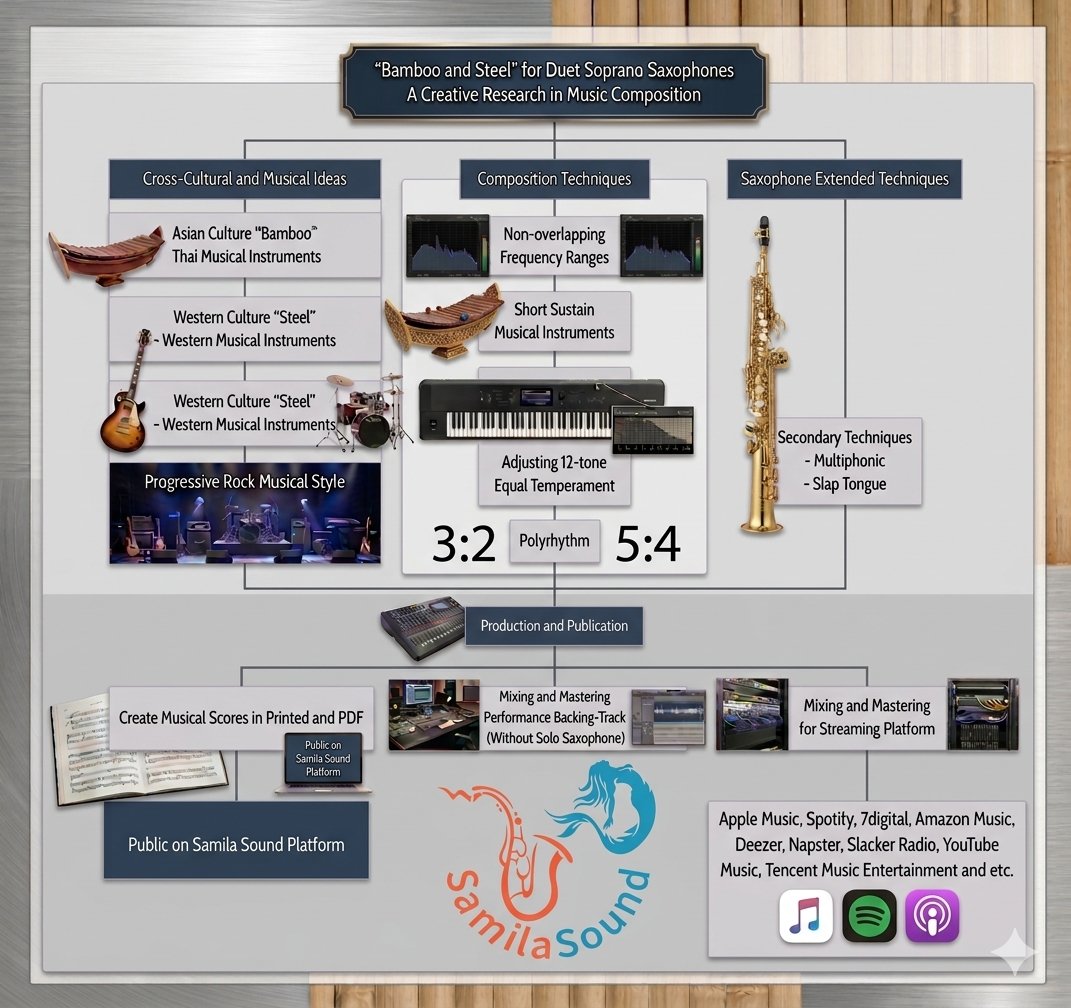
Background and Objectives: The creative research project “Bamboo and Steel” for duet soprano saxophone presents cross-cultural and musical ideas. The concept employs “Bamboo” as a symbol of Asian culture, representing simplicity, nature, and Thai musical tradition, while “Steel” symbolizes Western culture, industrial advancement, and modern musical technology. The work was composed in a progressive rock style, which aligns with the composer’s expertise and allows for the exploration of complex musical structures. This research has three main objectives: 1) to study the possibilities of blending Thai and Western musical instruments to achieve a harmonious sound combination; 2) to investigate contemporary saxophone performance techniques, emphasizing microtones—a pitch interval smaller than a semitone; and 3) to create a composition that applies microtonal techniques effectively in combination with Thai and Western musical elements.
Methods: The process began with selecting suitable Thai and Western instruments. Thai instruments were chosen based on tonal compatibility and non-overlapping frequency ranges (e.g., mong, ching, chab, jakhe). Most of these instruments have short sustain, except the mong, which functions as a bass. The jakhe and mong were adapted to the 12-tone equal temperament system by using the Melodyne plug-in before being integrated with Western instruments, including electric guitar, electric bass, synthesizer, and drum set. For the saxophone, the researcher focused on developing microtonal fingering on the soprano saxophone by testing several instrument brands to determine the most suitable fingering systems. Additional techniques—such as polyrhythm, multiphonics, and slap tongue—were also applied to create complex rhythmic and textural structures. The final stage involved recording, mixing, and mastering. The recording was produced in Logic Pro X through three approaches: live recording (saxophone and bass), sampling (Thai instruments and Superior Drummer 3 for drums), and synthesized sounds. Mixing emphasized sound balance, stereo dimension, EQ (Equalizer), compressor, and spatial effects (reverb and delay) to blend the timbres of instruments from different cultures. The final mix was sent to Fascination Street Studio (Sweden) for mastering to meet digital audio publishing standards.
Results: The outcome of this creative research is the composition Bamboo and Steel, which demonstrates the integration of Asian and Western musical elements. Technically, tonal blending was achieved by adjusting Thai instruments (jakhe, mong) to the 12-tone equal temperament system, enabling them to perform seamlessly with Western instruments. In terms of performance, the researcher developed flexible microtonal fingerings based on tonal variations among saxophone brands, producing clear microtonal expressions through close intervals and contrary motion between two saxophones. Structurally, the piece employs polyrhythms and multiphonics effectively, consistent with the characteristics of progressive rock. The composition has been published as a score and digital audio file through the Samila Sound platform, with QR code links to full recordings. It was premiered at the 20th World Saxophone Congress 2025 in China and later performed at the International Saxophone Meeting in Rome, Italy.
Conclusions: Bamboo and Steel successfully bridges Asian and Western musical worlds through the language of contemporary music. The work highlights the saxophone’s potential to employ microtonal and modern extended techniques while integrating Thai traditional instruments within a rock-based context. This project expands creative possibilities for saxophone repertoire and offers new perspectives on incorporating Thai music into global contemporary performance practice.
References
Davies, Hugh. “Microtone.” In The New Grove Dictionary of Music and Musicians. 2nd ed. Edited by Stanley Sadie and John Tyrrell, 624-626. London: Macmillan, 2001.
Londeix, Jean-Marie. Hello! Mr. Sax, ou, Paramètres du saxophone = or, Parameters of the saxophone. Paris: Alphonse Leduc, 1989.
Mac Erlaine, Seán. “Microtonality as an Expressive Device: An Approach for the Contemporary Saxophonist.” Masters diss., Technological University Dublin, 2009.
MasterClass. “Progressive Rock Guide: A Brief History of Prog Rock.” Accessed September 20, 2025. https://www.masterclass.com/articles/progressive-rock-guide.
Pruksavanich, Wisuwat. “‘Multiphonic Virtuoso’ for Alto Saxophone A Creative Research in Music Composition.” Rangsit Music Journal 20, no. 2 (July-December 2025): R0406. https://so06.tci-thaijo.org/index.php/rmj/article/view/277844. (in Thai) DOI: https://doi.org/10.59796/rmj.V20N2.2025.R0406
Saimee, Thanya, and Chakrit Chalermsuk. “Ranai Pai Koung: Khmer Ethnic Music in Sirattana District of Sisaket Province.” Journal of Modern Learning Development 8, no. 9 (September 2023): 406-420. https://so06.tci-thaijo.org/index.php/jomld/article/view/262302. (in Thai)
Weiss, Marcus, and Giorgio Netti. The Techniques of Saxophone Playing. Kassel: Bärenreiter, 2010.
Downloads
Published
How to Cite
Issue
Section
License
Copyright (c) 2026 College of Music

This work is licensed under a Creative Commons Attribution-NonCommercial-NoDerivatives 4.0 International License.
The copyright of the article belongs to the author. Published articles represent the views of the authors. The editorial team neither necessarily agree with nor take any responsibility for the article.