MUSICAL CHARACTERISTICS OF SAW SAM SAI SOLO ON LAOKHAEN SONGCHAN COMPOSED BY PROFESSOR UDOM ARUNRAT
DOI:
https://doi.org/10.65824/mmj.v9.286387Keywords:
Musical Characteristics, Saw Sam Sai, Laokhaen Songchan, Professor Udom ArunratAbstract
Background and Objectives: The solo performance represents a unique pinnacle within the heritage of Thai classical music culture. This specific genre of musical composition serves as a comprehensive repository of performance knowledge, intricate techniques, and artistic expressions tailored to each specific Thai traditional instrument. Furthermore, solo musical performances inherently embody three profound dimensions of artistic purpose: 1) Performance to demonstrate the unique idiomatic path (Thang Diao), which highlights the distinctive character, sonic capabilities, and structural pathways specific to each instrument; 2) Performance to showcase precision and absolute memorization, which evaluates the performer's mental acuity and mastery in recalling complex melodic routes and technical nuances flawlessly; and 3) Performance to demonstrate supreme virtuosity and dexterity, which reveals the advanced artistic proficiency of the soloist who executes these intricate pathways with impeccable accuracy, emotional depth, and complete mastery of advanced instrumental techniques. Crucially, a solo performance must always be accompanied by rhythmic percussion instruments to maintain the structural tempo. The genre of solo pieces can be classified into three major categories based on their origins and functions: 1) Solo pieces derived from traditional repertoire and fundamental musical paths, such as Khaek Mon Samchan; 2) Solo pieces designed to accompany dramatic performances, such as Choet Nok and Laophaen Songchan; and 3) Inherently independent solo compositions, such as Thayoi Diao. This research focuses on the solo performance of the Saw Sam Sai in the piece Laokhaen Songchan, following the specialized lineage and musical path of Professor Udom Arunrat (also traditionally known as Laophaen Songchan). This solo composition is historically presumed to have originated during the early Rattanakosin period and has since been continuously preserved, refined, and transmitted across generations by numerous Thai classical music masters. Consequently, this historical continuity and artistic depth have inspired the researcher to undertake a comprehensive musicological investigation into the musical characteristics, structural elements, and performance techniques of the solo Saw Sam Sai in Laokhaen Songchan following the pedagogical path of Professor Udom Arunrat.
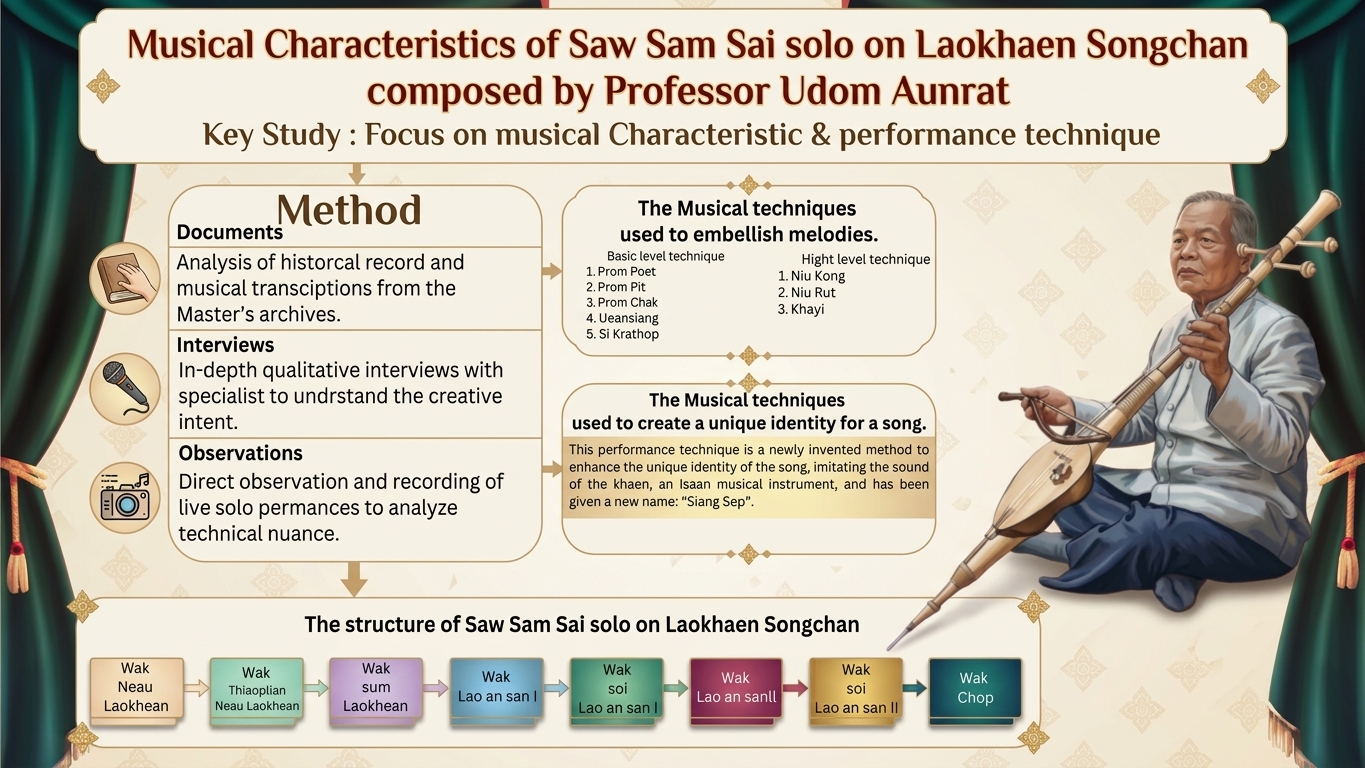
Methods: This study employs a qualitative research methodology based on musicological frameworks. The primary objective is to thoroughly investigate the structural musical characteristics and the specialized performance techniques required for the solo Saw Sam Sai performance of Laokhaen Songchan within the tradition of Professor Udom Arunrat. To achieve this, the researcher systematically gathered comprehensive data from diverse sources, including relevant academic literature, historical documents, textbook analyses, in-depth interviews with contemporary music masters and experts, direct participant observations during live demonstrations, and practical performance analysis. Furthermore, data triangulation and rigorous validation methods were implemented to ensure the accuracy, reliability, and integrity of the collected musicological information.
Results: The analytical study of the musical characteristics of the solo Saw Sam Sai in Laokhaen Songchan according to the path of Professor Udom Arunrat was successfully executed in accordance with the conceptual framework and research objectives. The empirical findings reveal that this specific solo path for the Saw Sam Sai in Laokhaen Songchan was meticulously adapted and refined from the traditional solo path of Laophaen Songchan. Professor Udom Arunrat deliberately selected the title Laokhaen Songchan for this composition. Structurally, the composition utilizes the specific classifier “Wak” to designate each musical phrase or section. The entire piece is composed of a total of 8 distinct Wak, arranged as follows: 1) Wak Nuea Laokhaen, 2) Wak Thiaoplian Nuea Laokhaen 3) Wak Sum Laokhaen, 4) Wak Lao An San I, 5) Wak Soi Lao An San I, 6) Wak Lao An San II, 7) Wak Soi Lao An San II and 8) Wak Chop. Regarding the modal structure, the analysis indicates that the primary scale or mode used is the F FGAXCDX scale, which acts as the principal structural tonality, while the B BCDXFGX scale functions as the secondary or auxiliary mode. In terms of performance techniques, the solo execution on the Saw Sam Sai exhibits two primary characteristics: 1) Performance techniques for melodic ornamentation, which refer to the foundational and advanced techniques used to embellish the basic melody of the Saw Sam Sai, including specialized fingering such as Phrom Poet, Phrom Pit, Phrom Chak, Uean Siang, Khayi, Si Krathop, Niu Rut, and Niu Kong; 2) Performance techniques for establishing unique identity, which specifically refers to “Siang Sep” (Sep sound). “Siang Sep” is an innovative, highly sophisticated performance technique created specifically for the Saw Sam Sai by artistically mimicking the acoustic characteristics, breath accents, and unique phrasing of the traditional northeastern reed mouth organ (Khaen). This distinctive “Siang Sep” technique functions as a signature stylistic ornament that enriches the identity of this musical path, and it has been developed into an advanced instructional exercise for the Saw Sam Sai, serving as a prerequisite study before students advance to other highly complex solo repertoires.
Conclusions: The study of musical characteristics Saw Sam Sai on Laokhaen Songchan by Professor Udom Arunrat demonstrates the development of solo performance styles from past to present, grounded in the lineage of knowledge transmitted through The Phraya Phumisewin (Jit Jittasevee) school. Furthermore, it illustrates the creation of performance techniques that enhance the unique identity of this particular solo style which is recognized as the sole Saw Sam Sai solo version with a Lao accent in the entire Saw Sam Sai solo repertoire.
References
Amatyakul, Poonpit. Thai Music on Gramophone Records. Bangkok: Hi-Fi Stereo, 1997. (in Thai)
Arunrat, Pongsilp. Melodious Sound of Saw Sam Sai. Bangkok: Upbeat Creations Company, 2014. (in Thai)
Arunrat, Pongsilp. Musical Characteristics Analysis. Nakhon Pathom: Silpakorn University Publishing, 2021. (in Thai)
Boonmasoongsong, Prachya, and Chanathip Kongon. “The Study of Ja-Khe Solo on Lao Khaen of Khru Suthan Buatang.” Journal of Music and Performing Arts, Khon Kaen University 5, no. 3 (September-December 2023): 67-90. https://so03.tci-thaijo.org/index.php/JournalofMUSPAKKU/article/view/272615. (in Thai)
Chaiseri, Phichit. Musical Analysis. Bangkok: Chulalongkorn University Press, 2016. (in Thai)
Chaiseri, Phichit. Thai Music Composition. Bangkok: Chulalongkorn University Press, 2013. (in Thai)
Cherdchoo, Waraporn. Siamese Musical Instruments in the Chronicles of French People during the Reign of King Narai the Great, 1576-1688. 2nd ed. Phitsanulok: Naresuan University Publishing House, 2023. (in Thai)
Chuto, Nisa. Qualitative Research. 2nd ed. Bangkok: P.N. Printing, 1997. (in Thai)
Deethum, Nalinnipa, and Jatuporn Seemuang. “The Study of Ja-Khe Solo on Lao Pan from the Gramophone Records.” Mahidol Music Journal 6, no. 1 (March-August 2023): 82-98. https://so04.tci-thaijo.org/index.php/mmj/article/view/263963.
Hin-on, Tharanat. Solo Saw Duang. Khon Kaen: Klangnana Vitthaya Press, 2018. (in Thai)
Kawphachone, Chanachai. “An Analytical Study of Solo Cha-khe on Lao-Pan Song.” Master’s Thesis, Srinakarinwirot University, 2004. (in Thai)
Phuphet, Wichai. “Laopan Analysis of Samarn Thongsuchot’s Ranad Tum Solo Style: A Case Study of Dr. Dussadee Meepom.” Academic Journal Phranakhon Rajabhat University 8, no. 1 (November-April 2017): 288-298. https://so01.tci-thaijo.org/index.php/AJPU/article/view/66744. (in Thai)
Preechajaroen, Somchai [Jit Phumisak]. Life and Art. 3rd ed. Nonthaburi: Sripanya, 2021. (in Thai)
Socatiyanurak, Natcha, Suphon Chanaphan, Kowit Keawsuwan, Sanannam Arunrattana, Pongsilp Arunrat, Pimalaporn Wongchinsri, Eakavit Srisumaung, Grit Puttagool, and Boondarika Kongphet. Memorial Book for the Royal Cremation Ceremony of Professor Udom Arunrat. Bangkok: n.p., 2006. (in Thai)
Tramote, Boontham. Thai Music Course Description. 2nd ed. Bangkok: Matichon, 1997. (in Thai)
Tramote, Montri. “Saw Sam Sai.” In Memorial Book for the Royal Cremation Ceremony of Phraya Phumisewin (Jit Jittasevee), 35-40. Bangkok: n.p., 1976. (in Thai)
Tramote, Montri, and Wichian Kulatan. Listening and Understanding to Thai Song. Bangkok: Thai Kasem, 1980. (in Thai)
Wisuttipat, Manop. Theory of Thai Music Analysis. Bangkok: Santisiri Kanphim, 2013. (in Thai)
Downloads
Published
How to Cite
Issue
Section
License
Copyright (c) 2026 College of Music

This work is licensed under a Creative Commons Attribution-NonCommercial-NoDerivatives 4.0 International License.
The copyright of the article belongs to the author. Published articles represent the views of the authors. The editorial team neither necessarily agree with nor take any responsibility for the article.