
Effects of Using an Online Competency-Based Learning Management System to Enhance High Vocational Certificate Students' Learning Achievement and Vocational Competence
Keywords:
online learning management, competency-based learning management system, vocational competence, learning achievementAbstract
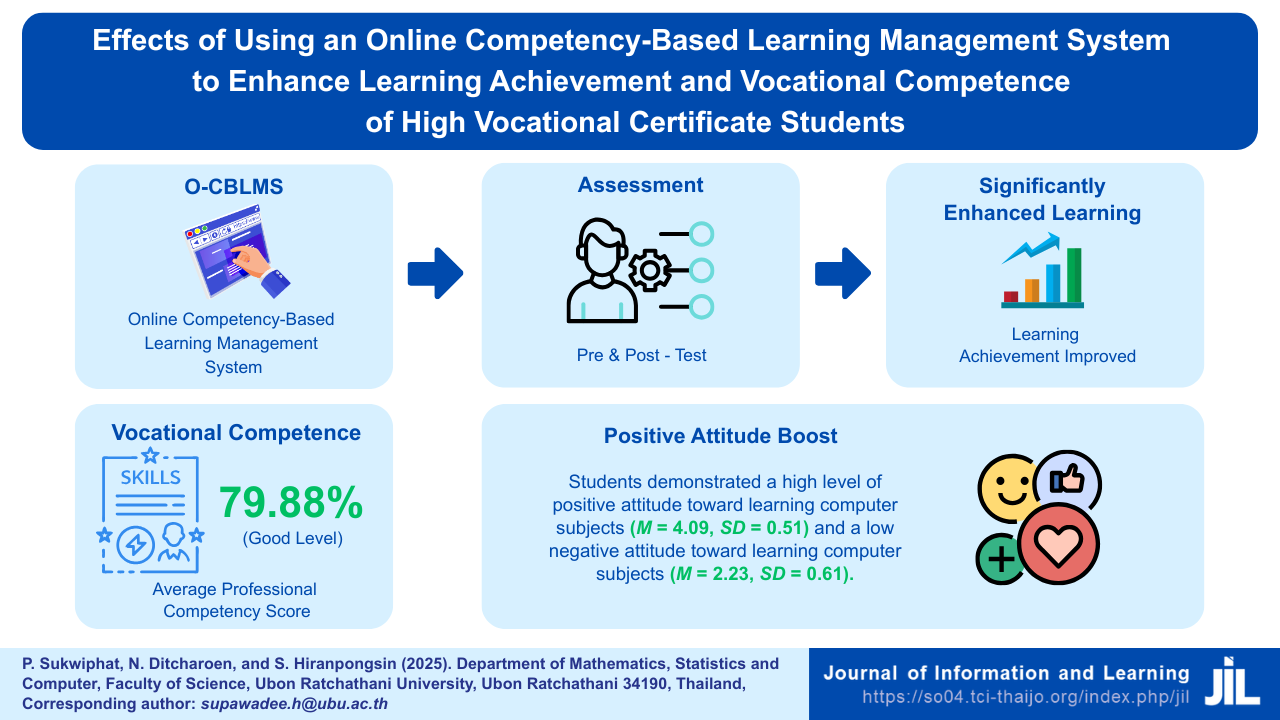
The objectives of this research are to study 1) the efficiency of an online competency-based learning management system, 2) students’ learning achievement and learning progress, 3) students' vocational competence, and 4) students’ attitudes toward computer studies. The research instruments included the online competency-based learning management system, learning management plans, learning achievement tests, competency assessment forms, and attitude assessment forms. The sample consisted of 25 higher vocational certificate students majoring in Computer and Digital Marketing, selected through purposive sampling. The research data were analyzed using mean, percentage, standard deviation, and dependent t-test. The results showed that the system met E1/E2 efficiency criteria at 80.00/80.60. Students’ post-learning achievement scores were significantly higher than pre-learning scores at the .01 level, with moderate learning gain. The average vocational competency assessment results were at a good level (79.88%). Students demonstrated positive attitudes toward computer studies at a high level (M = 4.09, SD = 0.51), while negative attitudes were at a low level (M = 2.23, SD = 0.61).
References
Bloom, B. S. (1976). Human characteristics and school learning. McGraw-Hill.
Brahmawong, C. (2013). Developmental testing of media and instructional package. Silpakorn Educational Research Journal, 5(1), 7–20. https://so05.tci-thaijo.org/index.php/suedureasearchjournal/article/view/28419
Chuchuoy, K., Srima, S., & Noichun, N. (2024). The development of a web-based lesson to enhance digital technology competency for pre-service teachers at Suan Sunandha Rajabhat University. SSU Academic Journal of Education, 8(2), 44–54. https://so04.tci-thaijo.org/index.php/ssru-edu/article/view/274725
Hake, R. R. (1998). Interactive-engagement versus traditional methods: A six-thousand-student survey of mechanics test data for introductory physics courses. American Journal of Physics, 66(1), 64–74. https://doi.org/10.1119/1.18809
Jitmit, J. (2019). The development of computer learning achievement on applied software program (Microsoft Excel) among primary 5 (Grade 5) students by using the direct instruction model [Master's thesis, Rajamangala University of Technology Thanyaburi]. Intellectual Repository at Rajamangala University of Technology Thanyaburi. http://www.repository.rmutt.ac.th/dspace/bitstream/123456789/3708/1/RMUTT-167615.pdf
Khambok, T., & Daungkamnoi, S. (2022). Development of learning achievement by using e-learning courses on the topic of the impact on using information technology on computer and information technology for careers subject for vocational certificate students. Journal of MCU Ubon Review, 7(2), 2337–2346. https://so06.tci-thaijo.org/index.php/mcjou/article/view/259842
Khamtub, P. (2019). The development of vocational competency-based learning management system. Journal of Education Studies, 47(3), 290–308. https://digital.car.chula.ac.th/educujournal/vol47/iss3/16
Khanthasiri, P., Bangthamai E., Autthawuttikul, S., & Mansukpol, W. (2023). The development for online learning community model based on the concept of collaborative learning for enhancing teaching technology skills by the competencies of professional teacher education students. Journal of Roi Kaensarn Academi, 8(8), 203–228. https://so02.tci-thaijo.org/index.php/JRKSA/article/view/262656
Khuntong, R. (2023). Development of students’ achievement and satisfaction towards online learning with the Google Classroom application using the T5 model. Journal of Information and Learning, 34(1), 111–119. https://so04.tci-thaijo.org/index.php/jil/article/view/258006
Klomim, K. (2021). The development of competency–based learning management by applying the King Rama IX's Philosophy based on the local identity to enhance competency of student teachers’ learning management. Journal of MCU Peace Studies, 9(6), 2554–2569. https://so03.tci-thaijo.org/index.php/journal-peace/article/view/250586
Kulthamyothin, A. (2020). Basic operating system. Academic Promotion Center.
Kumsuth, S. (2023). Competency-based curriculum to develop skills in the 21st century. Dhonburi Rajabhat University Journal, 17(2), 237–256. https://so02.tci-thaijo.org/index.php/journaldru/article/view/262305
Nuansri, M. (2021). The development of students’ achievement in educational research subject through blended learning management. Silpakorn Educational Research Journal, 13(1), 77–94. https://so05.tci-thaijo.org/index.php/suedureasearchjournal/article/view/246996
Office of the Vocational Education Commission. (2019, July 1). Lakkēn læ nǣo patibatkān čhatkān ʻāchīwasưksā radap prakāsanīyabat wichāchīp læ radap prakāsanīyabat wichā chīp chan sūng [Criteria and guidelines for vocational education management at the vocational certificate and higher vocational certificate levels]. https://bsq.vec.go.th/Portals/9/document/Course%20criteria/1.pdf
Pansantie, C. (2023). Online lesson development with Moodle LMS Computer and Information Technology Courses for students King Mongkut’s University of Technology North Bangkok Rayong Campus. Journal of Industrial Business Administration, 5(1), 59–71. https://so03.tci-thaijo.org/index.php/iba/article/view/269926
Pattanachian, A., & Akkaraboworn, S. (2021). The development of verification of educational achievement system:a case study of courses offered by faculty of management sciences, Prince of Songkla University. CUAST Journal, 10(1), 23–35. https://council-uast.com/journal/dl-file.php?id=113
Petchara, N., & Pheeraphan, N. (2022). The development of information system for evaluating lerners’ competencies following the basic education core curriculum. Journal of Buddhist Anthropology, 7(5), 125–140. https://so04.tci-thaijo.org/index.php/JSBA/article/view/258787
Phangphol, P., Phakamach, P., & Chaisakulkiet, U. (2022). The development of online teaching-learning platform on control of the operation of information system using flipped classroom approach combined with case-based learning for undergraduate students in the School of Information Technology. Sripatum Chonburi Academic Journal, 18(4), 100–114. https://so05.tci-thaijo.org/index.php/SPUCJ/article/view/259658
Polit, D. F., & Beck, C. T. (2006). The content validity index: Are you sure you know what's being reported? Critique and recommendations. Research in nursing & health, 29(5), 489–497. https://pubmed.ncbi.nlm.nih.gov/16977646
Pressman, R., & Maxim, B. (2014). Software engineering: A practitioner’s approach (8th ed.). McGraw-Hill.
Promla, P., & Sintanakul, K. (2021). The effect of learning management by competency-based learning blend with web-based teaching and problem-based learning according to MIAP process to develop computation thinking skill of vocational certificate student, information technology subject. KKU Research Journal (Graduate Studies) Humanities and Social Sciences, 9(2), 181–194. https://so04.tci-thaijo.org/index.php/gskkuhs/article/view/242750
Sanguanrat, S. & Parunggul, C. (2021). Curriculum and competency-based teaching in school. Journal of Sirindhornparithat, 22(2), 351–364. https://so06.tci-thaijo.org/index.php/jsrc/article/view/251951
Sawat, R., & Buosonte, R. (2022). Competency-based education: CBE. Journal of Liberal Art of Rajamangala University of Technology Suvarnabhumi, 4(1), 187–201. https://so03.tci-thaijo.org/index.php/art/article/view/254044
Sittisomboon, M. (2024). Proactive learning management strategy. Journal of Social Science and Cultural, 8(1), 164–172. https://so06.tci-thaijo.org/index.php/JSC/article/view/270159
Sukhum, C., & Vanichwatanavorachai, S. (2023). Competency-based learning design: concepts, instructional design and learning evaluation. Research and Development Journal Suan Sunandha Rajabhat University, 15(1), 65–78. https://so05.tci-thaijo.org/index.php/irdssru/article/view/261656
Thammasa, E., & Ditcharoen, N. (2021). Development of intelligent tutoring system based on adaptive testing for learning computer programming. Journal of Research Unit on Science, Technology and Environment for Learning, 12(2), 218–237. https://ejournals.swu.ac.th/index.php/JSTEL/article/view/13341
Thongtumluing, K. (2023). The development of blended learning model to enhance digital competency of the student in computer and information technology for Home Economics Profession Course. Journal of Roi Kaensarn Academi, 8(7), 416–435. https://so02.tci-thaijo.org/index.php/JRKSA/article/view/262099
Tiantong, M. (2005). Statistics and research methodology for Information Technology. King Mongkut’s University of Technology North Bangkok.
Udomphol, B., Pavaboot, S., & Pradupsri, M. (2022). The model of proactive competency-based learning management model along STEM education to enhance the learning management skills of pre-service teachers. Journal of Educational Review Faculty of Education in MCU, 9(1), 375–388. https://so02.tci-thaijo.org/index.php/EDMCU/article/view/255268
Whattananarong, K. (2010). Vocational competency. King Mongkut's University of Technology North Bangkok.
Worakam, P. (2021). Education research (13th ed.). Taksila Printing.
Downloads
Additional Files
Published
How to Cite
Issue
Section
Categories
License
Copyright (c) 2025 Journal of Information and Learning [JIL]

This work is licensed under a Creative Commons Attribution-NonCommercial-NoDerivatives 4.0 International License.
The Journal of Information and Learning is operated by the Office of Academic Resources, Prince of Songkla University. All articles published in the journal are protected by Thailand copyright law. This copyright covers the exclusive rights to share, reproduce and distribute the article, including in electronic forms, reprints, translations, photographic reproductions, or similar. Authors own copyrights in the works they have created as well as the Office of Academic Resources. The Journal reserves the right to edit the language of papers accepted for publication for clarity and correctness, as well as to make formal changes to ensure compliance with the journal's guidelines. All authors must take public responsibility for the content of their paper.


