
การประยุกต์ใช้ปัญญาประดิษฐ์ร่วมกับเทคโนโลยีโลว์โค้ดและโนโค้ดในการพัฒนากระบวนการเสนอตำแหน่งงานจากสถานประกอบการตามแนวทางสหกิจศึกษาและการศึกษาเชิงบูรณาการกับการทำงาน
คำสำคัญ:
สหกิจศึกษาและการศึกษาเชิงบูรณาการกับการทำงาน, ปัญญาประดิษฐ์, โลว์โค้ด, โนโค้ดบทคัดย่อ
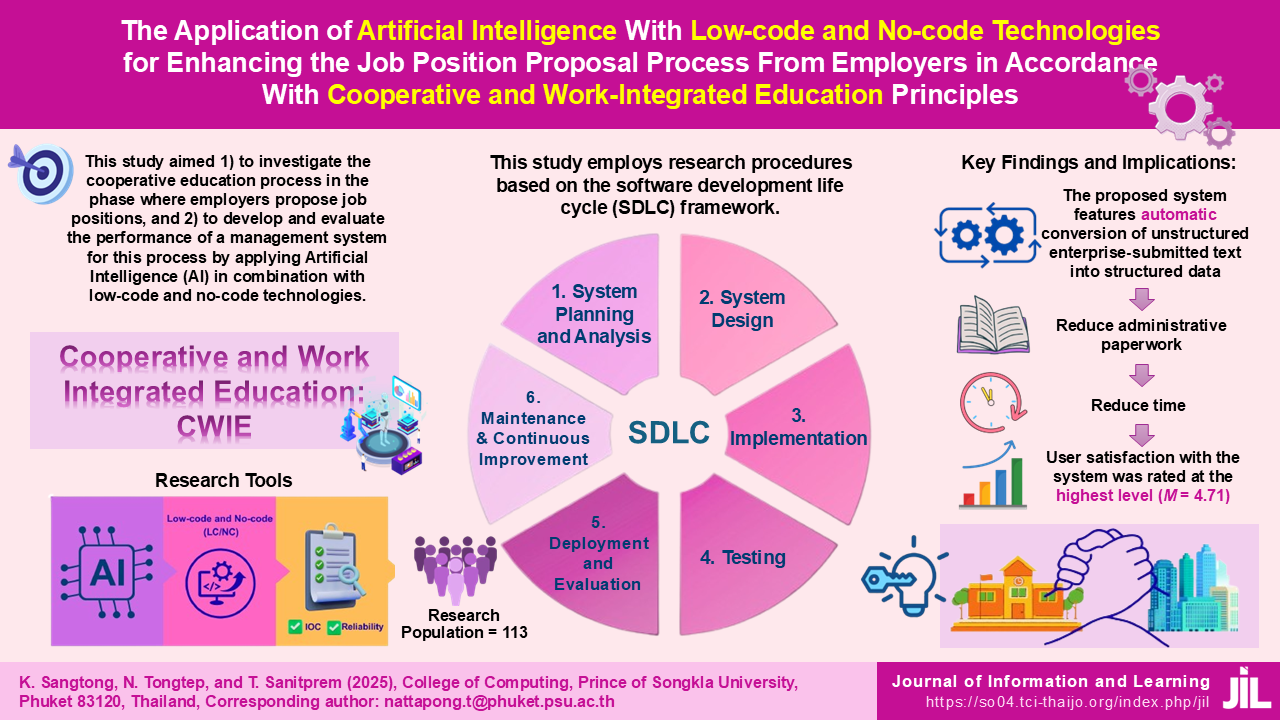
งานวิจัยนี้มีวัตถุประสงค์ 1) เพื่อศึกษากระบวนการสหกิจศึกษาในขั้นตอนการเสนอตำแหน่งงานจากสถานประกอบการ และ 2) เพื่อพัฒนาระบบบริหารจัดการกระบวนการสหกิจศึกษาในขั้นตอนการเสนอตำแหน่งงานจากสถานประกอบการ โดยใช้ปัญญาประดิษฐ์ ร่วมกับเทคโนโลยีโลว์โค้ดและโนโค้ด และประเมินประสิทธิภาพการใช้งานระบบ จากการศึกษา พบว่า กระบวนการแบบเดิม เจ้าหน้าที่ต้องใช้เวลานานในการจัดการเอกสารและข้อมูลด้วยตนเอง ส่งผลให้เกิดความล่าช้าและข้อผิดพลาดในการดำเนินงาน เพื่อแก้ไขปัญหาดังกล่าวจึงได้พัฒนาระบบบริหารจัดการกระบวนการสหกิจศึกษาโดยประยุกต์ใช้ปัญญาประดิษฐ์ร่วมกับเทคโนโลยีโลว์โค้ดและโนโค้ด เพื่ออำนวยความสะดวกในการเสนอและจัดการตำแหน่งงานจากสถานประกอบการ ระบบที่พัฒนาขึ้นมีคุณสมบัติในการแปลงข้อความจากสถานประกอบการให้เป็นข้อมูลโครงสร้างอย่างอัตโนมัติ ช่วยลดภาระงานด้านเอกสารของเจ้าหน้าที่และเพิ่มความรวดเร็วในการดำเนินงาน ผลการประเมินพบว่า ระบบสามารถลดระยะเวลาการจัดการข้อมูลจากเดิมที่ใช้ประมาณ 15 นาทีต่อหนึ่งตำแหน่งงานเหลือเพียงการใช้ระบบอัตโนมัติโดยไม่ต้องใช้เวลาจากเจ้าหน้าที่ และผู้ใช้งานมีความพึงพอใจต่อระบบในระดับมากที่สุด (M = 4.71) สะท้อนให้เห็นถึงประสิทธิภาพของระบบในการเพิ่มความสะดวก รวดเร็ว และส่งเสริมการมีส่วนร่วมระหว่างสถานประกอบการกับสถาบันอุดมศึกษา
เอกสารอ้างอิง
Alenezi, A. (2020). The relationship of students’ emotional intelligence and the level of their readiness for online education: A contextual study on the example of university training in Saudi Arabia. The Education and Science Journal, 22(4), 89–109. https://doi.org/10.17853/1994-5639-2020-4-89-109
Chankham, N., & Kulnattarawong, T. (2025). Development of intelligent educational guidance platform with AI chatbot to promote public relations for educational technology and communication curriculum. Journal of Humanities and Social Sciences Nakhon Phanom University, 15(1), 214–228. https://so03.tci-thaijo.org/index.php/npuj/article/view/282620
Chanpuypetch, W., Puataweepong, P. & Supeekit, T. (2022). Application of lean manufacturing system to improve production process: A case study of a steel pipe manufacturing company. KMUTT Research & Development Journal, 45(4), 435–454. https://doi.org/10.14456/kmuttrd.2022.25
Coll, K. R., & Zegwaard, E. K. (2006). Perceptions of desirable graduate competencies for science and technology new graduates. Research in Science and Technological Education, 24(1), 29–58. https://doi.org/10.1080/02635140500485340
Depa. (2025). Tech series: Artificial intelligence (AI). Depa. https://www.depa.or.th/th/article-view/tech-series-artificial-intelligence-ai
Dewnarain, S., Ramkissoon, H., & Mavondo, F. (2021). Social customer relationship management: A customer perspective. Journal of Hospitality Marketing & Management, 30(6), 673–698. https://doi.org/10.1080/19368623.2021.1884162
Hyrmet, M., & Arbana, K. (2020, September 10-12). Using internship management system to improve the relationship between internship seekers, employers and educational institutions. Proceedings of the ENTRENOVA-ENTerprise REsearch InNOVAtion Conference, Virtual Conference, IRENET-Society for Advancing Innovation and Research in Economy, Zagreb, Croatia, 97–104. https://www.econstor.eu/bitstream/10419/224679/1/10-ENT-2020-Mydyti-97-104.pdf
Ketusiri, A., Ketusiri, N., Senket, S., & Rianru, W. (2025). The artificial intelligence (AI) for teaching and learning management in the 21st century. Journal of Research Innovation for Society, 1(1), 44–51. https://so13.tci-thaijo.org/index.php/JRI/article/view/1735
Khatbanjong, S., & Mawan, V. (2021). Artificial intelligence (AI) technology and the categorization of fifth grade students’ academic achievements using K-means clustering learning algorithm. Journal of Education Studies, 49(2), 1–11. https://so02.tci-thaijo.org/index.php/EDUCU/article/view/249916
Khienchanaj, T. (2021). Technology adoption that affects satisfaction of students in the online distance education system at private university. Journal of MCU Nakhondhat, 8(8), 311–324. https://so03.tci-thaijo.org/index.php/JMND/article/view/254307
Kosolvadee, T. (2025). Kān plīanplǣng nai lōk kānphatthanā ʻǣ pō̜ phali khō̜chan phān low-code no-code development platform [The transformation in application development through low-code and no-code development platforms]. Depa. https://www.depa.or.th/th/article-view/low-code-no-code-development-platform
Ministry of Higher Education, Science, Research and Innovation. (2025, January 18). Cooperative and work integrated education. https://www.mhesi.go.th/index.php/flagship-project/6820-CWIE.html
Ngamsong, S., Lerk-u-suke, S., & Wongyai, S. (2021). Building of mobile application with no-code development for field data collection in tax administration of local administrative organization. Journal of Spatial Innovation Development, 2(3), 55–69. https://ph01.tci-thaijo.org/index.php/jsid/article/view/246312
Nitidecha, T. (2022). Application of lean concept to enhance academic support work in educational institutions, case study, Faculty of Logistics Burapha University. Burapha University Research Information. https://buuir.buu.ac.th/handle/1234567890/4752
Panthong, R., Tasaengwong, A., & Wongyai, W. (2022). Development of online internship management information systems: A case study in School of Information and Communication Technology, University of Phayao. The Journal of Spatial Innovation Development, 3(1), 53–66. https://ph01.tci-thaijo.org/index.php/jsid/article/view/248010
Parimi, S. (2025). Impact of low-code/no-code platforms. International Journal of Advanced Research in Science Communication and Technology. https://doi.org/10.13140/RG.2.2.34792.79366
Phongsajiraangkul, N., & Rangkoon, A. (2021). Approaches to increasing the efficiency of personnel working in the new normal era: A case study of Maintenance Division, Operation and Maintenance Department Provincial Electricity Authority Area 1 (Northeastern). Journal of Modern Learning Development, 7(1), 301–312. https://so06.tci-thaijo.org/index.php/jomld/article/view/251742
Pislae-ngam, K., & Inmor, S. (2023). Technology acceptance of chatbot artificial intelligence program to use financial service of the elderly age in Pathumtani Province. Journal of Industrial Business Administration, 5(2), 16–31. https://so03.tci-thaijo.org/index.php/iba/article/view/270517
Prince of Songkla University. (2019). Nǣo patibatkān čhatkān rīan kānsō̜n rāiwichā saha kit sưksā [Guidelines for teaching and learning management in cooperative education courses]. https://www.psu.ac.th/trang/wp-content/uploads/2562_Co-op.pdf
Prince of Songkla University, Phuket Campus. (2024). EdPEx of Prince of Songkla University, Phuket Campus. wixsite. https://info261518.wixsite.com/edpex/copy-of-forwritter
PTT Digital Connect. (2024). Rūčhak low code læ no code platform phǣ lotfō̜m phatthanā ʻǣ phali khō̜chan tō̜p čhōt thurakit yuk mai [Understanding low-code and no-code platforms: Application development solutions for modern businesses]. https://www.pttdigitalconnect.com/article/ptt-digital-low-code-no-code
Rodjan, M., Palwisut, P., Junkorn, A., & Wichaidit, S. (2023). Development of internship management platform for cooperative between educational institutions and establishment using responsive website. Maejo Information Technology and Innovation Journal, 10(2), 73–91. https://doi.org/10.14456/mitij.2024.13
Rowe, D. A., & Zegwaard. E. K. (2017). Developing graduate employability skills and attributes: Curriculum enhancement through work-integrated learning. Asia-Pacific Journal of Cooperative Education, 18(2), 87–99. https://www.ijwil.org/files/APJCE_18_2_87_99.pdf
Siritharo, P. (2024). The use of AI technology in adaptive learning. Chintasit Academic Journal, 2(3), 208–218. https://so19.tci-thaijo.org/index.php/Chintasit/article/view/946
Srisa-an, W. (2021a). Čhāk saha kit sưksā sū saha kit sưksā læ kānsưksā chœ̄ng būn nā kān kap kānthamngān [From cooperative education to cooperative and work integrated education: CWIE]. The Center for Cooperative Education and Career Development, Suranaree University of Technology. https://coop.sut.ac.th/CWIE/CWIE.pdf
Srisa-an, W. (2021b). Laksūt kānsưksā ʻoprom samrap phūbō̜rihān khanāčhān nithēt phū nithēt læ phū patibat ngān dān saha kit sưksā læ kānsưksā chœ̄ng būn nā kān kap kānthamngān [Curriculum training education for executive supervisor and worker for cooperative and work integrated education: CWIE ]. Thai Association for Cooperative Education. https://cwie.mhesi.go.th/readFile/trainingCwie_pMjk1TSCos1Tx28RHUcmVlnMeDCNI7DrybQaAeO7.pdf
Tantuen, J., & Santhuenkaew, T. (2023). Using artificial intelligence technology to develop students reading skills. Journal of Applied Education, 1(4), 23–28. https://so16.tci-thaijo.org/index.php/JAE/article/view/744
Tupsup, S., Shawarangkoon, S., Gerdpanya, P., & Kankaew, S. (2024). Development of online management system on professional experience course to support the situation of COVID-19 virus epidemic. Journal of science and technology RMUTSB, 8(3), 91–106. https://ph03.tci-thaijo.org/index.php/JSciTech/article/view/2958
Udompan, W., Neankratok, S., Prachai, S., & Pueannguyum, K. (2025). Development information system for reporting the employment status of students in cooperative and work integrated education Nakhonratchasima Rajabhat University. Journal of Technology Management Rajabhat Maha Sarakham University, 12(1), 92–105. https://ph02.tci-thaijo.org/index.php/itm-journal/article/view/257100
Varachai, T. (2025). Kānphatthanā ʻǣpphlikhēchan bǣp low code/no code [Low code/no code application development]. Facullty of Engineering, Prince of Songkla University. https://ecs.eng.psu.ac.th/blog-story/52-low-no-code
Wongrattana, C. (2018). Theknik kānchai sathiti phư̄a kānwičhai [Techniques for using statistics for research]. Chulalongkorn University.
ดาวน์โหลด
ไฟล์ประกอบ
เผยแพร่แล้ว
รูปแบบการอ้างอิง
ฉบับ
ประเภทบทความ
หมวดหมู่
สัญญาอนุญาต
ลิขสิทธิ์ (c) 2025 Journal of Information and Learning [JIL]

อนุญาตภายใต้เงื่อนไข Creative Commons Attribution-NonCommercial-NoDerivatives 4.0 International License.
เข้าถึงบทความได้โดยไม่เสียค่าใช้จ่าย นโยบายสัญญาอนุญาตปัจจุบัน CC BY-NC 4.0 ตั้งแต่ปีที่ 37 ฉบับที่ 2 (2569) สำหรับบทความก่อนหน้านี้ โปรดตรวจเงื่อนไขสิทธิบนหน้าบทความแต่ละเรื่อง ดูนโยบายการเข้าถึงแบบเปิดและสัญญาอนุญาต


