
การผลิตสื่อการ์ตูนแอนิเมชัน Stop Cyberbullying: หยุดการกลั่นแกล้งบนโลกไซเบอร์สำหรับนักเรียนในระดับประถมศึกษา
Article Sidebar
Main Article Content
บทคัดย่อ
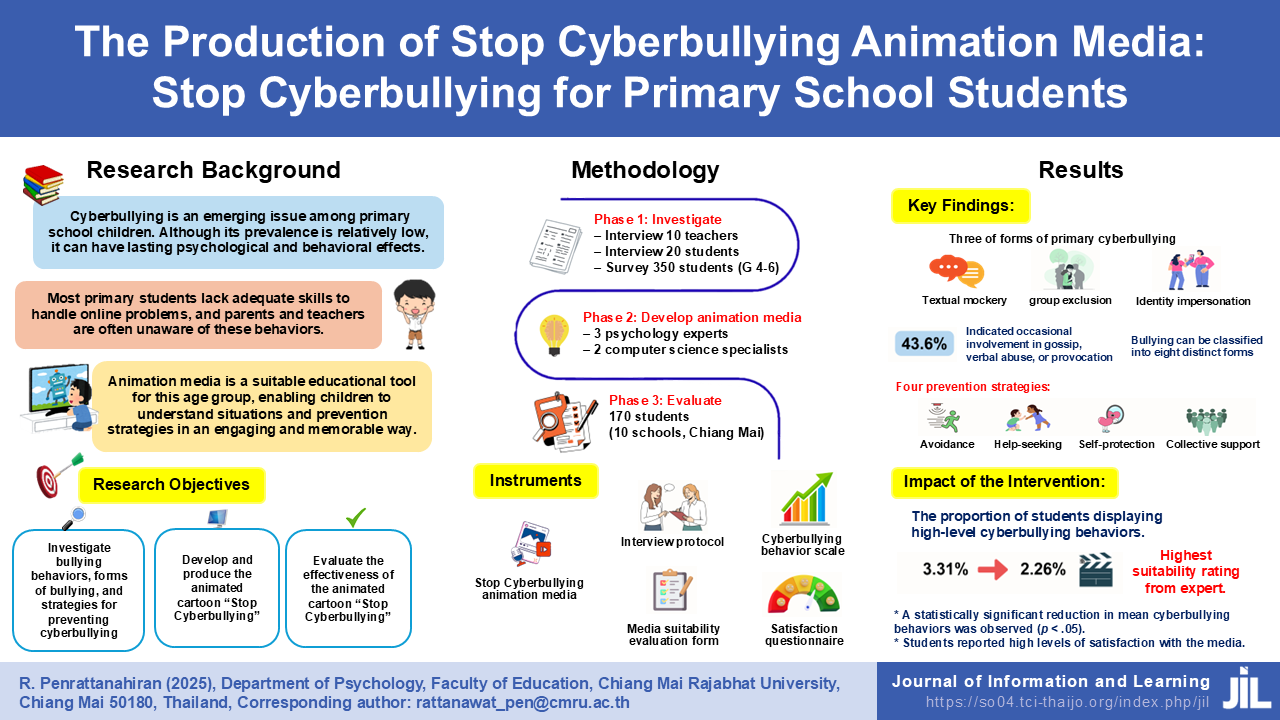
การวิจัยในครั้งนี้ดำเนินการวิจัย 3 ระยะ ได้แก่ 1) ศึกษาข้อมูลเกี่ยวกับการกลั่นแกล้งบนโลกไซเบอร์ โดย สัมภาษณ์ครู 10 คน นักเรียน 20 คน และสำรวจนักเรียนประถมศึกษาปีที่ 4-6 จำนวน 350 คน 2) พัฒนาสื่อโดยผู้เชี่ยวชาญด้านจิตวิทยา 3 คน และด้านคอมพิวเตอร์ 2 คน 3) ทดลองใช้สื่อกับนักเรียน 170 คน จาก 10 โรงเรียนในจังหวัดเชียงใหม่ เครื่องมือการวิจัย ประกอบด้วย 1) แบบสัมภาษณ์รูปแบบและกลยุทธ์การป้องกันการกลั่นแกล้งบนโลกไซเบอร์ 2) แบบวัดพฤติกรรมการกลั่นแกล้งบนโลกไซเบอร์ 3) สื่อการ์ตูนแอนิเมชัน Stop Cyberbullying 4) แบบประเมินความเหมาะสมของสื่อ และ 5) แบบสอบถามความพึงพอใจ วิเคราะห์ข้อมูลด้วยค่าร้อยละ ค่าเฉลี่ย ส่วนเบี่ยงเบนมาตรฐาน การวิเคราะห์เนื้อหา และการเปรียบเทียบผลก่อน-หลังการทดลอง ผลการวิจัยพบว่า 1) พฤติกรรมการกลั่นแกล้งทางไซเบอร์มี 3 รูปแบบหลัก ได้แก่ การล้อเลียนผ่านข้อความ การกีดกันออกจากกลุ่ม และการแอบอ้างตัวตน โดยนักเรียนส่วนใหญ่ไม่เคยมีพฤติกรรมดังกล่าว แต่มีพฤติกรรมนินทา ด่าทอ ยั่วยุนาน ๆ ครั้ง ร้อยละ 43.6 รูปแบบการกลั่นแกล้ง จำแนกได้ 8 รูปแบบและกลยุทธ์การป้องกันมี 4 วิธี คือ การหลีกเลี่ยง การขอความช่วยเหลือ การป้องกันตนเอง และการรวมกลุ่มช่วยเหลือกัน 2) สื่อการ์ตูนแอนิเมชันที่พัฒนาขึ้นได้รับการประเมินความเหมาะสมในระดับมากที่สุด 3) หลังใช้สื่อการ์ตูนแอนิเมชัน นักเรียนมีพฤติกรรมการกลั่นแกล้งระดับสูงลดลงจากร้อยละ 3.31 เหลือร้อยละ 2.26 และค่าเฉลี่ยพฤติกรรมลดลงอย่างมีนัยสำคัญทางสถิติที่ระดับ .05 และนักเรียนมีความพึงพอใจต่อสื่ออยู่ในระดับสูง
Article Details

อนุญาตภายใต้เงื่อนไข Creative Commons Attribution-NonCommercial-NoDerivatives 4.0 International License.
Journal of Information and Learning ดำเนินการโดยสำนักวิทยบริการ มหาวิทยาลัยสงขลานครินทร์ วิทยาเขตปัตตานี บทความที่ได้รับการตีพิมพ์ในวารสารได้รับความคุ้มครองตามกฎหมายลิขสิทธิ์ โดยเจ้าของลิขสิทธิ์จะมีสิทธิในการทำซ้ำ ดัดแปลง และเผยแพร่งานบทความ ทั้งรูปแบบอิเล็กทรอนิกส์ การทำฉบับสำเนา การแปล และการผลิตซ้ำในรูปแบบต่างๆ ลิขสิทธิ์บทความเป็นของผู้เขียนและสำนักวิทยบริการ มหาวิทยาลัยสงขลานครินทร์ วิทยาเขตปัตตานี วารสารฯ ขอสงวนสิทธิ์ในการพิจารณาตีพิมพ์ตามความเหมาะสม รวมทั้งการตรวจทานแก้ไข การปรับข้อความ หรือขัดเกลาภาษาให้ถูกต้องตามเกณฑ์ที่กำหนด สำหรับผลการวิจัยและความคิดเห็นที่ปรากฏในบทความถือเป็นความคิดเห็นและอยู่ในความรับผิดชอบของผู้เขียน
เอกสารอ้างอิง
Arif, A., Qadir, M. A., Martins, R. S., & Ahmed Khuwaja, H. M. (2024). The impact of cyberbullying on mental health outcomes amongst university students: A systematic review. PLOS Mental Health, 1(6), Article e0000166. https://doi.org/10.1371/journal.pmen.0000166
Bandura, A. (1977). Social learning theory. Englewood Cliffs.
Bland, T., Guo, M., & Dousay, T. A. (2024). Multimedia design for learner interest and achievement: A visual guide to pharmacology. BMC Medical Education, 24(1), Article 113. https://doi.org/10.1186/s12909-024-05077-y
Chainwong, P., Skulphan, S., & Thapinta, D. (2020). Being cyberbullied and suicide risk among youths. The Journal of Psychiatric Nursing and Mental Health, 34(3), 133–151. https://he02.tci-thaijo.org/index.php/JPNMH/article/view/241401
Chicote-Beato, M., González-Víllora, S., Bodoque-Osma, A., & Olivas, R. (2024). Cyberbullying intervention and prevention programmes in Primary Education (6 to 12 years): A systematic review. Aggression and Violent Behavior, 77, Article 101938. https://doi.org/10.1016/j.avb.2024.101938
Child and Youth Media Institute. (2018). Cyberbullying. Natchawat.
Chureemas, R., & Poksupphiboon, A. (2024). Using animation media to enhance digital citizenship education: Developing and validating educational content for Bangkok students. Proceedings of the 5th Kyoto Conference on Arts Media & Culture, 35–40. https://doi.org/10.22492/issn.2436-0503.2024.4
Désiron, J., & Schneider, S. (2024). Exploring the interplay of information relevance and colorfulness in multimedia learning. Frontiers in Psychology, 15, Article 1393113. https://doi.org/10.3389/fpsyg.2024.1393113
Doane, A. N., Kelley, M. L., & Pearson, M. R. (2016). Reducing cyberbullying: A theory of reasoned action based video prevention program for college students. Aggressive Behavior, 42(2), 136–146. https://doi.org/10.1002/ab.21610
Fonseca, J., & Borges-Tiago, T. (2024). Digital literacy education and cyberbullying combat: Scope and perspectives. In: A. Kavoura, T. Borges-Tiago, & F. Tiago (Eds), Strategic innovative marketing and tourism. ICSIMAT 2023. Springer Proceedings in Business and Economics. Springer. https://doi.org/10.1007/978-3-031-51038-0_18
Ginting, R. M., & Sahlepi, M. A. (2024). The impact of cyberbullying on adolescents on social media. International Journal of Sociology and Law, 1(2), 95–105. https://doi.org/10.62951/ijsl.v1i2.53
Hinduja, S., & Patchin, J. W. (2014). Bullying beyond the schoolyard: Preventing and responding to cyberbullying. Corwin press.
Hinduja, S., & Patchin, J. W. (2018). Cyberbullying: An update and synthesis of the research. In Handbook of bullying in schools: An international perspective (pp. 249-260). Routledge.
Inthanon, S. (2018). Cyberbullying. Child and Youth Media Institute.
Kohlberg, L. (1984). The philosophy of moral development: Moral stages and the idea of justice. Harper & Row.
Kreslavskaya, T. A. (2024). Psychological and pedagogical potential of animation in the education of primary school students: Analysis of modern approaches. Primary Education, 12(4), 26–31. https://doi.org/10.12737/1998-0728-2024-12-4-26-31
Kumari, K., & Yadav, R. K. (2024). The impact of cyberbullying on adolescents: Defining characteristics, consequences, and prevention strategies. International Journal For Multidisciplinary Research, 6(1), Article IJFMR240113915. https://doi.org/10.36948/ijfmr.2024.v06i01.13915
Kyshtymova, I., & Skorova, L. V. (2021). Psychological media competence: Basic content and structure. Integrative Psychological and Behavioral Science, 58, 771–785. https://doi.org/10.1007/s12124-021-09611-1
Lareki, A., Altuna, J., & Martínez-de-Morentin, J. I. (2023). Fake digital identity and cyberbullying. Media, Culture & Society, 45(2), 338–353. https://doi.org/10.1177/01634437221126081
Lertratthamrongkul, W. (2021). Cyberbullying among secondary school students: Prevalence, problem solving and risk behaviors. NEUARJ NEU Academic and Research Journal, 11(1), 275–289. https://so04.tci-thaijo.org/index.php/neuarj/article/view/249043
Li, C. (2024). A study of the application of educational psychology to educational practice. Communications in Humanities Research, 46, 7–11. https://doi.org/10.54254/2753-7064/46/20242271
Livazović, G., & Ham, E. (2019). Cyberbullying and emotional distress in adolescents: The importance of family, peers and school. Heliyon, 5(6), Article e01992. https://doi.org/10.1016/j.heliyon.2019.e01992
Lukács J, Á., Takács, J., Soósné Kiss, Z., Kapitány-Fövény, M., Falus, A., & Feith, H. J. (2023). The effects of a cyberbullying intervention programme among primary school students. Child & Youth Care Forum, 52, 893–911. https://doi.org/10.1007/s10566-022-09714-9
Mameli, C., Menabò, L., Brighi, A., Menin, D., Culbert, C., Hamilton, J., Scheithauer, H., Smith, P., Völlink, T., Willems, R., Purdy, N., & Guarini, A. (2022). Stay safe and strong: Characteristics, roles and emotions of student-produced comics related to cyberbullying. International Journal of Environmental Research and Public Health, 19(14), Article 8776. https://doi.org/10.3390/ijerph19148776
Martzoukou, K. (2022). “Maddie is online”: An educational video cartoon series on digital literacy and resilience for children. Journal of Research in Innovative Teaching & Learning, 15(1), 64–82. https://doi.org/10.1108/jrit-06-2020-0031
Mashlahah, A. U., Febriyana, N. H., & Najiha, N. (2024). Leveraging the animated video Ibra Berkisah to prevent bullying in early childhood. ThufuLA: Jurnal Inovasi Pendidikan Guru Raudhatul Athfal, 12(2), 329–344. https://doi.org/10.21043/thufula.v12i2.28939
Oktaviana, D. L., Rusnilawati. (2022). Role playing with digital comics in preventing bullying and cyberbullying behavior in elementary school. Jurnal Ilmiah Sekolah Dasar, 6(4), 603–609. https://doi.org/10.23887/jisd.v6i4.53685
Penrattanahiran R. (2021). Psychology for teachers. Chiang Mai Rajabhat University.
Saba, P., Qi, H., Saleem, A., Chen, I. J., Kausar, F. N., & Iqbal, M. F. (2023). Effects of animated movies on the aggression and behavior performance of primary school students and their control using a cognitive behavioral anger-control training (CBACT) program. Behavioral Sciences, 13(8), Article 659. https://doi.org/10.3390/bs13080659
Saracho, O. (2021). Theories of child development and their impact on early childhood education and care. Early Childhood Education Journal, 51, 15–30. https://doi.org/10.1007/s10643-021-01271-5
Slonje, R., & Smith, P. (2008). Cyberbullying: Another main type of bullying? Scandinavian Journal of Psychology, 49(2), 147–54. https://doi.org/10.1111/j.1467-9450.2007.00611.x
Smith, P., Mahdavi, J., Carvalho, M., Fisher, S., Russell, S., & Tippett, N. (2008). Cyberbullying: Its nature and impact in secondary school pupils. Journal of Child Psychology and Psychiatry, and Allied Disciplines, 49(4), 376–85. https://doi.org/10.1111/j.1469-7610.2007.01846.x
Thai Health Official. (2020, January 10). Phrưttikam būn lī dek Thai tit ʻandap 2 khō̜ng lōk [Thai children's bullying behavior ranks 2nd in the world]. https://www.thaihealth.or.th/?p=221002
Zamzami, M. R. A., & Zamzami, M. A. (2023). Designing teaching activity: Employing cartoon videos to improveyoung learners’ vocabulary. Pioneer: Journal of Language and Literature, 15(1), 102–118. https://doi.org/10.36841/pioneer.v15i1.2849
Zhang, W., Huang, S., Lam, L., Evans, R., & Zhu, C. (2022). Cyberbullying definitions and measurements in children and adolescents: Summarizing 20 years of global efforts. Frontiers in Public Health, 10, Article 1000504. https://doi.org/10.3389/fpubh.2022.1000504
Zhu, C., Huang, S., Evans, R., & Zhang, W. (2021). Cyberbullying among adolescents and children: A comprehensive review of the global situation, risk factors, and preventive measures. Frontiers in Public Health, 9, Article 634909. https://doi.org/10.3389/fpubh.2021.634909
