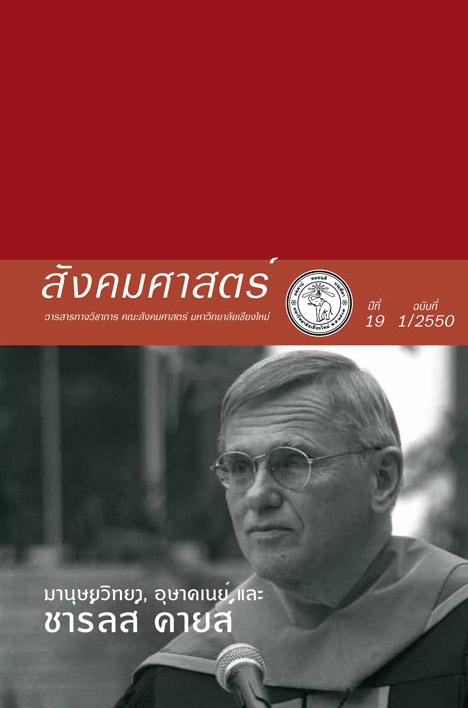
ชาร์ลส์ เอฟ คายส์ กับทิศทางใหม่ในไทศึกษา
Article Sidebar
Main Article Content
บทคัดย่อ
บทความนี้พยายามสำรวจทบทวนงานเขียนชิ้นสำคัญๆ ของ ชาร์ลส์ เอฟ คายส์ นักมานุษยวิทยาอเมริกัน ผู้วางรากฐานอย่างสำคัญต่อทิศทางและการศึกษาด้านมานุษยวิทยาวัฒนธรรมในเอเชียตะวันออกเฉียงใต้ ตลอดจนคุณูปการต่างๆ ที่งานศึกษาของนักมานุษยวิทยาท่านนี้มีต่อการศึกษาวัฒนธรรมของชนชาติไท หรือ ไทศึกษา เมื่อ “อ่าน” คายส์ ในฐานะที่เป็นนักมานุษยวิทยาแนวเวเบอร์เรี่ยน จะเห็นว่างานศึกษาด้านนี้ของ คายส์ ต่างล้วนมุ่งเน้นให้ความสำคัญต่อ ประเด็นปัญหาต่างๆ ที่เกี่ยวข้องพัวพันกับ “ชะตากรรม” ของชนชาติไทภายใต้บริบทประวัติศาสตร์ความสัมพันธ์เชิงอำนาจ การเปลี่ยนแปลงเข้าสู่สภาวะสมัยใหม่ และการก่อตัวขึ้นมาของรัฐชาติในภูมิภาคเอเชียตะวันออกเฉียงใต้ ความสนใจในประเด็นปัญหาดังกล่าวนี้เองที่ต่อมาโน้มนำให้ คายส์ หันเหความสนใจมาสู่การวิเคราะห์ศึกษา การเมืองของความเป็นชาติพันธุ์ อย่างไรก็ตาม การวิเคราะห์ การเมืองของความเป็นชาติพันธุ์ ดังกล่าวของคายส์ กลับมีแนวโน้ม หรือ “เลือก” ที่จะศึกษาทำความเข้าใจปรากฏการณ์ดังกล่าวเหล่านั้นในเชิงสถาบัน ผ่านปฏิบัติการทางอำนาจต่างๆ ของรัฐชาติ กระทั่งมองข้ามหรือละเล ปรากฏการณ์และประเด็นปัญหาต่างๆ ที่เกิดขึ้นในระดับชีวิตประจำวัน บทความนี้เสนอว่าหาก “สานต่อ” แนวการศึกษาการเมืองของความเป็นชาติพันธุ์ของ คายส์ ด้วยการเน้นให้ความสำคัญต่อการวิเคราะห์กระบวนการทางอำนาจเหล่านั้นผ่านปฏิบัติการต่างๆ หรือ การเมืองอัตลักษณ์ ของผู้คนธรรมดาสามัญในระดับชีวิตประจำวัน การ “สานต่อ” ทางวิชาการดังกล่าวนอกจากจะชี้ให้เห็นถึงคุณูปการ (และข้อจำกัด) จากงานศึกษาของ คายส์ ยังถือเป็นการนำเสนอ “ทางเลือก” สำคัญต่องานศึกษาทางด้านมานุษยวิทยาวัฒนธรรมในเขตลุ่มน้ำโขงตอนบน ตลอดจนแวดวงไทศึกษา ในบริบทใหม่ของการพัฒนาระดับภูมิภาค และการเคลื่อนย้ายถ่ายโอนของทุน ผู้คน สินค้า ข่าวสาร และวัฒนธรรมข้ามพรมแดนรัฐชาติยุคโลกาภิวัตน์
Article Details
ข้อเขียนทั้งหมดทีปรากฏในวารสารสังคมศาสตร์ เป็นความคิดเห็นของผู้เขียนโดยเฉพาะ มิใช่ทัศนคติของคณะสังคมศาสตร์ มหาวิทยาลัยเชียงใหม่ หรือกองบรรณาธิการวารสารสังคมศาสตร์
เอกสารอ้างอิง
ยศ สันตสมบัติ (2543) หลักช้าง: การสร้างใหม่ของอัตลักษณ์ไทในใต้คงกรุงเทพฯ: โครงการวิถีทรรศน์.
ยุกติ มุกดาวิตร (2549) “ปลดสายเดี่ยว ภูมิ (ประวัติ) ศาสตร์ชาติพันธ์ุในลุ่มน้ำโขง: ผ่านกรอบประวัติศาสตร์ชาติพันธ์ุนิพนธ์แบบพาดข้าม” ลุ่มน้ำโขง: วิกฤติ การพัฒนา และทางออก, ชาญวิทย์ เกษตรศิริ และ กัมปนาท
ภักดีกุล (บรรณาธิการ) กรุงเทพฯ: มูลนิธิโตโยต้าประเทศไทย; มูลนิธิโครงการตำาราสังคมศาสตร์และมนุษยศาสตร์: 190-208.
วสันต์ ปัญญาแก้ว (2550) เสียงไตลื้อ-สิบสองปันนา, เชียงใหม่: ภาควิชาสังคมวิทยาและมานุษยวิทยา คณะสังคมศาสตร์ มหาวิทยาลัยเชียงใหม่.
สุเทพ สุนทรเภสัช (2511) สังคมวิทยาของหมู่บ้านภาคตะวันออกเฉียงเหนือ(ผู้แปลและบรรณาธิการ) กรุงเทพฯ: แผนกวิชาสังคม คณะรัฐศาสตร์จุฬาลงกรณ์มหาวิทยาลัย.
สิงฆะ วรรณสัย (2518) พุทธตำนานพระเจ้าเลียบโลก (ปริวรรตจากคัมภีร์ใบลาน)เอกสารอัดสำเนา.
แสวง มาละแซม (2540) คนยองย้ายแผ่นดิน, กรุงเทพฯ: สำนักพิมพ์มหาวิทยาลัยธรรมศาสตร์.
Cohen, Paul T. (2000a) “A Buddha Kingdom in the Golden Triangle: Buddhist Revivalism and the Charismatic Monk Kruba Bunchum”, The Australian Journal of Anthropology, 2000, Vol. 11 No. 2, 141-154.
______ (2000b) “Lue across Borders: Pilgrimage and the Muang Sing Reliquary in Northern Laos”, in Where China meets Southeast Asia, edited by Grant Evans, Christopher Hutton, and Kuah Khun Eng, Singapore: Institute of Southeast Asian Studies: 145-161.
______ (2001) “Buddhism Unshackled: The Yuan ‘Holy Man’ Tradition and the Nation-State in the Tai World”, Journal of Southeast Asian Studies, Vol. 32, No. 2: 227-247.
Condominas, George (1987) “In Search of a Vat: The Dai in Internal and the Lao in External Exile”, in Proceedings of the International Conference on Thai Studies, The Australian National University, Canberra, 3-6 July, 1987, Volume 3: Part Two, compiled by Ann Buller, Canberra, ANU: 445-466.
Grabowsky, Volker (1999) “Forced Resettlement Campaigns in Northern Thailand and During the Early Bangkok Period, Journal of the Siam Society, Vol. 87, No. 1 & 2: 45-86.
Keyes, Charles F. (1966) “Ethnic Identity and Loyalty of Villagers in Northeastern Thailand”, Asian Survey, Vol. VI, No. 7 (July 1966): 362-369.
______ (1971) “Buddhism and Nation Integration in Thailand”, Journal of Asian Studies, Vol. 30, No. 3: 551-567.
______ (1975) “Buddhist Pilgrimage Centers and the Twelve-Year Cycle: Northern Thai Moral Orders in Space and Time”, History of Religions, Vol. 15, No. 1: 71-89.
______ (1977) The Golden Peninsula, New York: Macmillan Publishing Co., Inc.
______ (1982) “The Death of Two Buddhist Saints”, Journal of the American Academy of Religion, Thematic Studies, 4, 3-4.
______ (1991) “The proposed world of the school: Thai villagers entry into a bureaucratic state system” in Reshpaing Local Worlds: Rural Education and Cultural Change in Southeast Asia, ed. Charles F. Keyes, New Haven, CT: Yale University, Southeast Asian Studies: 87-138.
______ (1992) “Who are the Lue Revisited? Ethnic Identity in Laos, Thailand, and China”, Working Paper, Centre for International Studies. Cambridge: MIT.
______ (1994) “The Nation-State and the Politics of Indigenous Minorities: Reflections on Ethnic Insurgency in Burma”, Paper prepared for a conference on “Tribal Minorities and the State,” organised by the Harry Frank Guggenheim Foundation in Istanbul, February 21-25, 1994.
______ (1995) “Who are the Tai?: Reflections on the Invention of Local, Ethnic and National Identities,” Ethnic Identity: Creation Conflict, and Accommodation, Lola Romanucci-Ross and George A. De Vos, eds. Third Edition, Walnut Creek, CA: Alta Mira Press, 1995: 136-160.
______ (1999) “Fieldwork as History”, paper presented at A Symposium in Honor of A. Thomas Kirsch, Friends in the Field, Department of Sociology and Anthropology and Women Studies Centre , Faculty of Social Sciences, Chiang Mai University.
______ (2000) “A Princess in a Peoples’ Republic: A New Phase in the Construction of the Lao Nation,” in Civility and Savagery, Andrew Turton, ed. Richmond, Surrey, UK: Curzon. Pp. 206-26.
______ (2002a) “Presidential Address: ‘The Peoples of Asia’ – Science and Politics in the Classification of Ethnic Groups in Thailand, China, and Vietnam” Journal of Asian Studies, Vol. 61, No. 4 (November 2002): 1163-1203.
______ (2002b) “Weber and Anthropology,” Annual Review of Anthropology, Vol. 31 (2002): 233-255.
______ (2003) “The Politics of Language in Thailand and Laos,” in Fighting Words: Language Policy and Ethnic Relations in Asia, ed. by Michael E. Brown and umit Ganguly, Cambridge, MA: The MIT Press. Pp. 177-210.
Kirsch, A. Thomas (1966) “Development and Mobility among the Phu Thai of Northeast Thailand”, Asian Survey, Vol. 6, No. 7: 370-378.
Lebar, Frank M. and Gerald C. Hickey, John K. Musgrave (1964) Ethnic Groups of Mainland Southeast Asia, New Heaven: Human Relations Area Files Press.
Leach, Edmund R. (1954) Political systems of highland Burma, London: London School of Economics and Political Science (reprinted 1964).
Moerman, Michael (1965) “Ethnic Identification in a Complex Civilization: Who are the Lue?”, American Anthropologist, Vol. 67, No. 5 (Part 1): 1215-1230.
Penth, Hans (1994) A Brief History of Lan Na, Chiang Mai: Silkworm Books.
Pruess, James B. (1976) “Merit-seeking in public: Buddhist pilgrimage in northeastern Thailand”, Journal of the Siam Society 64 part1 (January 1976): 169-206.
Reynolds, Craig J. (1998) “Globalisation and Cultural Nationalism in Modern Thailand”, in Southeast Asian identities, edited by Joel S. Kahn, Singapore: Institute of Southeast Asian Studies: 115-145.
Scott, James C. (1998) Seeing Like A State, New Haven: Yale University.
Tambiah, Stanley (1976) “Monkhood as an Avenue of Social Mobility” World Conqueror and World Renouncer, New York: Cambridge University Press.
Thongchai Winichakul (1994) Siam mapped, Honolulu: University of Hawaii Press.
______ (2000) “The Other Within”, in Civility and Savagery, edited by Andrew Turton: 38-62.
Turton, Andrew (2000) Civility and Savagery, edited Richmond, Surrey, UK: Curzon.
______ (2006) “Remembering local history: Kuba Wajiraphanya (c.1853-1928), Phra Thongthip and the Muang way of life”, Journal of the Siam Society, Vol. 94 (2006): 147-176.
Wyatt, David K. (1966) “The Buddhist Monkhood as an Avenue of Social Mobility, in Traditional Thai Society” Sinlapakon, Vol. X No. 1.
