MYTH, MEANING AND STRUCTURE: A LÉVI-STRAUSSIAN ANALYSIS OF THAI-LANGUAGE OPERAS
DOI:
https://doi.org/10.65824/mmj.v9.282926Keywords:
Thai-Language Operas, Lévi-Straussian Analysis, Structuralism, Mythic Structures, Ethnomusicology, Contemporary Thai Culture, Socio-Cultural DynamicsAbstract
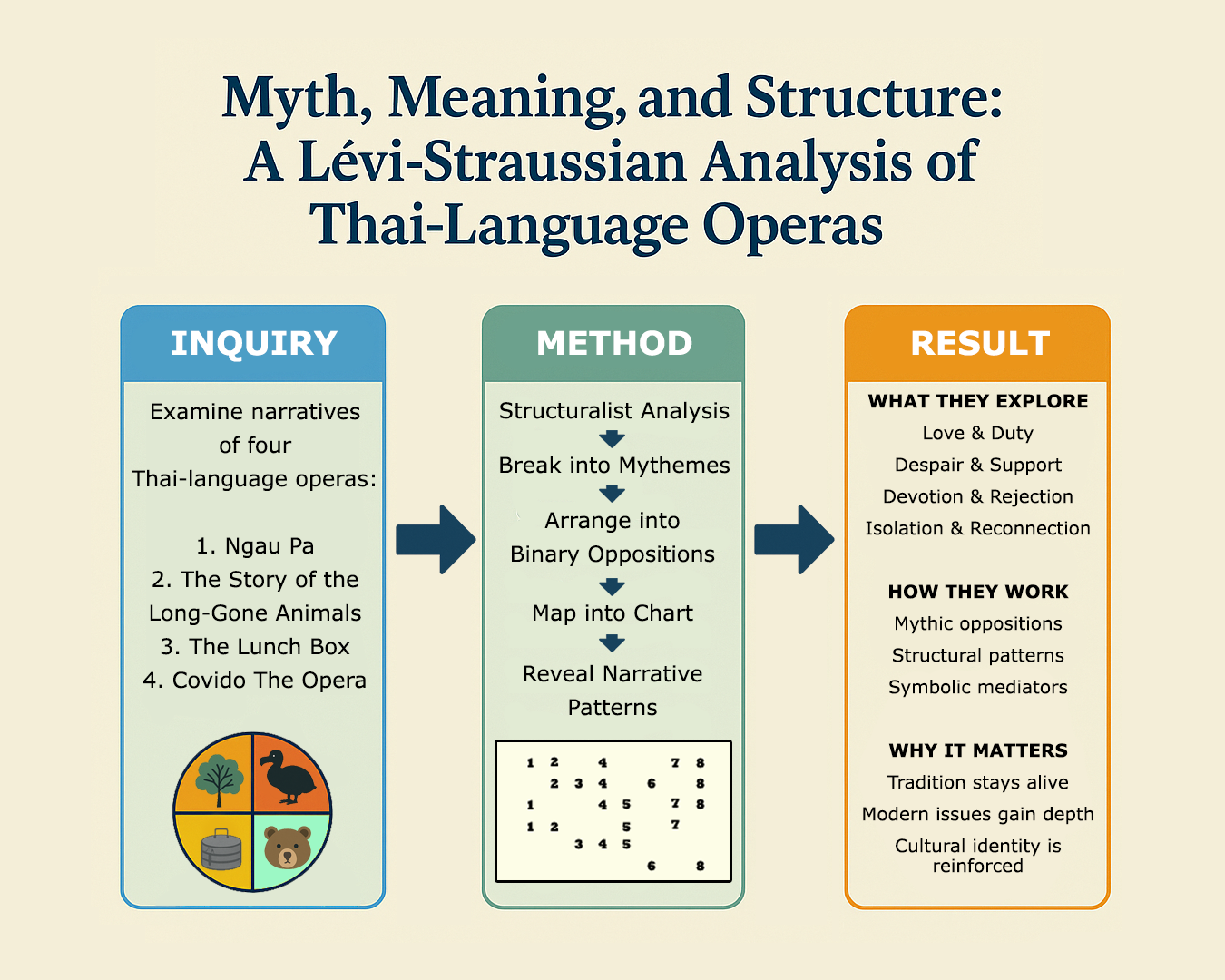
Background and Objectives: This research examines four Thai-language Western-style operas: Ngau Pa (2000) by Pathorn Srikaranonda, The Lunch Box (2009) by Thanapoom Sirichang, and The Story of the Long-Gone Animals (2008) and Covido The Opera (2021), both by Krisada and Napisi Reyes. Though relatively new, they already play a key role in Thailand’s opera tradition, bringing together old stories, Buddhist ideas and issues from modern life. The research employed Claude Lévi-Strauss’s theory of myth to examine ways operas use story patterns, and how their narrative structures maintain cultural values and tradition, while incorporating modern issues. The study aims to highlight inclusions such as family responsibility, love, grief, sacrifice, despair and renewal, as well as symbolic and supernatural entities which bring about transformation. As a result, the study shines a light on the ways Thai-language operas remain tied to tradition while integrating contemporary issues.
Methods: The research employs Lévi-Strauss’s structuralist method of analysis, in which each opera is first segmented into minimal narrative units (mythemes) based on libretti, synopses, and available performance materials. These units are then grouped into binary oppositions according to narrative tension, such as filial rejection versus maternal devotion or stasis versus reconnection. The oppositions are subsequently arranged into vertical columns to map how narrative relationships shift and develop across each work. This process enables rigorous comparison across the four operas while revealing underlying structural coherence. Secondary sources on structuralism, mythology, and opera provide contextual support and guide interpretation in line with Lévi-Strauss’s approach.
Results: The findings indicate that all four operas follow a consistent four-part mythic structure, demonstrating the continued influence of traditional narrative logic in Thai-language opera. Across the works, binary oppositions such as love versus duty, despair versus support, and isolation versus engagement are consistently shaped through symbolic or supernatural figures. These elements drive narrative transformation and allow contemporary concerns, including environmental crisis, mental health, and pandemic-induced isolation, to be expressed within enduring mythic patterns.
Conclusions: This research demonstrates that Thai-language opera functions as a contemporary vehicle for myth, using structural oppositions and symbolic elements to negotiate both traditional values and modern social issues. By applying Lévi-Straussian analysis, the research highlights how inherited narrative structures remain active and adaptable within a Southeast Asian operatic context. While limited by the small number of available works, the findings position Thai-language opera as a dynamic site of ethnomusicology in which cultural continuity and contemporary relevance intersect.
References
Alfila, Sinta, Dwi Widayati, and Bambang Riyanto. “Levi-Strauss’s Myth Structuralism in the Novel Lontara by Windy Joana.” Bahasa Indonesia Prima (BIP) 7, no. 1 (March 2025): 1-8. https://jurnal.unprimdn.ac.id/index.php/BIP/article/view/5993.
Alkan, Halit. “A Structuralist Analysis of William Shakespeare’s ‘Romeo and Juliet.’” Journal of Kesit Academy 7, no. 27 (June 2021): 27-36. DOI: https://doi.org/10.29228/kesit.51211
Beattie, Laura I. H. “Retelling Orpheus: Orpheus in the Renaissance.” Analyses/Rereadings/Theories: A Journal Devoted to Literature, Film and Theatre 2, no. 1 (2014): 1-8. DOI: https://doi.org/10.18778/2353-6098.2.01
Blum, Harold P. “A Psychoanalytic Enquiry into Pandora’s Box: Symbol and Metaphor.” In Language, Symbolization, and Psychosis, edited by Giovanna Ambrosio, Simona Argentieri, and Jorge Canestri, 18-30. London: Routledge, 2007. DOI: https://doi.org/10.4324/9780429476570-2
Bohlman, Philip V. World Music: A Very Short Introduction. 2nd ed. Oxford: Oxford University Press, 2020. DOI: https://doi.org/10.1093/actrade/9780198829140.001.0001
Brown, Ronald T., Lori Wiener, Mary Jo Kupst, Tara Brennan, Richard Behrman, Bruce E. Compas, T. David Elkin, et al. “Single Parents of Children with Chronic Illness: An Understudied Phenomenon.” Journal of Pediatric Psychology 33, no. 4 (May 2008): 408-421. DOI: https://doi.org/10.1093/jpepsy/jsm079
Buenstorf, Guido, and Christian Cordes. “Can Sustainable Consumption Be Learned? A Model of Cultural Evolution.” Ecological Economics 67, no. 4 (November 2008): 646-657. DOI: https://doi.org/10.1016/j.ecolecon.2008.01.028
Campbell, Joseph. The Hero with a Thousand Faces. 3rd ed. Novato, CA: New World Library, 2008.
Chawla, Nishtha, Ashlyn Tom, Mahadev Singh Sen, and Rajesh Sagar. “Psychological Impact of COVID-19 on Children and Adolescents: A Systematic Review.” Indian Journal of Psychological Medicine 43, no. 4 (July 2021): 294-299. DOI: https://doi.org/10.1177/02537176211021789
Doja, Albert. “Lévi-Strauss’s Heroic Anthropology Facing Contemporary Problems of the Modern World.” Reviews in Anthropology 49, no. 1-2 (2020): 4-38. DOI: https://doi.org/10.1080/00938157.2020.1794140
Doja, Albert. “The Shoulders of Our Giants: Claude Lévi-Strauss and His Legacy in Current Anthropology.” Social Science Information 45, no. 1 (March 2006): 79-107. DOI: https://doi.org/10.1177/0539018406061104
Dontsov, A. I., E. B. Perelygina, A. V. Drozdova, A. N. Shmidt, and E. N. Syutkina. “The Role of Mythological Ideas in Children’s Socialization and Subjective Well-Being.” In Early Childhood Care and Education, edited by Sonja Sheridan and Nikolay Veraksa, 221-229. European Proceedings of Social and Behavioural Sciences 43. London: Future Academy, 2018. DOI: https://doi.org/10.15405/epsbs.2018.07.30
Eagleton, Terry. “Post-Structuralism.” In Literary Theory: An Introduction, 2nd ed., 110-130. Oxford: Blackwell, 1996.
Elhai, Jon D., Robert D. Dvorak, Jason C. Levine, and Brian J. Hall. “Problematic Smartphone Use: A Conceptual Overview and Systematic Review of Relations with Anxiety and Depression Psychopathology.” Journal of Affective Disorders 207 (January 2016): 251-259. DOI: https://doi.org/10.1016/j.jad.2016.08.030
Everett, Yayoi Uno. Reconfiguring Myth and Narrative in Contemporary Opera: Osvaldo Golijov, Kaija Saariaho, John Adams, and Tan Dun. Bloomington: Indiana University Press, 2015. DOI: https://doi.org/10.2979/6786.0
Giovannini, Luca, and Daniil Skorinkin. “Computational Approaches to Opera Libretti.” Journal of Computational Literary Studies 3, No. 1 (2024): 1-23. https://doi.org/10.48694/jcls.3595.
Government of Singapore. “Maintenance of Parents Act 1995.” Singapore Statutes Online. Last modified 2024. https://sso.agc.gov.sg/Act/MPA1995.
Grimm, Jacob, and Wilhelm Grimm. “The Old Man and His Grandson.” In Grimms’ Tales for Young and Old: The Complete Stories, translated by Ralph Manheim, 263-264. New York: Anchor Books, 1983.
Halle, John. “From Linguistics to Musicology: Notes on Structuralism, Musical Generativism, Cognitive Science, and Philosophy.” Signata 6 (2015): 287-311. DOI: https://doi.org/10.4000/signata.1109
Hernández, René Landero, Benito Estrada Aranda, and Mónica Teresa González Ramírez. “Depression and Quality of Life for Women in Single-Parent and Nuclear Families.” The Spanish Journal of Psychology 12, no. 1 (May 2009): 171-183. DOI: https://doi.org/10.1017/S113874160000158X
Husaini, Muhd. Arief Al. “Understanding Traditional Malay Communities in Riau Using the Levi-Strauss Framework of Structuralism.” International Journal of Architecture and Urbanism 8, no. 1 (2024): 86-93. DOI: https://doi.org/10.32734/ijau.v8i1.15093
Isaac, Joanne L. “Effects of Climate Change on Life History: Implications for Extinction Risk in Mammals.” Endangered Species Research 7 (May 2009): 115-123. DOI: https://doi.org/10.3354/esr00093
Jankowska, Tatiana. “Between Nature and Culture: Lévi-Strauss’s Structural Analysis of Myth in the Light of Semiotics.” Respectus Philologicus 25, no. 30 (April 2014): 211-217. DOI: https://doi.org/10.15388/RESPECTUS.2014.25.30.16
Jones, Andrew R. “The Next Mass Extinction: Human Evolution or Human Eradication.” Journal of Cosmology 2 (2009): 316-333. https://thejournalofcosmology.com/Extinction108.html.
Kartomi, Margaret J. “‘Traditional Music Weeps’ and Other Themes in the Discourse on Music, Dance, and Theatre of Indonesia, Malaysia, and Thailand.” Journal of Southeast Asian Studies 26, no. 2 (September 1995): 366-400. DOI: https://doi.org/10.1017/S0022463400007141
Komjakraphan, Patcharee, and Wannee Chansawang. “The Lived Experience of Living in Skipped-Generation Household among Southern Thai Elders.” Journal of Research in Nursing-Midwifery and Health Sciences 35, no. 3 (September-December 2015): 35-56. https://he02.tci-thaijo.org/index.php/nur-psu/article/view/44341.
Kostićová, Zuzana Marie. “Axis Mundi in the Tropics: Uses and Abuses of Eliade’s Phenomenology of Religion in the Schelean Maya Studies.” Ethnologia Actualis 19, no. 2 (December 2019): 57-80. DOI: https://doi.org/10.2478/eas-2020-0004
Kotnik, Vlado. “Lévi-Strauss and the Opera.” Issues in Ethnology and Anthropology 4, no. 2 (2009): 101-120. DOI: https://doi.org/10.21301/eap.v4i2.6
Kozel, David. “A Musical Analysis of Mythical Thought in the Work of Claude Lévi-Strauss.” Musicologica Olomucensia 22 (2015): 61-78. https://www.academia.edu/24579189/A_Musical_Analysis_of_Mythical_Thought_in_the_Work_of_Claude_Lévi_Strauss. DOI: https://doi.org/10.5507/mo.2015.013
Kushanov, Yerzhan. “Mythological Theme in French Flute Music.” Saryn Art and Science Journal 9, no. 3 (2021): 32-38. https://sarynjournal.kz/index.php/saryn/article/view/152.
Lau, Shui Sum. “Filial Piety and U.S. Family Law: How Cultural Values Influence Caregiving, End-of-Life, and Estate Planning Decisions in Asian American Families.” Asian Pacific American Law Journal 26, no. 1 (Spring 2023): 123-144. https://www.jstor.org/stable/48743281. DOI: https://doi.org/10.5070/P326160687
Leavitt, John. “Mytheme and Motif: Lévi-Strauss and Wagner.” Intersections 30, no. 1 (2010): 95-116. DOI: https://doi.org/10.7202/1003501ar
Lee, Seungyeon. “Enchanted or Endangered by Sleep? Modern Interpretation of the Heroine’s Consciousness in Tales of Sleeping Beauty (Transformations by Anne Sexton and Beginning with O by Olga Broumas).” Interdisciplinary Humanities: Beyond the Binary 33, no. 2 (2016): 121-136.
Lévi-Strauss, Claude. “The Structural Study of Myth.” The Journal of American Folklore 68, no. 270 (October-December 1955): 428-444. https://www.people.iup.edu/sherwood/Archived-Courses/ENGL752SuII-05/Docs/Structural_Study_of_Myth.pdf. DOI: https://doi.org/10.2307/536768
Levy, Ze’ev. “Claude Lévi-Strauss’ Structural Anthropology and Mythology as Ultimate Meaning.” Ultimate Reality and Meaning 21, no. 2 (June 1998): 135-143. DOI: https://doi.org/10.3138/uram.21.2.135
Lincoln, Bruce. Apples and Oranges: Explorations In, On, and With Comparison. Chicago: University of Chicago Press, 2018. DOI: https://doi.org/10.7208/chicago/9780226564104.001.0001
Lux, Thomas E. “From Dream to Folklore in Northeast Thailand.” Asian Folklore Studies 30, no. 1 (1971): 85-96. DOI: https://doi.org/10.2307/1177766
Madden, M. Stuart. “Myth, Folklore and Ancient Ethics.” SSRN. Posted October 19, 2006. DOI: https://doi.org/10.2139/ssrn.938128
Mahikul, Wiriya, Peeradone Srichan, Udomsak Narkkul, Ingfar Soontarawirat, Amornphat Kitro, Natapol Pumipuntu, Sayambhu Saita, and Pisinee Narayam. “Mental Health Status and Quality of Life Among Thai People after the COVID-19 Outbreak: A Cross-Sectional Study.” Scientific Reports 14 (2024): 25896. DOI: https://doi.org/10.1038/s41598-024-77077-3
Mai, Alexander Chih-Yuan. “Mythologizing the Narrative: An Analytical Study of Turnage/Berkoff’s Greek (1989) and the Nature of Operatic Narrative.” English Language, Literature and Culture 6, no. 3 (2021): 82-90. DOI: https://doi.org/10.11648/j.ellc.20210603.15
Malhotra, Vikas. “Āveśa and Deity Possession in the Tantric Traditions of South Asia: History, Evolution, and Etiology.” PhD diss., University of California, Santa Barbara, 2022. https://escholarship.org/uc/item/1sp3k2wk.
Mazar, Sofia. “The Phenomenon of Intertextuality in 19th Century Italian Opera Libretti: The Example of G. Donizetti’s ‘Lucia Di Lammermoor.’” Psychology Research 12, no. 5 (May 2022): 244-252. DOI: https://doi.org/10.17265/2159-5542/2022.05.004
Misbah, Randa Abdelfattah Mohamed. “The Significance of Orpheus’s Myth in Sarah Ruhl’s Eurydice: An Intertextual Approach.” Faculty of Arts Journal 81, no. 4 (April 2021): 43-67. http://search.mandumah.com/Record/1182805. DOI: https://doi.org/10.21608/jarts.2021.62091.1071
Morris, Rosalind C. In the Place of Origins: Modernity and Its Mediums in Northern Thailand. Durham, NC: Duke University Press, 2000.
Mulder, Niels. Inside Thai Society: Interpretations of Everyday Life. Amsterdam: Pepin, 1996. https://archive.org/details/insidethaisociet0000muld.
North, Diana Richelle. “Epic Explorations in Opera: The Hero’s Overture.” PhD diss., Pacifica Graduate Institute, USA, 2020. https://www.proquest.com/openview/ff17bd0f40c918b45c69dcc661f176d2/.
Pavan, Luca. “Italian Opera Librettos with Similar Plot: Plagiarism or Established Practice?” International Journal of Languages, Literature and Linguistics 6, no. 2 (June 2020): 76-80. DOI: https://doi.org/10.18178/IJLLL.2020.6.2.254
Penner, Nina. Storytelling in Opera and Musical Theater. Bloomington, IN: Indiana University Press, 2020. DOI: https://doi.org/10.2307/j.ctv177tj35
Prawang, Fueanglada. “The Emergence of Thai Opera: Performance as Cultural Synergy.” PhD diss., Bangor University, 2021. https://research.bangor.ac.uk/files/37458630/2021_Prawang_PhD_Music_Thesis.pdf.
Pruksarungruang, Jidapa, and Douglas Rhein. “Depression Literacy: An Analysis of the Stigmatization of Depression in Thailand.” SAGE Open 12, no. 4 (October-December 2022): 1-18. DOI: https://doi.org/10.1177/21582440221140376
Ransri, Jesadakorn. “Mental Health and Well-Being of Thai Youth: Addressing the Growing Crisis.” Journal of Modern Academic Social Science (Online) 1, no. 2 (March-April 2024): 14-25. https://so19.tci-thaijo.org/index.php/J_ASS/article/view/754.
Ratanasiripong, Paul, Suda Hanklang, Worawon Nungdanjark, Yada Thongthammarat, and Emily Ramon. “Predictors of Mental Health among Secondary School Students in Thailand: The Roles of Grit, Self Esteem, and Smartphone Addiction.” Thai Journal of Public Health 54, no. 2 (May-August 2024): 903-917. https://www.ph.mahidol.ac.th/thjph/journal/54_2/05.pdf.
Reider, Noriko T. “Animating Objects: Tsukumogami ki and the Medieval Illustration of Shingon Truth.” Japanese Journal of Religious Studies 36, no. 2 (2009): 231-257. https://scispace.com/pdf/animating-objects-tsukumogami-ki-and-the-medieval-2gwuc9qlkq.pdf. DOI: https://doi.org/10.18874/jjrs.36.2.2009.231-257
Reyes, Krisada, and Napisi Reyes, dirs. Covido The Opera. 2021. MPEG.
Reyes, Krisada, and Napisi Reyes. “The Story of the Long-Gone Animals, Act 2: Transposed Score.” Unpublished score, 2021.
Richardson, Brian. “Beyond Poststructuralism: Theory of Character, the Personae of Modern Drama, and the Antinomies of Critical Theory.” Modern Drama 40, no. 1 (Spring 1997): 86-99. DOI: https://doi.org/10.1353/mdr.1997.0000
Sinh, Anindita. “The Jataka Tales through the Lens of Existential and Buddhist Ethics.” Confluence: Journal of Interdisciplinary Studies 4 (2020): 31-46. https://cjids.in/volume-iv-2020/the-jataka-tales-through-the-lens-of-existential-and-buddhist-ethics/.
Sringernyuang, Luechai, and Tida Sottiyotin. “‘Ya Luk Ka Tan Yoo’: An Ethnography of Filial Piety Culture, Medication Usage, and Health Perceptions of the Elderly in Rural Southern Thailand.” International Journal of Environmental Research and Public Health 19, no. 19 (October-1 2022): 12134. DOI: https://doi.org/10.3390/ijerph191912134
Suryadmaja, Galih, Retno Utari, Haryono, and Dewi Puspta Ningsih. “Analysis of Levi-Strauss's Structuralism on the Myth of Princess Mandalika.” Global Journal of Social Learning 1, no. 2 (June 2025): 42-51. DOI: https://doi.org/10.71094/gjsl.v1i2.61
Taşdelen, Enes. “Louise Glück’s ‘A Myth of Innocence’ and the Myth of Persephone: A Structuralist Analysis through Lévi-Strauss.” Istanbul University Journal of Sociology 45, no. 1 (2025): 240-261. DOI: https://doi.org/10.26650/SJ.2025.45.1.0763
Tuan, Iris H. “Myth and Levi-Strauss: Taiwan Musical The Classic of Mountains and Seas & Chinese Film The Monkey King: Kingdom of Women.” In Pop with Gods, Shakespeare, and AI, 65-81. Singapore: Springer Verlag, 2020. DOI: https://doi.org/10.1007/978-981-15-7297-5_4
Walsh, Roger. “Shamanic Experiences: A Developmental Analysis.” Journal of Humanistic Psychology 41, no. 3 (2001): 31-52. DOI: https://doi.org/10.1177/0022167801413004
Watanasin, Ratiwan. “Central Thai Food Culture and Acculturation During World War ii and the Vietnam War.” Manusya, Journal of Humanities 23, no. 2 (2020): 205-223. https://digital.car.chula.ac.th/manusya/vol23/iss2/4. DOI: https://doi.org/10.1163/26659077-02302004
Wongboonsin, Patcharawalai, Yupin Aungsuroch, and Naomi Hatsukano. “The Ageing Society and Human Resources to Care for the Older People in Thailand.” In Human Resources for the Health and Long-term Care of Older Persons in Asia, edited by Yuko Tsujita and Osuke Komazawa, 104-135. Jakarta: Economic Research Institute for ASEAN and Asia, 2020. https://www.ide.go.jp/library/English/Publish/Reports/Ec/pdf/202011_ch04.pdf.
Yedla, Suneetha, and Mahmood Hasan Al-Khazaali. “Filial Relationships in Shakespeare’s King Lear.” International Journal of English Language, Literature and Translation Studies 3, no. 3 (July-September 2016): 602-605. http://www.ijelr.in/3.3.16c/602-605%20Dr.%20SUNEETHA%20YEDLA.pdf.
Yiengprugsawan, Vasoontara, Cathy Banwell, Wakako Takeda, Jane Dixon, Sam-ang Seubsman, and Adrian Sleigh. “Health, Happiness and Eating Together: What Can a Large Thai Cohort Study Tell Us?” Global Journal of Health Science 7, no. 4 (2015): 270-277. DOI: https://doi.org/10.5539/gjhs.v7n4p270
Young, David. “The Hierarchy of Thailand and its Effects on English Language Learning.” LEARN Journal: Language Education and Acquisition Research Network 14, no. 1 (January-June 2021): 15-27. https://so04.tci-thaijo.org/index.php/LEARN/article/view/248675.
Zhao, Jinchao. “Filial Piety in Fluidity: The Tension between the Textual and Visual Traditions of Śyāma Jātaka in Early Medieval China.” Religions 14, no. 7 (2023): 860. DOI: https://doi.org/10.3390/rel14070860
Downloads
Published
How to Cite
Issue
Section
License
Copyright (c) 2026 College of Music

This work is licensed under a Creative Commons Attribution-NonCommercial-NoDerivatives 4.0 International License.
The copyright of the article belongs to the author. Published articles represent the views of the authors. The editorial team neither necessarily agree with nor take any responsibility for the article.