ANALYSING TONE-MELODY CORRESPONDENCE IN THAIPOP USING THE CANTOPOP "LING YI SEI SAAM" SONGWRITING METHOD
DOI:
https://doi.org/10.65824/mmj.v9.284689Keywords:
Ling Yi Sei Saam, Thai Popular Music, Thai Tone, Tone-Melody Mapping, CantopopAbstract
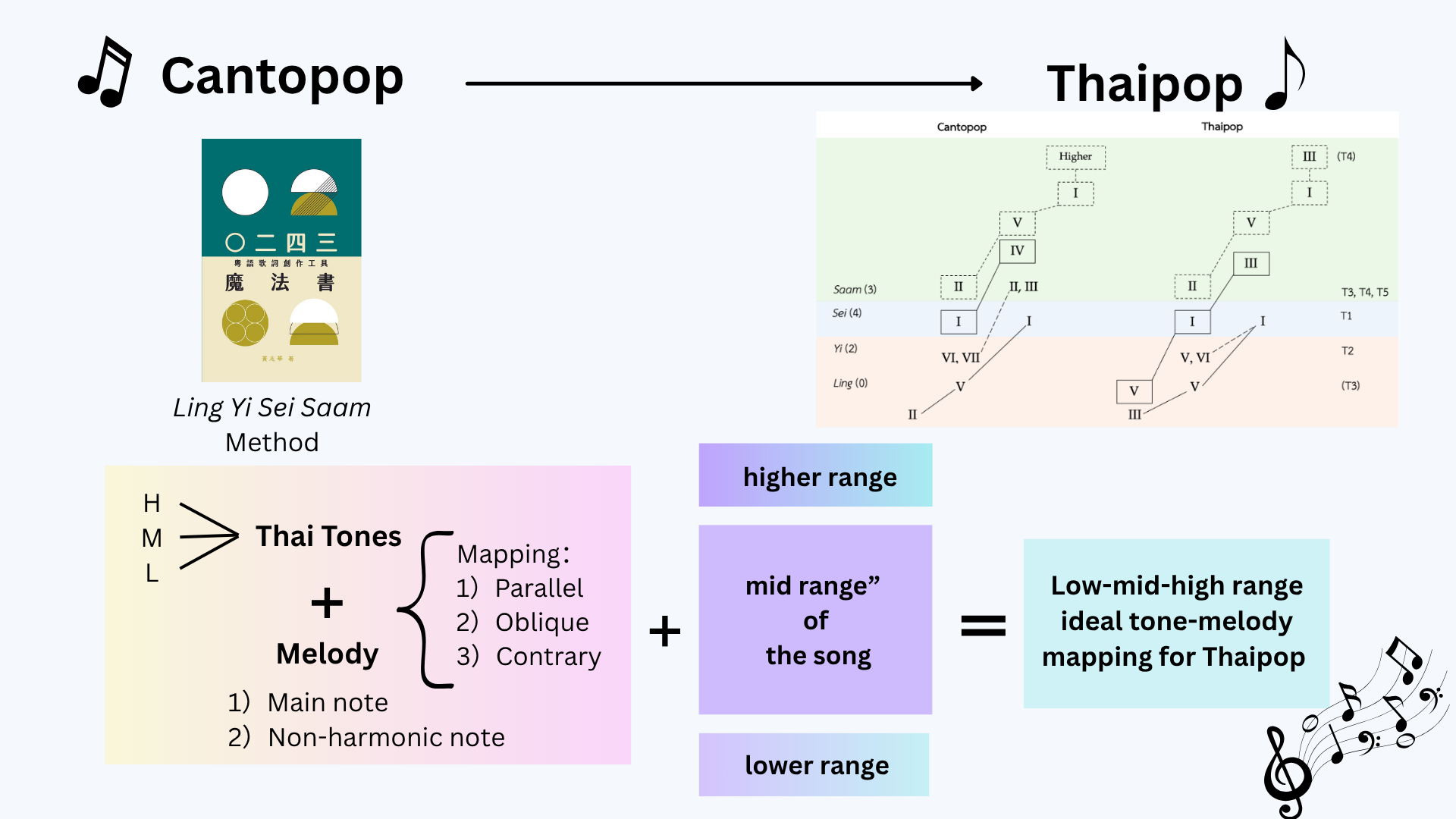
Background and Objectives: Over the past seven decades, Hong Kong scholars have developed systematic approaches to lyric-melody correspondence, contributing both to songwriting practice and to academic research. Of these approaches, the “Ling Yi Sei Saam” (0243) method stands as a representative example. However, research on this topic remains limited despite the rapid development of Thai popular music (Thaipop). Existing studies on Thai music have largely focused on traditional songs, leaving Thaipop underexplored from a musicological and linguistic perspective. In this study, we examine the phonological features of Thai tones, including their values and contours. We investigate lyric–melody correspondence in Thaipop, identifying songwriting techniques based on by the Ling Yi Sei Saam method. Furthermore, we propose a preliminary methodological framework for Thai lyric–melody alignment as a foundation for future research.
Methods: This study is a framework-based analytical study using the Ling Yi Sei Saam method. The lyric-melody correspondence in six Thai popular songs sung in standard Thai that are top-ranking in the Thaipop music charts, namely Top Charts and Billboard Thailand, were examined. Each song was transcribed and notated, including its lexical tone, IPA transcription, musical notation, and International Pitch Notation. Musical structure, scale degrees, and pitch intervals were systematically recorded, and tone values were mapped to the melodic contour. The aligned linguistic and musical data were then analysed to identify pitch range distributions and to compare patterns across the selected materials.
Results: The results show that tone-melody correspondence in Thaipop follows consistent structural patterns. Tone 1 aligns most frequently with the tonic in the central pitch range, while Tone 2 is stably mapped to lower scale degrees (V and VI). Tone 3 frequently occurs in the lowest pitch positions in a song besides when it is in the upper pitch range. Tone 4 and Tone 5 are associated with the upper pitch range and often mark melodic peaks. Tone 3, Tone 4, and Tone 5 belong to the higher pitch range, which map to scale degrees II and V and have a strong tendency to resolve to the tonic (I). In addition, this study shows that tone-melody mismatches commonly occur with the presence of a falling tone. Comparatively, Thaipop exhibits broader tonal distribution across pitch ranges than Cantopop, particularly in the treatment of the falling tone.
Conclusions: This study demonstrates that the alignment of lexical tones and melodies of the lyrics of Thaipop songs follows a consistent pattern to preserve lyrical intelligibility. The findings show that both Thai and Cantonese popular music share some similar language constraints and tone-melody mapping patterns, resulting in a modified Ling Yi Sei Saam framework adapted to Thaipop songwriting and analysis. Overall, this study develops a greater understanding of the lyric-melody relationship and highlights the need for further research.
References
Bauer, Robert S., and Paul K. Benedict. Modern Cantonese Phonology. New York: Mouton de Gruyter, 1997. DOI: https://doi.org/10.1515/9783110823707
Chan, Marjorie K. M. “Tone and Melody in Cantonese.” Paper presented at the 13th Annual Meeting of Berkeley Linguistic Society, Berkeley Linguistic Society, California, February 14-16, 1987. DOI: https://doi.org/10.3765/bls.v13i0.1828
Chao, Yuan Ren. “A System of ‘Tone Letters.’” Le Maître Phonétique 8 (45), no. 30 (April-June 1930): 24-27.
Chow, Man-ying. “Singing the Right Tones of the Words: The Principles and Poetics of Tone-Melody Mapping in Cantopop.” Master’s thesis, University of Hong Kong, 2012.
Drabkin, William. “Part-writing.” In The New Grove Dictionary of Music and Musicians, edited by Stanley Sadie and John Tyrrell, vol. xix, 177. London: Macmillan, 2001.
Fenlon, Iain. “Scale.” In The New Grove Dictionary of Music and Musicians, edited by Stanley Sadie and John Tyrrell, vol. xxii, 366. London: Macmillan, 2001.
Gandour, Jack. “Perceptual Dimensions of Tone: Evidence from Cantonese.” Journal of Chinese Linguistics 9, no. 1 (January 1981): 20-36.
Ho, W. S. Vincie. “An Optimality-theoretic Analysis of the Tone-melody mapping in Cantonese Popular Songs.” Paper presented at the International Symposium on Tonal Aspects of Languages, La Rochelle, France, April 27-29, 2006.
Ho, W. S. Vincie. “The Tone-Melody Interface of Popular Songs Written in Tone Languages.” Paper presented at the 9th International Conference on Music Perception and Cognition, University of Bologna, Italy, August 22-26, 2006.
Hombert, Jean-Marie. “Perception of Tones of Bisyllabic Nouns in Yoruba.” Studies in African Linguistics Supplement 6 (1976): 109-121.
Huang, Zhihua. Ling Yi Sei Saam (Cantonese Lyrics Writing Handbook). Hong Kong: Joint Publishing, 2024. (in Chinese)
Huron, David. Sweet Anticipation: Music and the Psychology of Expectation. Cambridge: MIT Press, 2006. DOI: https://doi.org/10.7551/mitpress/6575.001.0001
Hyer, Brian. “Tonality.” In The New Grove Dictionary of Music and Musicians, edited by Stanley Sadie and John Tyrrell, vol. xxv, 583. London: Macmillan, 2001.
Ketkaew, Chawadon, and Junyawan Suwannarat. “The Decline of Tone and Melody Correspondence in Modern Thai Pop Songs?: A Preliminary Analysis.” In the 20th International Congress of Phonetic Sciences, edited by Radek Skarnitzl and Jan Volín, 590-593. Prague: International Phonetic Association, 2023.
Ketkaew, Chawadon, and Pittayawat Pittayaporn. “Mapping between Lexical Tones and Musical Notes in Thai Pop Songs.” Paper presented at the 28th Pacific Asia Conference on Language, Information and Computation, Department of Linguistics, Chulalongkorn University, Phuket, Thailand, December 12-14, 2014.
Ketkaew, Chawadon. “Mapping between Tones and Musical Notes in Thai Pop Songs.” PhD diss., Chulalongkorn University, 2015. (in Thai)
Khochprasert, Jantana, Tanarach Anukul, and Jantra Noennok, “The Study of Prosody and Singing Techniques in Thai Classical Singing.” Music and Performing Arts Journal 9, no. 1 (January-June 2023): 32-44. (in Thai)
King, Jonathan. “Text-setting.” In The New Grove Dictionary of Music and Musicians, edited by Stanley Sadie and John Tyrrell, vol. xxv, 320. London: Macmillan, 2001.
Kirby, James. “Comparative Tonal Text-Setting in Mandarin and Cantonese Popular Song.” Paper presented at the 58th Annual Meeting of the Chicago Linguistic Society, Chicago Linguistic Society, Chicago, April 22-24, 2023.
Lau, Elaine. “Tone-Melody Relationship in Cantonese.” Working Papers in Linguistics: University of Hawai‘i at Mānoa 41, no. 3 (2010): 1-12.
Lee, Joanna C. “Hong Kong.” In The New Grove Dictionary of Music and Musicians, edited by Stanley Sadie and John Tyrrell, vol. xi, 686. London: Macmillan, 2001.
Lee, Yin Hei. “A Corpus Study of Tone-Melody Correspondence in Cantopop, 2000-2020.” Master’s thesis, The University of British Columbia, 2023.
List, George. “Speech Melody and Song Melody in Central Thailand.” Ethnomusicology 5, no. 1 (January 1961): 16-32. DOI: https://doi.org/10.2307/924305
Matthews, Stephen, and Virginia Yip. Cantonese: A Comprehensive Grammar. 2nd ed. London: Routledge, 2011.
Morén, Bruce and Elizabeth Zsiga. “The Lexical and Post-Lexical Phonology of Thai Tones.” Natural Language and Linguistic Theory 24, no. 1 (February 2006): 113-178. DOI: https://doi.org/10.1007/s11049-004-5454-y
Pittayaporn, Pittayawat. Vowel Lengthening in Thai: Implications for Modern Spelling. Bangkok: Chulalongkorn University, 2016. (In Thai)
Reetz, Henning, and Allard Jongman. Phonetics: Transcription, Production, Acoustics, and Perception. Chichester: John Wiley & Sons, 2009.
Roongruang, Panya. “Thailand.” In The New Grove Dictionary of Music and Musicians, edited by Stanley Sadie and John Tyrrell, vol. xxv, 336. London: Macmillan, 2001.
Schellenberg, Murray. “Does Language Determine Music in Tone Languages?” Ethnomusicology 56, no. 2 (Spring/Summer 2012): 266-278. DOI: https://doi.org/10.5406/ethnomusicology.56.2.0266
Downloads
Published
How to Cite
Issue
Section
License
Copyright (c) 2026 College of Music

This work is licensed under a Creative Commons Attribution-NonCommercial-NoDerivatives 4.0 International License.
The copyright of the article belongs to the author. Published articles represent the views of the authors. The editorial team neither necessarily agree with nor take any responsibility for the article.