MASTERING PROKOFIEV'S VIOLIN SONATAS OP. 56 AND 115: A PEDAGOGICAL FRAMEWORK BRIDGING TRADITIONAL METHODS AND MODERN REPERTOIRE
DOI:
https://doi.org/10.65824/mmj.v9.286004Keywords:
Violin Pedagogy, Sergei Prokofiev, Practice-led Research, 20th-Century Repertoire, Ensemble CollaborationAbstract
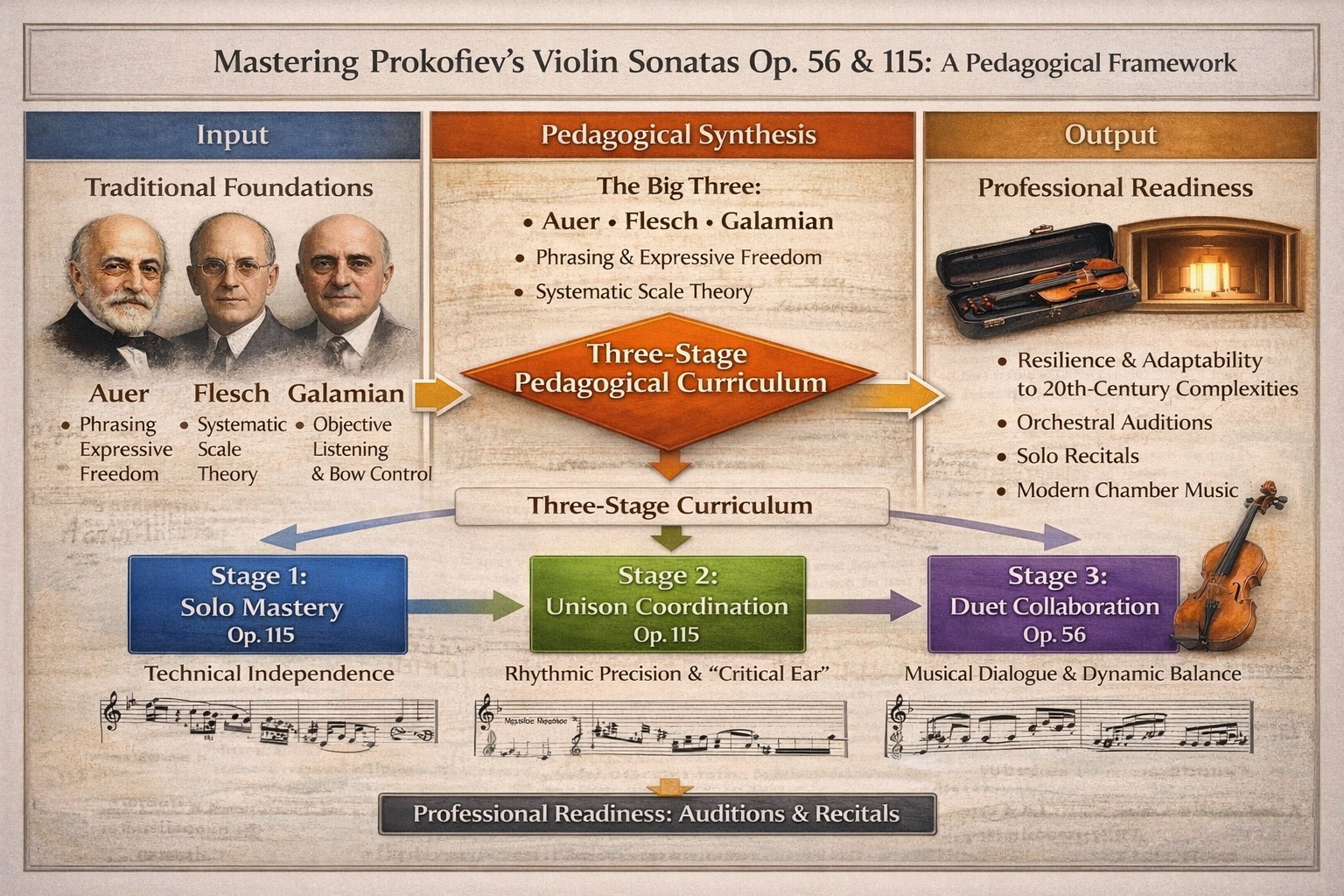
Background and Objectives: Although traditional violin pedagogy, deeply influenced by the pioneering methods of Leopold Auer, Carl Flesch, and Ivan Galamian, has had a profound impact on string education, its application remains largely confined to the classical and romantic repertoires. Given that the unique harmonic and rhythmic demands of 20th-century modernist music necessitate a modernized pedagogical approach, this study constructs a structured violin teaching framework based on Sergei Prokofiev’s Sonata for Two Violins, Op. 56, and Sonata for Solo Violin, Op. 115. The primary objective is to systematically recontextualize historical teaching principles to address the specific interpretive and technical challenges of these modernist works.
Methods: This study is positioned as practice-led pedagogical research. To articulate and systematize modern violin teaching practices, the research employs a triangulation approach integrating three distinct sources of professional evidence: detailed score analysis to identify structural and technical hurdles; the synthesis of pedagogical literature from Auer, Flesch, and Galamian; and reflective insights derived from performance practice. This methodology is operationalized through a three-phase iterative process encompassing historical contextualization, comparative technical calibration, and pedagogical synthesis.
Results: The research culminates in the development of a comprehensive, progressive three-stage curriculum: Solo Mastery (Op. 115), Unison Coordination (Op. 115), and Duet Collaboration (Op. 56). The framework successfully translates complex modernist concepts—such as chromatic displacement, intricate rhythmic synchronization, and dissonant counterpoint—into targeted, actionable exercises. By applying Flesch’s scale systems for intonation, Galamian’s principles for bowing and “critical ear” synchronization, and Auer’s relational phrasing for ensemble dialogue, the sequence cultivates technical independence, collective listening, and advanced chamber-music interaction.
Conclusions: This framework provides the first explicit pedagogical framework adapting the historically dominant Auer–Flesch–Galamian pedagogical methods to Prokofiev’s modernist repertoire. By shifting the instructional focus from mere mechanical execution to reciprocal peer learning within a social-constructivist framework, the curriculum not only deepens the interpretive understanding of Prokofiev's works but also equips advanced students with the technical resilience and collaborative empathy required for the broader canon of 20th- and 21st-century music.
References
Allingham, Emma, and Clemens Wöllner. “Effects of Attentional Focus on Motor Performance and Physiology in a Slow-Motion Violin Bow-Control Task: Evidence for the Constrained Action Hypothesis in Bowed String Technique.” Journal of Research in Music Education 70, no. 2 (July 2022): 168-189. DOI: https://doi.org/10.1177/00224294211034735
Arney, Kelley M. “A Comparison of the Violin Pedagogy of Auer, Flesch, and Galamian: Improving Accessibility and Use through Characterization and Indexing.” Master’s thesis, University of Texas at Arlington, 2006. https://mavmatrix.uta.edu/cgi/viewcontent.cgi?params=/context/music_theses/article/1004/type/native/&path_info=.
Auer, Leopold. Violin Playing as I Teach It. 3rd ed. New York: Dover Publications, 1980.
Bass, Richard. “Prokofiev’s Technique of Chromatic Displacement.” Music Analysis 7, no. 2 (July 1988): 197-214. DOI: https://doi.org/10.2307/854056
Blok, Vladimir. Sergei Prokofiev: Materials, Articles, Interviews. Moscow: Progress Publishers, 1978.
Dann, Elias. “The Second Revolution in the History of the Violin: A Twentieth-Century Phenomenon.” College Music Symposium 17, no. 2 (Fall 1977): 64-71. https://www.jstor.org/stable/40373889.
Fernández-Barros, Alba, David Duran, and Laia Viladot. “Peer Tutoring as a Tool for Developing the Intonation of Violin and Viola Students in Elementary Music Education.” Music Education Research 25, no. 2 (2023): 176-189. DOI: https://doi.org/10.1080/14613808.2023.2193210
Fiess, Stephen C. E. The Piano Works of Serge Prokofiev. Metuchen, NJ: Scarecrow Press, 1994.
Flesch, Carl. Scale System. Edited by Max Rostal. New York: Carl Fischer, 1970.
Flesch, Carl. The Art of Violin Playing: Book One. Translated and edited by Eric Rosenblith. New York: Carl Fischer, 2000.
Flesch, Carl. The Art of Violin Playing: Book Two. Translated and edited by Eric Rosenblith. New York: Carl Fischer, 2000.
Galamian, Ivan. Principles of Violin Playing and Teaching. Englewood Cliffs, NJ: Prentice-Hall, 1962.
Galamian, Ivan, and Sally Thomas. Principles of Violin Playing and Teaching. Mineola, NY: Courier Corporation, 2013.
Gaunt, Helena, and Danielle Shannon Treacy. “Ensemble Practices in the Arts: A Reflective Matrix to Enhance Team Work and Collaborative Learning in Higher Education.” Arts and Humanities in Higher Education 19, no. 4 (October 2020): 419-444. DOI: https://doi.org/10.1177/1474022219885791
Hanson, Lawrence, and Elisabeth Hanson. Prokofiev, The Prodigal Son: An Introduction to His Life and Work in Three Movements. London: Cassell, 1964.
Kalender, Caner, and Dolunay Akgül Barış. “Effectiveness of the Teaching Program Prepared to Improve Intonation Skills in Violin Education.” Education and Science 47, no. 211 (2022): 171-193. DOI: https://doi.org/10.15390/EB.2022.11530
Kim, Sooyoung. “Perspectives on the Symbiosis of Traditional and Modernist Techniques in Four Violin Compositions by Sergei Prokofiev.” DMA diss., University of Cincinnati, 2010. https://etd.ohiolink.edu/acprod/odb_etd/ws/send_file/send?accession=ucin1275918892&disposition=inline.
Morrison, Simon. The People's Artist: Prokofiev's Soviet Years. Oxford: Oxford University Press, 2010.
Nice, David. Prokofiev: From Russia to the West, 1891-1935. New Haven: Yale University Press, 2003.
Prokofiev, Sergei. “Sonata for 2 Violins, Op. 56.” Accessed January 13, 2026. https://imslp.org/wiki/Sonata_for_2_Violins%2C_Op.56_(Prokofiev%2C_Sergey)
Prokofiev, Sergei. Sonata for Two Violins, Op. 56. Edited by David Oistrakh. New York: G. Schirmer, 1983.
Prokofiev, Sergei. “Sonata for Solo Violin, Op. 115.” Accessed January 16, 2026. https://imslp.eu/files/imglnks/euimg/d/d2/IMSLP31618-PMLP71963-sonate_violon_solo_op_115.pdf.
Reeves, Julia Sakiko. “Gateways to 20th Century Violin Repertoire: Selections from Luciano Berio’s Duetti Per Due Violini.” DMA diss., University of North Carolina at Greensboro, 2018. https://www.digitalgreensboro.org/record/13900?ln=en&p=Gateways+to+20th+Century+Violin+Repertoire%3A+Selections+from+Luciano+Berio%27s+Duetti+Per+Due+Violini&v=pdf.
Robinson, Harlow. Sergei Prokofiev: A Biography. New York: Viking, 1987.
Steinhauser, Joanna. “A Historical Analysis and Performer’s Guide to Sergei Prokofiev’s Sonata for Solo or Unison Violins, Op. 115.” DMA diss., Louisiana State University, 2009. https://repository.lsu.edu/cgi/viewcontent.cgi?article=1041&context=gradschool_majorpapers.
Swoger-Ruston, John Paul. “Harmonic Intonation and Implication (Analyses and Compositions): Harmonic Perception and Intonation in the Reception and Performance of Alternative Tuning Systems in Contemporary Composition.” PhD diss., University of Plymouth, 2006. https://pearl.plymouth.ac.uk/cgi/viewcontent.cgi?article=1401&context=foahb-theses-other.
Tong, Fei. “Performance Guide to Selected Solo Violin Work of Sergei Prokofiev and Krzysztof Penderecki.” DMA diss., University of Georgia, 2021. https://openscholar.uga.edu/record/4598/files/Research%20Paper.pdf.
Downloads
Published
How to Cite
Issue
Section
License
Copyright (c) 2026 College of Music

This work is licensed under a Creative Commons Attribution-NonCommercial-NoDerivatives 4.0 International License.
The copyright of the article belongs to the author. Published articles represent the views of the authors. The editorial team neither necessarily agree with nor take any responsibility for the article.