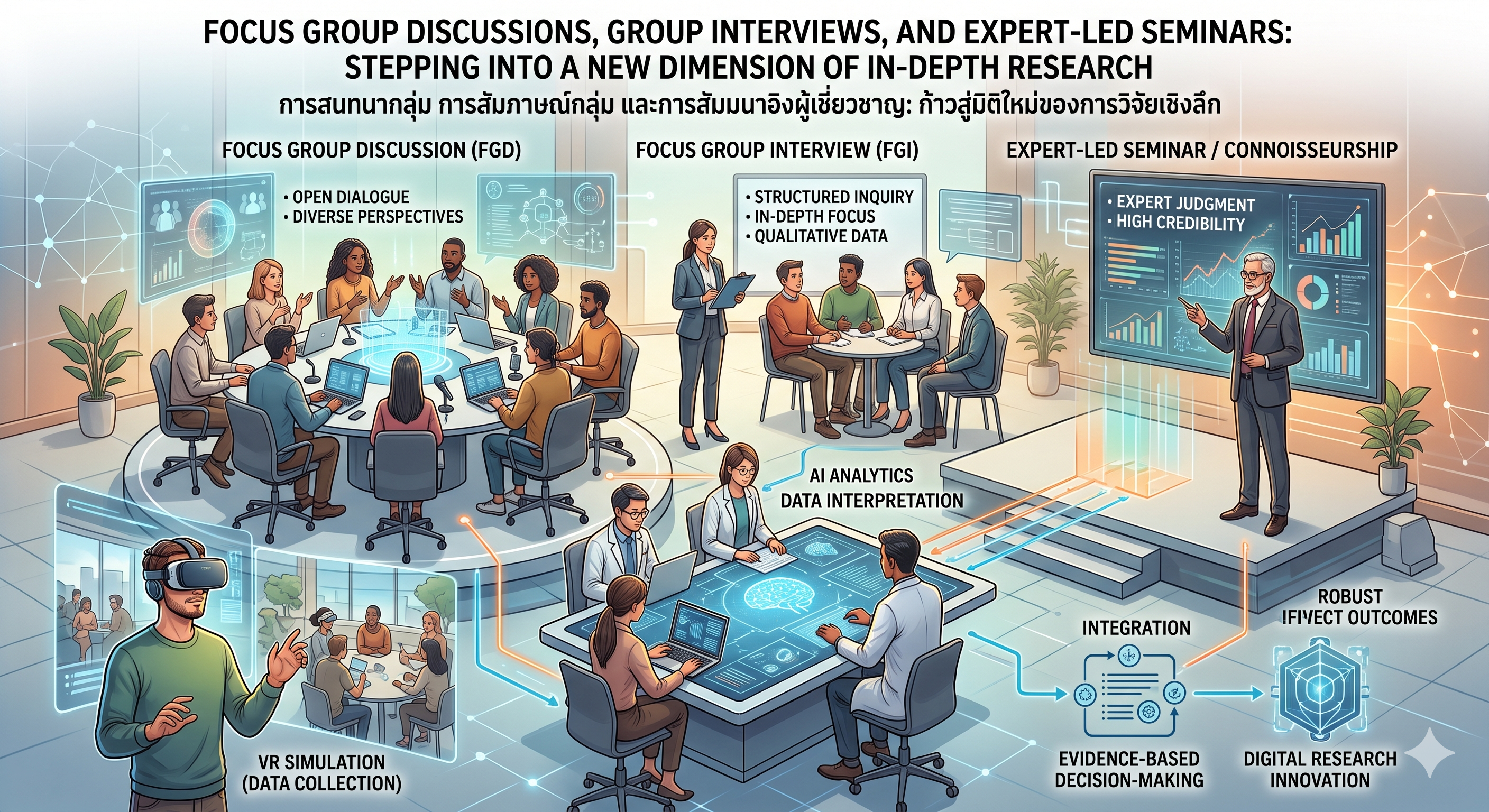
Focus Group Discussions, Group Interviews, and Expert-led Seminars: Stepping into a New Dimension of In-Depth Research
DOI:
https://doi.org/10.14456/rc-sdj.2026.2Keywords:
Focus Group Discussion, Focus Group Interview, Connoisseurship, Qualitative Research, Digital Research InnovationAbstract
Introduction: Qualitative research methodologies are crucial for understanding intricate human behaviors and complex social phenomena in the social sciences and humanities. As contemporary research challenges become increasingly multifaceted, refining advanced methodologies is essential. This article aims to critically explore three prominent qualitative research tools—Focus Group Discussion (FGD), Focus Group Interview (FGI), and Connoisseurship—along with their methodological evolution and strategic integration within the modern digital era.
Subject: The study comprehensively analyzes each method's definition, structured implementation process, inherent strengths, and contextual applicability. FGD is highlighted as an effective instrument for gathering diverse perspectives through open, interactive dialogue, making it suitable for exploring broad social issues. Conversely, FGI employs a more rigorously structured approach, facilitating the in-depth exploration of highly specific topics. Connoisseurship relies on refined expert judgment to generate insights with exceptional credibility and analytical depth. Furthermore, the article profoundly examines the integration of these traditional qualitative methods with cutting-edge technological advancements. Specifically, it discusses how incorporating Artificial Intelligence (AI) for real-time transcription and thematic extraction, alongside Virtual Reality (VR) for immersive participant environments, optimizes data collection, accelerates analysis, and enhances interpretation accuracy.
Conclusion: The findings conclusively indicate that utilizing these distinctive methods, whether applied individually or strategically combined, yields significantly more comprehensive, nuanced, and robust research outcomes. Integrating state-of-the-art digital advancements systematically mitigates traditional methodological limitations, thereby elevating research efficiency, strengthening data validity, and significantly expanding the overall scalability of contemporary qualitative studies.
Benefit, Utilization: The critical insights derived from this article empower modern researchers and practitioners to appropriately select, adapt, and synergize these methodologies while effectively navigating rapid technological shifts. This synthesized knowledge fundamentally supports rigorous, evidence-based decision-making. Consequently, these advanced approaches can be practically applied across a multitude of academic disciplines and professional fields, offering substantial contributions to strategic policy development, educational planning, and complex community-based studies.
References
Braun, V., & Clarke, V. (2006). Using thematic analysis in psychology. Qualitative Research in Psychology, 3(2), 77-101. https://doi.org/10.1191/1478088706qp063oa
Creswell, J. W. (2013). Qualitative inquiry and research design: Choosing among five approaches (3rd ed.). SAGE Publications.
Creswell, J. W., & Poth, C. N. (2018). Qualitative inquiry and research design: Choosing among five approaches (4th ed.). SAGE Publications.
Denzin, N. K., & Lincoln, Y. S. (2018). The SAGE handbook of qualitative research (5th ed.). SAGE Publications.
Eamtip, M. (2022). Focus group discussion: Qualitative data collection technique. Journal of Liberal Arts and Service Industry, 5(1), 96-104. (In Thai)
https://so01.tci-thaijo.org/index.php/JLASI/article/view/250740
Isarapreeda, W. (2022). Online Focus Group Discussion: Qualitative Data Collection Technique in the Era of Social Distancing the Online Focus Group Discussion: Qualitative Data Collection Technique During the Period of Social Distancing. ARU Research Journal Humanities and Social Sciences, 9(1), 135–148. (In Thai) https://so01.tci-thaijo.org/index.php/rdi-aru/article/view/249759
Krueger, R. A., & Casey, M. A. (2015). Focus groups: A practical guide for applied research (5th ed.). SAGE Publications.
Morgan, D. L. (1997). Focus groups as qualitative research (2nd ed.). SAGE Publications. https://doi.org/10.4135/9781412984287
Pinthapataya, S. (2024). Literature: Indicators of The Value of Research/Dissertation. Journal of Business and Industrial Development, 3(3), 1–2. (In Thai)
https://so15.tci-thaijo.org/index.php/Journalbid/article/view/402
Teerawithayaler, P. & Chumkaew, S. (2024). Evaluation of Management Styles through Expert Seminar Methods (Connoisseurship) in Educational Administration Research. Journal of Teacher Professional Development, 5(3), 15-28. (In Thai)
https://ph02.tci-thaijo.org/index.php/withayajarnjournal/article/view/255407