
การพัฒนาแบบประเมินทักษะการแก้ปัญหาอย่างสร้างสรรค์สำหรับกิจกรรมการเรียนรู้ตามแนวคิดสะตีมศึกษาเน้นโครงงานเป็นฐานด้วยการบูรณาการโมเดลเศรษฐกิจบีซีจี
คำสำคัญ:
แบบประเมินทักษะการแก้ปัญหาอย่างสร้างสรรค์, สะตีมศึกษา, โครงงานเป็นฐาน, โมเดลเศรษฐกิจบีซีจีบทคัดย่อ
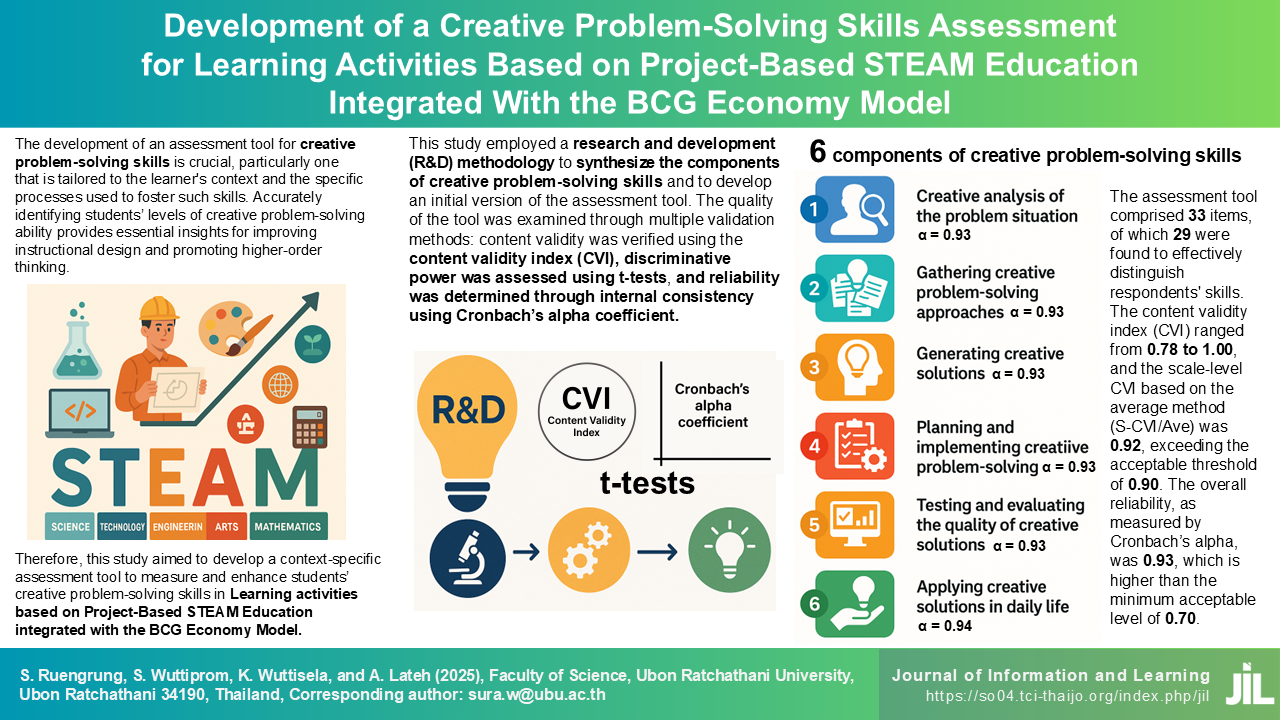
การวิจัยครั้งนี้มีวัตถุประสงค์ 1) เพื่อสังเคราะห์องค์ประกอบของทักษะการแก้ปัญหาอย่างสร้างสรรค์ และ 2) เพื่อพัฒนาและตรวจสอบคุณภาพของแบบประเมินทักษะการแก้ปัญหาอย่างสร้างสรรค์สำหรับกิจกรรมการเรียนรู้ตามแนวคิดสะตีมศึกษาเน้นโครงงานเป็นฐานด้วยการบูรณาการโมเดลเศรษฐกิจบีซีจี กลุ่มตัวอย่างที่ใช้ในการทดลองใช้เครื่องมือ คือ นักเรียนชั้นมัธยมศึกษาปีที่ 6 ห้องเรียนพิเศษวิทยาศาสตร์ คณิตศาสตร์ จำนวน 34 คน สังเคราะห์และนิยามองค์ประกอบของทักษะการแก้ปัญหาอย่างสร้างสรรค์โดยวิเคราะห์ความถี่ของคำสำคัญ และวิเคราะห์ข้อมูลเพื่อตรวจสอบคุณภาพของแบบประเมิน ได้แก่ ความเที่ยงตรงเชิงเนื้อหา อำนาจจำแนก และความเชื่อมั่น ผลการวิจัยพบว่า 1) องค์ประกอบของทักษะการแก้ปัญหาอย่างสร้างสรรค์ มี 6 องค์ประกอบ คือ (1) การวิเคราะห์สถานการณ์ปัญหาอย่างสร้างสรรค์ (2) การรวบรวมแนวทางการแก้ปัญหาอย่างสร้างสรรค์ (3) การสร้างสรรค์วิธีการแก้ปัญหา (4) การวางแผนและดำเนินการแก้ปัญหาอย่างสร้างสรรค์ (5) การทดสอบประเมินคุณภาพของวิธีการแก้ปัญหาอย่างสร้างสรรค์ และ (6) การนำไปใช้ในชีวิตประจำวันอย่างสร้างสรรค์ 2) แบบประเมินมีข้อคำถามทั้งหมด 33 ข้อคำถามมีความเที่ยงตรงเชิงเนื้อหาที่สามารถนำไปใช้ได้ โดยมีค่าดัชนี CVI อยู่ระหว่าง 0.78-1.00 และค่าเฉลี่ยสัดส่วน S-CVI/Ave เท่ากับ 0.92 สูงกว่าเกณฑ์ขั้นต่ำที่ยอมรับได้ 0.90 คุณภาพของแบบประเมินทักษะการแก้ปัญหาอย่างสร้างสรรค์อยู่ในระดับผ่านเกณฑ์ทุกองค์ประกอบ โดยมีค่าความเชื่อมั่นของครอนบาคแอลฟา รวมทั้งฉบับเท่ากับ 0.94 สูงกว่าเกณฑ์ขั้นต่ำที่ยอมรับได้ที่ 0.70 และมีข้อคำถามที่จำแนกได้จำนวน 29 ข้อคำถามจากข้อคำถามทั้งหมด
เอกสารอ้างอิง
Abraham, C., Zachary, S., Galy, B., Tali, S., & Roni, R. (2013). Transformational leadership and creative problem solving: The mediating role of psychological safety and reflexivity. Journal of Creative Behavior, 48(2), 155–135. https://doi.org/10.1002/jocb.43
Ahmed., S. A., & Alzahrani., S. G. (2020). Impact of creative problem-solving program on the development of creative thinking skills among university female students. Arts and Humanities, 28, 277–295. https://doi.org/10.4197/Art.28-9.9
Amran, M. S., Kutty, F. M., & Surat, S. (2019). Creative problem-solving (CPS) skills among university students. Creative Education, 10(12), 3049–3058. https://doi.org/10.4236/ce.2019.1012229
Anthawa, Y., & Art-in, S. (2024). The development of creative problem-solving and scientific thinking skills for grade 4 students using problem-based learning with augmented reality technology. Journal of Education Khon Kaen University, 47(2), 64–80. https://so02.tci-thaijo.org/index.php/EDKKUJ/article/view/266910
Apibuntho, P. N. (2024). Active learning to enhance creative problem-solving skills. Journal of Santayaphiwat Wat Nongnokkod, 2(4), 39–53. https://so16.tci-thaijo.org/index.php/jswn/article/view/818
Audmuangpiea, S., Ruangsan, N., & Saengsai, P. (2024). The development of a learning management model based on the Four Noble Truths to promote creative problem-solving skills among undergraduate students at Mahamakut Buddhist University, Isan Campus. Journal of Buddhist Education and Research, 10(3), 41–52. https://so06.tci-thaijo.org/index.php/jber/article/view/276695
Aytekin, A., & TopÇu, M. S. (2024). Improving 6th grade students’ creative problem-solving skills through plugged and unplugged computational thinking approaches. Journal of Science Education and Technology, 33(5), 1–25. https://doi.org/10.1007/s10956-024-10130-y
Başaran, M., & Erol, M. (2021). Recognizing aesthetics in nature with STEM and STEAM education. Research in Science & Technological Education, 41(1), 326–342. https://doi.org/10.1080/02635143.2021.1908248
Chaiyarat, K. (2024). Enhancing creative problem solving and learning motivation in social studies classrooms with gamified cooperative learning. Thinking Skills and Creativity, 54, Article 101616. https://doi.org/10.1016/j.tsc.2024.101616
Chaleoychanya, P., Thammetar, T., Satiman, A., & Bangtamai, E. (2023). Development of online project-based learning model integrated with design thinking to enhance creative problem-solving abilities and creative products of undergraduate students. Journal of Information and Learning, 34(2), 25–39. https://so04.tci-thaijo.org/index.php/jil/article/view/265423
Chanpala, P., & Sitthisomboon, M. (2021). The development of an instructional model to enhance creative problem-solving for student teachers at Rajabhat University. Journal of Education Naresuan University, 23(1), 204–213. https://so06.tci-thaijo.org/index.php/edujournal_nu/article/view/190682
Chung, C. C., Huang, S. L., Cheng, Y. M., & Lou, S. J. (2022). Using an iSTEAM project-based learning model for technology senior high school students: Design, development, and evaluation. International Journal of Technology and Design Education, 32, 905–941. https://link.springer.com/article/10.1007/s10798-020-09643-5
Churat, W., Chanunan, S., & Chaiyasith, W. C. (2023). Developing 11th graders' creative problem-solving skills using creative problem-solving models with infographics on the topic of acids – bases. Journal of Education and Innovation, 25(3), 229–239. https://so06.tci-thaijo.org/index.php/edujournal_nu/article/view/251696
Cronbach, L. J. (1951). Coefficient alpha and the internal structure of tests. Psychometrika, 16(3), 297–334. https://doi.org/10.1007/BF02310555
Faikhamta, C., Suknarusaithagul, N., Yokyong, S., Panyanukit, P., Prasoplarb, T., Muangsong, K., Ninubon, J., & Nuamcharoen, N. (2022). A conceptualization of STEM–BCG for education. Journal of Research in Unit for Science, Technology, and Environmental Learning, 13(2), 344–362. https://ejournals.swu.ac.th/index.php/JSTEL/article/view/14452
Hooijdonk, M. V., Mainhard, T., Kroesbergen, E. H., & Tartwijk, J. V., (2023). Creative problem solving in primary school students. Learning and Instruction, 88, 1–13. https://doi.org/10.1016/j.learninstruc.2023.101823
Isaksen, S. G., Puccio, G. J., & Treffinger, D. J. (1993). An ecological approach to creativity research: Profiling for creative problem solving. Journal of Creative Behavior, 27(3), 149–170. https://doi.org/10.1002/j.2162-6057.1993.tb00704.x
Jongchaloemchai, P. (2023). Key skills for future learners: Creative problem solving. Academic Journal of Phetchaburi Rajabhat University, 13(3), 125–133. https://so03.tci-thaijo.org/index.php/ajpbru/article/view/265063
Karamustafaoğlu, O., & Pektaş, H. M. (2023). Developing students’ creative problem-solving skills with inquiry-based STEM activity in an out-of-school learning environment. Education and Information Technologies, 28, 7651–7669. https://doi.org/10.1007/s10639-022-11496-5
Khodchapong, N. (2018). Development of psychological learning management model to promote creative problem solving among pre-service teachers [Doctoral dissertation, Srinakharinwirot University]. DSpace JSPUI. http://ir-ithesis.swu.ac.th/dspace/handle/123456789/269
Kima, S., IChoea, I., & Kaufman, J.C. (2019). The development and evaluation of the effect of creative problem-solving programs on young children’s creativity and character. Thinking Skills and Creativity, 33, Article 100590. https://doi.org/10.1016/j.tsc.2019.100590
Kong, S. C. (2022). Problem formulation in computational thinking development for nurturing creative problem solvers in primary School. Education and Information Technologies, 27, 12523–12542. https://doi.org/10.1007/s10639-022-11101-9
Kongpiboon, W. (2023). Learning management based on creative problem-solving approaches. Journal of Industrial Education, 22(1), 1–4. https://ph01.tci-thaijo.org/index.php/JIE/article/view/252562
Kraisujit, K., Charoendee, T., Khamthong, N., Singtokaew, S., & Pitipornthepin, S. (2022). STEM education for sustainable living. NSTDA Magazine, 50(236), 5–9. https://emagazine.ipst.ac.th/236/2
Küçükaydın, M. A., & Ulum, H. (2024). The mediating role of creative problem-solving between design thinking and self-efficacy in STEM teaching for STEM teacher candidates. International Journal of Technology and Design Education, 35, 629–645. https://doi.org/10.1007/s10798-024-09923-4
Kunacheva, N. (2023). Creative problem solving (CPS) learning management. Interdisciplinary Academic and Research Journal, 3(6), 649–668. https://doi.org/10.60027/iarj.2023.271089
Lee, T., O’Mahony, L., & Lebeck, P. (2023). Creative problem-solving. In Creativity and innovation (pp. 117–147). Palgrave Macmillan. https://doi.org/10.1007/978-981-19-8880-6_5
Lynn, M. R. (1986). Determination and quantification of content validity. Nursing Research, 35(6), 382–385. https://doi.org/10.1097/00006199-198611000-00017
Meetup, W. (2022). The development of creative problem-solving skills of six grade students with project-based learning management in combination with infographics [Master’s thesis, Silpakorn University]. DSpace JSPUI. http://ithesis-ir.su.ac.th/dspace/bitstream/123456789/4383/1/640620037.pdf
Mejía-Villa, A., Torres-Guevara, L. E., Prieto-Sandoval, V., Cabra, J., & Jaca, C. (2023). Training for sustainability through biomimicry and creative problem-solving processes. Thinking Skills and Creativity, 49, Article 101359. https://doi.org/10.1016/j.tsc.2023.101359
National Science and Technology Development Agency. (2020, December 16). What is the BCG economy model. NSTDA BCG Knowledge Repository. https://www.nstda.or.th/home/knowledge_post/what-is-bcg-economy-model
Office of the Basic Education Commission. (2021, October 28). Kao raek kan chatkan rienru doi chai khrongngan pen than [First steps in project-based learning management]. Ministry of Education. https://elibrary.ksp.or.th/index.php?lvl=notice_display&id=21656
Osborn, A. F. (1963). Applied imagination: Principles and procedures of creative problem solving (3rd rev. ed.). Scribners.
Park, Y. -S., & Green, J. (2019). Bringing computational thinking into science education. Journal of the Korean Earth Science Society, 40(4), 340–352. https://doi.org/10.5467/JKESS.2019.40.4.340
Pattiyathani, S. (2024). Creating a questionnaire or scale form. Journal of Graduate School of Management Studies of Sripatum University Khon Kaen Campus, 1(2), 1–17. https://so18.tci-thaijo.org/index.php/JGSM_SPUKK/article/view/541
Phaksunchai, M. (2019). Assessing of creative problem solving of King Mongkut's University of Technology Thonburi’s undergraduate students. Veridian E-Journal,Silpakorn University, 10(2), 2654–2661. https://he02.tci-thaijo.org/index.php/Veridian-E-Journal/article/view/105822
Phengnoi, D., & Boonsom, N. (2021). Development of scientific work creation and creative problem-solving abilities for fifth grade students by STEAM education-based learning activities management. Silpakorn Educational Research Journal, 13(1), 238–257. https://so05.tci-thaijo.org/index.php/suedureasearchjournal/article/view/249185
Phonphotthanamat, W. (2022). A comparative study of verifying the content validity of a research instrument with the IOC, CVR and CVI. Rangsit Journal of Information, 28(1), 169–192. https://rilj.rsu.ac.th/journal/57/article/281
Phuakchaowai, P., Sarayuthpitak, J., & Rodpipat, S. (2023). Development of health education learning using creative problem-solving model to enhance learning achievement and communication skills for secondary school students. Academic Journal of Thailand National Sports University, 15(3), 45–55. https://he02.tci-thaijo.org/index.php/TNSUJournal/article/view/257669
Pipatsuntikul, P., & Hutasukpat, S. (2023). Youth development model 4.0 to create innovation career skills with creative thinking. Research for Community Service Journal, 9(1), 34–48. https://so02.tci-thaijo.org/index.php/DRURDI/article/view/260218
Ploykrajang, K., Pitiporntapin, S., & Boonsoong, B. (2021). The development of creative problem-solving process on “Cells and Cell Functions” topic through STEAM Education. Journal of Educational Studies Review, 36(3), 163–175. https://so04.tci-thaijo.org/index.php/eduku/article/view/244398
Polit, D. F., & Beck, C. T. (2006). Essentials of nursing research: Methods, appraisal, and utilization (6th ed.). Lippincott Williams & Wilkins.
Prasoplarb, T., Pootawee, J., & Lertdechapat, K. (2024). Development of a BCG economy model-integrated STEM learning activities. Journal of Education Studies, 52(1), 1–15. https://so02.tci-thaijo.org/index.php/EDUCU/article/view/262243
Prommool, S., Boonchan, B., & Nopakun, A. (2024). The development of Thai teacher competencies in the new normal era based on sustainable development concepts. Journal of Association of Professional Development of Educational Administration of Thailand, 6(2), 451–465. https://so04.tci-thaijo.org/index.php/JAPDEAT/article/view/270896
Rastogi, R., Arora, N., & Tawar, P. S. (2018). Statistical analysis for the effect of positive thinking on stress management and creative problem solving for adolescents [Paper presentation].The 5th International Conference on Computing for Sustainable Global Development, New Delhi, India. https://www.researchgate.net/publication/326710205
Ruamcharoen, J., Kerdthip, K., & Jeerasathian, P. (2021). STEM education for lifelong learning: Case study to raise the creative products level from banana leaf to drive the community economy. Journal of Education and Innovative Learning, 1(2), 187–206. https://so06.tci-thaijo.org/index.php/jeil/article/view/248913
Saengloetuthai, J. (2017). Quality of research instrument. Journal of Research and Curriculum Development, 7(1), 1–15. https://ejournals.swu.ac.th/index.php/jrcd/article/view/9145
Sirapanuwat, N., Satiman, A., Thammetar, T., & Ruangrit, N. (2023). The development of a blended instructional model using augmented reality and innovative design-based learning to enhance undergraduate students' ability in creative jewelry design. Journal of Information and Learning, 33(3), 12–21. https://so04.tci-thaijo.org/index.php/jil/article/view/257918
Sophonhiranrak, S., Assapun, S., & Tubpan, T. (2023). Study and development of creative problem-solving performance factors from the creative problem-solving process. Journal of Graduate Studies Valaya Alongkron Rajabhat University, 17(3), 209–224. https://so02.tci-thaijo.org/index.php/JournalGradVRU/article/view/261030
Susing, J., & Chaijaroen, S. (2020). Designing framework of constructivist web-based learning environments with augmented reality to enhance creative thinking on topic of animation for grade 9 students. Journal of Information and Learning, 31(2), 1–9. https://so04.tci-thaijo.org/index.php/jil/article/view/245119
Suwanro, P., Intrasit, A., Riyapan, P., & Suwanro, S. (2023). The development of flipped classroom learning method to improve creative thinking skills in visual arts for first year students in art education program. Journal of Information and Learning, 34(1), 1–11. https://so04.tci-thaijo.org/index.php/jil/article/view/261210
Tapingkae, P. (2023). The development of an instructional model based on contextual inquiry project-based learning to enhance computational thinking for grade 7 students. Journal of Education Khon Kaen University, 46(3), 28–46. https://so02.tci-thaijo.org/index.php/EDKKUJ/article/view/260428
Treffinger, D. J. (2000). Understanding the history of CPS. In S. G. Isaksen (Ed.), Facilitative leadership: Making a difference with CPS (pp. 35-53). Kendall/Hunt.
Vongtathum, P. (2015). Creative problem-solving thinking skills for 21st century of learning. Journal of Education Khon Kaen University, 38(2), 111–121. https://so02.tci-thaijo.org/index.php/EDKKUJ/article/view/47932
Vorawattanachai, P. (2022). Fundamental knowledge in creative thinking. Journal of Educational Studies, 16(1), 14–31. https://edujournal.bsru.ac.th/publishes/20/articles/381
Wongratana, C. (2021). Techniques for using statistics in research (15th ed.). Amorn Printing.
Yaemkhayai, C. (2023). Development and inspection for measuring instruments of creative problem solving of students-teachers' professional. Journal of Academic Education Chiang Rai Rajabhat University, 8(2), 149–172. https://so05.tci-thaijo.org/index.php/jeducrru/article/view/266470
ดาวน์โหลด
ไฟล์ประกอบ
เผยแพร่แล้ว
รูปแบบการอ้างอิง
ฉบับ
ประเภทบทความ
หมวดหมู่
สัญญาอนุญาต
ลิขสิทธิ์ (c) 2025 Journal of Information and Learning [JIL]

อนุญาตภายใต้เงื่อนไข Creative Commons Attribution-NonCommercial-NoDerivatives 4.0 International License.
Journal of Information and Learning ดำเนินการโดยสำนักวิทยบริการ มหาวิทยาลัยสงขลานครินทร์ วิทยาเขตปัตตานี บทความที่ได้รับการตีพิมพ์ในวารสารได้รับความคุ้มครองตามกฎหมายลิขสิทธิ์ โดยเจ้าของลิขสิทธิ์จะมีสิทธิในการทำซ้ำ ดัดแปลง และเผยแพร่งานบทความ ทั้งรูปแบบอิเล็กทรอนิกส์ การทำฉบับสำเนา การแปล และการผลิตซ้ำในรูปแบบต่างๆ ลิขสิทธิ์บทความเป็นของผู้เขียนและสำนักวิทยบริการ มหาวิทยาลัยสงขลานครินทร์ วิทยาเขตปัตตานี วารสารฯ ขอสงวนสิทธิ์ในการพิจารณาตีพิมพ์ตามความเหมาะสม รวมทั้งการตรวจทานแก้ไข การปรับข้อความ หรือขัดเกลาภาษาให้ถูกต้องตามเกณฑ์ที่กำหนด สำหรับผลการวิจัยและความคิดเห็นที่ปรากฏในบทความถือเป็นความคิดเห็นและอยู่ในความรับผิดชอบของผู้เขียน


