The Influence of Internal Organizational Communication on Economic and Green Management Efficiency in Electric Truck Utilization within Logistics Organization
DOI:
https://doi.org/10.14456/rc-sdj.2026.4Keywords:
Internal Organizational Communication, Green Management Efficiency, Economic Efficiency, Electric Trucks, Logistics BusinessAbstract
Introduction: The logistics industry is an important mechanism driving the Thai economy. However, road transportation remains a major source of carbon dioxide emissions. The use of electric trucks is therefore an important approach to support green logistics and reduce energy costs. Nevertheless, the successful adoption of electric trucks requires internal organizational communication to create shared understanding among employees. This study aimed to analyze the influence of internal organizational communication on green management efficiency and economic efficiency.
Methodology: This study employed a quantitative research design and collected data using a questionnaire. The sample consisted of 101 employees from a logistics organization in Thailand that had adopted electric trucks. The respondents were selected through purposive sampling. The questionnaire covered internal organizational communication, green management efficiency, and economic efficiency. Data were analyzed using descriptive statistics and Ordinal Logit Regression with a Hierarchical Regression approach.
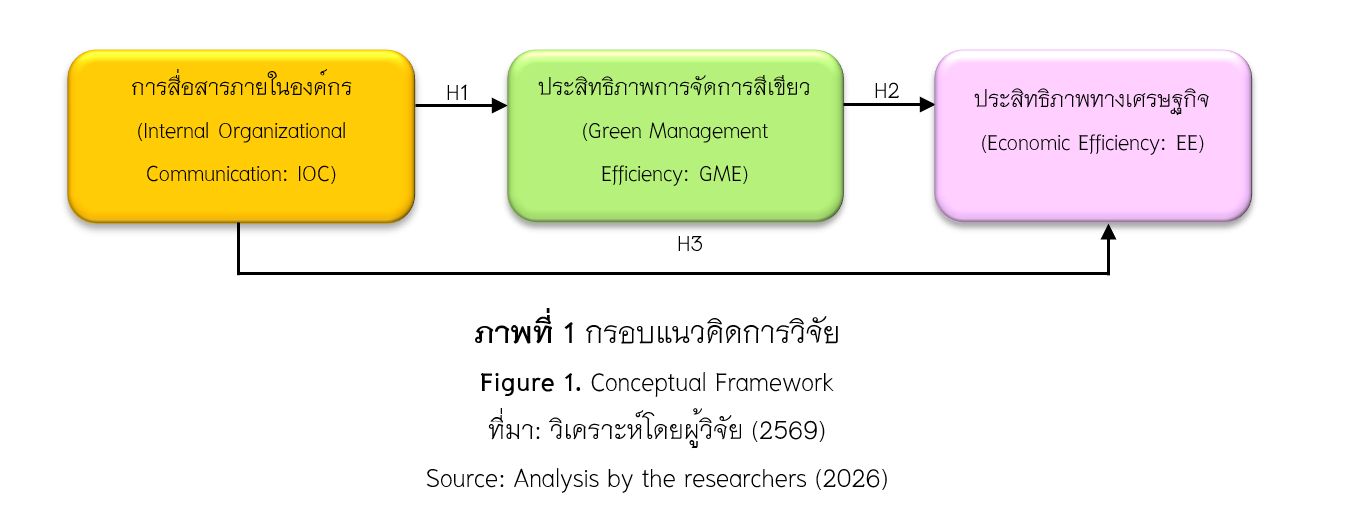
Results: The respondents reported a high level of agreement regarding internal organizational communication, green management efficiency, and economic efficiency. The Cronbach’s alpha coefficients of all three variables were at a high level. The analysis revealed that internal organizational communication had a statistically significant positive effect on green management efficiency and also had an indirect positive effect on economic efficiency through green management efficiency.
Discussion: The findings indicated that achieving economic efficiency from the use of electric trucks required effective green management. Such green management was supported by internal communication that created shared understanding among employees with different roles and experiences.
Suggestion: Logistics organization should establish electric truck policies that are linked to green management strategies, develop internal communication systems, and encourage feedback from operational employees. In addition, the government should support incentive measures, infrastructure development, and human resource development to accelerate the transition toward a low-carbon transportation system.
References
Altaf, A., El Amraoui, A., Delmotte, F., Lecoutre, C., & El Amraoui, L. (2025). Eco-Efficiency in Logistics and Cross-Docking: A Systematic Literature Review on the Usability of Green Vehicles. IEEE Access, 13, 196973-197000. https://doi.org/10.1109/ACCESS.2025.3629043
Chanda, R. C., Vafaei-Zadeh, A., Hanifah, H., Ashrafi, D. M., & Ahmed, T. (2024). Achieving a sustainable future by analyzing electric vehicle adoption in developing nations through an extended technology acceptance model. Sustainable Futures, 8, 100386. https://doi.org/10.1016/j.sftr.2024.100386
Christina, J. L., Alamelu, R., & Nigama, K. (2025). Synthesizing the impact of sustainable human resource management on corporate sustainability through multi method evidence. Discover Sustainability, 6(1), 666. https://doi.org/10.1007/s43621-025-01557-3
Department of Land Transport, Planning Division Transport Statistics Group. (2026). Statistics of accumulated registered vehicles up to December 2025 (In Thai). https://web.dlt.go.th/statistics/
Duangchinda, W., Kayee, P., Toraninpanich, S., Thawon, I., Dechkoch, K., Wongsapai, W., . . . Suttakul, P. (2025). Promoting battery-electric trucks through freight decarbonization policy in Thailand’s Eastern Economic Corridor. Journal of Energy Systems, 9(4), 322-334. https://doi.org/10.30521/jes.1760027
Energy Policy and Planning Office. (2025). Carbon dioxide emissions by energy type and economic sector (In Thai). Ministry of Energy. https://www.eppo.go.th/index.php/th/energy-information/static-energy/static-co2
Fullerton, A. S., & Anderson, K. F. (2023). Ordered regression models: A tutorial. Prevention Science, 24(3), 431-443. https://doi.org/10.1007/s11121-021-01302-y
Garg, A., & Vemaraju, S. (2024). The Impact of Green Logistics Management on Sustainable Logistics Performance. Library of Progress-Library Science, Information Technology & Computer, 44(3). 17301-17308.
Guo, H., Xu, J., Yang, W., & Yu, B. (2025). Overseas Network and Entrepreneurial Motivation on Returnee Entrepreneurial Performance: Findings from Hierarchical Multiple Regression and fsQCA Approaches. SSRN.5194563. https://doi.org/10.2139/ssrn.5194563
Kanyepe, J., Alfaneta, M., & Zizhou, B. (2023). Green logistics adoption and operational performance within the road freight sector: The moderating role of management commitment. Logistics Research, 16(1), 1-14. https://doi.org/10.23773/2023_12
Kartika, M., Ramdani, G., & Wijijayanti, T. (2026). Green Entrepreneurship in Developing Countries: A Systematic Review of the driving factors and challenges in realizing sustainable business. International Journal of Humanity Advance, Business & Sciences (IJHABS), 3(3), 423-434. https://doi.org/10.59971/ijhabs.v3i3.814
Lai, J., Zou, Y., Zhang, J., & Peres‐Neto, P. R. (2022). Generalizing hierarchical and variation partitioning in multiple regression and canonical analyses using the rdacca. hp R package. Methods in Ecology and Evolution, 13(4), 782-788. https://doi.org/10.1111/2041-210X.13800
Makprang, K. (2024). The Interplay of Green Logistics practices, Social Sustainability, and Government Policy in the Logistics Industry. Journal of Logistics and Digital Supply Chain, 2(1), 11-26.
Mu, Z., Zhao, F., Bai, F., Liu, Z., & Hao, H. (2024). Evaluating Fuel Cell vs. Battery Electric Trucks: Economic Perspectives in Alignment with China’s Carbon Neutrality Target. Sustainability, 16(6), 2427. In. https://doi.org/10.3390/su16062427
Musa, M. R., Wada, K. N., Elatikpo, I. S., Yusuf, K. M., Sagir, B., & Jediel, B. V. (2025). Technology Transfer and Green Logistics Integration: A Policy-Oriented Framework for Sustainable Logistics Firms in Nigeria. Journal of Science Innovation and Technology Research, 10(9), 293 - 311. https://doi.org/10.70382/ajsitr.v10i9.077
Pan, C., Abbas, J., Álvarez-Otero, S., Khan, H., & Cai, C. (2022). Interplay between corporate social responsibility and organizational green culture and their role in employees’ responsible behavior towards the environment and society. Journal of Cleaner Production, 366, 132878. https://doi.org/10.1016/j.jclepro.2022.132878
Rapson, D. S., & Muehlegger, E. (2023). The economics of electric vehicles. Review of environmental economics and policy, 17(2), 274-294. https://doi.org/10.1086/725484
Tang, W., He, H., & Tu, X. M. (2023). Applied categorical and count data analysis. Chapman and Hall/CRC.
Thanatrakolsri, P., & Sirithian, D. (2025). Toward low-carbon mobility: Greenhouse gas emissions and reduction opportunities in Thailand’s road transport sector. Clean Technologies, 7(3), 60. https://doi.org/10.3390/cleantechnol7030060
United Nations Framework Convention on Climate Change. (2022). Thailand long-term low greenhouse gas emission development strategy: Revised version. https://unfccc.int/sites/default/files/resource/Thailand%20LT-LEDS%20%28Revised%20Version%29_08Nov2022.pdf
Zeng, T., Zhang, H., Moura, S. J., & Shen, Z.-J. M. (2024). Economic and environmental benefits of automated electric vehicle ride-hailing services in New York City. Scientific Reports, 14(1), 4180. https://doi.org/10.1038/s41598-024-54495-x