อิทธิพลของการสื่อสารภายในองค์กรต่อประสิทธิภาพทางเศรษฐกิจและ ประสิทธิภาพการจัดการสีเขียวขององค์กรจากการใช้รถบรรทุกไฟฟ้าในธุรกิจโลจิสติกส์
DOI:
https://doi.org/10.14456/rc-sdj.2026.4คำสำคัญ:
การสื่อสารภายในองค์กร, ประสิทธิภาพการจัดการสีเขียว, ประสิทธิภาพทางเศรษฐกิจ, รถบรรทุกไฟฟ้า, ธุรกิจโลจิสติกส์บทคัดย่อ
ที่มาและวัตถุประสงค์การวิจัย: อุตสาหกรรมโลจิสติกส์เป็นกลไกสำคัญของเศรษฐกิจไทย แต่ภาคขนส่งทางถนน ยังเป็นแหล่งปล่อยก๊าซคาร์บอนไดออกไซด์ที่สำคัญ การใช้รถบรรทุกไฟฟ้า
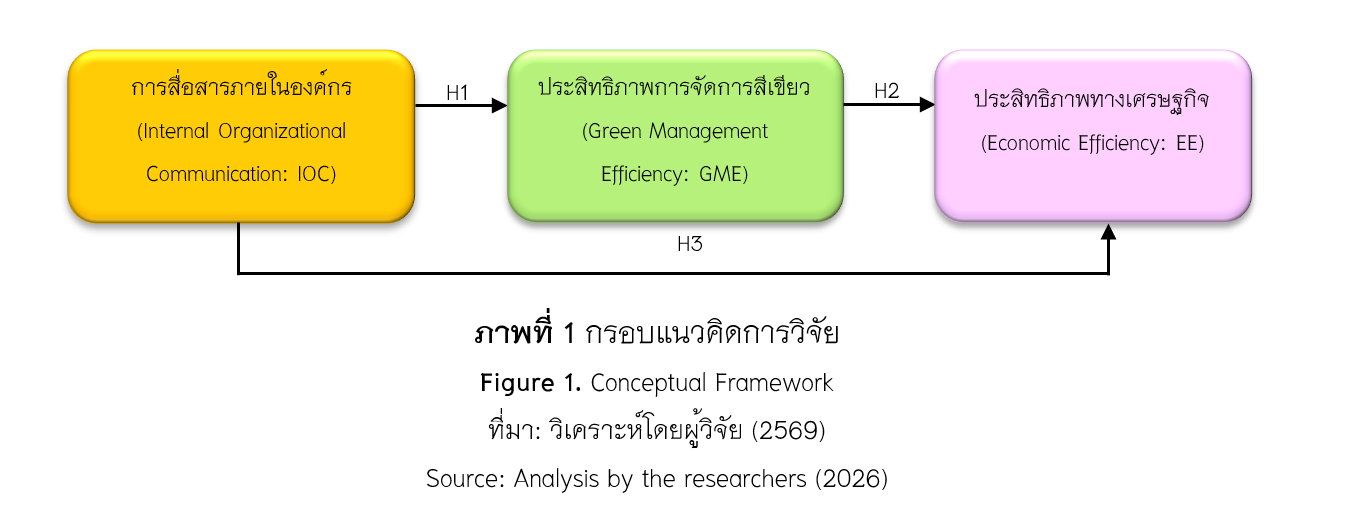
จึงเป็นแนวทางสำคัญในการสนับสนุนโลจิสติกส์สีเขียว และลดต้นทุนพลังงาน อย่างไรก็ตาม ความสำเร็จของการใช้รถบรรทุกไฟฟ้าต้องอาศัยการสื่อสารภายในองค์กรเพื่อสร้างความเข้าใจร่วมกัน งานวิจัยนี้มีวัตถุประสงค์เพื่อวิเคราะห์อิทธิพลของการสื่อสารภายในองค์กรต่อประสิทธิภาพการจัดการสีเขียวและประสิทธิภาพทางเศรษฐกิจ
ระเบียบวิธีวิจัย: การวิจัยนี้เป็นการวิจัยเชิงปริมาณ รวบรวมข้อมูลโดยใช้แบบสอบถาม
กลุ่มตัวอย่างคือพนักงานในองค์กรโลจิสติกส์ที่มีการใช้รถบรรทุกไฟฟ้า จำนวน 101 คน จากองค์กร
โลจิสติกส์แห่งหนึ่งในประเทศไทย ใช้วิธีการสุ่มแบบเฉพาะเจาะจง ครอบคลุมการสื่อสารภายในองค์กร ประสิทธิภาพการจัดการสีเขียว และประสิทธิภาพทางเศรษฐกิจ วิเคราะห์ข้อมูลด้วยสถิติเชิงพรรณนา และแบบจำลอง Ordinal Logit Regression แบบ Hierarchical Regression
ผลการวิจัย: ผู้ตอบแบบสอบถามมีความคิดเห็นต่อการสื่อสารภายในองค์กร ประสิทธิภาพการจัดการสีเขียว และประสิทธิภาพทางเศรษฐกิจอยู่ในระดับเห็นด้วยมาก โดยค่าสัมประสิทธิ์ครอนบาคของทั้งสามตัวแปรอยู่ในระดับสูง ผลการวิเคราะห์พบว่า การสื่อสารภายในองค์กรมีอิทธิพล
เชิงบวกต่อประสิทธิภาพการจัดการสีเขียวอย่างมีนัยสำคัญทางสถิติ และมีอิทธิพลเชิงบวกต่อประสิทธิภาพทางเศรษฐกิจทางอ้อมผ่านประสิทธิภาพการจัดการสีเขียว
อภิปรายผล: ผลการวิจัยสะท้อนว่า การใช้รถบรรทุกไฟฟ้าให้เกิดประสิทธิภาพทางเศรษฐกิจจำเป็นต้องอาศัยการจัดการสีเขียวที่มีประสิทธิภาพ ซึ่งเกิดจากการสื่อสารภายในองค์กรที่ช่วยสร้างความเข้าใจร่วมกันระหว่างบุคลากรต่างบทบาทและต่างประสบการณ์
ข้อเสนอแนะ: องค์กรโลจิสติกส์ควรกำหนดนโยบายการใช้รถบรรทุกไฟฟ้าให้เชื่อมโยงกับยุทธศาสตร์การจัดการสีเขียว พัฒนาระบบการสื่อสารภายในองค์กร และเปิดรับความคิดเห็นจากพนักงานระดับปฏิบัติการ ส่วนภาครัฐควรสนับสนุนมาตรการจูงใจ โครงสร้างพื้นฐาน และการพัฒนาบุคลากรเพื่อเร่งการเปลี่ยนผ่านสู่ระบบขนส่งคาร์บอนต่ำ
เอกสารอ้างอิง
Altaf, A., El Amraoui, A., Delmotte, F., Lecoutre, C., & El Amraoui, L. (2025). Eco-Efficiency in Logistics and Cross-Docking: A Systematic Literature Review on the Usability of Green Vehicles. IEEE Access, 13, 196973-197000. https://doi.org/10.1109/ACCESS.2025.3629043
Chanda, R. C., Vafaei-Zadeh, A., Hanifah, H., Ashrafi, D. M., & Ahmed, T. (2024). Achieving a sustainable future by analyzing electric vehicle adoption in developing nations through an extended technology acceptance model. Sustainable Futures, 8, 100386. https://doi.org/10.1016/j.sftr.2024.100386
Christina, J. L., Alamelu, R., & Nigama, K. (2025). Synthesizing the impact of sustainable human resource management on corporate sustainability through multi method evidence. Discover Sustainability, 6(1), 666. https://doi.org/10.1007/s43621-025-01557-3
Department of Land Transport, Planning Division Transport Statistics Group. (2026). Statistics of accumulated registered vehicles up to December 2025 (In Thai). https://web.dlt.go.th/statistics/
Duangchinda, W., Kayee, P., Toraninpanich, S., Thawon, I., Dechkoch, K., Wongsapai, W., . . . Suttakul, P. (2025). Promoting battery-electric trucks through freight decarbonization policy in Thailand’s Eastern Economic Corridor. Journal of Energy Systems, 9(4), 322-334. https://doi.org/10.30521/jes.1760027
Energy Policy and Planning Office. (2025). Carbon dioxide emissions by energy type and economic sector (In Thai). Ministry of Energy. https://www.eppo.go.th/index.php/th/energy-information/static-energy/static-co2
Fullerton, A. S., & Anderson, K. F. (2023). Ordered regression models: A tutorial. Prevention Science, 24(3), 431-443. https://doi.org/10.1007/s11121-021-01302-y
Garg, A., & Vemaraju, S. (2024). The Impact of Green Logistics Management on Sustainable Logistics Performance. Library of Progress-Library Science, Information Technology & Computer, 44(3). 17301-17308.
Guo, H., Xu, J., Yang, W., & Yu, B. (2025). Overseas Network and Entrepreneurial Motivation on Returnee Entrepreneurial Performance: Findings from Hierarchical Multiple Regression and fsQCA Approaches. SSRN.5194563. https://doi.org/10.2139/ssrn.5194563
Kanyepe, J., Alfaneta, M., & Zizhou, B. (2023). Green logistics adoption and operational performance within the road freight sector: The moderating role of management commitment. Logistics Research, 16(1), 1-14. https://doi.org/10.23773/2023_12
Kartika, M., Ramdani, G., & Wijijayanti, T. (2026). Green Entrepreneurship in Developing Countries: A Systematic Review of the driving factors and challenges in realizing sustainable business. International Journal of Humanity Advance, Business & Sciences (IJHABS), 3(3), 423-434. https://doi.org/10.59971/ijhabs.v3i3.814
Lai, J., Zou, Y., Zhang, J., & Peres‐Neto, P. R. (2022). Generalizing hierarchical and variation partitioning in multiple regression and canonical analyses using the rdacca. hp R package. Methods in Ecology and Evolution, 13(4), 782-788. https://doi.org/10.1111/2041-210X.13800
Makprang, K. (2024). The Interplay of Green Logistics practices, Social Sustainability, and Government Policy in the Logistics Industry. Journal of Logistics and Digital Supply Chain, 2(1), 11-26.
Mu, Z., Zhao, F., Bai, F., Liu, Z., & Hao, H. (2024). Evaluating Fuel Cell vs. Battery Electric Trucks: Economic Perspectives in Alignment with China’s Carbon Neutrality Target. Sustainability, 16(6), 2427. In. https://doi.org/10.3390/su16062427
Musa, M. R., Wada, K. N., Elatikpo, I. S., Yusuf, K. M., Sagir, B., & Jediel, B. V. (2025). Technology Transfer and Green Logistics Integration: A Policy-Oriented Framework for Sustainable Logistics Firms in Nigeria. Journal of Science Innovation and Technology Research, 10(9), 293 - 311. https://doi.org/10.70382/ajsitr.v10i9.077
Pan, C., Abbas, J., Álvarez-Otero, S., Khan, H., & Cai, C. (2022). Interplay between corporate social responsibility and organizational green culture and their role in employees’ responsible behavior towards the environment and society. Journal of Cleaner Production, 366, 132878. https://doi.org/10.1016/j.jclepro.2022.132878
Rapson, D. S., & Muehlegger, E. (2023). The economics of electric vehicles. Review of environmental economics and policy, 17(2), 274-294. https://doi.org/10.1086/725484
Tang, W., He, H., & Tu, X. M. (2023). Applied categorical and count data analysis. Chapman and Hall/CRC.
Thanatrakolsri, P., & Sirithian, D. (2025). Toward low-carbon mobility: Greenhouse gas emissions and reduction opportunities in Thailand’s road transport sector. Clean Technologies, 7(3), 60. https://doi.org/10.3390/cleantechnol7030060
United Nations Framework Convention on Climate Change. (2022). Thailand long-term low greenhouse gas emission development strategy: Revised version. https://unfccc.int/sites/default/files/resource/Thailand%20LT-LEDS%20%28Revised%20Version%29_08Nov2022.pdf
Zeng, T., Zhang, H., Moura, S. J., & Shen, Z.-J. M. (2024). Economic and environmental benefits of automated electric vehicle ride-hailing services in New York City. Scientific Reports, 14(1), 4180. https://doi.org/10.1038/s41598-024-54495-x