The Development of a Grassroots Economy Based on Cultural Capital through BCG (Bio-Circular-Green Economy) Strategy of the Karen Ethnic Group in Ban Nong Bang, Lin Thin Subdistrict, Thong Pha Phum District, Kanchanaburi Province
DOI:
https://doi.org/10.14456/nrru-rdi.2024.38Keywords:
Grassroots Economy, Cultural Capital, Karen Ethnic Group, BCG Strategy ModelAbstract
Background and Objective: The development of a participatory mechanism creates the potential for growth and a good quality of life for the Karen ethnic group in Ban Nong Bang, Linthin Subdistrict, Thong Pha Phum District, Kanchanaburi Province. This research aims to synthesize cultural capital, upgrade community products, and find ways to upgrade community products according to the BCG strategy (Bio-Economy, Circular Economy, and Green Economy).
Methodology: Mixed research methodology using purposive sampling to identify 53 informants and voluntarily randomly selected. The research instruments were 1) semi-structured interviews, 2) group discussion notes, 3) observation notes, and 4) field notebooks with content validity between 0.80-0.92 for the field data collection using in-depth interviews, group discussions, and community activities combined with participatory and non-participatory observations. The data were systematically analyzed for content by checking for accuracy, categorizing data, and interpreting them.
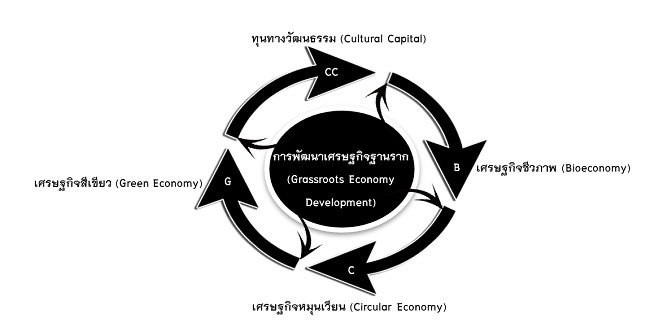
Results: 1) Three types of cultural capital: (1) Five dimensions of latent personal capital (traditional agricultural knowledge, beliefs and rituals, handicraft skills, local cooking skills, and knowledge of traditional medicinal herbs); (2) Two-dimensional capital (temples and sanctuaries, community development organizations and government projects); and (3) One-dimensional capital (Karen woven fabric and wickerwork). 2) Community product upgrading, consisting of (1) preserving local wisdom and traditional weaving; (2) changing from using chemical dyes to natural dyes; (3) integrating cultural capital with product development; (4) creating pride and sustainability in the community; for 3) Guidelines for upgrading community products according to the strategies of bioeconomy, circular economy and green economy by using methods of value-adding, maximum utilization and impact reduction.
Discussion: Integrating community cultural capital with bioeconomy, circular economy and green economy strategies can enhance products that enhance well-being, resilience and environmental safety, as well as increase market expansion opportunities for communities products.
Suggestion: The continuity of community product development should be created by using local resources and increasing digital channel innovation to sell and communicate meaning and identity to the public in truly.
References
Aroonsrimorakot, S., Laiphrakpam, M., & Paisantanakij, W. (2021). Application of innovative eco-friendly energy technology for sustainable agricultural farming. In Green Technological Innovation for Sustainable Smart Societies (pp. 211–231). Springer International Publishing. https://doi.org/10.1007/978-3-030-73295-0_10
Baldwin, M. (2012). Participatory action research. In M. Gray, J. Midgley, & S. Webb (Eds.), The SAGE handbook of social work (pp. 467–481). SAGE Publications.
Bentalha, B., & Alla, L. (2024). Revealing the subtleties: The art of qualitative studies in science and management. In Applying qualitative research methods to management science (pp. 1-21). IGI Global.
Bourdieu, P. (2011). The forms of capital. In The sociology of economic life (3rd ed.) (pp. 78-92). Routledge.
Bourdieu, P., & Richardson, J. G. (1986). Handbook of Theory and Research for the Sociology of Education. Greenwood Press.
Burapajatana, J. (2023). Cultural Product Development: Yok Dok Woven Textiles of Lum Poon. Journal of Fine Arts Research and Applied Arts, 10(1), 111-125.
Chaichana, N. (2020). Guidelines for Potential Strengthening in Food Security: A Case Study of Ban Thiphiye, Chalae Subdistrict, Thong Pha Phum District, Kanchanaburi Province. Journal of Community Development and Life Quality, 8(1), 158-171.
Chaichana, N. (2023). Approaches to building food security in the Khmu ethnic community of Ban Bon Khao Kaeng Riang, Tha Kradan Subdistrict, Si Sawat District, Kanchanaburi Province, using the BCG strategy. Southern Intanin Journal, Thaksin University, 18(1), 111-144.
Chaidirek, P., & Jotikasthira, T. (2023). The CreationalDesign Pattern of Sabai Mon fromthe Cultural Capital of Pathum Thani Province. Journal of Liberal Arts (WangNangLeng) RMUTP, 3(2), 18-34.
Dhamabutra, P. (2023). Strategic Innovation to Develop Halal Tourism inBang-Or Mosque Community, Bang Phat District, Bangkok. Sisaket Rajabhat University Journal, 17(2), 189-204.
Hurochkina, V., & Szapiro, T. (2024). The concept of ethnic capital: theoretical foundations and mechanisms of influence. Center for Ukrainian Reserch Studies at the SGH Warsaw School of Economics.
Maimun, T., Thongmark, C., Rattanatai, B., & Rojanadilok, T. (2023). BCG Economic Model for Balanced and Sustainable Development. EAU HERITAGE JOURNAL Social Science and Humanities, 13(2), 14-27.
National Science and Technology Development Agency (NSTDA). (2022, 8 February). Action plan for driving Thailand's development with the BCG economic model 2021-2027. What is the BCG?. https://waa.inter.nstda.or.th/stks/pub/bcg/BCG-Action-Plan-2564-2570-256502-02.pdf
Nontakaew Ferry, K., & Joungtrakul, J. (2021). Data Management in Qualitative Research. Journal of Community Research, Nakhon Ratchasima Rajabhat University, 15(2), 1-12.
Office of Registration Administration, Department of Provincial Administration. (2022). Population statistics by the Civil Registration Bureau (monthly). Population statistics. https://stat.bora.dopa.go.th/stat/statnew/statMONTH/statmonth/#/displayData
Raksawin, K., Suthasupa, S., & Pimwern, T. (2024). The Participatory Urban Development and Renewal: AnalyzingInsights from Experts and Specialists in Urban Development in Thailand. Journal of Roi Kaensarn Academi, 9(7), 121–136.
Rattanaphan, K., & Ingthaisong, P. (2023). Creating Shared Value with BCG Economy Model of Thai Government. Journal of Innovative Media and Communication, Rajamangala University of Technology Thanyaburi, 2(1), 60-74.
Rose, D. (2024). The Service Element in added value. In The Marketing of Industrial Products (pp. 124-133). Routledge.
Ruangsanka, S. (2023). Ecosystem Services of Community Forest and Quality of Life and Environment. Journal of Interdisciplinary Innovation Review, 6(5), 307-320.
Sangaramoorthy, T., & Kroeger, K. A. (2020). Rapid ethnographic assessments: A practical approach and toolkit for collaborative community research. Routledge.
Sang-aroon, P., & Sunthorn, W. (2023). Thai Product Identity Packaging to supportsouvenirs in 4 regions. Journal Design Echo, 4(2), 17-25.
Shavelson, R. J., Gao, X., & Baxter, G. P. (1995). On the content validity of performance assessments: Centrality of domain specification. In Birenbaum, M., & Douchy, F. (eds.), Alternatives in Assessment of Achievements, Learning Process, and Prior Knowledge (pp. 131–141). Kluwer Academic.
Sinlacharu, T. (2014). Research and statistical data analysis with SPSS and AMOS (15th ed.). S. R. Printing Mass Products.
Stoecker, R., & Falcón, A. (Eds.). (2022). Handbook on participatory action research and community development. Edward Elgar Publishing.
Tracy, N. R., Sieber, T., Phillips, A., Leondar-Wright, B., Alatorre, L. M., Ali, B. M., & Underriner, J. (2020). Collaborating for change: A Participatory Action Research casebook. Rutgers University Press.
Udomsap, W., Sukchaona, P., Pollachai, W., Sukchaona, S., Paksee, S., & Chaichana, N. (2024). Guidelines for Preserving Karen Tradition of Paddy Threshing for Sustainable Community Development: A Case Study of Ban Nong Bang and Ban Thung Suea Thon communities at Thong Pha Phum District in Kanchanaburi Province. Inthaninthaksin Journal, 19(1), 113-139.
Ulrich, K. T., & Eppinger, S. D. (2016). Product design and development. McGraw-Hill.
Downloads
Published
How to Cite
Issue
Section
License
Copyright (c) 2024 Research and Development Institute, Nakhon Ratchasima Rajabhat University

This work is licensed under a Creative Commons Attribution-NonCommercial-NoDerivatives 4.0 International License.