รูปแบบกุฎีจีน: การยกระดับศักยภาพการท่องเที่ยวโดยชุมชนเชิงนวัตกรรมเพื่อสร้างคุณค่าอัตลักษณ์พื้นถิ่นด้วยภูมิปัญญาและนวัตกรรมบนฐานเศรษฐกิจ BCG ย่านกะดีจีน
DOI:
https://doi.org/10.14456/rc-sdj.2025.02คำสำคัญ:
นวัตกรรมท่องเที่ยวโดยชุมชน, เศรษฐกิจบีซีจี, กุฎีจีน, อัตลักษณ์วัฒนธรรมบทคัดย่อ
ที่มา(ภูมิหลัง): พื้นฐานและวิวัฒนาการร่องรอยอารยธรรมไทยทางประวัติศาสตร์ ภูมิปัญญา ค่านิยม และมรดกทางวัฒนธรรมตามวิถีคนสยามแห่งกรุงรัตนโกสินทร์ นำมาสู่การสร้างมูลค่าผ่านนวัตกรรมและรูปแบบธุรกิจเชิงอัตลักษณ์พื้นถิ่น ซึ่งเป็นการมุ่งศึกษา ประเมินศักยภาพ การพัฒนา และประเมินผลการดำเนินงานที่ส่งผลกระทบทางรากฐานความเป็นอยู่ เศรษฐกิจ และสังคมที่ดีสำหรับพื้นที่เป้าหมายและผู้คนภายในชุมชนกุฎีจีน แขวงวัดกัลยาญ์ เขตธนบุรี กรุงเทพมหานคร
วิธีการ: การวิจัยแบบผสมผสานกับการวิจัยเชิงปฏิบัติการแบบมีส่วนร่วม คือ ระเบียบวิธีวิจัยที่นำมาใช้กับกลุ่มเป้าหมายแบบเฉพาะเจาะจง 3 กลุ่ม และกลุ่มเป้าหมายแบบมีเงื่อนไข 3 กลุ่ม โดยใช้แบบบันทึกข้อมูล หลักสูตรการอบรม แบบจำลองธุรกิจ 9 ช่อง และแนวคิดเชิงออกแบบ การเก็บรวบรวมด้วยการสัมภาษณ์ การสังเกตแบบมีส่วนร่วม การฝึกอบรมเชิงปฏิบัติการ การประชุม การทดลอง การทดสอบ และประเมินผล เพื่อนำข้อมูลมาวิเคราะห์เนื้อหาด้วยวิธีการจำแนกและสรุปอุปนัย การใช้โปรแกรมสร้างสูตรในตารางเพื่อประมวลผลคะแนนเฉลี่ย โปรแกรมกราฟิกออกแบบบรรจุภัณฑ์ และโปรแกรมสร้างภาพแผนธุรกิจ
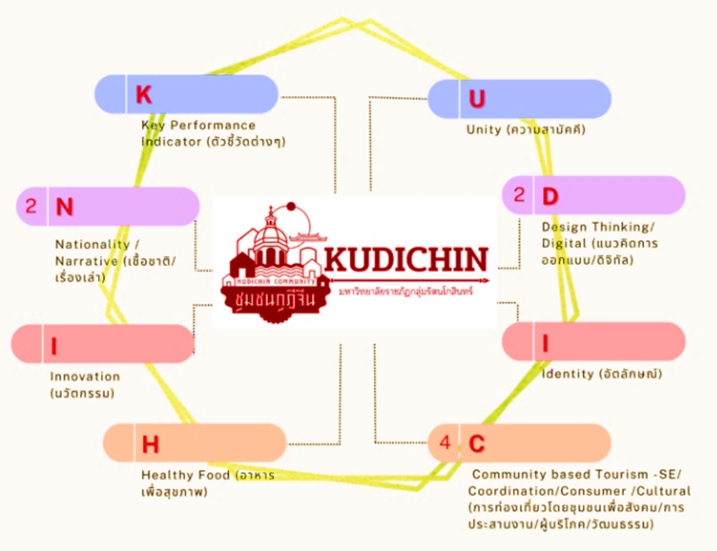
ผลลัพธ์: หนึ่งในชุมชนเก่าแก่ฝั่งธนบุรี คือ ชุมชนกุฎีจีน มีความหลากหลายทางเชื้อชาติ ศาสนา และวัฒนธรรม โดยผู้คนในชุมชนส่วนใหญ่ประกอบอาชีพรับจ้าง ค้าขาย และอุตสาหกรรมครัวเรือนมาอย่างยาวนาน ทำให้เกิดศักยภาพด้านการเข้าถึงแหล่งท่องเที่ยวที่น่าสนใจ รวมทั้งต้นตำรับผลิตภัณฑ์ขึ้นชื่อ ซึ่งเป็นเอกลักษณ์ที่ลูกหลานในชุมชนสืบทอดมาจนถึงปัจจุบัน โดยศักยภาพของกลุ่มบุคคลย่านกะดีจีน ได้รับการจดแจ้งเป็นกลุ่มกิจการเพื่อสังคม ทำให้สามารถพัฒนารูปแบบการท่องเที่ยวเชิงวัฒนธรรมในชุมชนกุฎีจีน ประกอบด้วย แบบแผนธุรกิจขนมฝรั่งกุฎีจีนดีมาก สูตรขนมฝรั่งกุฎีจีนเพื่อสุขภาพใช้หญ้าหวานแทนน้ำตาลในการยกระดับต่อยอดสู่ตลาดสากลและบรรจุภัณฑ์สร้างสรรค์จากอัตลักษณ์ชุมชน เป็นผลงานองค์ความรู้ภายใต้เครื่อข่ายความร่วมมือการเผยแพร่บนสื่อโทรทัศน์และสื่อสังคมออนไลน์ระดับประเทศและต่างประเทศ แอปพลิเคชันแหล่งเรียนรู้ย่านกะดีจีนบนเว็บไซต์ การจดแจ้งขนมฝรั่งกุฎีจีนเป็นสิ่งบ่งชี้ทางภูมิศาสตร์ และท้ายสุดสามารถค้นพบรูปแบบกุฎีจีน “K-U-D-I-C-H-I-N” สำหรับนักวิจัยเชิงพื้นได้นำไปถ่ายทอด ขยายผลและใช้ประโยชน์ในพื้นที่ได้จริง
บทสรุป: การศึกษานี้ มุ่งพัฒนากระบวนการส่งเสริมแหล่งเรียนรู้วัฒนธรรมพื้นที่เก่าแก่ ผ่านการมีส่วนร่วมของคนในท้องถิ่น โดยใช้แนวทางสร้างสรรค์ที่เชื่อมโยงเศรษฐกิจหมุนเวียน ความหลากหลายทางชีวภาพ และความยั่งยืน เพื่อผลักดันให้เป็นเอกลักษณ์แหล่งดึงดูดผู้มาเยือนและสร้างผลกระทบเชิงบวกต่อชุมชนโดยรวม
เอกสารอ้างอิง
Arensberg, C., & Kimball, S. (1965). Culture and community. Harcourt, Brace & World.
Bakhshi, H., Hargreaves, I., & Mateos-Garcia, J. (2013). A manifesto for the creative economy. Nesta Operating.
Bangkok Metropolitan. (2020, June). 90th Anniversary Book of Thonguri District. https://url.in.th/CEZFY
Boonleang, P. (2018). Development of packaging of Nai Mae pork rind products, Lampang Province [Unpublished master’s independent study]. Maejo University.
Bourne, L. S. (1996). Reurbanization, uneven urban development, and the debate on new urban forms. Urban geography, 17(8), 690-713. https://doi.org/10.2747/0272-3638.17.8.690
Capolongo, S., Sdino, L., Dell’Ovo, M., Moioli, R., & Della Torre, S. (2019). How to assess urban regeneration proposals by considering conflicting values. Sustainability, 11(14), 3877. https://doi.org/10.3390/su11143877
Chantanee, M., & Inthasont, S. (2023). Enhancing the potential of creative community-based tourism for area development based on local identity of the Si Ayutthaya Group Network in the Khlong Chik community. Journal of Research and Academics, 6(3), 153–170. https://doi.org/10.14456/jra.2023.61
Chantawanich, S. (2011). Data analysis in qualitative research (10th ed.). Chulalongkorn University Press.
Cohen, A. P. (2013). Symbolic construction of community. Routledge.
Dees, J. G., Emerson, J., & Economy, P. (2002). Enterprise nonprofits: A toolkit for social entrepreneurs. Wiley.
Department of Intellectual Property. (2016, August 19). Form Sor Chor.01. Download Form. https://url.in.th/IQYdq
Emerson, J. (2003). The blended value proposition: Integrating social and financial returns. California Management Review, 45(4), 35-51. https://doi.org/10.2307/41166187
Gülersoy, N. Z., & Gürler, E. (2011). Conceptual challenges on urban transformation. ITU A| Z, 8(1), 10-24.
Guo, P., Li, Q., Guo, H., & Li, H. (2021). Quantifying the core driving force for the sustainable redevelopment of industrial heritage: Implications for urban renewal. Environmental Science and Pollution Research, 28(35), 48097-48111. https://doi.org/10.1007/s11356-021-14054-7
Haugh, H. (2007). Community-led social venture creation. Entrepreneurship Theory and Practice, 31(2), 161-182. https://doi.org/10.1111/j.1540-6520.2007.00168.x
Hughes, T. P. (2004). Human-built world: How to think about technology and culture. University of Chicago Press.
Jantarakast, P., Waiyakrud, K., & Wan-Uta, P. (2022). Enhancing the potential of creative community-based tourism for area development based on local identity of Ban Ngiew Subdistrict, Sam Khok District, Pathum Thani Province. Journal of Management Science Review, 24(2), 19-28.
Kanchanathiti, P., Thammapornpilas, J., Sriumpornroj, P., & Phukaoluan, S. (2004). Study for the conservation and development of water tourism in inner Bangkok and nearby areas: Complete research report. National Science, Technology and Innovation Policy Office.
Kattiyapornpong, U., & Miller, K. E. (2011). Social Structure and Psychographic Explanations of Destination Preference of Australians’ Travel to South-East Asia. Asia Pacific Journal of Tourism Research, 16(1), 39–56. https://doi.org/10.1080/10941665.2011.539390
Kluckhohn, C. (1962). The concept of culture. In R. Kluckhohn (Ed.), Culture and behavior (pp. 19-73). Free Press.
Labadi, S., Giliberto, F., Rosetti, I., Shetabi, L., Yildirim, E. (2021). Heritage and the Sustainable Development Goals: Policy Guidance for Heritage and Development Actors. ICOMOS.
Lerdloompheephan, P. (2019). Platform: Change Business Strategy. Journal of Humanities and Social Sciences Thonburi University, 14(1), 150-157.
Li, Y., & Hunter, C. (2015). Community involvement for sustainable heritage tourism: a conceptual model. Journal of Cultural Heritage Management and Sustainable Development, 5(3), 248-262. https://doi.org/10.1108/JCHMSD-08-2014-0027
Ministry of Tourism and Sports. (2025, January 24). Accommodation situation, number of visitors and income from visitors, January-December 2024 (preliminary). Domestic Tourism Statistics (Classify by region and province 2024). https://mots.go.th/news/category/760
National Science and Technology Development Agency. (2023). How to read a GDA nutrition label. ThaiSook. https://www.thaisook.org/2023/04/27/product-label2/
Naughton, J. (2011). From Gutenberg to Zuckerberg: What you really need to know about the internet. Hachette UK.
Nocca, F. (2017). The role of cultural heritage in sustainable development: Multidimensional indicators as decision-making tool. Sustainability, 9(10), 1882. https://doi.org/10.3390/su9101882
Noknoi, J. (2009). Various perspectives on knowledge management and the creation of a learning organization. S. Asia Place.
Office of the Higher Education Policy Council, Science, Research and Innovation. (n.d.). BCG in Action : The New Sustainable Growth Engine (Bio-Circular-Green Economy). BCG Economic Model. https://www.nxpo.or.th/th/bcg-economy/
Office of the National Economic and Social Development Council. (2022). The thirteenth national economic and social development plan (2023-2027). The National Economic and Social Development Plan. https://www.nesdc.go.th/main.php?filename=develop_issue
Office of the National Research Council of Thailand. (2022). Corporate Strategy 2023-2027. Organizational Policy and Strategy, National Research Council of Thailand (NRCT). https://pr.nrct.go.th/aboutus-history/cor-str/
Oliveira, M. A. Y., & Ferreira, J. J. P. (2011). Business Model Generation: A handbook for visionaries, game changers and challengers. African Journal of Business Management, 5(7). http://repositorio.inesctec.pt/handle/123456789/2119
Olujobi, O. J., Okorie, U. E., Olarinde, E. S., & Aina-Pelemo, A. D. (2023). Legal responses to energy security and sustainability in Nigeria's power sector amidst fossil fuel disruptions and low carbon energy transition. Heliyon, 9(7), e17912.
Osterwalder, A., & Pigneur, Y. (2010). Business model generation: a handbook for visionaries, game changers, and challengers. John Wiley & Sons.
Parrish, B. D. (2010). Sustainability-driven entrepreneurship: Principles of organization design. Journal of business Venturing, 25(5), 510-523. https://doi.org/10.1016/j.jbusvent.2009.05.005
Petchrakul, A. (2020). Create documents, spreadsheets and presentations with OFFICE with new capabilities in OFFICE 2019. Simplify.
Phongam, P. (2023, June 1). Canva User Guide. Training documents [Download]. https://noc.rmutp.ac.th/course-canva-pdf/
Radosavljević, U., Đorđević, A., Lalović, K., Živković, J., & Đukanović, Z. (2019). Nodes and networks: The generative role of cultural heritage for urban revival in Kikinda. Sustainability, 11(9), 2509. https://doi.org/10.3390/su11092509
Ratten, V., & Braga, V. (2019). Tourism innovation. Journal of Hospitality and Tourism Management, 41, 171-174. https://doi.org/10.1016/j.jhtm.2019.10.002
Saikko, A. (2013). Music industry: opportunities and challenges of exporting a finnish artist abroad [Bachelor’s thesis]. https://urn.fi/URN:NBN:fi:amk-2013121921967
Samadkul, M. (2021). Participation of community in cultural tourism development: A case study of Kudee Jeen [Master’s thesis, Chulalongkorn University]. Chula Digital Collections. https://digital.car.chula.ac.th/chulaetd/8038/
Smith, W. K., Gonin, M., & Besharov, M. L. (2013). Managing social-business tensions: A review and research agenda for social enterprise. Business Ethics Quarterly, 23(3), 407-442. https://doi.org/10.5840/beq201323327
The Secretariat of the House of Representatives. (2019). A report on the study of the development of the Kadi Chin community towards sustainable security. Printing Office, Office of the Senate Secretariat, acting as the Office of the National Legislative Assembly Secretariat.
Thirakowitkhajorn, K., & Tularak, W. (2020). A new work model for motorcycle riders delivering food controlled by the platform. Friedrich Ebert Foundation in collaboration with the Institute for Labor and Economic Justice.
Waddock, S. A., & Graves, S. B. (1997). The corporate social performance-financial performance link. Strategic Management Journal, 18(4), 303-319. https://doi.org/10.1002/(SICI)1097-0266(199704)18:4<303::AID-SMJ869>3.0.CO;2-G
Wang, Z., Zhuang, Q., Ma, Y., & Li, P. (2022). A Study on the Path of Narrative Renewal of Traditional Villages: A Case of Shawan Ancient Town, Guangdong, China. International Journal of Environmental Research and Public Health, 20(1), 372. https://doi.org/10.3390/ijerph20010372
Watts, S. (2021, April 1). Digital Platforms: A Brief Introduction. The Business of IT Blog. https://www.bmc.com/blogs/digital-platforms/
Xia, J., Gu, X., Fu, T., Ren, Y., & Sun, Y. (2024). Trends and Future Directions in Research on the Protection of Traditional Village Cultural Heritage in Urban Renewal. Buildings, 14, 1362. https://doi.org/10.3390/buildings14051362
Zeng, Z., Li, L., & Pang, Y. (2017). Analysis on climate adaptability of traditional villages in Lingnan, China World Cultural Heritage Site of Majianglong Villages as example. Procedia Engineering, 205, 2011-2018. https://doi.org/10.1016/j.proeng.2017.10.074
Zittrain, J. (2009). The future of the internet: and how to stop it. Penguin UK.