
Active Learning Management Using Game-Based Learning With Board Games to Enhance Awareness of Financial Behavior for Upper Elementary Students
Keywords:
active learning, game-based learning, board games, financial behaviorAbstract
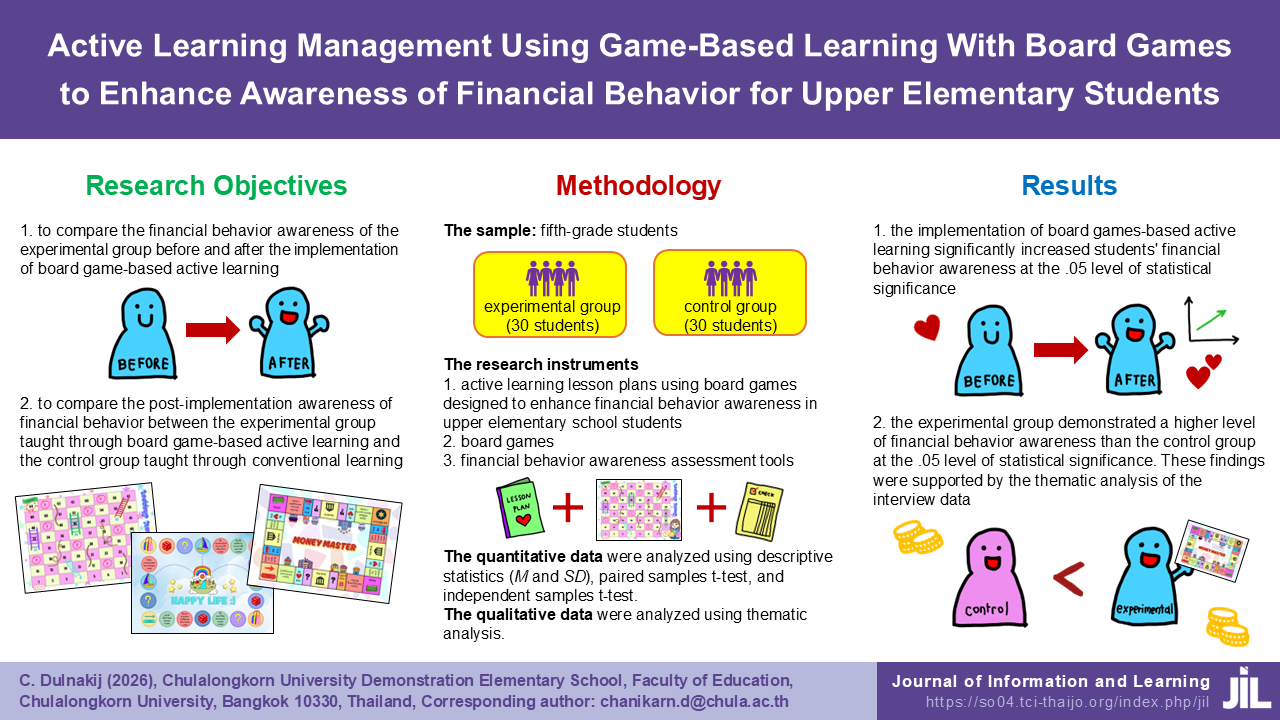
The purposes of this research were: 1) to compare the financial behavior awareness of the experimental group before and after the implementation of board game-based active learning, and 2) to compare the post-implementation awareness of financial behavior between the experimental group taught through board game-based active learning and the control group taught through conventional learning. The sample, consisting of 60 fifth-grade students from Chulalongkorn University Demonstration Elementary School, divided into two classrooms of 30 students each. The research instruments included active learning lesson plans using board games designed to enhance financial behavior awareness in upper elementary school students, board games, and financial behavior awareness assessment tools. The quantitative data were analyzed using descriptive statistics (mean and standard deviation), paired samples t-test, and independent samples t-test, while the qualitative data were analyzed using thematic analysis. The results of this research revealed that 1) the implementation of board games-based active learning significantly increased students' financial behavior awareness at the .05 level of statistical significance, and 2) the experimental group demonstrated a higher level of financial behavior awareness than the control group at the .05 level of statistical significance. These findings were supported by the thematic analysis of the interview data.
References
Bank of Thailand. (2022). Rāingān phon kānsamrūat thaksa thāng kānngœ̄n khō̜ng Thai pī sō̜ngphanhārō̜ihoksiphā [Thai financial literacy survey reports 2022]. https://www.bot.or.th/content/dam/bot/image/research-and-publications/2565ThaiFLsurvey.pdf
Barbazette, J. (2006). The art of great training delivery: Strategies, tools, and tactics. Pfeiffer.
Bayeck, R. Y. (2020). Examining board gameplay and learning: A multidisciplinary review. Simulation & Gaming, 51(4), 402–427. https://doi.org/10.1177/1046878119901286
Boyatzis, R. E. (1998). Transforming qualitative information: Thematic analysis and code development. Sage.
Braun, V., & Clarke, V. (2006). Using thematic analysis in psychology. Qualitative Research in Psychology, 3(2), 77–101. https://doi.org/10.1191/1478088706qp063oa
Cardinot, A., McCauley, V., & Fairfield, J. A. (2022). Designing physics board games: A practical guide for educators. Physics Education, 57(3), 1–12. https://doi.org/10.1088/1361-6552/ac4ac4
Charerum, S., & Khlaisang, J. (2026). Effect of mobile application model using a game-based Thai music soft power concept to promote music skills and music aesthetics for secondary school students. ECT Education and Communication Technology Journal, 21(30), 91–102. https://so01.tci-thaijo.org/index.php/ectstou/article/view/277813
Chutisuntarakul, C. (2023, November 30). Lumphrāng sū kān pennī thī khon Gen Z khūan rawang [Beware of debt trap for Gen Z]. The Stock Exchange of Thailand. https://www.set.or.th/th/education-research/education/happymoney/knowledge/article/104-tsi-beware-of-debt-trap-for-gen-z
Dechakkupt, P., & Yindeesuk, P. (2018). Kānrīanrū chœ̄ng ruk bǣp rūam phalang kap PLC phư̄a kānphatthanā [Collaborative active learning with PLC for development]. Chulalongkorn University.
Johnjun, A., & Supanut, A. (2022). Behavioral financial and loan repayment plan on student loan fund: Case study in borrower’s Pibulsongkram Rajabhat University. Rajapark Journal, 16(48), 234–248. https://so05.tci-thaijo.org/index.php/RJPJ/article/view/257975
Khemmani, T. (2011). Sipsī withī sō̜n samrap khrū mư̄ʻāchīp [14 teaching methods for professional teachers] (10th ed.). Chulalongkorn University.
Khetwit, P., & Ongrardwanich, N. (2023). The development of achievement in Thai literature “Rammakian Narai Prab Nonthok” of Matthayomsuksa 2 students by using active learning with board games. Journal of Modern Learning Development, 8(10), 201–218. https://so06.tci-thaijo.org/index.php/jomld/article/view/262835
Khlaisang, J. (2017). Kānphalit læ chai sư̄ yāng pen rabop phư̄a kānrīanrū nai satawat thī yīsipʻet [Systematic production and use of media for 21st century learning]. Chulalongkorn University.
Kolb, D. A. (1984). Experiential learning: Experience as the source of learning and development. Prentice-Hall.
Ministry of Education. (2008). Tūa chī wat læ sāra kānrīanrū kǣn klāng klum sāra kānrīanrū sangkhommasưksā sātsanā læ watthanatham [Indicators and core learning content: Social studies, religion, and culture learning area]. Agricultural co-operative federation of Thailand.
Nautiyal, V. V., Silverio, S. A., & Salvador, E. E. P. (2024). Let's get on-board: A practical framework for designing and implementing educational board games in K-12 classrooms. Frontiers in Education, 9, Article 1420515. https://doi.org/10.3389/feduc.2024.1420515
Office of the Basic Education Commission. (2019). Nǣothāng kān nithēt phư̄a phatthanā læ songsœ̄m kānčhatkān rīanrū chœ̄ng ruk (Active learning) tām nayōbāi lot wēlā rīan phœ̄m wēlā rū [Supervision guidelines for developing and promoting active learning management according to the moderate class, more knowledge policy]. Office of the Basic Education Commission.
Phiwma, N. (2021). Learning management using game-based learning by integrating computer game technology. Journal of Humanities and Social Sciences Ratchaphruek University, 7(Special), 1–15. https://so03.tci-thaijo.org/index.php/rpu/article/view/257367
Pratkanis, A. R., Breckler, S. J., & Greenwald, A. G. (Eds.). (1989). Attitude structure and function. Lawrence Erlbaum Associates.
Pruttikul, S. (2012). Quality of students derived from active learning process. Journal of Educational Administration, Burapha University, 6(2), 1–13. https://so02.tci-thaijo.org/index.php/EduAdm_buu/article/view/11570
Ra-ngubtook, W. (2002). Theknik læ kitčhakam kānrīanrū thī nēn phū rīan pen samkhan tām laksūt kānsưksā naphư̄n thān B.E. 2544̄ [Student-centered learning techniques and activities according to the basic education curriculum A.D. 2001]. Prikwarn Graphic.
Shimabukuro, M., Toki, T., Shimabukuro, H., Kubo, Y., Takahashi, S., & Shinjo, R. (2022). Development and application of an environmental education tool (board game) for teaching integrated resource management of the water cycle on coral reef islands. Sustainability, 14(24), Article 16562. https://doi.org/10.3390/su142416562
Tangpakdee, R. (2022). The development of board games production model for education in Thailand. STOU Education Journal, 15(2), 117–132. https://so05.tci-thaijo.org/index.php/edjour_stou/article/view/257826
Theobald, E. J., Hill, M. J., Tran, E., Agrawal, S., Arroyo, E. N., Behling, S., Chambwe, N., Cintrón, D. L., Cooper, J. D., Dunster, G., Grummer, J. A., Hennessey, K., Hsiao, J., Iranon, N., Jones II, L., Jordt, H., Keller, M., Lacey, M. E., Littlefield, C. E., . . . Freeman, S. (2020). Active learning narrows achievement gaps for underrepresented students in undergraduate science, technology, engineering, and math. Proceedings of the National Academy of Sciences, 117(12), 6476–6483. https://doi.org/10.1073/pnas.1916903117
Tinsman, B. (2008). The game inventor’s guidebook. Morgan James Publishing.
Whitebread, D., & Bingham, S. (2013). Habit formation and learning in young children. Money Advice Service.
Winarta, S., & Pamungkas, A. S. (2021). The role of financial behavior, financial attitude, financial strain, and risk tolerance in explaining financial satisfaction. Proceedings of the Ninth International Conference on Entrepreneurship and Business Management (ICEBM 2020), 174, 520–524. https://doi.org/10.2991/aebmr.k.210507.077
Downloads
Additional Files
Published
How to Cite
Issue
Section
Categories
License
Copyright (c) 2026 Journal of Information and Learning

This work is licensed under a Creative Commons Attribution-NonCommercial 4.0 International License.
The Journal of Information and Learning is operated by the Office of Academic Resources, Prince of Songkla University. All articles published in the journal are protected by Thailand copyright law. This copyright covers the exclusive rights to share, reproduce and distribute the article, including in electronic forms, reprints, translations, photographic reproductions, or similar. Authors own copyrights in the works they have created as well as the Office of Academic Resources. The Journal reserves the right to edit the language of papers accepted for publication for clarity and correctness, as well as to make formal changes to ensure compliance with the journal's guidelines. All authors must take public responsibility for the content of their paper.


