
Information Retrieval and Access Behaviors Related to Tham Khwan Nak Ceremony in Central Thailand
Keywords:
Khwan Nage, ceremony, retrieval behavior, retrieval and access, cultural intellectual heritageAbstract
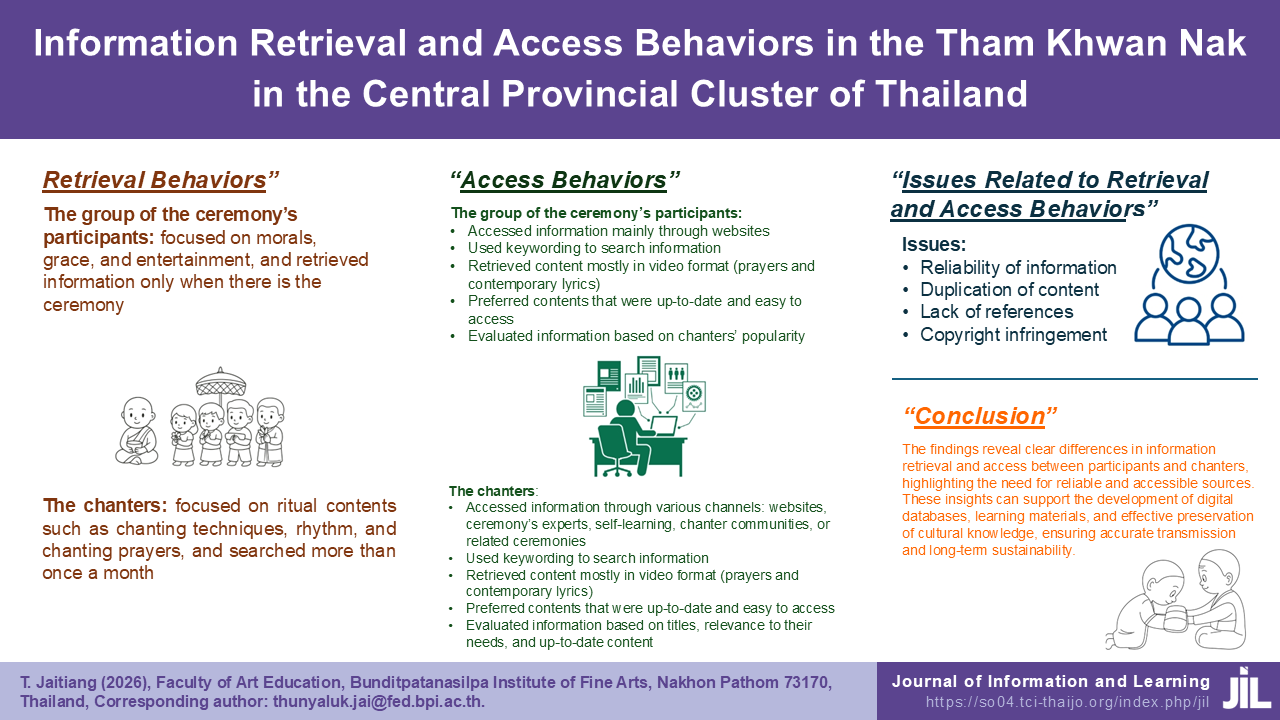
This study aims to explore information retrieval and access behaviors related to Tham Khwan Nak ceremony (a traditional Thai pre-ordination ritual) in Central Thailand. A total of 40 key informants were recruited selected using snowball sampling and classified into two groups: 25 of the ceremony’s participants (four mothers of the ordinands, 15 relatives, and six colleagues) and 15 Tham Khwan Nak chanters. The study employed a qualitative research approach. Data were collected through semi-structured interviews and analyzed using content analysis. The findings revealed three main aspects of information behavior. With regard to information retrieval behaviors, the informants retrieved information differently. The ceremony participants focused on morals, grace (especially for parents), and entertainment, whereas the chanters paid attention to ritual content such as chanting techniques, rhythm, and chanting prayers. The two groups also showed different information retrieval frequencies; for example, the participants only retrieved the information when there was the ceremony, yet the chanters searched for the information more than once a month. In terms of information access behaviors the participants accessed the information through websites, but the chanters accessed it through various channels such as websites, the ceremony’s experts, self-learning, chanter communities, or related ceremonies. Keywording was the most frequently used method to access information through websites. The searched information was in videos, prayers, and contemporary lyrics, respectively. To evaluate the information, the users paid attention to up-to-date and easy-to-access information. To evaluate content after searching for the information, the participants considered using content based on chanters’ popularity, whereas the chanters would retrieve the information in response to their needs, up-to-date content, and titles. Regarding issues related to information retrieval and access behaviors, there were problems with reliability, duplication, references, and copyright infringement.
References
Bates, M. J. (1989). The design of browsing and berrypicking techniques for the online search interface. UCLA School of Education & Information Studies. https://pages.gseis.ucla.edu/faculty/bates/berrypicking.html?ref=blog.codinghorror.com
Chanlun, J. (2020). Information behavior during COVID-19 pandemic era. TLA Bulletin, 64(2), 36–49. https://so06.tci-thaijo.org/index.php/tla_bulletin/article/view/244124
Choochan, N., Chairaksa, S., & Meebua, S. (2025). Krui Nak: Conservation and development of Na Muen Si weaving wisdom, Trang province. Journal of Humanities and Social Sciences, 7(1), 53–74. https://so03.tci-thaijo.org/index.php/husoskru/article/view/277429
Creswell, J. W., & Creswell, J. D. (2018). Research design: Qualitative, quantitative, and mixed methods approaches (5th ed.). SAGE Publications.
Department of Cultural Promotion. (2013). Listing of the intangible cultural heritage. Department of Cultural Promotion. https://book.culture.go.th/newbook/ich/ich2013.pdf
Ellis, D., & Haugan, M. (1997). Modelling the information seeking patterns of engineers and research scientists in an industrial environment. Journal of Documentation, 53, 384–403. https://doi.org/10.1108/EUM0000000007204
Hiangrat, P. (2019). Information behavior of undergraduate students at Rajabhat Mahasarakham Universities. Chophayom Journal, 30(2), 241–248. https://so01.tci-thaijo.org/index.php/ejChophayom/article/view/213506
Hnongbundit, S., Kongsaband, P., & Chantaraj, N. (2022). The interpretation and transcription from scramble Naga text in Northeastern part to the literature for youngs. Journal of Modern Learning Development, 7(2), 376–392. https://so06.tci-thaijo.org/index.php/jomld/article/view/255560
Khwanriang, P., Sukhampha, R., & Vaisamruat, K. (2021). Ocal women village health volunteers’ information behavior during the COVID-19 pandemic in Mueang Chiang Mai District, Chiang Mai Province. Silpakorn University Journal, 41(5), 30–42. https://so05.tci-thaijo.org/index.php/sujthai/article/view/253216
Kuenui, P. (2022). Social media use behavior and social media literacy among students in Changklangprachanukul school Nakhon Si Thammarat province. Journal of MCU Nakhondhat, 9(6), 198–211. https://so03.tci-thaijo.org/index.php/JMND/article/view/262070
Mala, P. (1996). A study of the buddhist pre-ordination Sites in Pranakon Sri Ayutthaya province. ARU Research Journal Humanities and Social Sciences, 3(6), 23–27. https://tdc.thailis.or.th/tdc/browse.php?option=show&browse_type=title&titleid=286656&query=%A2%C7%D1%AD%B9%D2%A4&s_mode=any&d_field=&d_start=0000-00-00&d_end=2568-12-31&limit_lang=&limited_lang_code=&order=&order_by=&order_type=&result_id=5&maxid=9
Naisap, T. (1999). A study of the ordination blessing tradition in Phitsanulok province. The research in supported by Pibulsongkram Rajabhat University.
Phetdi, V., & Monying, W. (2020). The study of belief of human birth appearing in literature performed the chanting parents' loving kindness ceremony: Birth Chapter. Aksara Pibul Journal, 1(2), 27–37. https://so02.tci-thaijo.org/index.php/APBJ/article/view/249165
Phomyucol, P., Jantima, N., Tanthiang, T., Choomyen, Y., Phuntadaporn, N., & Ruangnon, B. (2025). The type of ritual in making a wish for Naga of CDR Direk Klaharn. Fine-Applied Arts and Cultural Science Journal, 1(1), 62-73. https://so13.tci-thaijo.org/index.php/FACS-JO/article/view/1969
Promthong, J., Kabmala, M., & Chansanam, W. (2022). Information retrieval behaviors and access to cultural knowledge on Thai-Khmer textiles. Silpakorn University Journal, 42(5), 38–50. https://so05.tci-thaijo.org/index.php/sujthai/article/view/257900
Savolainen, R. (1995). Everyday life information seeking: Approaching information seeking in the context of way of life. Library & Information Science Research, 17(3), 259–294. https://doi.org/10.1016/0740-8188(95)90048-9
Sethaputrakoses. (1967). Pra phē ʻong nai kān kœ̄t [Traditions related to birth.]. In Praphēnī kīeokap chīwit [Life-cycle rituals] (pp. 1–72). The Fine Arts .Department. https://www.finearts.go.th/songkhlalibraryk/view/15300-ประเพณีเกี่ยวกับชีวิตของกรมศิลปากร
Somsriploy, S. (2023). Buddhist preordaining ceremony of master Sailom Sitsurin group, Tumbon Nong-Ong, Amphur U-Thong, Supanburi Province: Component, process, symbols and meanings in ritual. Journal of MCU Ubon Review, 8(3), 909–924. https://so06.tci-thaijo.org/index.php/mcjou/article/view/270237
UNESCO. (2003). Convention for the safeguarding of the intangible cultural heritage. https://ich.unesco.org/doc/src/01852-EN.pdf
Wilson, T. D. (2000). Human information behaviour. Informing Science, 3(2), 49–56. https://doi.org/10.28945/576
Wilson, T. D. (2022). Exploring information behaviour an introduction. https://informationr.net/ir/Exploring%20information%20behaviour.pdf
Wongboonmak, S., Ruthamnong, S., Chongchorhor, C., & Chotiadapa, C. (2025). Information behavior of undergraduate students at Kamphaeng Phet. The Golden Teak: Humanity and Social Science Journal, 31(2), 117–132. https://so05.tci-thaijo.org/index.php/tgt/article/view/278671
Downloads
Additional Files
Published
How to Cite
Issue
Section
Categories
License
Copyright (c) 2026 Journal of Information and Learning

This work is licensed under a Creative Commons Attribution-NonCommercial 4.0 International License.
The Journal of Information and Learning is operated by the Office of Academic Resources, Prince of Songkla University. All articles published in the journal are protected by Thailand copyright law. This copyright covers the exclusive rights to share, reproduce and distribute the article, including in electronic forms, reprints, translations, photographic reproductions, or similar. Authors own copyrights in the works they have created as well as the Office of Academic Resources. The Journal reserves the right to edit the language of papers accepted for publication for clarity and correctness, as well as to make formal changes to ensure compliance with the journal's guidelines. All authors must take public responsibility for the content of their paper.


