
พฤติกรรมการค้นคืนและการเข้าถึงสารสนเทศการทำขวัญนาคของกลุ่มจังหวัดภาคกลางในประเทศไทย
คำสำคัญ:
ขวัญนาค, พฤติกรรมสารสนเทศ, การค้นคืนและการเข้าถึง, มรดกภูมิปัญญาทางวัฒนธรรมบทคัดย่อ
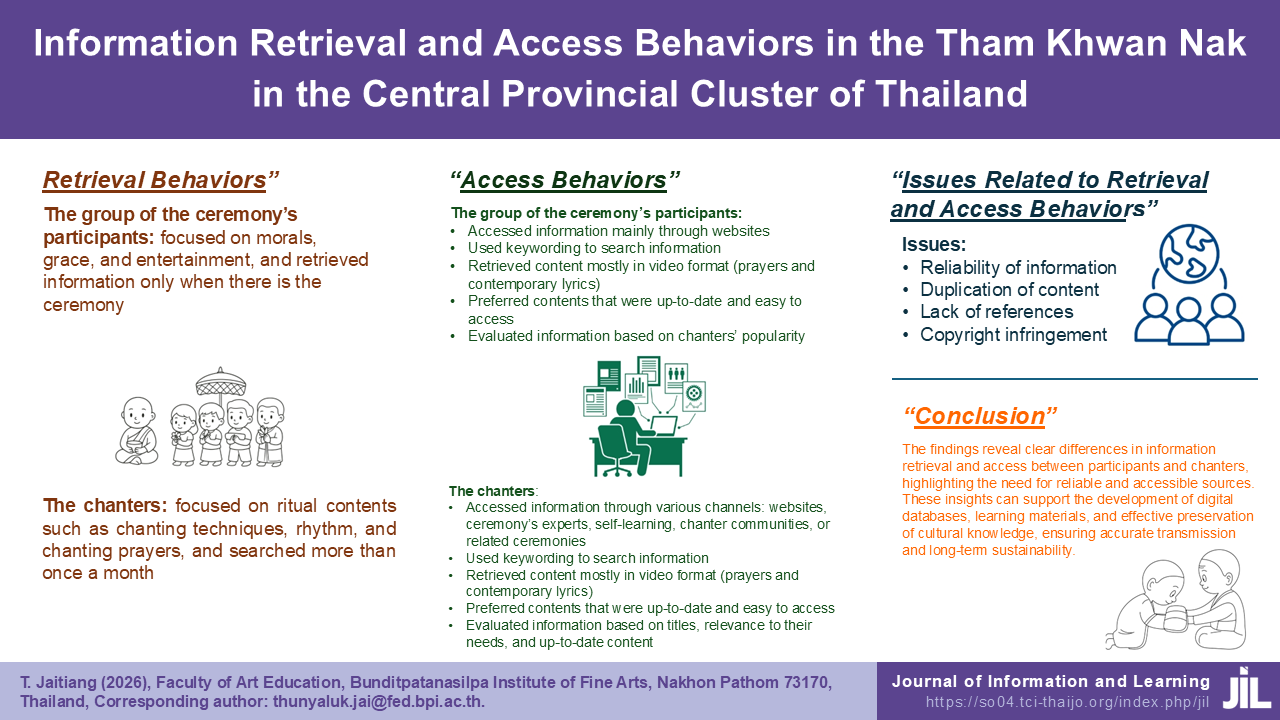
บทความวิจัยนี้มีวัตถุประสงค์เพื่อศึกษาพฤติกรรมการค้นคืนและการเข้าถึงสารสนเทศการทำขวัญนาคของกลุ่มจังหวัดภาคกลางในประเทศไทย ผู้ให้ข้อมูล 2 กลุ่ม ประกอบด้วย กลุ่มผู้เข้าร่วมการทำขวัญนาค 25 คน ได้แก่ มารดานาค จำนวน 4 คน ญาติพี่น้อง 15 คน เพื่อนร่วมงาน จำนวน 6 คน และกลุ่มหมอทำขวัญนาค 15 คน รวม 40 คน โดยวิธีการสุ่มแบบลูกโซ่และใช้วิธีการวิจัยเชิงคุณภาพ เครื่องมือในการวิจัย ได้แก่ แบบสัมภาษณ์กึ่งโครงสร้าง และวิเคราะห์ข้อมูลด้วยวิธีการวิเคราะห์เนื้อหา ผลการวิจัย พบว่า 1) ด้านพฤติกรรมการค้นคืนสารสนเทศ กลุ่มผู้เข้าร่วมการทำขวัญนาคและกลุ่มหมอทำขวัญนาคมีวัตถุประสงค์ในการค้นคืนสารสนเทศที่แตกต่างกัน โดยกลุ่มผู้เข้าร่วมการทำขวัญนาคมุ่งเน้นการค้นหาสารสนเทศให้ความสำคัญกับเนื้อหาที่สะท้อนคุณค่าทางคุณธรรม โดยเฉพาะเรื่องความกตัญญูต่อบิดามารดา และความบันเทิง ขณะที่กลุ่มหมอทำขวัญนาคมุ่งเน้นการค้นหาสารสนเทศที่เกี่ยวข้องกับเนื้อหาเชิงพิธีกรรม เช่น วิธีการร้อง ทำนอง และบทสู่ขวัญ สำหรับความถี่ในการค้นคืน พบว่า กลุ่มผู้เข้าร่วมการทำขวัญนาคจะค้นหาข้อมูลเฉพาะในช่วงที่มีการจัดงานบวชนาคเท่านั้น ในขณะที่กลุ่มหมอทำขวัญนาคมีการค้นคืนสารสนเทศมากกว่าหนึ่งครั้งต่อเดือน 2) ด้านพฤติกรรมการเข้าถึงสารสนเทศ กลุ่มผู้เข้าร่วมการทำขวัญนาคส่วนใหญ่เข้าถึงสารสนเทศผ่านเว็บไซต์เป็นหลัก ส่วนกลุ่มหมอทำขวัญนาคมีการเข้าถึงสารสนเทศผ่านหลายช่องทาง ได้แก่ เว็บไซต์ ผู้เชี่ยวชาญด้านการทำขวัญนาค การเรียนรู้ด้วยตนเอง เพื่อนกลุ่มหมอทำขวัญนาค และจากประสบการณ์หรือเหตุการณ์ที่เกี่ยวข้อง วิธีการกำหนดคำค้นส่วนใหญ่ใช้การสืบค้นผ่านเว็บไซต์โดยใช้คำสำคัญ (Keyword) เนื้อหาที่เข้าถึงส่วนใหญ่อยู่ในรูปแบบวิดีโอ บทแหล่ บททำขวัญ และเนื้อเพลงร่วมสมัย ในการประเมินเนื้อหาสารสนเทศ ผู้ใช้ให้ความสำคัญกับความทันสมัยและความสะดวกในการเข้าถึง สำหรับการประเมินเนื้อหาหลังการสืบค้น กลุ่มผู้เข้าร่วมการทำขวัญนาคจะพิจารณาจากชื่อเสียงของกลุ่มหมอทำขวัญนาค ขณะที่กลุ่มหมอทำขวัญนาคจะประเมินจากชื่อเรื่อง ความตรงกับความต้องการของเนื้อหา และความทันสมัยของข้อมูล 3) ด้านปัญหาพฤติกรรมการค้นคืนและการเข้าถึงสารสนเทศ ปัญหาที่พบในการค้นคืนและการเข้าถึงสารสนเทศเกี่ยวกับการทำขวัญนาค ได้แก่ ความน่าเชื่อถือของข้อมูล ความซ้ำซ้อนของเนื้อหา การขาดแหล่งอ้างอิงต้นฉบับ และปัญหาด้านลิขสิทธิ์ของบททำขวัญนาค
เอกสารอ้างอิง
Bates, M. J. (1989). The design of browsing and berrypicking techniques for the online search interface. UCLA School of Education & Information Studies. https://pages.gseis.ucla.edu/faculty/bates/berrypicking.html?ref=blog.codinghorror.com
Chanlun, J. (2020). Information behavior during COVID-19 pandemic era. TLA Bulletin, 64(2), 36–49. https://so06.tci-thaijo.org/index.php/tla_bulletin/article/view/244124
Choochan, N., Chairaksa, S., & Meebua, S. (2025). Krui Nak: Conservation and development of Na Muen Si weaving wisdom, Trang province. Journal of Humanities and Social Sciences, 7(1), 53–74. https://so03.tci-thaijo.org/index.php/husoskru/article/view/277429
Creswell, J. W., & Creswell, J. D. (2018). Research design: Qualitative, quantitative, and mixed methods approaches (5th ed.). SAGE Publications.
Department of Cultural Promotion. (2013). Listing of the intangible cultural heritage. Department of Cultural Promotion. https://book.culture.go.th/newbook/ich/ich2013.pdf
Ellis, D., & Haugan, M. (1997). Modelling the information seeking patterns of engineers and research scientists in an industrial environment. Journal of Documentation, 53, 384–403. https://doi.org/10.1108/EUM0000000007204
Hiangrat, P. (2019). Information behavior of undergraduate students at Rajabhat Mahasarakham Universities. Chophayom Journal, 30(2), 241–248. https://so01.tci-thaijo.org/index.php/ejChophayom/article/view/213506
Hnongbundit, S., Kongsaband, P., & Chantaraj, N. (2022). The interpretation and transcription from scramble Naga text in Northeastern part to the literature for youngs. Journal of Modern Learning Development, 7(2), 376–392. https://so06.tci-thaijo.org/index.php/jomld/article/view/255560
Khwanriang, P., Sukhampha, R., & Vaisamruat, K. (2021). Ocal women village health volunteers’ information behavior during the COVID-19 pandemic in Mueang Chiang Mai District, Chiang Mai Province. Silpakorn University Journal, 41(5), 30–42. https://so05.tci-thaijo.org/index.php/sujthai/article/view/253216
Kuenui, P. (2022). Social media use behavior and social media literacy among students in Changklangprachanukul school Nakhon Si Thammarat province. Journal of MCU Nakhondhat, 9(6), 198–211. https://so03.tci-thaijo.org/index.php/JMND/article/view/262070
Mala, P. (1996). A study of the buddhist pre-ordination Sites in Pranakon Sri Ayutthaya province. ARU Research Journal Humanities and Social Sciences, 3(6), 23–27. https://tdc.thailis.or.th/tdc/browse.php?option=show&browse_type=title&titleid=286656&query=%A2%C7%D1%AD%B9%D2%A4&s_mode=any&d_field=&d_start=0000-00-00&d_end=2568-12-31&limit_lang=&limited_lang_code=&order=&order_by=&order_type=&result_id=5&maxid=9
Naisap, T. (1999). A study of the ordination blessing tradition in Phitsanulok province. The research in supported by Pibulsongkram Rajabhat University.
Phetdi, V., & Monying, W. (2020). The study of belief of human birth appearing in literature performed the chanting parents' loving kindness ceremony: Birth Chapter. Aksara Pibul Journal, 1(2), 27–37. https://so02.tci-thaijo.org/index.php/APBJ/article/view/249165
Phomyucol, P., Jantima, N., Tanthiang, T., Choomyen, Y., Phuntadaporn, N., & Ruangnon, B. (2025). The type of ritual in making a wish for Naga of CDR Direk Klaharn. Fine-Applied Arts and Cultural Science Journal, 1(1), 62-73. https://so13.tci-thaijo.org/index.php/FACS-JO/article/view/1969
Promthong, J., Kabmala, M., & Chansanam, W. (2022). Information retrieval behaviors and access to cultural knowledge on Thai-Khmer textiles. Silpakorn University Journal, 42(5), 38–50. https://so05.tci-thaijo.org/index.php/sujthai/article/view/257900
Savolainen, R. (1995). Everyday life information seeking: Approaching information seeking in the context of way of life. Library & Information Science Research, 17(3), 259–294. https://doi.org/10.1016/0740-8188(95)90048-9
Sethaputrakoses. (1967). Pra phē ʻong nai kān kœ̄t [Traditions related to birth.]. In Praphēnī kīeokap chīwit [Life-cycle rituals] (pp. 1–72). The Fine Arts .Department. https://www.finearts.go.th/songkhlalibraryk/view/15300-ประเพณีเกี่ยวกับชีวิตของกรมศิลปากร
Somsriploy, S. (2023). Buddhist preordaining ceremony of master Sailom Sitsurin group, Tumbon Nong-Ong, Amphur U-Thong, Supanburi Province: Component, process, symbols and meanings in ritual. Journal of MCU Ubon Review, 8(3), 909–924. https://so06.tci-thaijo.org/index.php/mcjou/article/view/270237
UNESCO. (2003). Convention for the safeguarding of the intangible cultural heritage. https://ich.unesco.org/doc/src/01852-EN.pdf
Wilson, T. D. (2000). Human information behaviour. Informing Science, 3(2), 49–56. https://doi.org/10.28945/576
Wilson, T. D. (2022). Exploring information behaviour an introduction. https://informationr.net/ir/Exploring%20information%20behaviour.pdf
Wongboonmak, S., Ruthamnong, S., Chongchorhor, C., & Chotiadapa, C. (2025). Information behavior of undergraduate students at Kamphaeng Phet. The Golden Teak: Humanity and Social Science Journal, 31(2), 117–132. https://so05.tci-thaijo.org/index.php/tgt/article/view/278671
ดาวน์โหลด
ไฟล์ประกอบ
เผยแพร่แล้ว
รูปแบบการอ้างอิง
ฉบับ
ประเภทบทความ
หมวดหมู่
สัญญาอนุญาต
ลิขสิทธิ์ (c) 2026 Thunyaluk Jaitiang

อนุญาตภายใต้เงื่อนไข Creative Commons Attribution-NonCommercial 4.0 International License.
เข้าถึงบทความได้โดยไม่เสียค่าใช้จ่าย นโยบายสัญญาอนุญาตปัจจุบัน CC BY-NC 4.0 ตั้งแต่ปีที่ 37 ฉบับที่ 2 (2569) สำหรับบทความก่อนหน้านี้ โปรดตรวจเงื่อนไขสิทธิบนหน้าบทความแต่ละเรื่อง ดูนโยบายการเข้าถึงแบบเปิดและสัญญาอนุญาต

