
Evaluating the Effectiveness of a Digital Workload Management Information System in Enhancing Organizational Management Efficiency: A Case Study of the Faculty of Engineering, Mahasarakham University
Keywords:
digital workload management system, workload management, data-driven decision-making, information systems, educational organizationAbstract
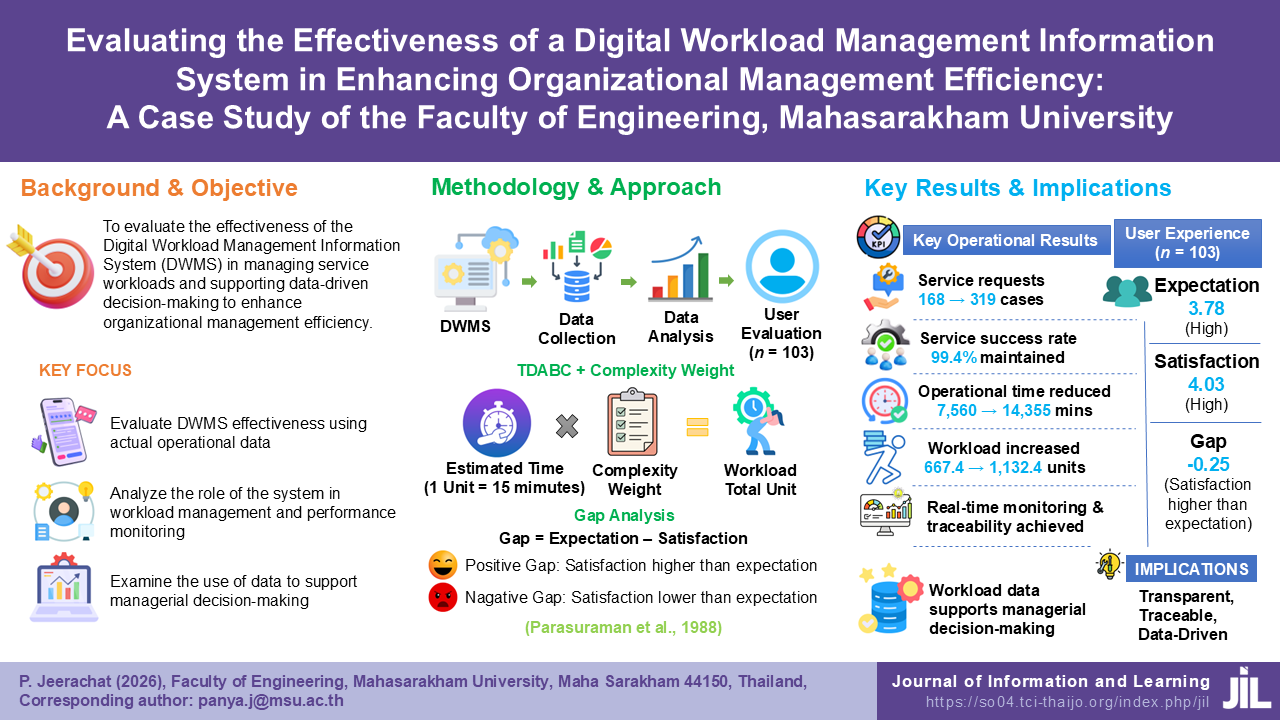
The management of IT infrastructure and audiovisual workloads in educational organizations are often hindered by fragmented data and a lack of systematic tracking, which limits the use of information for managerial decision-making. This study aims to 1) evaluate the effectiveness of the digital workload management system (DWMS) based on real usage data, 2) analyze the role of the system role in managing workload and tracking, and 3) examine the use of system-generated data to support managerial decision-making. This research utilizes an information system development approach integrated with empirical evaluation from actual usage. The sample includes 65 faculty members and 38 support staff. The research instrument is the DWMS, consisting of a service request system, a database, a workload calculation module, a data analytics dashboard, and task-tracking system. The workload model was developed based on task frequency, duration, and task complexity. Data were analyzed using descriptive statistics. The results from eight months of implementation revealed that the system processed 319 service tasks, with a total workload of 1,132.4 units and a success rate of 99.4%. The system reduced total processing time by 14,355 minutes and decreased paper consumption by 638 sheets, while facilitating real-time task tracking and enhancing dashboard-based analytics.The findings indicate that DWMS functions as a data infrastructure that integrates workload management, process tracking, and data-driven decision-making, thereby enhancing organizational management efficiency in educational institutions.
References
Ahamed, Z., Khemakhem, M., Eassa, F., Alsolami, F., Basuhail, A., & Jambi, K. (2023). Deep reinforcement learning for workload prediction in federated cloud environments. Sensors, 23(15), Article 6911. https://doi.org/10.3390/s23156911
Al-Okaily, M., Al-Okaily, A., Shiyyab, F., & Masadah, W. (2020). Accounting information system effectiveness from an organizational perspective. Management Science Letters, 10, 3991–4000. https://doi.org/10.5267/j.msl.2020.7.010
Aziz, A. A., Jusoh, J. A., & Awang, W. S. (2026). Business intelligence for higher education: Empowering data-driven decision making. Springer. https://doi.org/10.1007/978-3-032-05361-9
Feng, T., Huang, L., Peng, X., Qiao, T., & Wu, X. (2025). An integrative review of cognitive workload assessment for safety management. BMC Nursing, 24, Article 1363. https://doi.org/10.1186/s12912-025-03987-w
Giotopoulos, K. C., Michalopoulos, D., Vonitsanos, G., Papadopoulos, D., Giannoukou, I., & Sioutas, S. (2024). Dynamic workload management system in the public sector. Information, 15(6), Article 335. https://doi.org/10.3390/info15060335
Islam, A., & Chang, K. (2021). Real-time AI-based informational decision-making support system utilizing dynamic text sources. Applied Sciences, 11(13), Article 6237. https://doi.org/10.3390/app11136237
Koukaras, C., Hatzikraniotis, E., Mitsiaki, M., Koukaras, P., Tjortjis, C., & Stavrinides, S. (2025). Revolutionising educational management with AI and wireless networks: A framework for smart resource allocation and decision-making. Applied Sciences, 15(10), 5293. https://doi.org/10.3390/app15105293
Ministry of Higher Education, Science, Research and Innovation. (2021). Higher education development plan for Thailand’s manpower production and development (2021–2027). Office of the Permanent Secretary. https://www.mhesi.go.th/index.php/all-media/book-ministry/10830-แผนด้านการอุดมศึกษาเพื่อผลิตและพัฒนากำลังคนของประเทศ-พ-ศ-2564-–-2570-ฉบับปรับปรุง-พ-ศ-2566-–-2570.html
Muda, R., Adnan, N. L., Wan Jusoh, W. N. H., & Yusoff, R. (2025). Performance measurement system in Malaysian higher education institutions. Information Management and Business Review, 17(1), 241–251. https://doi.org/10.22610/imbr.v17i1(I).4392
Nuryanti, Y., Simorangkir, Y. N., Asbari, M., Ferdiyanto, Y. A., & Waruwu, H. (2025). Integrating big data and information systems in higher education: Implications for organizational productivity and efficiency. Indonesian Journal of Management and Economic Research, 2(1), 121–129. https://doi.org/10.70508/xz9wy932
OECD. (2023). Digital government policy framework. https://www.oecd.org/governance/digital-government
Parasuraman, A., Zeithaml, V. A., & Berry, L. L. (1988). SERVQUAL: A multiple-item scale for measuring consumer perceptions of service quality. Journal of Retailing, 64(1), 12–40. https://doi.org/10.5281/zenodo.14579730
Salbiah, S., & Nasution, M. I. P. (2023). Analysis of data processing in management information systems. Jurnal Ilmiah Ekonomi dan Manajemen, 2(11). Article 3017. https://doi.org/10.61722/jiem.v2i11.3017
Singun, A. (2025). Unveiling the barriers to digital transformation in higher education institutions: A systematic literature review. Discover Education, 4, Article 37. https://doi.org/10.1007/s44217-025-00430-9
Sukmandhani, A. A., Rusly, J. K., Pratama, A., & Ohliati, J. (2022). Design and implementation of a dashboard web-based service management operations. Journal of Advances in Information Technology, 13(6), 632–637. https://doi.org/10.12720/jait.13.6.632-637
UNESCO. (2022). The financing of education in Thailand. https://unesdoc.unesco.org/ark:/48223/pf0000384381
UNICEF. (2025). Thailand education fact sheets 2022. https://www.unicef.org/thailand/reports/thailand-education-fact-sheets-2022
Verhoef, P. C., Broekhuizen, T. L. J., Bart, Y., Bhattacharya, A., Dong, J. Q., Fabian, N., & Haenlein, M. (2021). Digital transformation: A multidisciplinary reflection and research agenda. Journal of Business Research, 122, 889–901. https://doi.org/10.1016/j.jbusres.2019.09.022
Wang, K., Li, B., Tian, T., Zakuan, N., & Rani, P. (2023). Evaluate the drivers for digital transformation in higher education institutions in the era of Industry 4.0. Journal of Innovation & Knowledge, 8(2), Article 100364. https://doi.org/10.1016/j.jik.2023.100364
World Bank. (2023). Thailand digital data infrastructure roadmap. https://www.worldbank.org/en/country/thailand/publication/thailand-digital-data-infrastructure-roadmap
World Bank. (2025). Thailand economic monitor, july 2025: Digital pathways to growth. https://doi.org/10.1596/43469
Xue, Q., Al Mamun, A., Hosen, M., Hasan, M., & Sohag, K. (2026). Dynamic capabilities in higher education: How big data analytics fuels digital service innovation in HEIs. Education and Information Technologies, 31, 2713–2736. https://doi.org/10.1007/s10639-026-13929-x
Downloads
Additional Files
Published
How to Cite
Issue
Section
Categories
License
Copyright (c) 2026 Journal of Information and Learning

This work is licensed under a Creative Commons Attribution-NonCommercial 4.0 International License.
The Journal of Information and Learning is operated by the Office of Academic Resources, Prince of Songkla University. All articles published in the journal are protected by Thailand copyright law. This copyright covers the exclusive rights to share, reproduce and distribute the article, including in electronic forms, reprints, translations, photographic reproductions, or similar. Authors own copyrights in the works they have created as well as the Office of Academic Resources. The Journal reserves the right to edit the language of papers accepted for publication for clarity and correctness, as well as to make formal changes to ensure compliance with the journal's guidelines. All authors must take public responsibility for the content of their paper.


