
Virtual English Language Learning With AI, AR, and Gamification: Enhancing English Skills and Speaking Confidence for Beginner Learners
Keywords:
artificial intelligence (AI), augmented reality (AR), gamification, English language learning, speaking confidenceAbstract
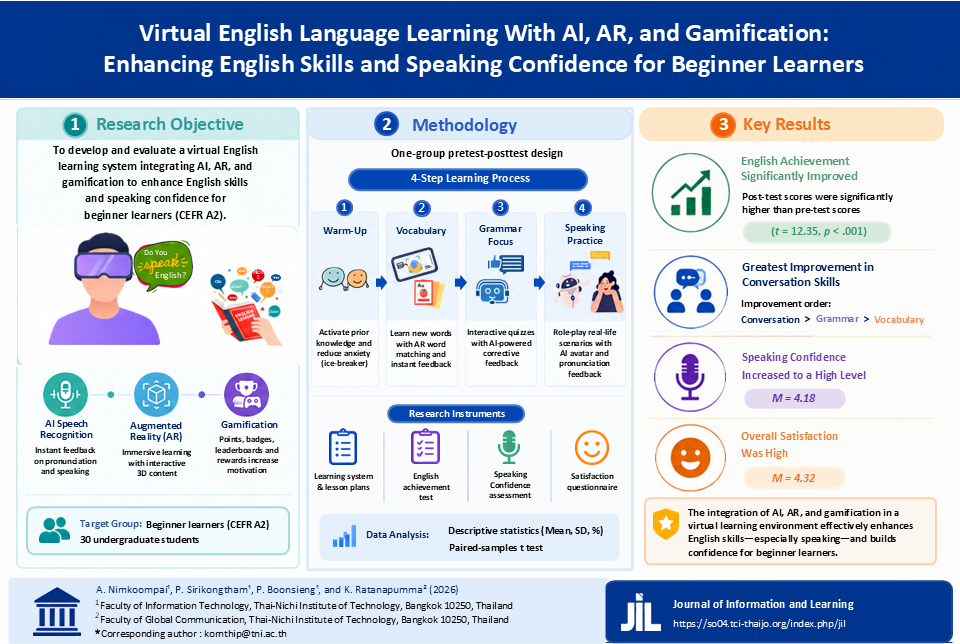
This research aimed to: 1) to develop and evaluate the quality of a virtual English language learning system integrating AI speech recognition, augmented reality (AR), and gamification for beginner learners; 2) to compare students' English language learning achievements in vocabulary, grammar, and conversation before and after using the developed system; 3) to study students' English speaking confidence after using the system; and 4) to study students' satisfaction with the developed system. The study employed a one-group pretest-posttest design. The sample consisted of 30 undergraduate students, selected through purposive sampling. The research instruments included the virtual English language learning system and lesson plans, an English achievement test, an English speaking confidence assessment, and a satisfaction questionnaire. Data were analyzed using descriptive statistics (mean, standard deviation, and percentage) and inferential statistics (Paired samples t-test). The results revealed that: 1) the quality of the developed learning system was evaluated by experts at the highest level of appropriateness; 2) the learners' posttest English achievement scores were significantly higher than their pretest scores (t = 12.35, p < .001), with conversation skills showing the highest improvement, followed by grammar and vocabulary; 3) the learners' English speaking confidence increased to a high level (M = 4.18); and 4) their overall satisfaction with the system was at a high level (M = 4.32).
References
Amin, E. A. (2025). The impact of augmented reality on vocabulary acquisition and engagement among college ESP students. Theory and Practice in Language Studies, 15(2), 414–425. https://tpls.academypublication.com/index.php/tpls/article/view/9396
Chan, S., & Lo, N. (2024). Enhancing EFL/ESL instruction through gamification: A comprehensive review of empirical evidence. Frontiers in Education, 9, Article 1395155. https://doi.org/10.3389/feduc.2024.1395155
Christou, E., Vassiliou, P., & Parmaxi, A. (2025). Augmented reality in language learning: A systematic literature review of the state-of-the-art and task design considerations. Innovation in Language Learning and Teaching, 1–28. https://doi.org/10.1080/17501229.2025.2504706
Dennis, N. K. (2024). Using AI-powered speech recognition technology to improve English pronunciation and speaking skills. IAFOR Journal of Education, 12(2), 107-126. https://doi.org/10.22492/ije.12.2.05
Dunleavy, M., Dede, C., & Mitchell, R. (2009). Affordances and limitations of immersive participatory augmented reality simulations for teaching and learning. Journal of Science Education and Technology, 18, 7–22. https://doi.org/10.1007/s10956-008-9119-1
Kotp, M. H., Bassyouny, H. A. A., Aly, M. A., Ibrahim, R. K., Hendy, A., Attia, A. S., Mekdad, A. K., Hafez, A. A., Farghaly Abdelaliem, S. M., Baghdadi, N. A., Hendy, A., & Ismail, H. A. (2025). Game on or game over? Gamification from 360-degree perspective, perception, confidence, and challenges in simulation based nursing education: Mixed-method study. BMC Nursing, 24. https://doi.org/10.1186/s12912-025-03253-z
Laksanasut, S. (2025). Gamification in ESL/EFL education: Transforming language learning and teaching through play. TESOL and Technology Studies, 6(1), 16–29. https://doi.org/10.48185/tts.v6i1.1562
Lee, K. (2012). Augmented reality in education and training. TechTrends, 56(2), 13–21. https://doi.org/10.1007/s11528-012-0559-3
Mohebbi, A. (2025). Speaking without fear: How AI is transforming language learning for the anxious and introverted. Language Exploration, 1(2), Article 3416. https://www.academia.edu/130457090/Speaking_without_fear_How_AI_is_transforming_language_learning_for_the_anxious_and_introverted
Qin, L., & Poopatwiboon, S. (2023). English speaking anxiety of Thai EFL undergraduate students: Dominant type, level, and coping strategies. English Language Teaching, 16(6), 102–112. https://doi.org/10.5539/elt.v16n6p102
TÜV Rheinland. (2024, December 5). XREAL new AR glasses receive TÜV Rheinland eye comfort (5 star) and high visibility certificates. https://www.tuv.com/press/en/press-releases/xreal-one-series.html
Wang, C., Zou, B., Du, Y., & Wang, Z. (2024). The impact of different conversational generative AI chatbots on EFL learners: An analysis of willingness to communicate, foreign language speaking anxiety, and self-perceived communicative competence. System, 127, Article 103533. https://doi.org/10.1016/j.system.2024.103533
Wu, J., Jiang, H., & Chen, S. (2024). Augmented reality technology in language learning: A meta-analysis. Language Learning & Technology, 28(1), 1–23. https://doi.org/10.64152/10125/73596
XREAL. (2024, December 5). Introducing XREAL One Series: World’s first cinematic AR glasses with X1 independent spatial computing chip. PR Newswire. https://www.prnewswire.com/in/news-releases/introducing-xreal-one-series-worlds-first-cinematic-ar-glasses-with-x1-independent-spatial-computing-chip-for-complete-spatial-screen-control-302322456.html
Yan, W., Li, B., & Lowell, V. L. (2025). Integrating artificial intelligence and extended reality in language education: A systematic literature review (2017–2024). Education Sciences, 15(8), Article 1066. https://doi.org/10.3390/educsci15081066
Yousefi, F., Salehi, M., & Fakhraee Faruji, L. (2024). The effect of collaborative, online augmented reality games on EFL learners’ speaking performance and communication apprehension. Journal of New Trends in English Language Learning, 3(4). https://doi.org/10.71528/jntell.2024.1119114
Downloads
Additional Files
Published
How to Cite
Issue
Section
Categories
License
Copyright (c) 2026 Journal of Information and Learning

This work is licensed under a Creative Commons Attribution-NonCommercial 4.0 International License.
The Journal of Information and Learning is operated by the Office of Academic Resources, Prince of Songkla University. All articles published in the journal are protected by Thailand copyright law. This copyright covers the exclusive rights to share, reproduce and distribute the article, including in electronic forms, reprints, translations, photographic reproductions, or similar. Authors own copyrights in the works they have created as well as the Office of Academic Resources. The Journal reserves the right to edit the language of papers accepted for publication for clarity and correctness, as well as to make formal changes to ensure compliance with the journal's guidelines. All authors must take public responsibility for the content of their paper.


