
Latent Profile Analysis of Digital Disruption Learning Environment and Artificial Intelligence Platform to Identify the Digital Identities of Teacher Professional Students
Keywords:
latent profile analysis, digital identities, digital disruption learning environment, artificial intelligence platform, teacher professional studentsAbstract
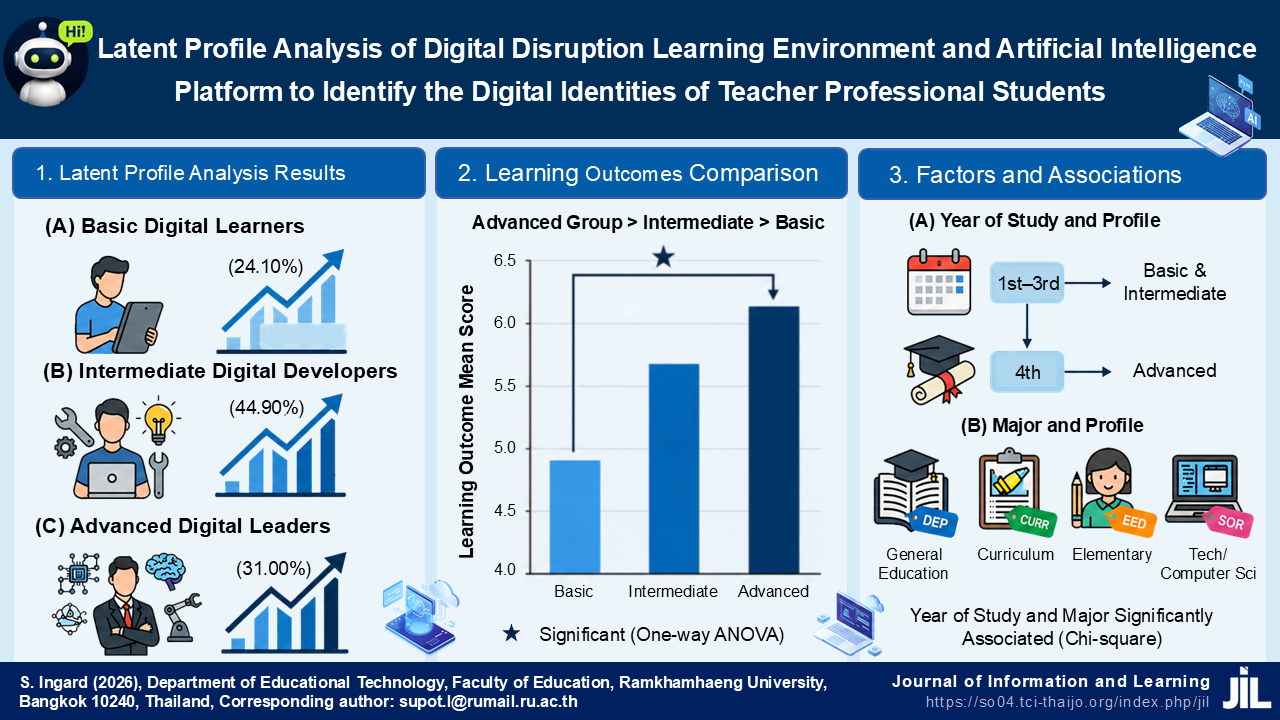
This research aimed to: 1) analyze the latent profiles of learning outcomes among teacher professional students based on indicators of digital disruption environment perception and artificial intelligence platform utilization; 2) compare differences in learning outcomes across students with distinct latent digital identities; and 3) examine the relationship between personal characteristics and these latent digital identity groups. The sample consisted of 528 teacher professional students from higher education institutions in Bangkok and its vicinity, selected through multi-stage random sampling. The research instrument was a 6-point rating scale questionnaire with content validity verified by the index of item-objective congruence (IOC) and reliability confirmed by Cronbach’s alpha coefficient. Data were analyzed using latent profile analysis (LPA), one-way analysis of variance (One-way ANOVA), and chi-square test. The findings revealed that: 1) The 3-class latent profile model demonstrated the best fit with the empirical data, classifying students into the basic digital learner group (24.10%), intermediate digital developer group (44.90%), and advanced digital leader group (31.00%). 2) Learning outcomes significantly differed among the groups, with the advanced digital leader group achieving the highest mean score, followed by the Intermediate digital developer and basic digital learner groups, respectively. 3) Year of study and major were significantly associated with the latent digital identity groups. Specifically, the basic digital learner group primarily comprised 1st-to-3rd-year students, regardless of gender, majoring in general education and curriculum and instruction. The intermediate digital developer group constituted the largest baseline across all factors, with the highest density in elementary and early childhood education majors. Meanwhile, the advanced digital leader group predominantly consisted of 4th-year students majoring in technology, computer science, and science.
References
Akogul, S., & Erisoglu, M. (2017). An approach for determining the number of clusters in a model-based cluster analysis. Entropy, 19(9), Article 452. https://doi.org/10.3390/e19090452
Bae, H., Hur, J., Park, J., Choi, G. W., & Moon, J. (2024). Pre-service teachers' dual perspectives on generative AI: Benefits, challenges, and integrating into teaching and learning. Online Learning, 28(3), 321–345. https://doi.org/10.24059/olj.v28i3.4543
Burgos-Videla, C. G., Castillo Rojas, W. A., López Meneses, E., & Martínez, J. (2021). Digital competence analysis of university students using latent classes. Education Sciences, 11(8), Article 385. https://doi.org/10.17159/2520-9868/i79a02
Campbell, E., & Kapp, R. (2020). Developing an integrated, situated model for digital literacy in pre-service teacher education. Journal of Education, 79, 18–30. https://doi.org/10.17159/2520-9868/i79a02
Çebi, A., & Reisoğlu, I. (2020). Digital competence: A study from the perspective of pre-service teachers in Turkey. Journal of New Approaches in Educational Research, 9, 294–308. https://doi.org/10.7821/naer.2020.7.583
Chen, X. (2024). Collaborative design with conversational artificial intelligence: A case study of pre-service language teachers in multidisciplinary teams. International Journal of Technology in Teaching and Learning, 20(2), 95–107. https://doi.org/10.37120/ijttl.2024.20.2.01
Collins, L. M., & Lanza, S. T. (2010). Latent class and latent transition analysis: With applications in the social, behavioral, and health sciences. Wiley. https://doi.org/10.1002/9780470567333
Cronbach, L. J. (1990). Essentials of psychological testing (5th ed.). Harper Collins Publishers.
Galindo-Domínguez, H., & Bezanilla, M. J. (2021). Digital competence in the training of pre-service teachers: Perceptions of students in the degrees of early childhood education and primary education. Journal of Digital Learning in Teacher Education, 37(4), 262–278. https://doi.org/10.1080/21532974.2021.1934757
Gökbulut, B. (2026). Enhancing pre-service teachers' AI-TPACK through sustainable development goals: A mixed-methods study on AI-supported Web 2.0 tools. Sustainability, 18(6), Article 2963. https://doi.org/10.3390/su18062963
Hernández-Orellana, M., Pérez-Garcias, A., & Roco-Videla, Á. (2021). Characterization of the digital identity of Chilean university students considering their personal learning environments. Future Internet, 13(3), Article 74. https://doi.org/10.3390/fi13030074
Heuling, L. S., Wild, S., & Vest, A. (2021). Digital competences of prospective engineers and science teachers: A latent profile and correspondence analysis. International Journal of Education in Mathematics, Science and Technology, 9(3), 760-782. https://doi.org/10.46328/ijemst.1831
Higher Education Standards Committee. (2022). Notification of details of learning outcomes according to higher education qualification standards B.E. 2565. Royal Thai Government Gazette, 139 (Special Issue 212 Ng). https://www.ops.go.th/th/chesdownloads/edustandard/download/1079/6940
Ingard, S. (2025a). A confirmatory model of an artificial intelligence-supported learning environment influence toward learning outcome of teachers professional students. Journal of Educational Technology and Communications Faculty of Education Mahasarakham University, 8(28), 53–66. https://so02.tci-thaijo.org/index.php/etcedumsujournal/article/view/282076
Ingard, S. (2025b). The digital disruption learning environment influence toward learning outcome of teachers professional students. e-Journal of Education Studies, Burapha University, 7(3), 37–54. https://so01.tci-thaijo.org/index.php/ejes/article/view/282567
Luo, J., Zhu, C., Hu, L., & Sun, M. (2025). Empowering preservice teachers through textbook design activities with GAI-based chatbot. IEEE Transactions on Learning Technologies, 18, 822–832. https://doi.org/10.1109/TLT.2025.3606757
Masitoh, F., Cahyono, B. Y., Suryati, N., & Suhartoyo, E. (2023). Pre-service EFL teachers' identity construction in relation to digital gamification: A social theory of learning perspective. The JALT CALL Journal, 19(3), 245–268. https://doi.org/10.29140/jaltcall.v19n3.1062
Masyn, K. E. (2013). Latent class analysis and finite mixture modeling. In T. D. Little (Ed.), The Oxford handbook of quantitative methods: Vol. 2. Statistical analysis (pp. 551–611). Oxford University Press. https://doi.org/10.1093/oxfordhb/9780199934898.013.0025
Mayer, D. G. (1995). Psychology (4th ed.). Worth Publishers.
McLay, K. F., & Reyes, V. C. (2019). Identity and digital equity: Reflections on a university educational technology course. Australasian Journal of Educational Technology, 35(6), 15–29. https://doi.org/10.14742/ajet.5552
Nirmala Grace Rani, S. (2025). The future of AI in teacher education: Challenges and opportunities. Indian Educational Researcher, 18(2), 28–32. https://doi.org/10.34293/0974-2123.v18n2.004
Novriyanto, E., Harsani, P., & Hardhienata, S. (2025). Peningkatan kompetensi professional guru di era digital melalui pengembangan pelatihan berbasis artificial intelligence dan blended learning. Wawasan: Jurnal Ilmu Manajemen, Ekonomi dan Kewirausahaan, 3(2), 112–125. https://doi.org/10.58192/wawasan.v3i2.3054
Nykvist, S., & Mukherjee, M. (2016). Who am I? Developing pre-service teacher identity in a digital world. Procedia - Social and Behavioral Sciences, 217, 851–857. https://doi.org/10.1016/j.sbspro.2016.02.012
Nylund-Gibson, K., & Choi, A. Y. (2018). Ten frequently asked questions about latent class analysis. Translational Issues in Psychological Science, 4(4), 440–461. https://doi.org/10.1037/tps0000176
Ounejjar, L. A., Lachgar, M., Ouhayou, O., Laanaoui, M. D., Refki, E., Makaoui, R., & Saoud, A. (2024). SmartBlendEd: Enhancing blended learning through AI-optimized scheduling and user-centric design. SoftwareX, 27, Article 101891. https://doi.org/10.1016/j.softx.2024.101891
Persidskaya, O. (2024). Theoretical and methodological framework of typologization of digital identity. Social Psychology and Society, 15(4), 58–74. https://psyjournals.ru/en/journals/sps/archive/2024_n4/Persidskaya
Rahden, J., Rubach, C., & Porsch, R. (2025). Competence beliefs using technology in school and teaching – How can we use variance and covariance to identify teachers' profiles? Teaching and Teacher Education, 154, Article 104869. https://doi.org/10.1016/j.tate.2024.104869
Santrock, J. W. (1997). Psychology. Brown & Benchmark.
Seol, H. (2024). snowRMM: Rasch mixture, LCA, and test equating analysis (Version 5.9.1) [Jamovi module]. https://github.com/topics/latent-profile-analysis
Tangpattanakit, J., & Senariddhikrai, P. (2022). The role of confirmatory factor analysis (CFA) in structural equation modeling (SEM). Journal of Management Sciences Kasetsart University, 1(2), 99–110. https://kuojs.lib.ku.ac.th/index.php/jmsku/article/view/5185
Tlebaldinova, A. S., Kumargazhanova, S. K., Smailova, S. S., Konurbayeva, Z. T., & Seitahmetova, Z. M. (2025). Cluster analysis of behavioral factors in the formation of students' digital identity. Bulletin of D. Serikbayev EKTU, 1, 221-232. https://doi.org/10.51885/1561-4212_2025_1_221
Wang, R., & Mokhtar, M. M. (2025). Empowering oral English teachers with AI to improve digital and blended teaching competencies. Edelweiss Applied Science and Technology, 9(8), 1716–1724. https://doi.org/10.55214/2576-8484.v9i8.9694
Downloads
Additional Files
Published
How to Cite
Issue
Section
Categories
License
Copyright (c) 2026 Journal of Information and Learning

This work is licensed under a Creative Commons Attribution-NonCommercial 4.0 International License.
The Journal of Information and Learning is operated by the Office of Academic Resources, Prince of Songkla University. All articles published in the journal are protected by Thailand copyright law. This copyright covers the exclusive rights to share, reproduce and distribute the article, including in electronic forms, reprints, translations, photographic reproductions, or similar. Authors own copyrights in the works they have created as well as the Office of Academic Resources. The Journal reserves the right to edit the language of papers accepted for publication for clarity and correctness, as well as to make formal changes to ensure compliance with the journal's guidelines. All authors must take public responsibility for the content of their paper.


