
การพัฒนาระบบการเรียนรู้ภาษาอังกฤษเสมือนจริงโดยใช้ AI, AR และ Gamification เพื่อส่งเสริมทักษะภาษาอังกฤษและความมั่นใจในการพูดสำหรับผู้เรียนระดับต้น
คำสำคัญ:
ปัญญาประดิษฐ์, ความเป็นจริงเสริม, เกมมิฟิเคชัน, การเรียนรู้ภาษาอังกฤษ, ความมั่นใจในการสื่อสารบทคัดย่อ
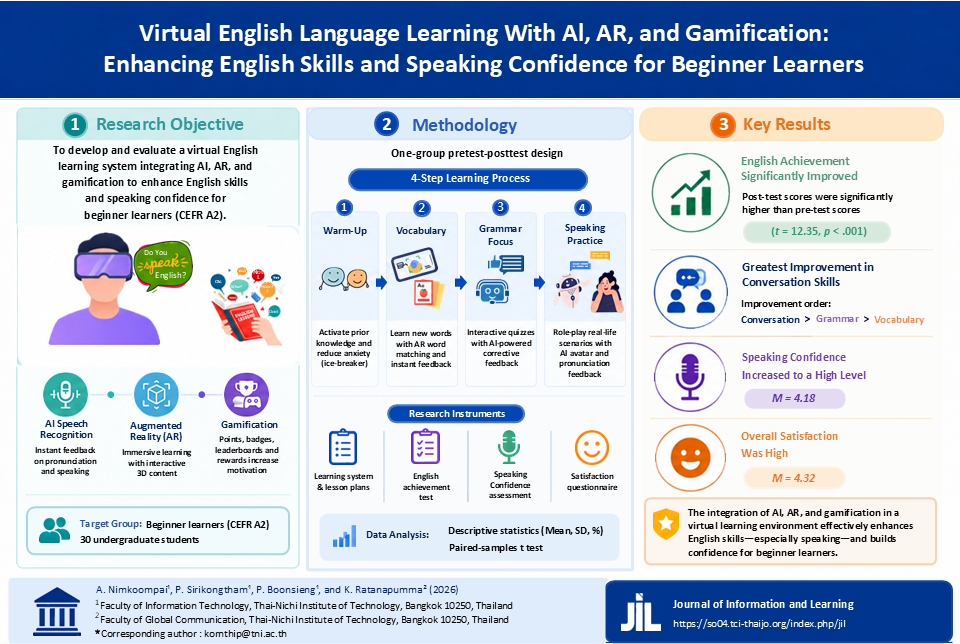
การวิจัยครั้งนี้มีวัตถุประสงค์เพื่อ 1) พัฒนาและประเมินคุณภาพของระบบการเรียนรู้ภาษาอังกฤษเสมือนจริง ที่ผสมผสานเทคโนโลยีการรู้จำเสียง (AI speech recognition) ความเป็นจริงเสริม และเกมมิฟิเคชัน สำหรับผู้เรียนระดับเริ่มต้น 2) เปรียบเทียบผลสัมฤทธิ์ทางการเรียนด้านทักษะภาษาอังกฤษ (คำศัพท์ ไวยากรณ์ และการสนทนา) ของผู้เรียนก่อนและหลังการเรียน 3) ศึกษาความมั่นใจในการพูดภาษาอังกฤษของผู้เรียนหลังการเรียนด้วยระบบที่พัฒนาขึ้น และ 4) ศึกษาความพึงพอใจของผู้เรียนที่มีต่อระบบการเรียนรู้ภาษาอังกฤษเสมือนจริง การวิจัยใช้รูปแบบกลุ่มทดลองกลุ่มเดียวทดสอบก่อนและหลังเรียน (One-group pretest-posttest design) กลุ่มตัวอย่างเป็นนักศึกษาระดับปริญญาตรี จำนวน 30 คน ซึ่งได้มาจากการเลือกกลุ่มตัวอย่างแบบเจาะจง เครื่องมือที่ใช้ในการวิจัยประกอบด้วย 1) ระบบการเรียนรู้และแผนการจัดการเรียนรู้ภาษาอังกฤษเสมือนจริง 2) แบบทดสอบวัดผลสัมฤทธิ์ทางการเรียน 3) แบบประเมินความมั่นใจในการพูดภาษาอังกฤษ และ 4) แบบสอบถามความพึงพอใจต่อระบบการเรียนรู้ การวิเคราะห์ข้อมูลใช้สถิติเชิงพรรณนา (ค่าเฉลี่ย ส่วนเบี่ยงเบนมาตรฐาน และร้อยละ) และสถิติเชิงอนุมาน (Paired samples t-test) ผลการวิจัย พบว่า 1) ระบบการเรียนรู้ภาษาอังกฤษเสมือนจริงที่พัฒนาขึ้นมีคุณภาพตามการประเมินของผู้เชี่ยวชาญอยู่ในระดับมากที่สุด 2) ผลสัมฤทธิ์ทางการเรียนด้านทักษะภาษาอังกฤษหลังเรียนสูงกว่าก่อนเรียนอย่างมีนัยสำคัญทางสถิติที่ระดับ .001 (t = 12.35, p < .001) โดยพบพัฒนาการสูงสุดในทักษะการสนทนา รองลงมา คือ ไวยากรณ์และคำศัพท์ ตามลำดับ 3) ผู้เรียนมีความมั่นใจในการพูดภาษาอังกฤษอยู่ในระดับมาก (M = 4.18) และ 4) มีความพึงพอใจต่อระบบการเรียนรู้โดยรวมอยู่ในระดับมาก (M = 4.32)
เอกสารอ้างอิง
Amin, E. A. (2025). The impact of augmented reality on vocabulary acquisition and engagement among college ESP students. Theory and Practice in Language Studies, 15(2), 414–425. https://tpls.academypublication.com/index.php/tpls/article/view/9396
Chan, S., & Lo, N. (2024). Enhancing EFL/ESL instruction through gamification: A comprehensive review of empirical evidence. Frontiers in Education, 9, Article 1395155. https://doi.org/10.3389/feduc.2024.1395155
Christou, E., Vassiliou, P., & Parmaxi, A. (2025). Augmented reality in language learning: A systematic literature review of the state-of-the-art and task design considerations. Innovation in Language Learning and Teaching, 1–28. https://doi.org/10.1080/17501229.2025.2504706
Dennis, N. K. (2024). Using AI-powered speech recognition technology to improve English pronunciation and speaking skills. IAFOR Journal of Education, 12(2), 107-126. https://doi.org/10.22492/ije.12.2.05
Dunleavy, M., Dede, C., & Mitchell, R. (2009). Affordances and limitations of immersive participatory augmented reality simulations for teaching and learning. Journal of Science Education and Technology, 18, 7–22. https://doi.org/10.1007/s10956-008-9119-1
Kotp, M. H., Bassyouny, H. A. A., Aly, M. A., Ibrahim, R. K., Hendy, A., Attia, A. S., Mekdad, A. K., Hafez, A. A., Farghaly Abdelaliem, S. M., Baghdadi, N. A., Hendy, A., & Ismail, H. A. (2025). Game on or game over? Gamification from 360-degree perspective, perception, confidence, and challenges in simulation based nursing education: Mixed-method study. BMC Nursing, 24. https://doi.org/10.1186/s12912-025-03253-z
Laksanasut, S. (2025). Gamification in ESL/EFL education: Transforming language learning and teaching through play. TESOL and Technology Studies, 6(1), 16–29. https://doi.org/10.48185/tts.v6i1.1562
Lee, K. (2012). Augmented reality in education and training. TechTrends, 56(2), 13–21. https://doi.org/10.1007/s11528-012-0559-3
Mohebbi, A. (2025). Speaking without fear: How AI is transforming language learning for the anxious and introverted. Language Exploration, 1(2), Article 3416. https://www.academia.edu/130457090/Speaking_without_fear_How_AI_is_transforming_language_learning_for_the_anxious_and_introverted
Qin, L., & Poopatwiboon, S. (2023). English speaking anxiety of Thai EFL undergraduate students: Dominant type, level, and coping strategies. English Language Teaching, 16(6), 102–112. https://doi.org/10.5539/elt.v16n6p102
TÜV Rheinland. (2024, December 5). XREAL new AR glasses receive TÜV Rheinland eye comfort (5 star) and high visibility certificates. https://www.tuv.com/press/en/press-releases/xreal-one-series.html
Wang, C., Zou, B., Du, Y., & Wang, Z. (2024). The impact of different conversational generative AI chatbots on EFL learners: An analysis of willingness to communicate, foreign language speaking anxiety, and self-perceived communicative competence. System, 127, Article 103533. https://doi.org/10.1016/j.system.2024.103533
Wu, J., Jiang, H., & Chen, S. (2024). Augmented reality technology in language learning: A meta-analysis. Language Learning & Technology, 28(1), 1–23. https://doi.org/10.64152/10125/73596
XREAL. (2024, December 5). Introducing XREAL One Series: World’s first cinematic AR glasses with X1 independent spatial computing chip. PR Newswire. https://www.prnewswire.com/in/news-releases/introducing-xreal-one-series-worlds-first-cinematic-ar-glasses-with-x1-independent-spatial-computing-chip-for-complete-spatial-screen-control-302322456.html
Yan, W., Li, B., & Lowell, V. L. (2025). Integrating artificial intelligence and extended reality in language education: A systematic literature review (2017–2024). Education Sciences, 15(8), Article 1066. https://doi.org/10.3390/educsci15081066
Yousefi, F., Salehi, M., & Fakhraee Faruji, L. (2024). The effect of collaborative, online augmented reality games on EFL learners’ speaking performance and communication apprehension. Journal of New Trends in English Language Learning, 3(4). https://doi.org/10.71528/jntell.2024.1119114
ดาวน์โหลด
ไฟล์ประกอบ
เผยแพร่แล้ว
รูปแบบการอ้างอิง
ฉบับ
ประเภทบทความ
หมวดหมู่
สัญญาอนุญาต
ลิขสิทธิ์ (c) 2026 Apichaya Nimkoompai, Puwadol Sirikongtham, Pramuk Boonsieng, Kornthip Ratanapumma

อนุญาตภายใต้เงื่อนไข Creative Commons Attribution-NonCommercial 4.0 International License.
เข้าถึงบทความได้โดยไม่เสียค่าใช้จ่าย นโยบายสัญญาอนุญาตปัจจุบัน CC BY-NC 4.0 ตั้งแต่ปีที่ 37 ฉบับที่ 2 (2569) สำหรับบทความก่อนหน้านี้ โปรดตรวจเงื่อนไขสิทธิบนหน้าบทความแต่ละเรื่อง ดูนโยบายการเข้าถึงแบบเปิดและสัญญาอนุญาต

