
Factors Influencing Readiness for Integrating AR and VR in Distance Learning: An Application of the eTAM Model
Keywords:
AR, VR, eTAM, distance learning, factors influencing readinessAbstract
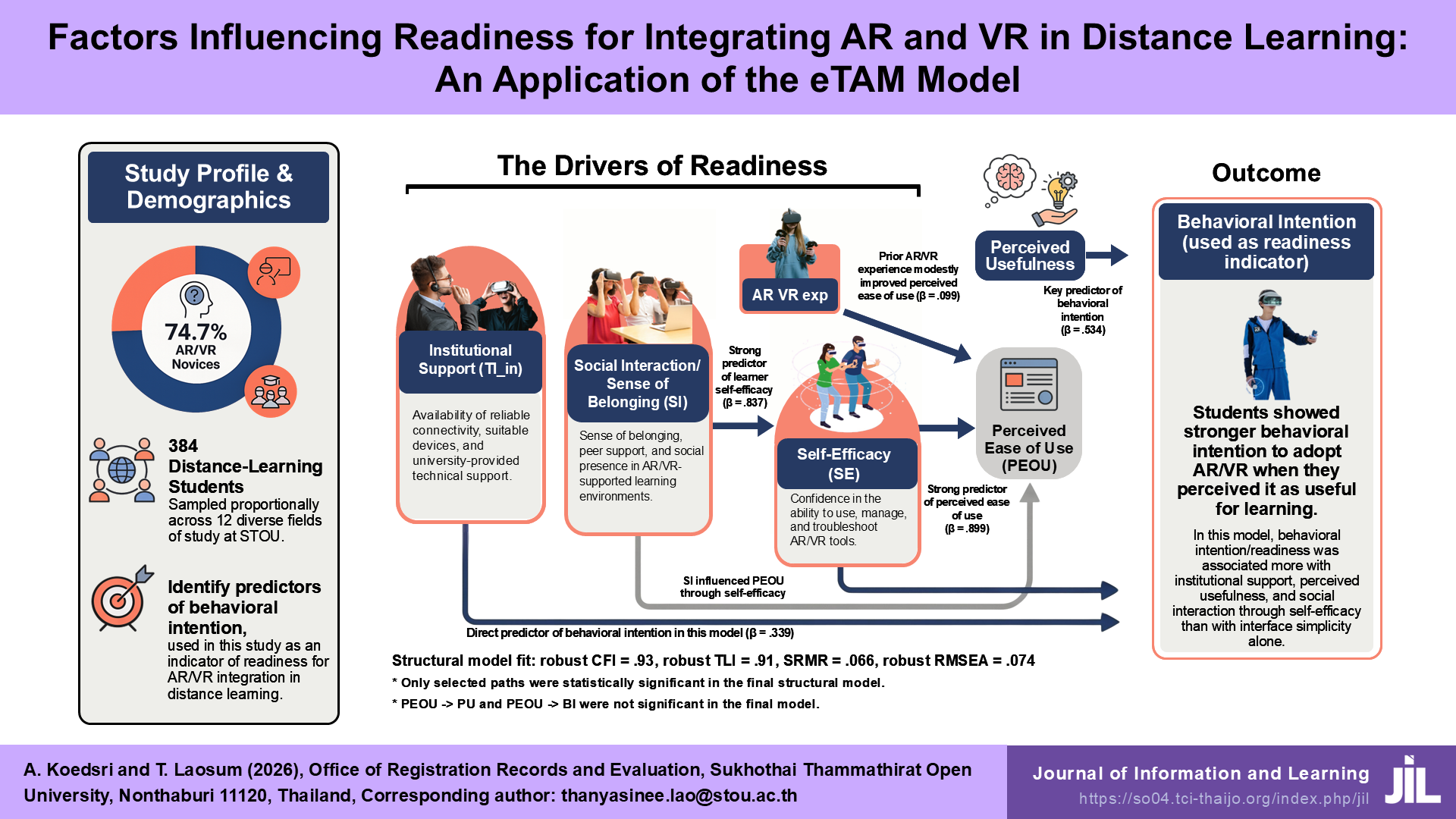
The objectives were 1) to validate an extended Technology Acceptance Model (eTAM) measurement model for augmented reality (AR)/virtual reality (VR) readiness of undergraduate distance-learning students and 2) to estimate the direct and indirect effects of institutional, social, and psychological factors on the students’ behavioral intention (BI). Data were collected from 384 undergraduate distance-learning students. A three-step sampling procedure was used: (1) the population was divided into 12 fields of study; (2) 384 participants were proportionally allocated across the fields; and (3) students were selected by simple random sampling within each field. An initial 36-item instrument was reduced to 22 indicators through confirmatory factor analysis (CFA). The measurement model was evaluated using CFA with robust maximum likelihood estimation. The construct validity was examined using composite reliability, average variance, the Fornell–Larcker, and HTMT criteria. Structural equation modeling (SEM) was used to test the proposed eTAM relationships. The model showed acceptable fit with CFI = .93, TLI = .92, robust CFI = .95, robust TLI = .94, SRMR = .048, and robust RMSEA = .066, satisfying the recommended criteria (CFI/TLI > .90, SRMR < .08, and RMSEA close to .06). It was found that self-efficacy (SE) strongly predicted perceived ease of use (PEOU; β = .899). Social interaction and sense of belonging (SI) was a strong predictor of SE (β = .837). Institutional technology and infrastructure support (TI_in; β = .099) contributed modestly. Behavioral intention (BI) was most strongly predicted by PU (β = .339), whereas TI_in influenced BI indirectly through PU rather than through a direct path. The model explained substantial variance in SE (R2 = .75), PEOU (R2 = .71), PU (R2 = .96), and BI (R2 = .81).
References
Abad-Segura, E., González-Zamar, M.-D., Luque-de la Rosa, A., & Morales-Cevallos, M. B. (2020). Sustainability of educational technologies: An approach to augmented reality research. Sustainability, 12(9), Article 4091. https://doi.org/10.3390/su12104091
Akçayır, M., & Akçayır, G. (2017). Advantages and challenges associated with augmented reality for education: A systematic review of the literature. Educational Research Review, 20, 1–11. https://doi.org/10.1016/j.edurev.2016.11.002
Akour, I., Al-Maroof, R., Alfaisal, R., & Salloum, S. (2022). A conceptual framework for determining metaverse adoption in higher institutions of the Gulf area: An empirical study using a hybrid SEM–ANN approach. Computers and Education: Artificial Intelligence, 3, Article 100052. https://doi.org/10.1016/j.caeai.2022.100052
Al-Adwan, A. S., Li, N., Al-Adwan, A., Abbasi, G. A., Albelbisi, N. A., & Habibi, A. (2023). Extending the Technology Acceptance Model (TAM) to predict university students’ intentions to use metaverse-based learning platforms. Education and Information Technologies, 28, 15381–15413. https://doi.org/10.1007/s10639-023-11816-3
Bacca, J., Baldiris, S., Fabregat, R., Graf, S., & Kinshuk. (2014). Augmented reality trends in education: A systematic review of research and applications. Educational Technology & Society, 17(4), 133–149. http://www.jstor.org/stable/jeductechsoci.17.4.133
Bandura, A. (1997). Self-efficacy: The exercise of control. W. H. Freeman.
Billinghurst, M., & Duenser, A. (2012). Augmented reality in the classroom. Computer, 45(7), 56–63. https://doi.org/10.1109/MC.2012.111
Biocca, F., Harms, C., & Burgoon, J. K. (2003). Toward a more robust theory and measure of social presence: Review and suggested criteria. Presence: Teleoperators and Virtual Environments, 12(5), 456–480. https://doi.org/10.1162/105474603322761270
Brown, T. A. (2015). Confirmatory factor analysis for applied research (2nd ed.). The Guilford Press.
Cheng, K. H., & Tsai, C. C. (2013). Affordances of augmented reality in science learning: Suggestions for future research. Journal of Science Education and Technology, 22(4), 449–462. https://doi.org/10.1007/s10956-012-9405-9
Cheung, G. W., Cooper-Thomas, H. D., Lau, R. S., & Wang, L. C. (2024). Reporting reliability, convergent and discriminant validity with structural equation modeling: A review and best-practice recommendations. Asia Pacific Journal of Management, 41, 745–783. https://doi.org/10.1007/s10490-023-09871-y
Compeau, D. R., & Higgins, C. A. (1995). Computer self-efficacy: Development of a measure and initial test. MIS Quarterly, 19(2), 189–211. https://doi.org/10.2307/249688
Davis, F. D. (1989). Perceived usefulness, perceived ease of use, and user acceptance of information technology. MIS Quarterly, 13(3), 319–340. https://doi.org/10.2307/249008
Fan, X., Jiang, X., & Deng, N. (2022). Immersive technology: A meta analysis of augmented/virtual reality applications and their impacts on tourism experience. Tourism Management, 91, Article 104534. https://doi.org/10.1016/j.tourman.2022.104534
Fornell, C., & Larcker, D. F. (1981). Structural equation models with unobservable variables and measurement error: Algebra and statistics. Journal of Marketing Research, 18(3), 382–388. https://doi.org/10.1177/002224378101800313
George, D., & Mallery, P. (2010). SPSS for Windows step by step: A simple guide and reference (10th ed., 17.0 update). Allyn & Bacon.
Gonzalez Cordova, C. V., & Solis Garza, C. M. (2025). Enhancing learning through VR game design in higher education. The 19th European Conference on Games Based Learning, Levanger, Norway, 19(1), 329–338. https://doi.org/10.34190/ecgbl.19.1.3985
Gunawardena, C. N., & Zittle, F. J. (1997). Social presence as a predictor of satisfaction within a computer-mediated conferencing environment. American Journal of Distance Education, 11(3), 8–26. https://doi.org/10.1080/08923649709526970
Hair, J. F., Black, W. C., Babin, B. J., & Anderson, R. E. (2019). Multivariate data analysis (8th ed.). Cengage.
Henseler, J., Ringle, C. M., & Sarstedt, M. (2015). A new criterion for assessing discriminant validity in variance-based structural equation modeling. Journal of the Academy of Marketing Science, 43(1), 115–135. https://doi.org/10.1007/s11747-014-0403-8
Hu, L.-T., & Bentler, P. M. (1999). Cutoff criteria for fit indexes in covariance structure analysis: Conventional criteria versus new alternatives. Structural Equation Modeling: A Multidisciplinary Journal, 6(1), 1–55. https://doi.org/10.1080/10705519909540118
Huang, H., & Liaw, S. (2018). An analysis of learners’ intentions toward virtual reality learning based on constructivist and technology acceptance approaches. The International Review of Research in Open and Distributed Learning, 19(1), 91–115. https://doi.org/10.19173/irrodl.v19i1.2503
Ichsan, M., Sik-Lanyi, C., & Guzsvinecz, T. (2025). Virtual reality in skill development through user experience and technology advancements. Discover Computing, 28, Article 171. https://doi.org/10.1007/s10791-025-09703-1
Jung, T., Chung, N., & Leue, M. C. (2015). The determinants of recommendations to use augmented reality technologies: The case of a Korean theme park. Tourism Management, 49, 75–86. https://doi.org/10.1016/j.tourman.2015.02.013
Kline, R. B. (2024). Principles and practice of structural equation modeling (5th ed.). Guilford Press.
Li, P., Fang, Z., & Jiang, T. (2022). Research into improved distance learning using VR technology. Frontiers in Education, 7, Article 757874. https://doi.org/10.3389/feduc.2022.757874
Liarokapis, F. (2007). An augmented reality interface for visualizing and interacting with virtual content. Virtual Reality, 11, 23–43. https://doi.org/10.1007/s10055-006-0055-1
Liaw, S. S., & Huang, H. M. (2013). Perceived satisfaction, perceived usefulness and interactive learning environments as predictors to self regulation in e learning environments. Computers & Education, 60(1), 14–24. https://doi.org/10.1016/j.compedu.2012.07.015
Liberati, N. (2016). Augmented reality and ubiquitous computing: The hidden potentialities of augmented reality. AI & Society, 31(1), 17–28. https://doi.org/10.1007/s00146-014-0543-x
Little, T. D., Cunningham, W. A., Shahar, G., & Widaman, K. F. (2002). To parcel or not to parcel: Exploring the question, weighing the merits. Structural Equation Modeling: A Multidisciplinary Journal, 9(2), 151–173. https://doi.org/10.1207/S15328007SEM0902_1
Luo, Y., & Du, H. (2022). Learning with desktop virtual reality: Changes and interrelationship of self-efficacy, goal orientation, technology acceptance and learning behavior. Smart Learning Environments, 9, Article 22. https://doi.org/10.1186/s40561-022-00203-z
Noble, S. M., Saville, J. D., & Foster, L. L. (2022). VR as a choice: What drives learners’ technology acceptance? International Journal of Educational Technology in Higher Education, 19, Article 6. https://doi.org/10.1186/s41239-021-00310-w
Puiu, S., & Udrişti¬oiu, M. T. (2024). The behavioural intention to use virtual reality in schools: A technology acceptance model. Behavioural Sciences, 14(7), Article 615. https://doi.org/10.3390/bs14070615
Radianti, J., Majchrzak, T. A., Fromm, J., & Wohlgenannt, I. (2020). A systematic review of immersive virtual reality applications for higher education: Design elements, lessons learned, and research agenda. Computers & Education, 147, Article 103778. https://doi.org/10.1016/j.compedu.2019.103778
Rovinelli, R. J., & Hambleton, R. K. (1977). On the use of content specialists in the assessment of criterion-referenced test item validity. Tijdschrift voor Onderwijsresearch, 2(2), 49–60. https://files.eric.ed.gov/fulltext/ED121845.pdf
Slater, M., & Sanchez-Vives, M. V. (2016). Enhancing our lives with immersive virtual reality. Frontiers in Robotics and AI, 3, Article 74. https://doi.org/10.3389/frobt.2016.00074
Sumardani, D., & Lin, C. H. (2024). Investigating the factors that influence the implementation of virtual reality in science learning. Journal Pendidikan IPA Indonesia, 13(1), 76–89. https://doi.org/10.15294/jpii.v13i1.44018
Venkatesh, V., & Davis, F. (2000). A theoretical extension of the technology acceptance model: Four longitudinal field studies. Management Science, 46(2), 186–204. https://doi.org/10.1287/mnsc.46.2.186.11926
Venkatesh, V., Morris, M. G., Davis, G. B., & Davis, F. D. (2003). User acceptance of information technology: Toward a unified view. MIS Quarterly, 27(3), 425–478. https://ssrn.com/abstract=3375136
Wang, G., & Shin, C. (2022). Influencing factors of usage intention of metaverse education application platform: Empirical evidence based on PPM and TAM models. Sustainability, 14(24), Article 17037. https://doi.org/10.3390/su142417037
Worthington, R. L., & Whittaker, T. A. (2006). Scale development research: A content analysis and recommendations for best practices. The Counseling Psychologist, 34(6), 806–838. https://doi.org/10.1177/0011000006288127
Wu, H. K., Lee, S. W. Y., Chang, H. Y., & Liang, J. C. (2013). Current status, opportunities and challenges of augmented reality in education. Computers & Education, 62, 41–49. https://doi.org/10.1016/j.compedu.2012.10.024
Xie, T., Zheng, L., Liu, G., & Liu, L. (2022). Exploring structural relations among computer self-efficacy, perceived immersion, and intention to use virtual reality training systems. Virtual Reality, 26, 1725–1744. https://doi.org/10.1007/s10055-022-00656-0
Downloads
Additional Files
Published
How to Cite
Issue
Section
Categories
License
Copyright (c) 2026 Journal of Information and Learning

This work is licensed under a Creative Commons Attribution-NonCommercial 4.0 International License.
The Journal of Information and Learning is operated by the Office of Academic Resources, Prince of Songkla University. All articles published in the journal are protected by Thailand copyright law. This copyright covers the exclusive rights to share, reproduce and distribute the article, including in electronic forms, reprints, translations, photographic reproductions, or similar. Authors own copyrights in the works they have created as well as the Office of Academic Resources. The Journal reserves the right to edit the language of papers accepted for publication for clarity and correctness, as well as to make formal changes to ensure compliance with the journal's guidelines. All authors must take public responsibility for the content of their paper.


