Developing Thailand as a creative tourism hub for Muslim tourists in ASEAN: case study Phuket Province
Article Sidebar
Main Article Content
Abstract
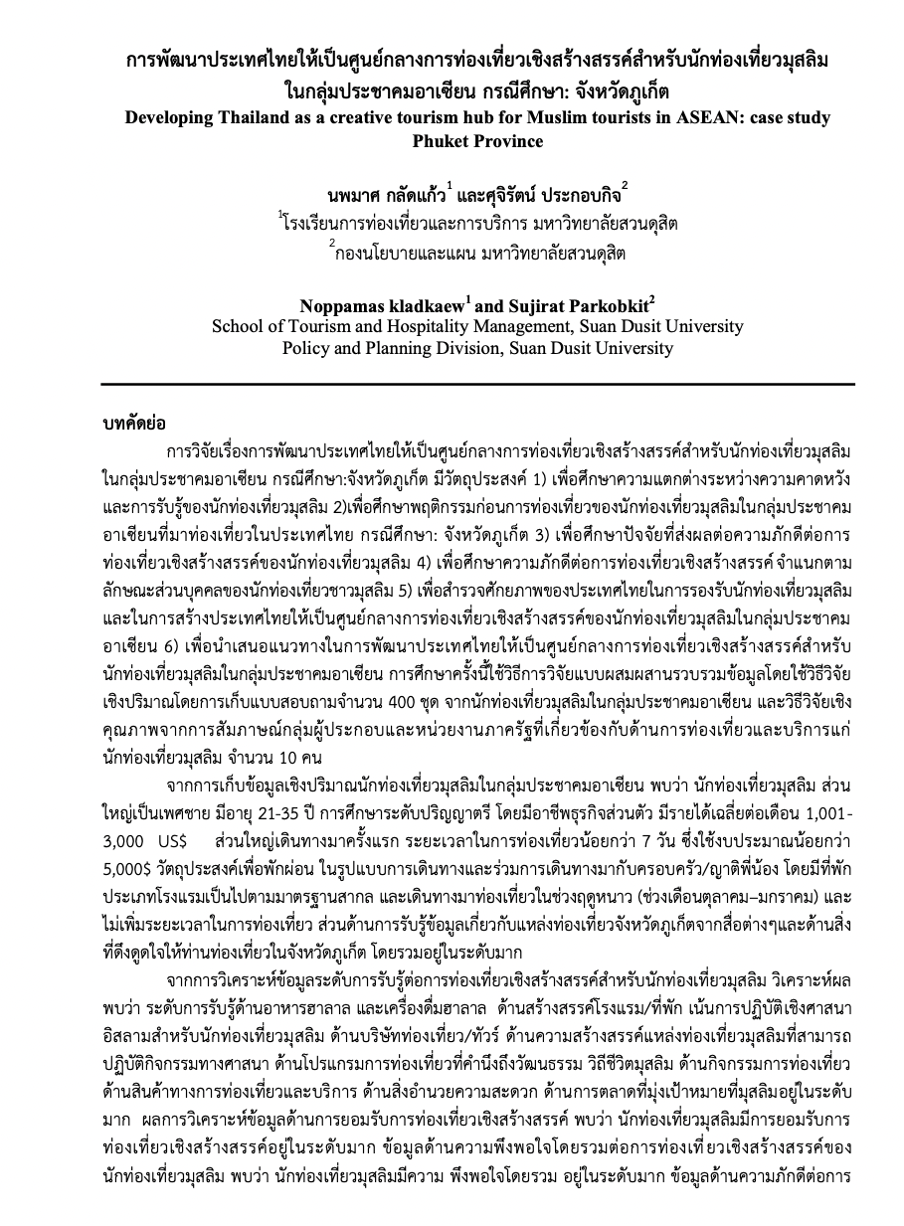
The study of the developing Thailand to be creative tourism hub for Muslim tourists in ASEAN: case study Phuket Province aims to 1) study the difference between the Muslim tourists’ expectation and perception; 2) study ASEAN Muslim tourists’ behavior who travel to Phuket Province of Thailand; 3) examine the destination loyalty factors toward creative tourism activity for Muslim tourists; 4) investigate attributes of Muslim tourist towards destination loyalty; 5) explore potential of Thailand to be Muslim hub especially for creative tourism destination in ASEAN; 6) provide the suggestion for developing Thailand to be Muslim hub for creative tourism destination in ASEAN. This study employed mixed method approach. The survey was the technique used in quantitative study, 400 questionnaires were collected from the ASEAN Muslim tourists. The qualitative approach was carried out using an interview of 10 representatives from related Muslim tourists businesses both from private and government organizations.
The results of the quantitative study found out that the majority of Muslim tourist in ASEAN were male, who aged between 21-35 years old and hold at least undergraduate degree. The main occupation of the respondents were businessman with the salary between 1,001 - 3,000 US$. Most of the respondents were the first time traveler and stay in Thailand less than 7 days with the travelling budget below 5,000$. The main purpose of visiting Thailand was for holiday and majority of the participants traveled with family. The main accommodation of the respondents was the standard hotel and most favorite season to visit Thailand was winter (October-January). Most of the respondents tended not to extend their stay.
The level of the tourist perception and the tourist attraction of Phuket as a tourist destination were ranked as excellence which means they know about tourism in Phuket. The analysis of the level of the creative tourism perception of the Muslim tourist has revealed that Halal food and drink, Muslim friendly accommodation, Muslim friendly and Muslim culture tourist activity, tourism product and facility for Muslim and the Muslim focus marketing were rated to be very good during their stay in Phuket which refer to the importance of Muslim friendly facilities. The result of the acceptance of the creative tourism of the Muslim tourists was very high. Also the Muslim tourists were satisfied for the overall destination and the intention to recommend the destination. The study also revealed that the respondents were highly agreed to revisit the destination.
The results of the qualitative study discovered that creative tourism destination in Phuket were filled of the outstanding of art and cultural attraction in the beautiful natural environment. The destination provide the tourists with the variety local way of life and the local wisdom. However, there were also some problems that during the analysis of the qualitative data which was the need of transportation improvement for the tourists to arrive to the destination conveniently, fast and safe. The finding of the study would suggest the related government organization and also private one to help in promoting of the destination where Muslim creative tourism activities were held as well as to support the engagement of the business and local community in the area especially the understanding of the idea of creative tourism in order to attract the tourists to the destination and create the memorable travel experience for the loyalty purpose. Last but not least, the knowledge of the Muslim beliefs and practice in order to welcome those potential Muslim tourists.
Article Details

This work is licensed under a Creative Commons Attribution-NonCommercial-NoDerivatives 4.0 International License.
ลิขสิทธิ์ต้นฉบับที่ได้รับการตีพิมพ์ในวารสารเพื่อการพัฒนาการท่องเที่ยวสู่ความยั่งยืน ถือเป็นกรรมสิทธิ์ของโรงเรียนการท่องเที่ยวและการบริการ มหาวิทยาลัยสวนดุสิต ห้ามผู้ใดนำข้อความทั้งหมดหรือบางส่วนไปพิมพ์ซ้ำ เว้นแต่จะได้รับอนุญาตอย่างเป็นลายลักษณ์อักษรจากโรงเรียนการท่องเที่ยวและการบริการ มหาวิทยาลัยสวนดุสิต นอกจากนี้ เนื้อหาที่ปรากฎในบทความเป็นความรับผิดชอบของผู้เขียน ทั้งนี้ไม่รวมความผิดพลาดอันเกิดจากเทคนิคการพิมพ์
References
กองวิจัยการตลาดการท่องเที่ยวแห่งประเทศไทย. (2560) TAT Review: Global Muslim Travel 2017
ภาพรวมตลาดการท่องเที่ยวมุสลิม. 3/2560 กรกฏาคม-กันยายน.
กองบรรณาธิการวอยซ์ทีวี. (2560). ไทยมีแนวโน้มเป็นศูนย์กลางการท่องเที่ยว 'ฮาลาล'. Biz Feed. สืบค้นเมื่อ 19 กรกฏาคม 2560. https://voicetv.co.th/watch/508687
กรมการท่องเที่ยว, (2558). สถิตินักท่องเที่ยว สืบค้นจาก.http://www.tourism.go.th
จิราวดี รัตนไพฑูรยชัย. (2556 ). ตลาดท่องเที่ยวมุสลิม โอกาสของไทยภายใต้ AEC.กรุงเทพธุรกิจ.
ณรงค์ โพธิ์พฤกษานันท์. (2551). ระเบียบวิธีวิจัย (พิมพ์ครั้งที่5). กรุงเทพมหานคร : ส.เอเซียเพรส
ทวีศักดิ์ ตั้งปฐมวงศ์. (2555). การก้าวสู่ประชาคมอาเซียน. กรุงเทพฯ: สํานักงานเลขาธิการสภาผู้แทนราษฎร.
ธเนศ ศรีสถิตย์. (2554). การจัดการธุรกิจแหล่งท่องเที่ยว (พิมพ์ครั้งที่ 7). นนทบุรี :มหาวิทยาลัยสุโขทัยธรรมาธิราช.
บุญเลิศ จิตตั้งวัฒนา. (2557). พฤติกรรมนักท่องเที่ยว (พิมพ์ครั้งที่ 2). กรุงเทพฯ:เฟริ์นข้าหลวง พริ้นติ้งแอนด์พับลิชชิ่ง.
ปิติ ศรีแสงนาม. (2555). ศูนย์อาเซียนศึกษาแห่งจุฬาลงกรณ์มหาวิทยาลัย http://www.thai-aec.com/802#ixzz3QIWHRaNP
ศราวุฒิ อารีย์. (2558) .การท่องเที่ยววิถีอิสลาม: โอกาสของไทยในประชาคมเศรษฐกิจอาเซียน.วารสารมนุษยศาสตร์
และสังคมศาสตร์ มหาวิทยาลัยรังสิต. ปีที่ : 10 ฉบับที่ : 18 หน้า : 1-17
ศุภลักษณ์ อัครางกูร. (2555).พฤติกรรมนักท่องเที่ยว.กรุงเทพ: คลังนานาวิทยา
สุดแดน วิสุทธิลักษณ์ และคณะ. (2556).การท่องเที่ยวเชิงสร้างสรรค์. กรุงเทพฯ : องค์การบริหารการพัฒนาพื้นที่พิเศษเพื่อการท่องเที่ยวอย่างยั่งยืน (องค์การมหาชน).
สถาบันฮาลาล มหาวิทยาลัยสงขลานครินทร์. (2560). อาหารมุสลิม กับ อาหารฮาลาล. http://www.halinst.psu.ac.th/th/knowledge-th/halalarticle-th/467-2015-02-12-02-42-07.html
องค์การบริหารการพัฒนาพื้นที่พิเศษเพื่อการท่องเที่ยวอย่างยั่งยืน. (2558). การท่องเที่ยวเชิงสร้างสรรค์. สืบจาก http://www.dasta.or.th
Book
Battour, M. M., Battor, M. M., & Ismail, M. (2012). The mediating role of tourist
satisfaction: A study of Muslim tourists in Malaysia. Journal of Travel & Tourism
Marketing, 29(3), 279-297.
Dugan, B. (1994). Religion and food service. Cornell Hotel and Restaurant Administration
Quarterly, 35(6), 80-85.
Dickman, S. (1996). Tourism: An Introductory Text, 2nd ed., Australia: Hodder Education.
Ghadami, M. (2012). The role of Islam in the tourism industry. Management Arts,
52(11204), e11209.
Henderson, J.C. (2010). Sharia-Compliant Hotels. Tourism and Hospitality Research, 10(3), 246-254
Huang, S. S. & Hsu, C. H. (2009). Effects of travel motivation, past experience, perceived
constraint, and attitude on revisit intention. Journal of Travel Research.
Moufakkir,O. and Kelly,Y.(eds.).(2010). Tourism, progress and peace. Cabi.
Mohammad, B.A.M.A.&Som. A.P. (2010). An analysis of push and pull travel motivation of foreign tourist to Jordan. International Journal of Business and Management, 5(12),41-50
Mohsin, A. (2005). Tourist attitudes and destination marketing—the case of Australia's
Northern Territory and Malaysia. Tourism Management, 26(5), 723-732.
Mohsin, A., & Ryan, C. (1997). Business visitors to the northern territory expo. Tourism
Recreation Research, 22(2), 67-69.
Namin, A.A. Tajzadeh. (2013). “Value Creation in Tourism: An Islamic Approach.” International Research Journal of Applied and Basic Sciences 4 : pp.1252-1264.
Ozdemir, I., & Met, O. (2012). The expectations of Muslim religious customers in the lodging industry: The case of Turkey. In A. Zainal, S. Radzi, R. Hashim, C. Chik & R. Abu (Eds.), Current Issues in Hospitality and Tourism Research and Innovation (323- 328). London.
Prayag, G. and Ryan, C. (2011) The relationship between the push & pull attributes of a tourist destination: the role of nationality. An analytical qualitative research approach. Current Issues in Tourism 14(2): 121-143.
Rahman, M. K. (2014). Motivating factors of Islamic tourist’s destination loyalty: an
empirical investigation in Malaysia. Journal of Tourism and Hospitality
Management, 2(1), 63-77.
Rasma, A. A. (2008). Tourism… Islam put it controls and corrected the distorted
concepts. al-forqan, V (493)[Online]. Retrieved July 413, 2008.
Shakona, M., Backman, K., Backman, S., Norman, W., Luo, Y., & Duffy, L. (2015).
Understanding the traveling behavior of Muslims in the United States.
International Journal of Culture, Tourism and Hospitality Research, 9(1), 22-35.
Weidenfeld, A. (2006). Religious needs in the hospitality industry. Tourism and
Hospitality research, 6(2), 143-159.
Weidenfeld, A. D. I., & Ron, A. S. (2008). Religious needs in the tourism industry. Anatolia,
19(2), 357-361.
Zulkharnain, A., & Jamal, S. A. (2012). Muslim guest perception of value towards Syariah concept hotel. In A. Zainal, S. Radzi, R. Hashim, C. Chik & R. Abu (Eds.), Current Issues in Hospitality and Tourism (337-340). Leiden: CRC Press.
Žabkar, V., Brenčič, M. M., & Dmitrović, T. (2010). Modelling perceived quality, visitor
satisfaction and behavioural intentions at the destination level. Tourism
management, 31(4), 537-546.
Zamani-Farahani, H. & Henderson, J. C. 2010. "Islamic tourism and managing tourism
development in Islamic societies: The cases of Iran and Saudi Arabia",
International Journal Tourism Research. 12, 79-89.
