
การวิเคราะห์โปรไฟล์แฝงสภาพการเรียนการสอนดิจิทัลพลิกผันและแพลตฟอร์มปัญญาประดิษฐ์เพื่อระบุอัตลักษณ์ดิจิทัลของนักศึกษาวิชาชีพครู
คำสำคัญ:
การวิเคราะห์โปรไฟล์แฝง, อัตลักษณ์ดิจิทัล, สภาพแวดล้อมการเรียนการสอนดิจิทัลพลิกผัน, แพลตฟอร์มปัญญาประดิษฐ์, นักศึกษาวิชาชีพครูบทคัดย่อ
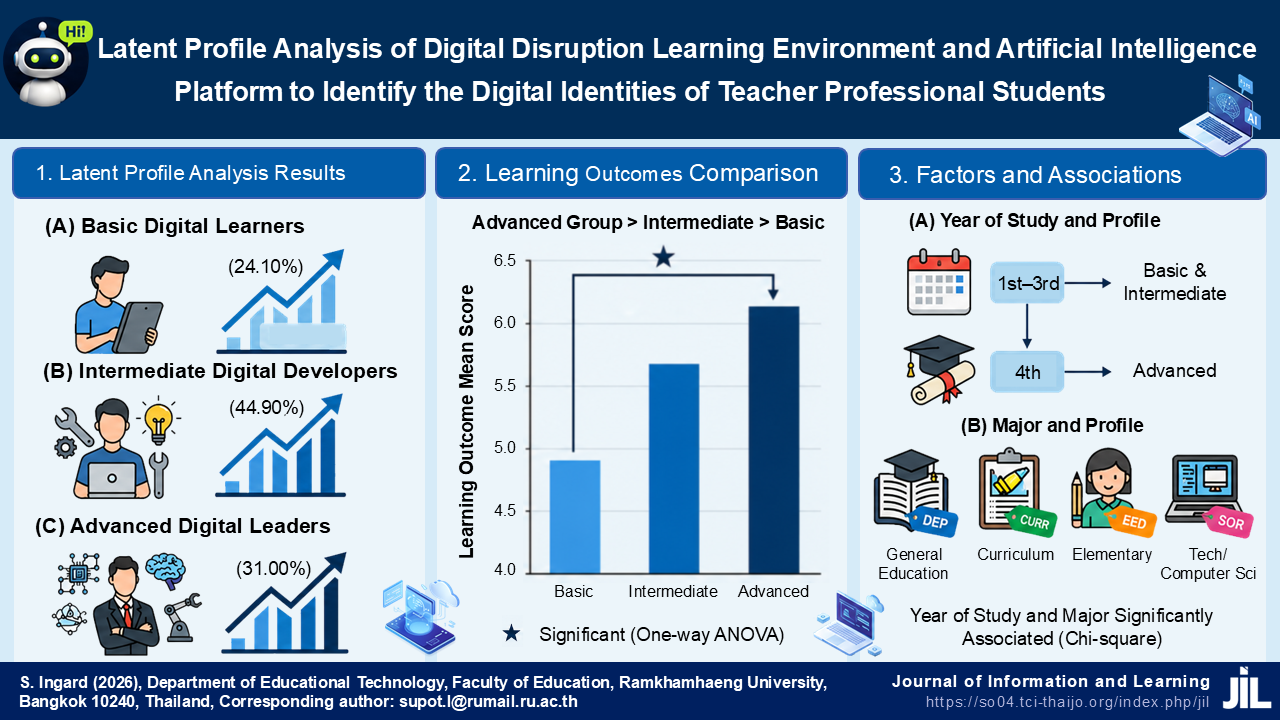
การวิจัยนี้ มีวัตถุประสงค์เพื่อ 1) วิเคราะห์โปรไฟล์แฝงผลลัพธ์การเรียนรู้ของนักศึกษาวิชาชีพครูจากตัวแปรบ่งชี้ด้านการรับรู้สภาพแวดล้อมดิจิทัลพลิกผันและการใช้แพลตฟอร์มปัญญาประดิษฐ์ 2) เปรียบเทียบความแตกต่างของผลลัพธ์การเรียนรู้ระหว่างกลุ่มนักศึกษาที่มีอัตลักษณ์ดิจิทัลแฝงแตกต่างกัน และ 3) ศึกษาความสัมพันธ์ระหว่างลักษณะส่วนบุคคลกับกลุ่มอัตลักษณ์ดิจิทัลแฝง กลุ่มตัวอย่าง คือ นักศึกษาวิชาชีพครูระดับปริญญาตรีในสถาบันอุดมศึกษาเขตกรุงเทพมหานครและปริมณฑล จำนวน 528 คน ซึ่งได้มาจากการสุ่มแบบหลายขั้นตอน เครื่องมือวิจัย คือ แบบสอบถามมาตราส่วนประเมินค่า 6 ระดับ ที่มีคุณภาพผ่านเกณฑ์ IOC และสัมประสิทธิ์แอลฟาของครอนบาค วิเคราะห์ข้อมูลด้วยการวิเคราะห์โปรไฟล์แฝง (LPA) การวิเคราะห์ความแปรปรวนแบบจำแนกทางเดียว (One-way ANOVA) และสถิติทดสอบไคสแควร์ ผลการวิจัย พบว่า 1) แบบจำลองโปรไฟล์แฝงรูปแบบ 3 กลุ่ม มีความสอดคล้องกับข้อมูลเชิงประจักษ์ดีที่สุด ได้แก่ กลุ่มเรียนรู้ดิจิทัลระดับพื้นฐาน (ร้อยละ 24.10) กลุ่มพัฒนาการดิจิทัลระดับปานกลาง (ร้อยละ 44.90) และกลุ่มผู้นำดิจิทัลระดับสูง (ร้อยละ 31.00) 2) ผลลัพธ์การเรียนรู้ระหว่างกลุ่มแตกต่างกันอย่างมีนัยสำคัญทางสถิติ โดยกลุ่มผู้นำดิจิทัลระดับสูงมีคะแนนเฉลี่ยสูงสุด รองลงมา คือ กลุ่มพัฒนาการดิจิทัลระดับปานกลาง และกลุ่มเรียนรู้ดิจิทัลระดับพื้นฐาน ตามลำดับ และ 3) ชั้นปีและสาขาวิชามีความสัมพันธ์กับกลุ่มอัตลักษณ์ดิจิทัลแฝงอย่างมีนัยสำคัญทางสถิติ โดยกลุ่มเรียนรู้ดิจิทัลพื้นฐานส่วนใหญ่เป็นนักศึกษาชั้นปีที่ 1–3 สายศึกษาทั่วไปและหลักสูตรและการสอนที่ไม่จำกัดเพศ กลุ่มพัฒนาการดิจิทัลระดับปานกลางเป็นกลุ่มใหญ่ที่สุดในทุกปัจจัย โดยมีนักศึกษาสายประถมศึกษาและปฐมวัยหนาแน่นที่สุด ส่วนกลุ่มผู้นำดิจิทัลระดับสูง คือ นักศึกษาชั้นปีที่ 4 สายเทคโนโลยี คอมพิวเตอร์ และวิทยาศาสตร์เป็นหลัก
เอกสารอ้างอิง
Akogul, S., & Erisoglu, M. (2017). An approach for determining the number of clusters in a model-based cluster analysis. Entropy, 19(9), Article 452. https://doi.org/10.3390/e19090452
Bae, H., Hur, J., Park, J., Choi, G. W., & Moon, J. (2024). Pre-service teachers' dual perspectives on generative AI: Benefits, challenges, and integrating into teaching and learning. Online Learning, 28(3), 321–345. https://doi.org/10.24059/olj.v28i3.4543
Burgos-Videla, C. G., Castillo Rojas, W. A., López Meneses, E., & Martínez, J. (2021). Digital competence analysis of university students using latent classes. Education Sciences, 11(8), Article 385. https://doi.org/10.17159/2520-9868/i79a02
Campbell, E., & Kapp, R. (2020). Developing an integrated, situated model for digital literacy in pre-service teacher education. Journal of Education, 79, 18–30. https://doi.org/10.17159/2520-9868/i79a02
Çebi, A., & Reisoğlu, I. (2020). Digital competence: A study from the perspective of pre-service teachers in Turkey. Journal of New Approaches in Educational Research, 9, 294–308. https://doi.org/10.7821/naer.2020.7.583
Chen, X. (2024). Collaborative design with conversational artificial intelligence: A case study of pre-service language teachers in multidisciplinary teams. International Journal of Technology in Teaching and Learning, 20(2), 95–107. https://doi.org/10.37120/ijttl.2024.20.2.01
Collins, L. M., & Lanza, S. T. (2010). Latent class and latent transition analysis: With applications in the social, behavioral, and health sciences. Wiley. https://doi.org/10.1002/9780470567333
Cronbach, L. J. (1990). Essentials of psychological testing (5th ed.). Harper Collins Publishers.
Galindo-Domínguez, H., & Bezanilla, M. J. (2021). Digital competence in the training of pre-service teachers: Perceptions of students in the degrees of early childhood education and primary education. Journal of Digital Learning in Teacher Education, 37(4), 262–278. https://doi.org/10.1080/21532974.2021.1934757
Gökbulut, B. (2026). Enhancing pre-service teachers' AI-TPACK through sustainable development goals: A mixed-methods study on AI-supported Web 2.0 tools. Sustainability, 18(6), Article 2963. https://doi.org/10.3390/su18062963
Hernández-Orellana, M., Pérez-Garcias, A., & Roco-Videla, Á. (2021). Characterization of the digital identity of Chilean university students considering their personal learning environments. Future Internet, 13(3), Article 74. https://doi.org/10.3390/fi13030074
Heuling, L. S., Wild, S., & Vest, A. (2021). Digital competences of prospective engineers and science teachers: A latent profile and correspondence analysis. International Journal of Education in Mathematics, Science and Technology, 9(3), 760-782. https://doi.org/10.46328/ijemst.1831
Higher Education Standards Committee. (2022). Notification of details of learning outcomes according to higher education qualification standards B.E. 2565. Royal Thai Government Gazette, 139 (Special Issue 212 Ng). https://www.ops.go.th/th/chesdownloads/edustandard/download/1079/6940
Ingard, S. (2025a). A confirmatory model of an artificial intelligence-supported learning environment influence toward learning outcome of teachers professional students. Journal of Educational Technology and Communications Faculty of Education Mahasarakham University, 8(28), 53–66. https://so02.tci-thaijo.org/index.php/etcedumsujournal/article/view/282076
Ingard, S. (2025b). The digital disruption learning environment influence toward learning outcome of teachers professional students. e-Journal of Education Studies, Burapha University, 7(3), 37–54. https://so01.tci-thaijo.org/index.php/ejes/article/view/282567
Luo, J., Zhu, C., Hu, L., & Sun, M. (2025). Empowering preservice teachers through textbook design activities with GAI-based chatbot. IEEE Transactions on Learning Technologies, 18, 822–832. https://doi.org/10.1109/TLT.2025.3606757
Masitoh, F., Cahyono, B. Y., Suryati, N., & Suhartoyo, E. (2023). Pre-service EFL teachers' identity construction in relation to digital gamification: A social theory of learning perspective. The JALT CALL Journal, 19(3), 245–268. https://doi.org/10.29140/jaltcall.v19n3.1062
Masyn, K. E. (2013). Latent class analysis and finite mixture modeling. In T. D. Little (Ed.), The Oxford handbook of quantitative methods: Vol. 2. Statistical analysis (pp. 551–611). Oxford University Press. https://doi.org/10.1093/oxfordhb/9780199934898.013.0025
Mayer, D. G. (1995). Psychology (4th ed.). Worth Publishers.
McLay, K. F., & Reyes, V. C. (2019). Identity and digital equity: Reflections on a university educational technology course. Australasian Journal of Educational Technology, 35(6), 15–29. https://doi.org/10.14742/ajet.5552
Nirmala Grace Rani, S. (2025). The future of AI in teacher education: Challenges and opportunities. Indian Educational Researcher, 18(2), 28–32. https://doi.org/10.34293/0974-2123.v18n2.004
Novriyanto, E., Harsani, P., & Hardhienata, S. (2025). Peningkatan kompetensi professional guru di era digital melalui pengembangan pelatihan berbasis artificial intelligence dan blended learning. Wawasan: Jurnal Ilmu Manajemen, Ekonomi dan Kewirausahaan, 3(2), 112–125. https://doi.org/10.58192/wawasan.v3i2.3054
Nykvist, S., & Mukherjee, M. (2016). Who am I? Developing pre-service teacher identity in a digital world. Procedia - Social and Behavioral Sciences, 217, 851–857. https://doi.org/10.1016/j.sbspro.2016.02.012
Nylund-Gibson, K., & Choi, A. Y. (2018). Ten frequently asked questions about latent class analysis. Translational Issues in Psychological Science, 4(4), 440–461. https://doi.org/10.1037/tps0000176
Ounejjar, L. A., Lachgar, M., Ouhayou, O., Laanaoui, M. D., Refki, E., Makaoui, R., & Saoud, A. (2024). SmartBlendEd: Enhancing blended learning through AI-optimized scheduling and user-centric design. SoftwareX, 27, Article 101891. https://doi.org/10.1016/j.softx.2024.101891
Persidskaya, O. (2024). Theoretical and methodological framework of typologization of digital identity. Social Psychology and Society, 15(4), 58–74. https://psyjournals.ru/en/journals/sps/archive/2024_n4/Persidskaya
Rahden, J., Rubach, C., & Porsch, R. (2025). Competence beliefs using technology in school and teaching – How can we use variance and covariance to identify teachers' profiles? Teaching and Teacher Education, 154, Article 104869. https://doi.org/10.1016/j.tate.2024.104869
Santrock, J. W. (1997). Psychology. Brown & Benchmark.
Seol, H. (2024). snowRMM: Rasch mixture, LCA, and test equating analysis (Version 5.9.1) [Jamovi module]. https://github.com/topics/latent-profile-analysis
Tangpattanakit, J., & Senariddhikrai, P. (2022). The role of confirmatory factor analysis (CFA) in structural equation modeling (SEM). Journal of Management Sciences Kasetsart University, 1(2), 99–110. https://kuojs.lib.ku.ac.th/index.php/jmsku/article/view/5185
Tlebaldinova, A. S., Kumargazhanova, S. K., Smailova, S. S., Konurbayeva, Z. T., & Seitahmetova, Z. M. (2025). Cluster analysis of behavioral factors in the formation of students' digital identity. Bulletin of D. Serikbayev EKTU, 1, 221-232. https://doi.org/10.51885/1561-4212_2025_1_221
Wang, R., & Mokhtar, M. M. (2025). Empowering oral English teachers with AI to improve digital and blended teaching competencies. Edelweiss Applied Science and Technology, 9(8), 1716–1724. https://doi.org/10.55214/2576-8484.v9i8.9694
ดาวน์โหลด
ไฟล์ประกอบ
เผยแพร่แล้ว
รูปแบบการอ้างอิง
ฉบับ
ประเภทบทความ
หมวดหมู่
สัญญาอนุญาต
ลิขสิทธิ์ (c) 2026 Supot Ingard

อนุญาตภายใต้เงื่อนไข Creative Commons Attribution-NonCommercial 4.0 International License.
เข้าถึงบทความได้โดยไม่เสียค่าใช้จ่าย นโยบายสัญญาอนุญาตปัจจุบัน CC BY-NC 4.0 ตั้งแต่ปีที่ 37 ฉบับที่ 2 (2569) สำหรับบทความก่อนหน้านี้ โปรดตรวจเงื่อนไขสิทธิบนหน้าบทความแต่ละเรื่อง ดูนโยบายการเข้าถึงแบบเปิดและสัญญาอนุญาต

