
Strategies Development to Enhance the Ability of Elementary School Teachers Using Situation-Based Learning Supported by Artificial Intelligence and Professional Learning Communities for Instructional Design
Keywords:
teacher competency enhancement, situation-based learning, artificial intelligence, professional learning communities, instructional designAbstract
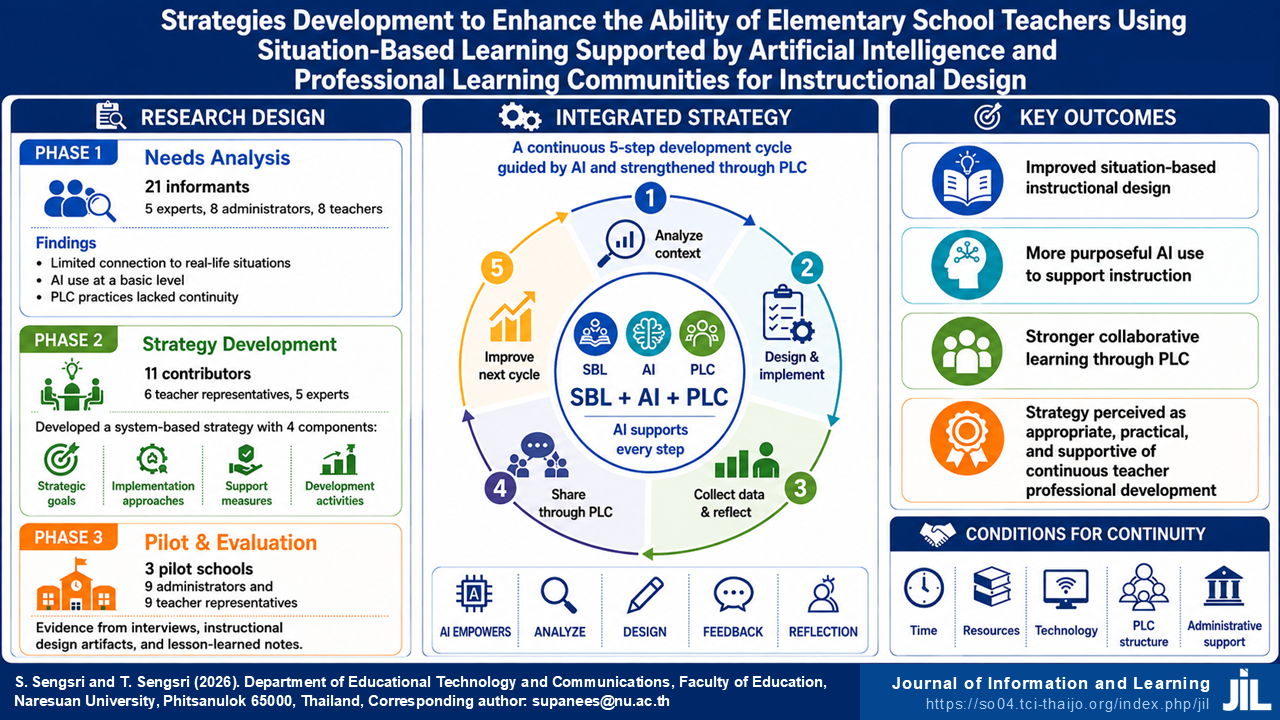
The objectives of this study were to: 1) examine the current conditions, desired conditions, and priority needs for enhancing the competencies of basic education teachers; 2) develop strategies to enhance basic education teachers’ competencies through the integration of situation-based learning, the use of artificial intelligence, and collaborative learning through professional learning communities for instructional design and teaching management; and 3) implement and evaluate the strategies to enhance basic education teachers’ competencies. The study employed a research and development design and was conducted in three phases. The informants consisted of five experts, eight school administrators, and eight teachers in Phase 1; six teacher representatives and five experts in Phase 2; and nine school administrators and teacher representatives from three pilot schools in Phase 3. The research instruments included semi-structured interview forms, draft teacher competency enhancement strategies with an appropriateness evaluation form, and an interview form for evaluating strategy implementation. Data were analyzed using content analysis and descriptive statistics, including mean and standard deviation (SD). The findings revealed that 1) in Phase 1, the current conditions reflected limitations in designing learning activities connected to real-life situations, the basic-level use of artificial intelligence use, and discontinuity in professional learning community practices, whereas the desired conditions emphasized practice-based learning, the use of artificial intelligence to support professional work, and systematic collaborative learning; 2) in Phase 2, the developed strategies were system-based and consisted of four components: strategic goals, implementation approaches, support measures, and development activities; and 3) in Phase 3, the implementation of the strategies resulted in positive changes among teachers in the design of situation-based learning activities, the use of artificial intelligence for instruction, and collaborative learning through professional learning communities. Teachers and school administrators considered the strategies appropriate, practical, and conducive to continuous professional development.
References
Bouwmans, M., Runhaar, P., Wesselink, R., & Mulder, M. (2017). Fostering teachers’ team learning: An interplay between transformational leadership and participative decision-making. Teaching and Teacher Education, 65, 71–80. https://doi.org/10.1016/j.tate.2017.03.010
Chen, L. (2022). Facilitating teacher learning in professional learning communities through action research: A qualitative case study in China. Teaching and Teacher Education, 119, Article 103875. https://doi.org/10.1016/j.tate.2022.103875
Christensen, A. A., & Jerrim, J. (2025). Professional learning communities and teacher outcomes: A cross-national analysis. Teaching and Teacher Education, 156, Article 104920. https://doi.org/10.1016/j.tate.2024.104920
Darling-Hammond, L., Flook, L., Cook-Harvey, C., Barron, B., & Osher, D. (2020). Implications for educational practice of the science of learning and development. Applied Developmental Science, 24(2), 97–140. https://doi.org/10.1080/10888691.2018.1537791
Darling-Hammond, L., Hyler, M. E., & Gardner, M. (2017). Effective teacher professional development. Learning Policy Institute. https://doi.org/10.54300/122.311
Fullan, M. (2021). The right drivers for whole system success. Centre for Strategic Education.
Global Education Monitoring Report Team. (2024). 2024 Youth report: Technology in education: A tool on our terms! UNESCO. https://doi.org/10.54676/ELSQ4648
Herrington, J., Reeves, T. C., & Oliver, R. (2014). Authentic learning environments. In J. M. Spector, M. D. Merrill, J. Elen, & M. J. Bishop (Eds.), Handbook of research on educational communications and technology (4th ed., pp. 401–412). Springer.
Huang, L., Liang, M., Xiong, Y., Wu, X., & Lim, C. P. (2024). A systematic review of technology-enabled teacher professional development during COVID-19 pandemic. Computers & Education, 223, Article 105168. https://doi.org/10.1016/j.compedu.2024.105168
Kolb, D. A. (2015). Experiential learning: Experience as the source of learning and development (2nd ed.). Pearson Education.
Li, K., Wang, P., & Chen, G. (2025). How can AI be integrated into teacher professional development programs? A systematic review based on an adapted technology-based learning model. Teaching and Teacher Education, 168, Article 105219. https://doi.org/10.1016/j.tate.2025.105219
Luyten, H., & Bazo, M. (2019). Transformational leadership, professional learning communities, teacher learning and learner centred teaching practices: Evidence on their interrelations in Mozambican primary education. Studies in Educational Evaluation, 60, 14–31. https://doi.org/10.1016/j.stueduc.2018.11.002
OECD. (2016). Innovating education and educating for innovation: The power of digital technologies and skills. OECD. https://doi.org/10.1787/9789264265097-en
OECD. (2021). The state of global education: 18 months into the pandemic.OECD. https://doi.org/10.1787/1a23bb23-en
OECD. (2025). Empowering learners for the age of AI: An AI literacy framework for primary and secondary education [Review draft]. OECD.https://ailiteracyframework.org/wp-content/uploads/2025/05/AILitFramework_ReviewDraft.pdf
Plass, J. L., Homer, B. D., & Kinzer, C. K. (2015). Foundations of game-based learning. Educational Psychologist, 50(4), 258–283. https://doi.org/10.1080/00461520.2015.1122533
Saeedian, S., & Ghaderi, A. (2023). Scenario-based classroom context mode: Reshaping non-native teachers’ decision-making and pedagogical reasoning. Asian-Pacific Journal of Second and Foreign Language Education, 8, Article 36. https://doi.org/10.1186/s40862-023-00208-2
UNESCO. (2021). AI and education: Guidance for policy-makers. https://doi.org/10.54675/PCSP7350
Downloads
Additional Files
Published
How to Cite
Issue
Section
Categories
License
Copyright (c) 2026 Supanee Sengsri, Thongchai Sengsri

This work is licensed under a Creative Commons Attribution-NonCommercial 4.0 International License.
Free access to published articles. Current licensing policy: CC BY-NC 4.0 from Volume 37, Issue 2 (2026). For earlier articles, consult the rights information on the individual article page. See our Open Access, Copyright and Licensing policy.

