
Analysis and Data Visualization of the Settlement Patterns of Ethnic Groups in Lanna
Keywords:
settlement patterns, ethnic groups in Lanna, data visualizationAbstract
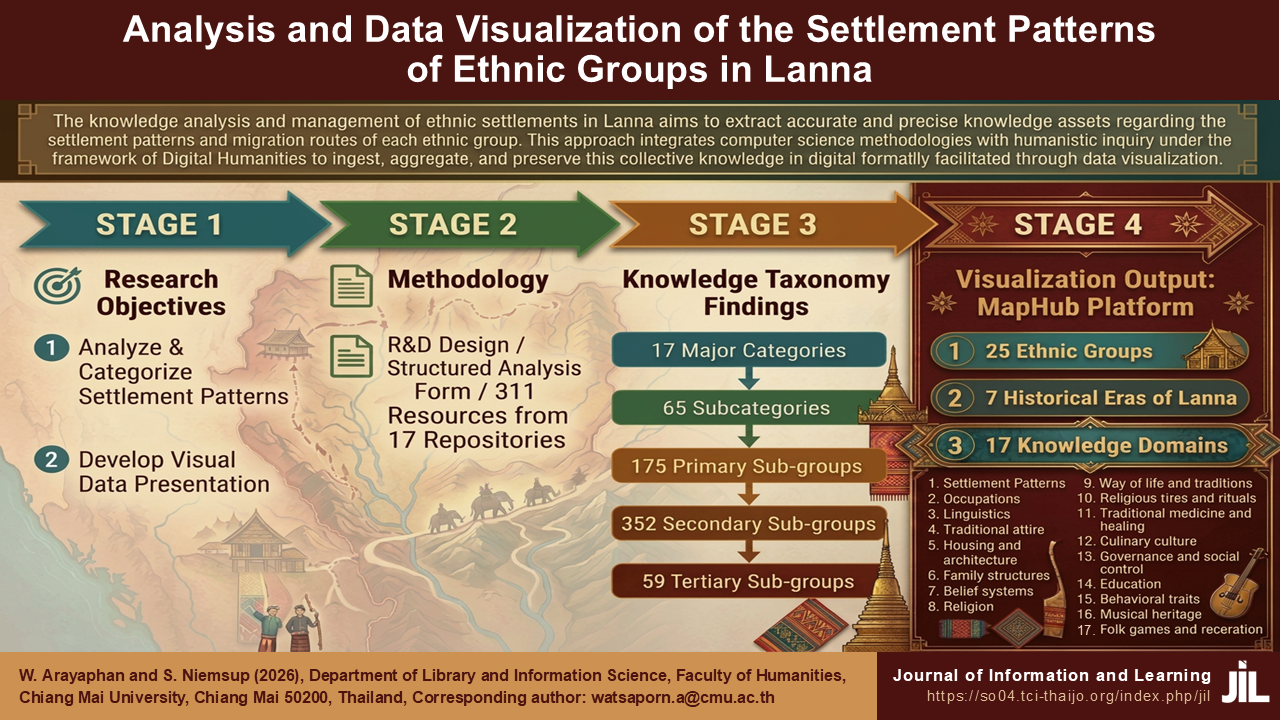
This research, focusing on the analysis and visualization of ethnic settlements in Lanna, aims to: 1) analyze and categorize settlement patterns, and 2) develop a visual data presentation of these settlements. Adopting a research and development (R&D) methodology, the study utilized a structured analysis form as the primary data collection instrument. The sample comprised 311 information resources retrieved from 17 specialized repositories. The findings revealed a multi-level knowledge taxonomy consisting of 17 major categories, 65 subcategories, 175 primary sub-groups, 352 secondary sub-groups, and 59 tertiary sub-groups. Regarding the visualization component, the MapHub platform was employed as the core developmental tool. The web-based interface is categorized into three interactive modules: 1) classification by 25 ethnic groups; 2) chronological display across 7 historical eras of Lanna; and 3) thematic visualization of 17 knowledge domains, namely: settlement, occupations, linguistics, traditional attire, housing and architecture, family structures, belief systems, religion, way of life and traditions, religious rites and rituals, traditional medicine and healing, culinary culture, governance and social control, education, behavioral traits, musical heritage, and folk games and recreation.
References
Abdinassir, N. (2024). Assimilation and acculturation processes in the study of inter-ethnic marriages. Special Treatment Interdisciplinary Journal, 10(Special Issue), 7–21. https://doi.org/10.18458/KB.2024.SI.7
Baker, D., & Ellis, L. (2025). Encyclopedia of libraries, librarianship, and information science (4 Vol.). Elsevier.
Broughton, V. (2023). Facet analysis: The evolution of an idea. Cataloging & Classification Quarterly, 61(5–6), 411–438. https://doi.org/10.1080/01639374.2023.2196291
Buasruang, A., & Premsrirat, S. (1998). Encyclopedia of ethnic groups in Thailand: Nyahkur. Institute for Language and Culture Research for Rural Development, Mahidol University.
Bunyasaranai, P. (2025, April 18). Ethnic groups in Thailand: Lahu. Princess Maha Chakri Sirindhorn Anthropology Centre. https://ethnicity.sac.or.th/database-ethnic/206
Center for the Promotion of Art Culture and Creative Lanna. (2026, April 17). Lanna ethnic group. Chiang Mai University. https://art-culture.cmu.ac.th/Lanna/ethnic
Chaipikusit, P. (1999). Sip sō̜ng chon phao nai prathēt Thai: Watthanatham praphēnī thī pen ʻēkkalak [Twelve ethnic groups in thailand: Unique cultures and traditions]. Pupae Ota.
Chanruang, B. (2023). Practical data visualization & analytics with Looker Studio. IDC Premier.
Chanthamatharee, K. (2025, April 11). Ethnic groups in Thailand: Kammu (Khmu). Princess Maha Chakri Sirindhorn Anthropology Centre. https://ethnicity.sac.or.th/database-ethnic/162
Chauhan, P. S., Arya, R., Chakrawarti, R. K., Jayamani, E., Sharma, N., & Rawat, R. (2025). Information visualization for intelligent systems. John Wiley & Sons.
Chiwarak, P. (2023). A brief history of the words Lanna and Lanna Thai. Thammasat Journal of History, 10(1), 79–106. https://so05.tci-thaijo.org/index.php/thammasat_history/article/view/262649
Chuaykird, P. (2022, March 26). Lanna: Lan Xang, cultural heritage of the Mekong river basin people. Institute for Social Development Research, Khon Kaen University. https://rsdi.kku.ac.th/?p=2442
Cogley, B. (2022). Functional aesthetics for data visualization. John Wiley & Sons.
Emery, A. K. (2014). The data visualization design process: a step-by-step guide for beginners. Depict Data Studio. https://depictdatastudio.com/data-visualization-design-process-step-by-step-guide-for-beginners
Doxiadis, C. A. (1976). Ekistic elements, action for human settlements. Norton.
Haneda, S., & Ono, A. (2022). R&D management practices and innovation: Evidence from a firm survey. Springer Nature Singapore. https://doi.org/10.1007/978-981-16-9797-5
Hattarakiatcharoen, B. (2013). Analysis and organizing knowledge recorded in palm leaf manuscripts [Unpublished doctoral dissertation]. Khon Kaen University.
Hattarakiatcharoen, B., Manmart, L. & Nantapichai, S. (2014). Analyzing and classifying knowledge content in transliterated Thai palm leaf manuscripts. KKU Research Journal (Graduate Studies), 14(1), 36–54. https://ph02.tci-thaijo.org/index.php/gskku/article/view/23078
Health Center for Ethnic Group, Marginal People and Migrant Worker. (2026, April 17). Ethnic minority population data for 20 provinces. Department of Health. Ministry of Public Health. https://hhdclampang.anamai.moph.go.th:8080/hhdcdashboard/ethnics
Herndon, J. (Ed.). (2022). Data science in the library: Tools and strategies for supporting data-driven research and instruction. Facet Publishing.
Highland Research and Development Institute. (2019). Khō̜mūn phư̄nthān khō̜ng chumchon bon phư̄nthī sūng [Basic information about highland communities]. https://hrdi.gdcatalog.go.th/en/dataset/highland_data_stat
Hjørland, B., & Gnoli, C. (Eds.). (2025a). Classification. In Encyclopedia of knowledge organization. ISKO. https://www.isko.org/cyclo/classification.htm
Hjørland, B., & Gnoli, C. (Eds.). (2025b). Content analysis. In Encyclopedia of knowledge organization. ISKO. https://www.isko.org/cyclo/content_analysis.htm
Hurst, A. (2023). Chapter 17, content analysis. In Introduction to qualitative research methods. Oregon State University. https://open.oregonstate.education/qualresearchmethods/chapter/chapter-17-content-analysis
Institute of Language and Culture for Rural Development, Mahidol University. (2005). Ethnic minority languages and cultures in crisis: Challenges and opportunities. Institute of Language and Culture for Rural Development, Mahidol University.
Jaroenruen, Y. (2019). Automatically creating authority files from bibliographic databases using the Faceted Application of Subject Terminology (FAST). Princess of Naradhiwas University Journal of Humanities and Social Sciences, 6(2), 141–151. https://so05.tci-thaijo.org/index.php/pnuhuso/article/view/180511
Kachacharoen, P. (2022). Data storytelling and visualization. IDC Premier.
Kesthet, B. (2019). Rākngao phaophan nai Sayām [Roots and ethnicity in Siam]. Inthanin.
Komor, M., & Grzyb, K. (2023). Qualitative content analysis: A research method in social science. Educational Studies Review, 43(2), 143–163. https://doi.org/10.12775/PBE.2023.032
Krachajan, P. (2026, April 30). Ethnic groups in Thailand: Nyahkur. Princess Maha Chakri Sirindhorn Anthropology Centre. https://ethnicity.sac.or.th/database-ethnic/171
Lau, G., & Pan, L. (2015). A 5-step guide to data visualization. Elsevier. https://health.usf.edu/media/ytombwds/a-5-step-guide-to-data-visualization.pdf
Leebsang, N. (1996). Labor migration of the Khmu ethnic group: Situation and impacts on the community. Hilltribe Research Institute, Department of Public Welfare, Ministry of Labour and Social Welfare.
Lerch, A. (2023). An introduction to audio content analysis: music information retrieval tasks and applications (2nd ed.). Wiley–IEEE Press.
Liu, J., Zheng, B., & Tang, H. (2023). The science of rural human settlements: A comprehensive overview. Frontiers in Environmental Science, 11, Article 1274281. https://doi.org/10.3389/fenvs.2023.1274281
MapHub. (2026). Create interactive maps. https://maphub.net
Matanbun, W., Jinajanchai, T., Leksomboon, K., & Champaval, S. (2013). Chāttiphan Thai phư̄n rāp nai Lānnā [Tai lowland ethnic groups in Lanna]. Social Research Institute, Chiang Mai University.
Mayring, P. (2022). Qualitative content analysis: A step-by-step guide. Sage.
Mekhatria, M. (2026, April 17). 5 steps to create an effective data visualization. Highsoft. https://www.highcharts.com/blog/best-practices/5-steps-to-create-an-effective-data-visualization
Mueangchanchey, R. (2005). Lōk that khō̜ng klum chāttiphan nai prathēt Thai: Nithān Thai sōng [The worldview of ethnic groups in Thailand: Thai Song Tales]. Sahathamik Printing House.
Muensee, C., Intaraksa, A., & Phewnil, O. (2015). Human settlement in limited areas in Mae Poon and Mae Prong Watershed areas, Mae Poon Sub-District, Laplae District, Uttaradit Province. Journal of Social Science Srinakharinwirot University, 18, 40–50. https://ejournals.swu.ac.th/index.php/JOS/article/view/7022
Office of the National Security Council. (2023). Action plan for promoting coexistence in Multicultural Society in Thailand (2023–2027). Office of the National Security Council.
Ongsakul, S. (1996). History of Lanna (2nd ed.). Amarin Printing and Publishing.
Ongsakul, S. (2001). History of Lanna (3rd ed.). Amarin Printing and Publishing.
Ongsakul, S. (2018). A complete history of Lanna (12th ed.). Amarin Printing and Publishing.
Orozco, G., & Díaz-Cuevas, P. (2025). Developing an open-source tool for collaborative mapping: process, challenges and solutions. GeoFocus. International Review of Geographical Information Science and Technology, 36, 1–24. https://dx.doi.org/10.21138/GF.898
Phonphotthanamat, W. (2022). A comparative study of verifying the content validity of a research instrument with the IOC, CVR and CVI. RSU Library Journal, 28(1), 169–192. https://rilj.rsu.ac.th/download/article/281
Prasad, B. D. (2008). Content analysis: a method in social science research. Research Methods for Social Work, 5, 1–20. https://www.miguelangelmartinez.net/IMG/pdf/2008_Prasad_Content_Analysis_chapter.pdf
Premchaiswadi, W., & Romsaiyud, W. (2011). Navigation without GPS: Fake location for mobile phone tracking. Siam University.
Princess Maha Chakri Sirindhorn Anthropology Centre. (2003, March 26–28). Nation and ethnicity: Lifestyles and ethnic diversity in the contemporary world: Abstract. The 2nd Annual Anthropology Conference, Bangkok, Thailand. https://elibrary.tsri.or.th/fullP/PDG4610006/PDG4610006V11/PDG4610006V11_full.pdf
Princess Maha Chakri Sirindhorn Anthropology Centre. (2025, April 10). Klum chāttiphan nai prathēt Thai: Lua (Mal, Prai) [Ethnic groups in Thailand: Lua (Mal, Prai)]. https://ethnicity.sac.or.th/ethnic_detail?EID=199
Punya, P., Saitong, P., & Kaenampornpan, M. (2014). Development of 3D navigation map application navigating in Mahasarakham University (MSU-GPS). Journal of Engineering and Innovation, 7(2), 45–54. https://ph02.tci-thaijo.org/index.php/eng_ubu/article/view/84392
Ratchakitcha. (2023). Dictionary of urban planning terms. Royal Institute of Thailand. Thanaplace.
Rivkin, B. S. (2024). Navigation without GPS. Gyroscopy and Navigation. 15, 83–98. https://doi.org/10.1134/S2075108724700202
Royal Institute of Thailand. (2026, April 17). Dictionary of the Royal Institute of Thailand.
Saiphan, P. (2025, April 9). Ethnic groups in Thailand: Tai Dam. Princess Maha Chakri Sirindhorn Anthropology Centre.
Shamchuk, L. (2024). Canadian perspectives: a content analysis of selected English language LIS research. The Canadian Journal of Information and Library Science, 47(3), 36–48. https://doi.org/10.5206/cjils-rcsib.v47i3.20169
Shirowzhan, S. (Ed.). (2022). Data science, data visualization, and digital twins. IntechOpen.
Singh, K. (2026). Social research methods and applications: Qualitative, quantitative, and mixed methods approaches. Routlidge.
Sodsangkrit, M. (2013). Kānsưksā thāng phāsāsāt chœ̄ng prawattisāt rư̄ang khwāmsamphan khō̜ng phāsā Thai thin ʻĪsān kap phāsā Čhīn [A historical linguistic study on the relationship between Northeastern Thai Dialects and Chinese]. Ubon Ratchathani University.
Stenou, K. (2002). UNESCO universal declaration on cultural diversity. Cultural Diversity Series No. 1.
Suebsonti, P. (1987). Kānwičhai bannāraksasāt læ sāranithēt sāt [Library and Information Science Research]. Chulalongkorn University.
Sutthinirankul, C. (2003). Content analysis in information science. In Compilation of academic materials: Research in information science units (pp. 1–7). Sukhothai Thammathirat Open University.
Thai Junior Encyclopedia Foundation. (2026a, April 17). Kān tang thin thān khō̜ng manut [Human settlements]. In Thai Junior Encyclopedia (Vol. 17). Thai Junior Encyclopedia Foundation by His Majesty King Bhumibol Adulyadej The Great. https://saranukromthai.or.th/ebookpage/18
Thai Junior Encyclopedia Foundation. (2026b, April 17). Chāttiphan [Ethnicity]. In Thai Junior Encyclopedia (Vol. 23). Thai Junior Encyclopedia Foundation by His Majesty King Bhumibol Adulyadej The Great. https://saranukromthai.or.th/smallchild/722
Thananthong, T. (2022). Data visualization for data science: Design and development. Thammasat University.
Thuamsuk, K. (2015, December 2–4). Kāo sūdi čhi lom nu sō̜ yasā sot di čhi than phư̄a sangkhom læ sapphayākō̜n khwāmrū [Stepping towards digital humanities, Digital Society and Knowledge Resources] [Symposium]. Proceedings of the 31st Conference on Cooperation Among University Libraries, Khon Kaen, Thailand.
Tosarath, N., & Meesathan, W. (1997). Encyclopedia of ethnic groups in Thailand: Mien (Yao). Institute for Language and Culture Research for Rural Development, Mahidol University. https://repository.li.mahidol.ac.th/handle/123456789/48617
Yathai, S. (2025, February 11). Klum chāttiphan nai prathēt Thai: Lu Mien [Ethnic groups in Thailand: Lu Mien]. Princess Maha Chakri Sirindhorn Anthropology Centre. https://ethnicity.sac.or.th/ethnic_detail?EID=213
Downloads
Additional Files
Published
How to Cite
Issue
Section
Categories
License
Copyright (c) 2026 Journal of Information and Learning

This work is licensed under a Creative Commons Attribution-NonCommercial 4.0 International License.
The Journal of Information and Learning is operated by the Office of Academic Resources, Prince of Songkla University. All articles published in the journal are protected by Thailand copyright law. This copyright covers the exclusive rights to share, reproduce and distribute the article, including in electronic forms, reprints, translations, photographic reproductions, or similar. Authors own copyrights in the works they have created as well as the Office of Academic Resources. The Journal reserves the right to edit the language of papers accepted for publication for clarity and correctness, as well as to make formal changes to ensure compliance with the journal's guidelines. All authors must take public responsibility for the content of their paper.


