
The Development of a Learning Model in the Metaverse Environment Using Scaffolding Techniques to Promote Collaborative Problem-Solving for Undergraduate Students
Keywords:
learning model, collaborative problem-solving, metaverse learning environment, scaffoldingAbstract
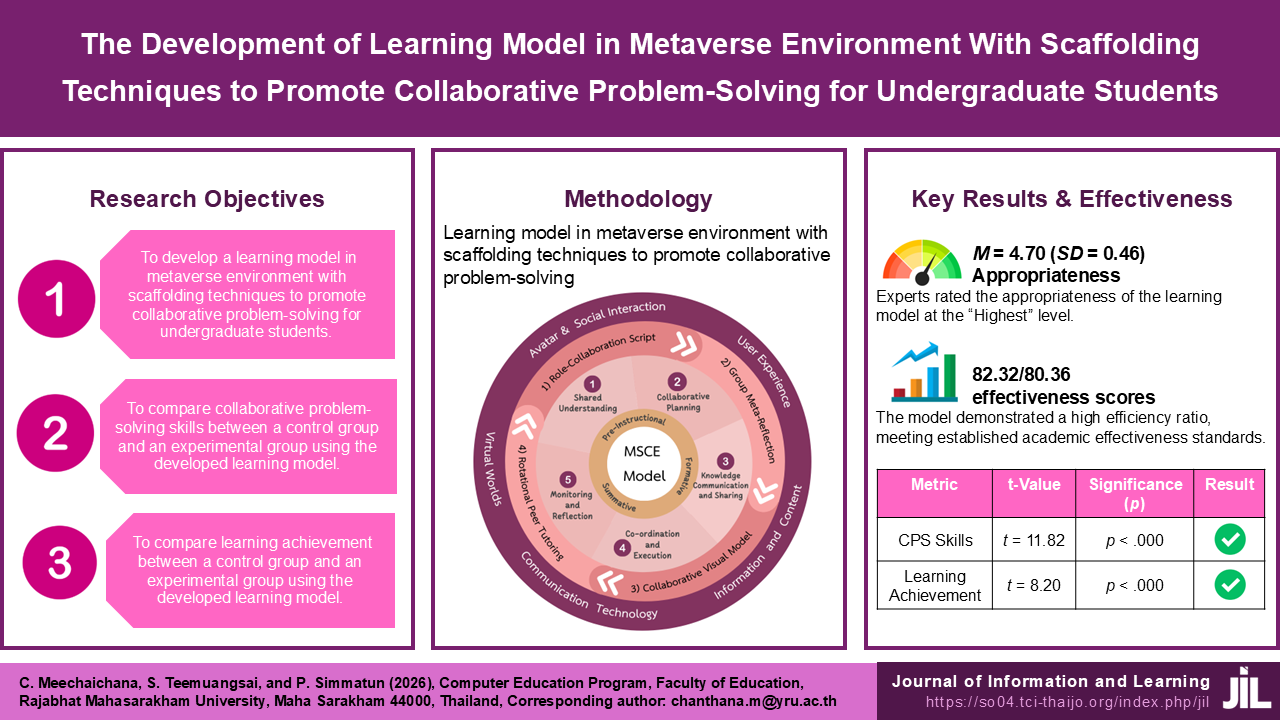
This study aimed to 1) develop a learning model in the metaverse environment using scaffolding techniques to promote collaborative problem-solving for undergraduate students; 2) compare collaborative problem-solving skills between a control group and an experimental group using the developed learning model; and 3) compare the learning achievement between the two groups. The samples were second-year undergradu-ate students in the Bachelor of Education program enrolled in Learning Management Methodology 2. The study included 35 students whose major is computer education in the experimental group and the other 35 students from general science in control group. All of them were selected by cluster random sampling. The research instruments used were the developed learning model, lesson plans, a collaborative problem-solving skills test, and a learning achievement test. Data were analyzed using mean, standard deviation, and an independent t-test. The findings revealed that 1) the developed learning model consisted of four com-ponents: (1) the metaverse learning environment, (2) scaffolding, (3) collaborative problem-solving learning, and (4) evaluation. Students utilized five distinct steps: (1) shared understanding, (2) collaborative planning, (3) knowledge communication and sharing, (4) co-ordination and execution, and (5) monitoring and reflec-tion while conducting the activities. The model achieved an efficiency of 82.32/80.36. 2) The collaborative problem-solving skills of the experimental group were significantly higher than those of the control group at the .01 level. 3) The learning achievement of the experimental group was also significantly higher than that of the control group at the .01 level.
References
Badriah, L., Mahanal, S., Lukiati, B., & Sari, M. S. (2024), Collaborative mind mapping in RICOSRE learning model to improve students’ information literacy. International Journal of Evaluation and Research in Education, 15(1), 559–569. http://doi.org/10.11591/ijere.v13i1.26840
Bangpra, D., & Srisawas, Y. (2022). Learning management through “Scaffolding” to foster creativity of diploma students in management branch at Songkhla community college. KRIS Journal Online, 2(2), 31–40. https://so08.tci-thaijo.org/index.php/KRIS/article/view/3228
Berk, L. E., & Winsler, A. (1995). Scaffolding children’s learning: Vygotsky early childhood education. Seven Street Studio.
Boonlue, S. (2022). Metaverse for education: The connection between the metaverse with the real world of learning to create immersive learning. Academic Journal of North Bangkok University, 11(1), 9–16. https://so01.tci-thaijo.org/index.php/NBU/article/view/258310
Boonprasom, C. (2022). The collaborative learning management system with a virtual team utilizing cloud technology to enhance collaboration skills of undergraduate students. Journal of Information and Learning, 33(2), 32–44. https://so04.tci-thaijo.org/index.php/jil/article/view/257055
Boonsatirakul, J. (2022). Research synthesis on problem solving skills of higher education students between 2011–2020. Journal of Educational Measurement, 39(105), 227–238. https://so06.tci-thaijo.org/index.php/JEMEPTB/article/view/257516
Chaktrimongkhol, U., & Klyasamrid, I. (2022). Development of collaborative problem-solving competency chat-type online test for secondary school students. Journal of Educational Measurement, Educational and Psychological Test Bureau, 39(105), 88–98. https://so06.tci-thaijo.org/index.php/JEMEPTB/article/view/257493
Fadhli R., Suharyadi, A., Firdaus, F., & Bustari, M. (2023). Developing a digital learning environment team-based project to support online learning in Indonesia. International Journal of Evaluation and Research in Education, 12(3), 1599–1608. http://doi.org/10.11591/ijere.v12i3.24040
Hidayati, N., Zubaidah, S., & Amnah, S. (2023). Effective learning model bases problem based learning and digital mind maps to improve student’s collaboration skills. International Journal of Evaluation and Research in Education, 12(3), 1307–1314. http://doi.org/10.11591/ijere.v12i3.22654
Hiranrat, W., Ruksasuk, N., & Chaijarone, S. (2017). Scaffolding on virtual classroom in english teaching matthayomsuksa 5 students. Journal of Information Technology, 13(2), 51–63. https://ph01.tci-thaijo.org/index.php/IT_Journal/article/view/105145
Inprasert, M. (2020). Attitudes of undergraduate students at Thammasat University toward general education and GREATS attributes. Thammasat University.
Joyce, B. R., Weil, M., & Showers, B. (1992). Models of teaching. Allyn & Bacon.
Kantaboon, K. (2022). Communication model on metaverse for education at communication arts under Sukhothai Thammathirat Open University. Journal of Humanities and Social Sciences, 20(3), 123–144. https://so03.tci-thaijo.org/index.php/jhusoc/article/view/264140
Kasetiam, N., Roungrong, P., & Roungbundit, T. (2023). Development of an online metaverse lesson using with active learning approach titled “Technology for solving problems” in design and technology course, of 9th grade students. Journal of Education and Innovation, 26(1), 152–162. https://so06.tci-thaijo.org/index.php/edujournal_nu/article/view/262572
Khodchapong, N. (2023). A study of needs assessment for soft skills development in student teachers. Journal of Roi Kaensarn Academi, 8(4), 250–267. https://so02.tci-thaijo.org/index.php/JRKSA/article/view/260255
Kongna, N., & Srilapo, N. (2023). Metaverse and the future of Thailand’s education. Journal of Educational Studies, 17(1), 1–12. https://so17.tci-thaijo.org/index.php/EduBSRU/article/view/249
Koompapun, P., & Ketsing, J. (2024). The development of 10th Graders’ collaborative problem solving competency using DEEPER scaffolding model. STOU Educational Journal, 17(1), 16–36. https://so05.tci-thaijo.org/index.php/edjour_stou/article/view/266771
Maghaydah, S., Al-Emran, M., Maheshwari, P., & Al-Sharafi, M. A. (2024). Factors affecting metaverse adoption in education: A systematic review, adoption framework, and future research agenda. Heliyon, 10(7), 1–17. https://doi.org/10.1016/j.heliyon.2024.e28602
National PISA Center. (2020). PISA 2015 phon kānpramœ̄n kān kǣpanhā bǣp rūam mư̄ [PISA 2015 results on collaborative problem solving]. https://pisathailand.ipst.ac.th/pisa2015-cps-fullreport
OECD. (2017). PISA 2015 assessment and analytical framework: Science, reading, mathematics, financial literacy and collaborative problem solving (Revised ed.). OECD Publishing. https://doi.org/10.1787/9789264281820-en
Office of the National Education Commission. (2003). Education in Thailand 2002/2003. Amarin Printing and Publishing. https://backoffice.onec.go.th/uploads/Book/743-file.pdf
Panamala, P., Wichaakharawit, C., Senivongse Na Ayudhya, V., & Kumpeerapang, C. (2024). Metaverse: Learning by virtual technology. Journal of Association of Professional Development of Educational Administration of Thailand, 6(4), 485–497. https://so04.tci-thaijo.org/index.php/JAPDEAT/article/view/271037
Pawang, S., & Chookhampaeng, S. (2020). The development of the competency in collaborative problem solving by using learning management through deeper scaffolding framework of mathayomsuksa 4 student. Journal of MCU Nakhondhat, 7(9), 175–192. https://so03.tci-thaijo.org/index.php/JMND/article/view/246735
Penphu, W., Suksawang, P. & Wongupparaj, P. (2023). Enhancing complex problem-solving skills of adolescents by applying information processing theory and self-regulation learning. Journal of Educational Measurement Mahasarakham University, 29(1), 176–192. https://so02.tci-thaijo.org/index.php/jemmsu/article/view/256660
Phiangchan, N., & Kijkuakul, S. (2022). Guidelines to development of collaborative problem solving competency using STEM learning approach on geohazard of 12th graders during the Covid-19 epidemic. Journal of Yala Rajabhat University, 18(2), 10–20. https://so04.tci-thaijo.org/index.php/yru_human/article/view/258836
Phosuwan, A., Sopeerak, S., & Rampai, N. (2021). Development of a model constructivism virtual learning environment for abilities of nursing student’s analytical thinking Boromarajonani College of Nursing. Journal of MCU Peace Studies, 9(1), 380–400. https://so03.tci-thaijo.org/index.php/journal-peace/article/view/244675
Pooyang, I., Kaosaiyaporn, O., & Lateh, A. (2023). Development of virtual learning environment based on constructivism to enhance computational thinking skills in grade 10 students taking computing science course 1. Journal of Information and Learning, 34(2), 40–51. https://so04.tci-thaijo.org/index.php/jil/article/view/263913
Promsatien, Y. (2020). The development of inquiry learning combined with concept mapping and cooperative learning to enhance problem solving thinking for undergraduate students. Rajabhat Maha Sarakham University Journal, 14(3), 103–114. https://so05.tci-thaijo.org/index.php/rmuj/article/view/248517
Puttasri, W., Autthawuttikul, S., Thammetar, T., & Laisema, S. (2023). A development of an active learning instructional model in smart classroom environment by using engineering design process with the situated learning to enhance professional competencies in industrial prototype product design for undergraduate students. Journal of Roi Kaensarn Academi, 8(8), 12–29. https://so02.tci-thaijo.org/index.php/JRKSA/article/view/262668
Raviwongse, R. (2022). Guidelines for metaverse platform development to enhance future learning and services. Ratthapirak Journal, 64(3), 32–41. https://so05.tci-thaijo.org/index.php/ratthapirak/article/view/263604
Sinluenam, P., Photisuvan, C. & Saisophon, P. (2018). The Study of Scaffoldingin the Microsoft Excel 2010 workshop. Veridian E-Journal, 11(2), 850–866. https://he02.tci-thaijo.org/index.php/Veridian-E-Journal/article/view/141364
Siripokhapirom, K., & Sanrach, C. (2022). The development of online collaborative learning using problem-based learning and three stay one stray technique to improve group working skills. Technical Education Journal, 13(2), 1–10. https://ojs.kmutnb.ac.th/index.php/jote/article/view/5914
Soutthaboualy, T., Chatwattana, P., & Piriyasurawong, P. (2022) Interactive augmented reality technology via blended instruction lesson on cloud. Higher Education Studies, 12(3), 9–18. https://ccsenet.org/journal/index.php/hes/article/view/0/47272
Sripan, T., & Jeerapattanatorn, P. (2022). Exnovation: The ultimate development of innovation and roles of metaverse in education and training in the next normal era. Journal of Innovation and Management, Suan Sunandha Rajabhat University, 7(2), 174–188. https://so03.tci-thaijo.org/index.php/journalcim/article/view/260360
Vygotsky, L. S., & Cole, M. (1978). Mind in society: The development of higher psychological processes. Harvard University.
Wingsakul, S., Rampai, N., & Diteeyont, W. (2024). Development of metaverse classroom with gamification concept to enhance student’s computational thinking skills of upper primary school. Journal of Educational Review Faculty of Educational in MCU, 11(2), 365–379. https://so02.tci-thaijo.org/index.php/EDMCU/article/view/269121
Womut, K., & Topithak, K. (2021). The development of collaboration skill indicators of undergraduate students. Journal of Faculty of Education Pibulsongkram Rajabhat University, 9(1), 69–80. https://so02.tci-thaijo.org/index.php/edupsru/article/view/248897
Downloads
Additional Files
Published
How to Cite
Issue
Section
Categories
License
Copyright (c) 2026 Journal of Information and Learning

This work is licensed under a Creative Commons Attribution-NonCommercial 4.0 International License.
The Journal of Information and Learning is operated by the Office of Academic Resources, Prince of Songkla University. All articles published in the journal are protected by Thailand copyright law. This copyright covers the exclusive rights to share, reproduce and distribute the article, including in electronic forms, reprints, translations, photographic reproductions, or similar. Authors own copyrights in the works they have created as well as the Office of Academic Resources. The Journal reserves the right to edit the language of papers accepted for publication for clarity and correctness, as well as to make formal changes to ensure compliance with the journal's guidelines. All authors must take public responsibility for the content of their paper.


