
The Effectiveness of an Information Literacy Training Program at the Faculty of Science, Mahidol University
Keywords:
information literacy, training effectiveness, online learning, curriculum development, mixed methods researchAbstract
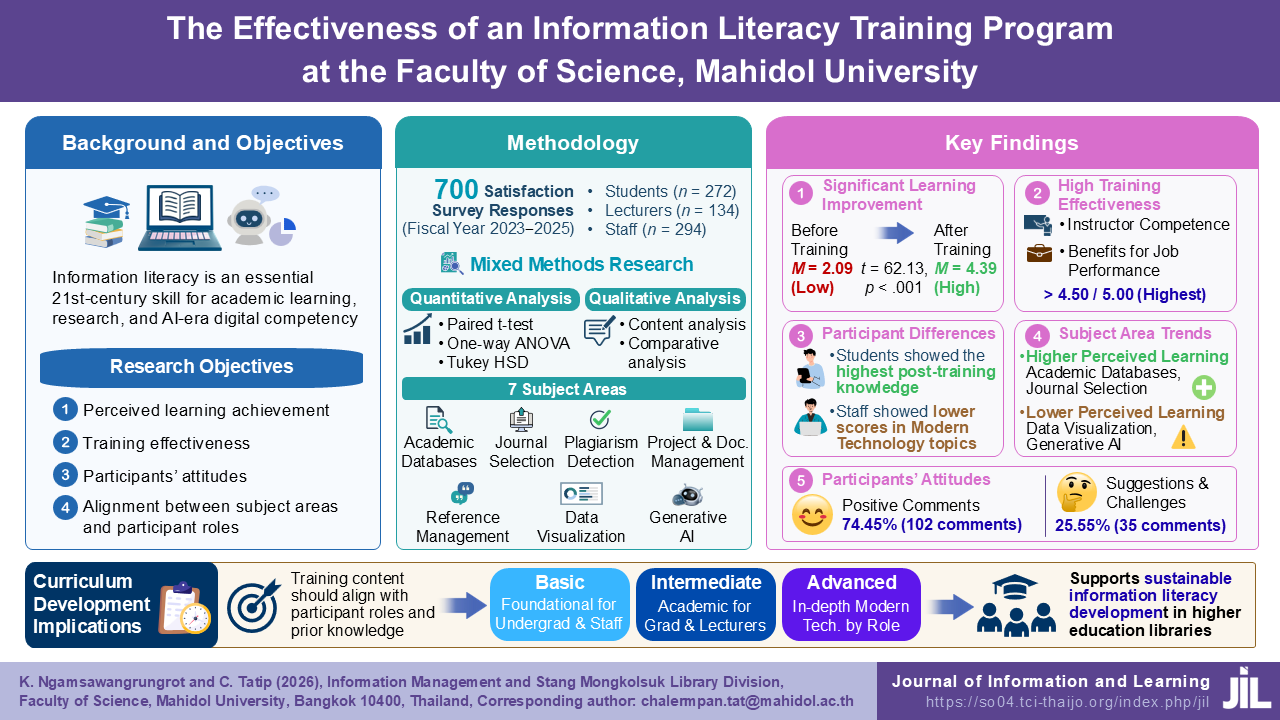
This mixed-methods research aimed to investigate 1) perceived learning achievements, 2) training effectiveness, 3) participants’ attitudes, and 4) congruence between training subject areas and participant roles within the Information Literacy Training Program at the Faculty of Science, Mahidol University, conducted through an online learning format. The sample consisted of 700 satisfaction survey responses collected during the fiscal years 2023–2025, with a response rate of 24.60%. Quantitative data were analyzed using frequency, percentage, mean, standard deviation, paired t-test, one-way analysis of variance (One-way ANOVA), and Tukey HSD post hoc comparison, while qualitative data were analyzed using content analysis. The research findings revealed that 1) participants’ perceived post-training knowledge was at a high level (M = 4.39, SD = 0.61), which was significantly higher than their low-level pre-training knowledge (M = 2.09, SD = 1.00), with statistical significance at the .001 level. The student group and Academic Databases and Journal Selection subject areas showed the highest mean scores, whereas the staff group and Data Visualization and Generative AI subject areas showed the lowest mean scores. 2) Overall training effectiveness regarding the instructors’ capabilities and the practical benefits for work performance was rated at the highest level (mean exceeding 4.50). Perceived benefits for work performance differed significantly depending on the alignment between the content and the role context of the target groups. 3) The majority of the 137 responses (74.45%) expressed positive attitudes, finding the activities interesting and wishing to participate in future sessions, while 25.55% suggested an extended training duration, supporting documents, in-depth content, and basic knowledge provision. 4) The comparative analysis revealed two patterns of alignment between subject areas and participant roles, leading to recommendations for curriculum development categorized into three levels (Basic, Intermediate, and Advanced) based on Bloom’s Taxonomy.
References
Anderson, L. W., & Krathwohl, D. R. (Eds.). (2001). A taxonomy for learning, teaching, and assessing: A revision of Bloom’s taxonomy of educational objectives. Longman.
Association of College and Research Libraries. (1989). Presidential committee on information literacy: Final report. American Library Association. https://www.ala.org/acrl/publications/whitepapers/presidential
Association of College and Research Libraries. (2016). Framework for information literacy for higher education. American Library Association. https://www.ala.org/acrl/standards/ilframework
Baytas, C., & Ruediger, D. (2025). Making AI generative for higher education: Adoption and challenges among instructors and researchers. Ithaka S+R. https://doi.org/10.18665/sr.322677
Bowling, A. (2005). Just one question: If one question works, why ask several? Journal of Epidemiology & Community Health, 59(5), 342–345. https://doi.org/10.1136/jech.2004.021204
Butdisuwan, S. (2019). Kān rū sārasonthēt (Information literacy) samrap naksưksā nai sathāban ʻudomsưksā [Information literacy for higher education students]. T.L.A. Bulletin, 51(2), 73–80. https://so06.tci-thaijo.org/index.php/tla_bulletin/article/view/169321
Chen, C. C., Wang, N. C., Tu, Y. F., & Lin, H. J. (2021). Research trends from a decade (2011–2020) for information literacy in higher education: Content and bibliometric mapping analysis. Proceedings of the Association for Information Science and Technology, 58(1), 48–59. https://doi.org/10.1002/pra2.435
Cohen, J. (1988). Statistical power analysis for the behavioral sciences (2nd ed.). Lawrence Erlbaum Associates.
Creswell, J. W., & Plano Clark, V. L. (2025). Designing and conducting mixed methods research (4th ed.). SAGE Publications.
Eisinga, R., Grotenhuis, M., & Pelzer, B. (2013). The reliability of a two-item scale: Pearson, Cronbach, or Spearman-Brown? International Journal of Public Health, 58(4), 637–642. https://doi.org/10.1007/s00038-012-0416-3
Howard, G. S. (1980). Response-shift bias: A problem in evaluating interventions with pre/post self-reports. Evaluation Review, 4(1), 93–106. https://doi.org/10.1177/0193841x8000400105
Kidder, L. H., & Judd, C. M. (1986). Research methods in social relations (5th ed.). Holt, Rinehart and Winston.
Kirkpatrick Partners. (2024). The Kirkpatrick model. https://www.kirkpatrickpartners.com/the-kirkpatrick-model
Knowles, M. S. (1984). Andragogy in action: Applying modern principles of adult education. Jossey-Bass.
Kolb, D. A. (2014). Experiential learning: Experience as the source of learning and development (2nd ed.). Pearson Education.
Krippendorff, K. (2019). Content analysis: An introduction to its methodology (4th ed.). SAGE Publications.
Lu, R., Shi, F., & Sun, H. (2025). Research on the evaluation of college students’ information literacy under the background of sustainable development: A case study of Yancheng Institute of Technology. Sustainability, 17(21), Article 9389. https://doi.org/10.3390/su17219389
MacCallum, K., Parsons, D., & Mohaghegh, M. (2023). Identifying the components of foundational Artificial Intelligence (AI) literacy - early results from a Delphi study [Conference paper]. ASCILITE 2023: People, Partnerships and Pedagogies, Christchurch, New Zealand. https://doi.org/10.14742/apubs.2023.672
Ngernpoolsap, D., Sanchon, P., & Boonwattanopas, D. (2024). Media and information literacy among higher education students in Thailand: A post Covid-19 pandemic literature synthesis. Thai Reading Journal, 28(1), 62–77. https://so01.tci-thaijo.org/index.php/rdj/article/view/274455
Pelletier, K., McCormack, M., Muscanell, N., Reeves, J., Robert, J., & Arbino, N. (2024). 2024 EDUCAUSE horizon report, teaching and learning edition. EDUCAUSE. https://library.educause.edu/-/media/files/library/2024/5/2024hrteachinglearning.pdf
Pinto, M., Garcia-Marco, J., Caballero, D., Manso, R., Uribe, A., & Gomez, C. (2024). Assessing information, media and data literacy in academic libraries: Approaches and challenges in the research literature on the topic. The Journal of Academic Librarianship, 50(5), Article 102920. https://doi.org/10.1016/j.acalib.2024.102920
Sanches, T., & Chan, E. (2023). Higher education students’ perceptions towards information literacy: A study in Macau. Ibersid, 17(2), 41–48. https://doi.org/10.54886/ibersid.v17i2.4910
Siemens, G. (2005). Connectivism: A learning theory for the digital age. International Journal of Instructional Technology and Distance Learning, 2(1), Article 01. https://www.itdl.org/Journal/Jan_05/article01.htm
Thalheimer, W. (2024). LTEM: The learning-transfer evaluation model. Work-Learning Research. https://www.worklearning.com/ltem
Turner, R. C., & Carlson, L. (2003). Indexes of item-objective congruence for multidimensional items. International Journal of Testing, 3(2), 163–171. https://doi.org/10.1207/s15327574ijt0302_5
UNESCO. (2013). Global media and information literacy assessment framework: Country readiness and competencies. https://unesdoc.unesco.org/ark:/48223/pf0000224655
UNESCO. (2023). Information literacy. https://www.unesco.org/en/ifap/information-literacy
Wanous, J. P., Reichers, A. E., & Hudy, M. J. (1997). Overall job satisfaction: How good are single-item measures? Journal of Applied Psychology, 82(2), 247–252. https://doi.org/10.1037/0021-9010.82.2.247
World Economic Forum. (2023). The future of jobs report 2023. https://www.weforum.org/publications/the-future-of-jobs-report-2023
Downloads
Additional Files
Published
How to Cite
Issue
Section
Categories
License
Copyright (c) 2026 Journal of Information and Learning

This work is licensed under a Creative Commons Attribution-NonCommercial 4.0 International License.
The Journal of Information and Learning is operated by the Office of Academic Resources, Prince of Songkla University. All articles published in the journal are protected by Thailand copyright law. This copyright covers the exclusive rights to share, reproduce and distribute the article, including in electronic forms, reprints, translations, photographic reproductions, or similar. Authors own copyrights in the works they have created as well as the Office of Academic Resources. The Journal reserves the right to edit the language of papers accepted for publication for clarity and correctness, as well as to make formal changes to ensure compliance with the journal's guidelines. All authors must take public responsibility for the content of their paper.


