
Needs Assessment for Developing a Personal Learning Environment Application Based on Self-Determined Learning and Learning Contract to Enhance Lifelong Learning Skills of Student Teachers
Keywords:
personal learning environment, self-determined learning, learning contract, lifelong learning skillsAbstract
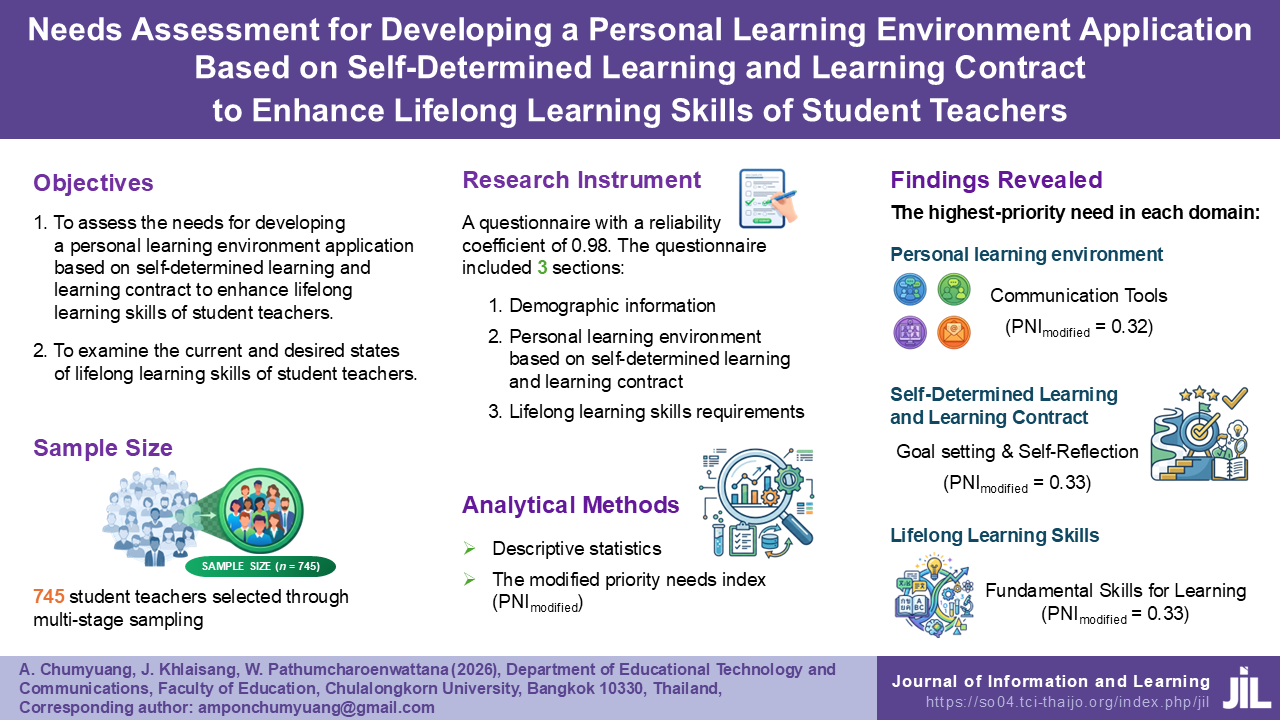
This study aimed to 1) assess the needs for developing a personal learning environment application based on self-determined learning and learning contract to enhance student teachers’ lifelong learning skills, and 2) examine the student teachers’ current and desired states of lifelong learning skills. The sample consisted of 745 student teachers selected through multi-stage sampling. The research instrument was a questionnaire with a reliability coefficient of 0.98, which included sections on demographic information, personal learning environments based on self-determined learning and learning contract and lifelong learning skills requirements. The data were analyzed using descriptive statistics and the Modified Priority Needs Index (PNImodified). The findings revealed that the highest-priority need in the personal learning environment domain was communication tools between students and teachers and among students (PNImodified = 0.32). In the self-determined learning and learning contract domain, the highest-priority needs were participation in goal setting, learning plans, learning supports, self-regulation, and evaluation between teachers and students (PNImodified = 0.33), together with self-reflection of online learning and activities (PNImodified = 0.33) Regarding lifelong learning skills, the highest-priority need was fundamental skills for learning and daily life activities (PNImodified = 0.33), followed by personal, social, and emotional skills (PNImodified = 0.31), and personal skills for professional development (PNImodified = 0.31). The findings of this study will serve as a basis for the development of a personal learning environment application to foster student teachers’ lifelong learning skills.
References
Alserhan, S., Alqahtani, T. M., Yahaya, N., Al-Rahmi, W. M., & Abuhassna, H. (2023). Personal learning environments: Modeling students’ self-regulation enhancement through a learning management system platform. IEEE Access, 11, 5464–5482. https://doi.org/10.1109/ACCESS.2023.3236504
Altuncekic, A. (2025). Personalized learning experiences and learner activism in mobile learning with generative AI support. In Artificial intelligence and the future of personalized education (pp. 41–64). IGI Global. https://doi.org/10.4018/979-8-3373-7574-8.ch003
Aytaç, A., Alemdar, M., Akay, Y., & Avcu, Y. E. (2024). Fostering tech integration: Teachers’ attitudes mediating lifelong learning and technology integration self-efficacy. Participatory Educational Research, 11(6), 112–133. https://doi.org/10.17275/per.24.82.11.6
Bin Syed Ali, S. K., & Bai, K. (2024). Personalized education via mobile technology flexible learning frameworks. International Journal of Interactive Mobile Technologies, 18(18), 146–156. https://doi.org/10.3991/ijim.v18i18.50659
Blaschke, L. M. (2021). The dynamic mix of self-determined learning and technology: Preparing learners for lifelong learning. British Journal of Educational Technology, 52, 1629–1645. https://doi.org/10.1111/bjet.13105
Cabrera Ramos, J. F., Álvarez Álvarez, A., & Jerez Naranjo, Y. V. (2022). El Entorno Personal de Aprendizaje de profesores en formación en Educación Física. Estudio de preferencias durante la crisis sanitaria COVID-19 en el contexto chileno. Edutec. Revista Electrónica de Tecnología Educativa, 79, 166–181. https://doi.org/10.21556/edutec.2022.79.2443
Celik, O. C., & Taspinar, M. (2024). Preparing pre-service primary teachers to facilitate students’ key competences for lifelong learning. Issues in Educational Research, 34(3), 848–870. https://search.informit.org/doi/10.3316/informit.T2024121700010091236000712
Clement, M., Op de Beeck, I., & Rajagopal, K. (2023). Towards the mainstreaming of online mobility at KU Leuven. Education Sciences, 13(1), Article 14. https://doi.org/10.3390/educsci13010014
Dabbagh, N. (2024). The personal learning environment (PLE): A student-centered approach that supports a techno-social digital transformation in higher education. In A. Badran, E. Baydoun, S. Hillman, & J. Mesmar (Eds.), Higher education in the Arab world (pp. 57–81). Springer. https://doi.org/10.1007/978-3-031-70779-7_3
Dabbagh, N., & Castañeda, L. (2020). The PLE as a framework for developing agency in lifelong learning. Educational Technology Research and Development, 68(6), 3041–3055. https://doi.org/10.1007/s11423-020-09831-z
Dhanushya, M., & Kakade, P. (2025). A conceptual framework for integrating social media platforms as collaborative tools in ICT education. Scholarly Research Journal for Humanity Science & English Language, 13(70), 58–67. https://doi.org/10.5281/zenodo.16633747
Erarslan, A., & Şeker, M. (2021). Investigating E-learning motivational strategies of higher education learners against online distractors. Online Learning, 25(2), 262–279. https://doi.org/10.24059/OLJ.V25I2.2252
European Commission. (2019). Key competences for lifelong learning. Publications Office of the European Union. https://data.europa.eu/doi/10.2766/569540
Gaur, V. (2025). Teacher training in lifelong learning—the importance of digital competence in the encouragement of teaching innovation. The Business & Management Review, 15(3), Article 24. https://doi.org/10.24052/bmr/v15nu03/art-24
Hainsworth, N., Dowse, E., Cummins, A., Ebert, L., & Foureur, M. (2022). Heutagogy: A self-determined learning approach for Midwifery Continuity of Care experiences. Nurse Education in Practice, 60, Article 103329. https://doi.org/10.1016/j.nepr.2022.103329
Hase, S. (2016). Self-determined learning (heutagogy): Where have we come since 2000? Southern Institute of Technology Journal of Applied Research. https://www.researchgate.net/publication/305778049
Hien, H., & Suppasetseree, S. (2024). The effects of a personal learning environment on Vietnamese EFL undergraduate students’ speaking skills. International Journal of Learning, Teaching and Educational Research, 23(8), 180–202. https://doi.org/10.26803/ijlter.23.8.10
Huang, R., & Huang, R. (2025). College students’ self-regulated learning in digital environments: Dilemmas, mechanisms, and multi-level interventions. Journal of Sociology and Education, 1(8). https://doi.org/10.63887/jse.2025.1.8.28
Kausar, H., & Ajmal, M. (2024). Meta-analysis study: Expectations of 21st century teaching from pre-service teacher education programs. Journal of Research in Social Sciences, 12(2), 1–14. https://doi.org/10.52015/jrss.12i2.268
Knoblauch, C., & Döller, L. (2025). Local experiences, global perspectives: Preparing future teachers for diverse societies through community engagement. Educatia 21 Journal, 31, Article 01. https://doi.org/10.24193/ed21.2025.31.01
Knowles, M. S. (1986). Using learning contracts: Practical approaches to individualizing and structuring learning. Jossey-Bass.
Krejcie, R. V., & Morgan, D. W. (1970). Determining sample size for research activities. Educational and Psychological Measurement, 30(3), 607–610. https://doi.org/10.1177/001316447003000308
Lan, P. S., Liu, M. C., & Baranwal, D. (2023). Applying contracts and online communities to promote student self-regulation in English learning at the primary-school level. Interactive Learning Environments, 31(1), 468–479. https://doi.org/10.1080/10494820.2020.1789674
Li, H., & Casey, A. (2026). Exploring how social media shapes the personal learning environments of Chinese pre-service physical education teachers. Sport, Education and Society, 31(3), 451–464. https://doi.org/10.1080/13573322.2025.2508855
Lim, J., & Newby, T. J. (2021). Preservice teachers’ attitudes toward Web 2.0 personal learning environments (PLEs): Considering the impact of self-regulation and digital literacy. Education and Information Technologies, 26(4), 3699–3720. https://doi.org/10.1007/s10639-021-10432-3
Lofandri, W. (2024). Heutagogy approach in mobile learning: Developing technology-enabled lifelong learning. International Journal of Interactive Mobile Technologies, 18(17), 31–45. https://doi.org/10.3991/ijim.v18i17.50681
Low, E. L. (2024). Rethinking teacher education in pandemic times and beyond. Educational Research for Policy and Practice, 23(3), 395–406. https://doi.org/10.1007/s10671-023-09337-4
Matischek-Jauk, M., & Reicher, H. (2021). Social and emotional learning as part of professional development in initial teacher education. In International approaches to promoting social and emotional learning in schools (pp. 90–108). Routledge. https://doi.org/10.4324/9781003093053-8
Moore, R. L. (2020). Developing lifelong learning with heutagogy: Contexts, critiques, and challenges. Distance Education, 41(3), 381–401. https://doi.org/10.1080/01587919.2020.1766949
Na Songkhla, J. (2018). Kānʻō̜kbǣp kān rīan nǣo di čhi than [Digital learning design]. Chulalongkorn University.
Nan Cenka, B. A., Santoso, H. B., & Junus, K. (2024). Using the personal learning environment to support self-regulated learning strategies: A systematic literature review. Interactive Learning Environments, 32(4), 1368–1384. https://doi.org/10.1080/10494820.2022.2120019
Noviyanti, S. D. (2021). Online learning contract: A way disciplining students. Journal of Language Intelligence and Culture, 3(2), 93–106. https://jlic.uinkhas.ac.id/index.php/jlic/article/view/56
OECD. (2018). The future of education and skills: Education 2030. OECD Publishing. https://doi.org/10.1787/54ac7020-en
Office of the National Strategy Committee. (2018). Yutthasāt chāt B.E. 2561–2580 [National strategy (A.D. 2018–2037)]. Royal Thai Government Gazette, 135(82a), 1–71. https://www.ratchakitcha.soc.go.th/DATA/PDF/2561/A/082/T_0001.PDF
Office of the Permanent Secretary, Ministry of Higher Education, Science, Research and Innovation. (2024). Student statistics. Higher Education Information System. https://info.mhesi.go.th/homestat_std.php
Pedro, L., & Santos, C. (2022). Communication-driven digital learning environments: 10 years of research and development of the Campus platform. In M. Ivanović, A. Klašnja-Milićević, & L. C. Jain (Eds.), Handbook on intelligent techniques in the educational process (pp. 341–359). Springer. https://doi.org/10.1007/978-3-031-04662-9_16
Rahimi, E., van den Berg, J., & Veen, W. (2015). A learning model for enhancing the student’s control in educational process using Web 2.0 personal learning environments. British Journal of Educational Technology, 46(4), 780–792. https://doi.org/10.1111/bjet.12170
Ramaila, S., & Molwele, A. J. (2022). The role of technology integration in the development of 21st century skills and competencies in life sciences teaching and learning. International Journal of Higher Education, 11(5), 9–17. https://doi.org/10.5430/ijhe.v11n5p9
Rattanamanee, N. (2019). The development of questionnaires for educational research (3rd ed.). Chulalongkorn University.
Rus-Casas, C., Rubia, M., Eliche-Quesada, D., Jiménez-Castillo, G., & Aguilar-Peña, J. D. (2021). Online tools for the creation of personal learning environments in engineering studies for sustainable learning. Sustainability, 13(3), Article 1179. https://doi.org/10.3390/su13031179
Rusli, R., Rahman, A., & Abdullah, H. (2020). Student perception data on online learning using heutagogy approach in the Faculty of Mathematics and Natural Sciences of Universitas Negeri Makassar, Indonesia. Data in Brief, 29, Article 105152. https://doi.org/10.1016/j.dib.2020.105152
Saadatmand, M., Uhlin, L., Hedberg, M., Åbjörnsson, L., & Kvarnström, M. (2017). Examining learners’ interaction in an open online course through the community of inquiry framework. European Journal of Open, Distance and e-Learning, 20(1), 61–79. https://doi.org/10.1515/eurodl-2017-0004
Sadeck, O., Moses, M. B., Tunjera, N., & Chigona, A. (2023). Self-regulated e-learning in pre-service teacher training for realities of 21st century classrooms. Electronic Journal of e-Learning, 21(3), 211–221. https://doi.org/10.34190/ejel.21.3.2659
Said, N., Soekarno, M., Nik Mohamed, N. Z., & Jeoffrey Pudin, C. S. (2021). The feasibility of a personal learning environment (PLE) to support academic writing: ESL pre-service teachers’ perspectives. International Journal of Education, Psychology and Counseling, 6(43), 110–121. https://gaexcellence.com/ijepc/article/view/3358
Sala, A., Punie, Y., Garkov, V., & Cabrera, M. (2020). LifeComp: The European framework for personal, social and learning to learn key competence. Publications Office of the European Union. https://doi.org/10.2760/302967
Sun, Y., & Xu, X. (Eds.). (2024). The development of personal learning environments in higher education: Promoting culturally responsive teaching and learner autonomy. Routledge. https://doi.org/10.4324/9781003285243
Tarnanen, M., Kauppinen, M., Kainulainen, J., Hankala, M., & Aalto, E. (2023). Enhancing professional learning of primary student teachers of L1 and L2 through a hybrid learning environment. In K. Sadeghi, & M. Thomas (Eds.), Second language teacher professional development (pp. 219–237). Palgrave Macmillan. https://doi.org/10.1007/978-3-031-12070-1_11
Teachers' Council of Thailand. (2019). Khō̜bangkhap khuru saphā wādūai māttrathān wichāchīp (chabap thī 4) B.E. 2562 [Regulations of the Teachers' Council of Thailand on Professional Standards (No. 4) A.D. 2019]. Royal Thai Government Gazette, 136(Special Issue 68 Ng), 18–20. https://www.ratchakitcha.soc.go.th/DATA/PDF/2562/E/068/T_0018.PDF
Tondeur, J., Trevisan, O., Howard, S. K., & van Braak, J. (2025). Preparing preservice teachers to teach with digital technologies: An update of effective SQD-strategies. Computers & Education, 232, Article 105262. https://doi.org/10.1016/j.compedu.2025.105262
Uyar, A. (2023). 21st century skills of pre-service teachers and visions of faculties of education in acquiring 21st century skills. International Journal of Contemporary Educational Research, 10(1), 262–278. https://doi.org/10.33200/ijcer.1274201
Wei, W., Mejia, C., & Qi, R. (2021). A personal learning environment (PLE) approach to mobile teaching and learning on a short-term study abroad. Journal of Hospitality, Leisure, Sport & Tourism Education, 29, Article 100296. https://doi.org/10.1016/j.jhlste.2020.100296
Wongwanich, S. (2015). Needs assessment research (3rd ed.). Chulalongkorn University.
World Economic Forum. (2015). New vision for education: Unlocking the potential of technology. https://www3.weforum.org/docs/WEFUSA_NewVisionforEducation_Report2015.pdf
World Economic Forum. (2020). The future of jobs report 2020. World Economic Forum.
Xu, X., Li, Z., Hin Hong, W. C., Xu, X., & Zhang, Y. (2024). Effects and side effects of personal learning environments and personalized learning in formal education. Education and Information Technologies, 29(14), 20729–20756. https://doi.org/10.1007/s10639-024-12685-0
Zhong, K., Zhang, H., Lei, V. N.-L., & Xu, X. (2024). The impact of personal learning environments platform on junior middle school students’ self-regulated learning and English reading achievements. International Journal of Information and Education Technology, 14(12), 1750–1762. https://doi.org/10.18178/ijiet.2024.14.12.2206
Zhou, Q., Jiang, J., Yin, Z., & Liu, Y. (2026). Between the school and the screen: How digital informal learning shapes Chinese novice physical education teachers' identity. Frontiers in Psychology, 17, Article 1767468. https://doi.org/10.3389/fpsyg.2026.1767468
Downloads
Additional Files
Published
How to Cite
Issue
Section
Categories
License
Copyright (c) 2026 Journal of Information and Learning

This work is licensed under a Creative Commons Attribution-NonCommercial 4.0 International License.
The Journal of Information and Learning is operated by the Office of Academic Resources, Prince of Songkla University. All articles published in the journal are protected by Thailand copyright law. This copyright covers the exclusive rights to share, reproduce and distribute the article, including in electronic forms, reprints, translations, photographic reproductions, or similar. Authors own copyrights in the works they have created as well as the Office of Academic Resources. The Journal reserves the right to edit the language of papers accepted for publication for clarity and correctness, as well as to make formal changes to ensure compliance with the journal's guidelines. All authors must take public responsibility for the content of their paper.


