
การพัฒนากลยุทธ์เสริมสมรรถนะครูระดับการศึกษาขั้นพื้นฐานโดยใช้สถานการณ์เป็นฐานที่ขับเคลื่อนด้วยปัญญาประดิษฐ์และชุมชนการเรียนรู้วิชาชีพเพื่อการออกแบบการเรียนการสอน
คำสำคัญ:
การเสริมสมรรถนะครู, สถานการณ์เป็นฐาน, ปัญญาประดิษฐ์, ชุมชนการเรียนรู้วิชาชีพ, การออกแบบการเรียนการสอนบทคัดย่อ
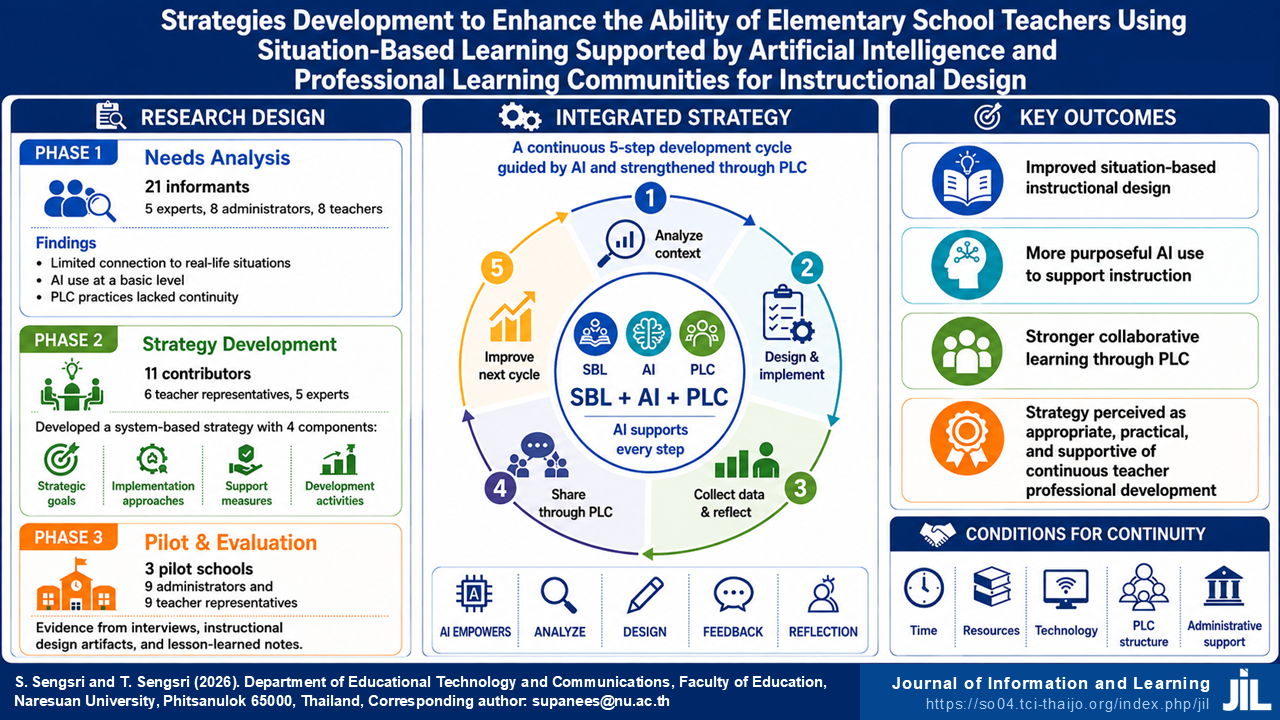
การวิจัยนี้มีวัตถุประสงค์เพื่อ 1) ศึกษาสภาพปัจจุบัน สภาพที่พึงประสงค์ และความต้องการจำเป็นในการเสริมสมรรถนะครูระดับการศึกษาขั้นพื้นฐาน 2) พัฒนากลยุทธ์เสริมสมรรถนะครูระดับการศึกษาขั้นพื้นฐาน โดยบูรณาการการเรียนรู้ตามสถานการณ์ การใช้ปัญญาประดิษฐ์ และการเรียนรู้ร่วมกันผ่านชุมชนการเรียนรู้วิชาชีพ เพื่อการออกแบบและจัดการเรียนการสอน และ 3) ทดลองใช้และประเมินกลยุทธ์เสริมสมรรถนะครูระดับการศึกษาขั้นพื้นฐาน การวิจัยเป็นการวิจัยและพัฒนา แบ่งการดำเนินงานออกเป็น 3 ระยะ ผู้ให้ข้อมูลประกอบด้วย ระยะที่ 1 ผู้ทรงคุณวุฒิ 5 คน ผู้บริหารสถานศึกษา 8 คน และครู 8 คน รวม 21 คน ระยะที่ 2 ผู้แทนครู 6 คน และผู้ทรงคุณวุฒิ 5 คน และระยะที่ 3 ผู้บริหารสถานศึกษาและผู้แทนครูจากสถานศึกษานำร่อง 3 แห่ง รวม 9 คน เครื่องมือวิจัย ได้แก่ แบบสัมภาษณ์กึ่งโครงสร้าง ร่างกลยุทธ์เสริมสมรรถนะครูแบบประเมินความเหมาะสมของร่างกลยุทธ์ และแบบสัมภาษณ์เพื่อประเมินผล การทดลองใช้กลยุทธ์วิเคราะห์ข้อมูลโดยใช้การวิเคราะห์เนื้อหาและสถิติเชิงพรรณนา ได้แก่ ค่าเฉลี่ย (M) และ ส่วนเบี่ยงเบนมาตรฐาน (SD) ผลการวิจัยพบว่า 1) ระยะที่ 1 สภาพปัจจุบันของการเสริมสมรรถนะครูยังมีข้อจำกัดด้านการออกแบบการเรียนรู้ที่เชื่อมโยงกับสถานการณ์จริง การใช้ปัญญาประดิษฐ์ยังอยู่ในระดับพื้นฐาน และการดำเนินงานชุมชนการเรียนรู้วิชาชีพยังขาดความต่อเนื่อง ขณะที่สภาพที่พึงประสงค์มุ่งเน้นการเรียนรู้จากการปฏิบัติจริง การใช้ปัญญาประดิษฐ์สนับสนุนงานวิชาชีพ และการเรียนรู้ร่วมกันอย่างเป็นระบบ 2) ระยะที่ 2 กลยุทธ์ที่พัฒนาขึ้นมีลักษณะเป็นกลยุทธ์เชิงระบบ ประกอบด้วย 4 องค์ประกอบ ได้แก่ เป้าหมายของกลยุทธ์ แนวทางดำเนินการ มาตรการสนับสนุน และกิจกรรมการพัฒนา และ 3) ระยะที่ 3 ผลการทดลองใช้กลยุทธ์พบว่า ครูมีการเปลี่ยนแปลงเชิงบวกด้านการออกแบบการเรียนรู้ตามสถานการณ์ การใช้ปัญญาประดิษฐ์เพื่อสนับสนุนการสอน และการเรียนรู้ร่วมกันผ่านชุมชนการเรียนรู้วิชาชีพ โดยครูและผู้บริหารเห็นว่ากลยุทธ์มีความเหมาะสม นำไปใช้ได้จริง และเอื้อต่อการพัฒนาวิชาชีพครูอย่างต่อเนื่อง
เอกสารอ้างอิง
Bouwmans, M., Runhaar, P., Wesselink, R., & Mulder, M. (2017). Fostering teachers’ team learning: An interplay between transformational leadership and participative decision-making. Teaching and Teacher Education, 65, 71–80. https://doi.org/10.1016/j.tate.2017.03.010
Chen, L. (2022). Facilitating teacher learning in professional learning communities through action research: A qualitative case study in China. Teaching and Teacher Education, 119, Article 103875. https://doi.org/10.1016/j.tate.2022.103875
Christensen, A. A., & Jerrim, J. (2025). Professional learning communities and teacher outcomes: A cross-national analysis. Teaching and Teacher Education, 156, Article 104920. https://doi.org/10.1016/j.tate.2024.104920
Darling-Hammond, L., Flook, L., Cook-Harvey, C., Barron, B., & Osher, D. (2020). Implications for educational practice of the science of learning and development. Applied Developmental Science, 24(2), 97–140. https://doi.org/10.1080/10888691.2018.1537791
Darling-Hammond, L., Hyler, M. E., & Gardner, M. (2017). Effective teacher professional development. Learning Policy Institute. https://doi.org/10.54300/122.311
Fullan, M. (2021). The right drivers for whole system success. Centre for Strategic Education.
Global Education Monitoring Report Team. (2024). 2024 Youth report: Technology in education: A tool on our terms! UNESCO. https://doi.org/10.54676/ELSQ4648
Herrington, J., Reeves, T. C., & Oliver, R. (2014). Authentic learning environments. In J. M. Spector, M. D. Merrill, J. Elen, & M. J. Bishop (Eds.), Handbook of research on educational communications and technology (4th ed., pp. 401–412). Springer.
Huang, L., Liang, M., Xiong, Y., Wu, X., & Lim, C. P. (2024). A systematic review of technology-enabled teacher professional development during COVID-19 pandemic. Computers & Education, 223, Article 105168. https://doi.org/10.1016/j.compedu.2024.105168
Kolb, D. A. (2015). Experiential learning: Experience as the source of learning and development (2nd ed.). Pearson Education.
Li, K., Wang, P., & Chen, G. (2025). How can AI be integrated into teacher professional development programs? A systematic review based on an adapted technology-based learning model. Teaching and Teacher Education, 168, Article 105219. https://doi.org/10.1016/j.tate.2025.105219
Luyten, H., & Bazo, M. (2019). Transformational leadership, professional learning communities, teacher learning and learner centred teaching practices: Evidence on their interrelations in Mozambican primary education. Studies in Educational Evaluation, 60, 14–31. https://doi.org/10.1016/j.stueduc.2018.11.002
OECD. (2016). Innovating education and educating for innovation: The power of digital technologies and skills. OECD. https://doi.org/10.1787/9789264265097-en
OECD. (2021). The state of global education: 18 months into the pandemic.OECD. https://doi.org/10.1787/1a23bb23-en
OECD. (2025). Empowering learners for the age of AI: An AI literacy framework for primary and secondary education [Review draft]. OECD.https://ailiteracyframework.org/wp-content/uploads/2025/05/AILitFramework_ReviewDraft.pdf
Plass, J. L., Homer, B. D., & Kinzer, C. K. (2015). Foundations of game-based learning. Educational Psychologist, 50(4), 258–283. https://doi.org/10.1080/00461520.2015.1122533
Saeedian, S., & Ghaderi, A. (2023). Scenario-based classroom context mode: Reshaping non-native teachers’ decision-making and pedagogical reasoning. Asian-Pacific Journal of Second and Foreign Language Education, 8, Article 36. https://doi.org/10.1186/s40862-023-00208-2
UNESCO. (2021). AI and education: Guidance for policy-makers. https://doi.org/10.54675/PCSP7350
ดาวน์โหลด
ไฟล์ประกอบ
เผยแพร่แล้ว
รูปแบบการอ้างอิง
ฉบับ
ประเภทบทความ
หมวดหมู่
สัญญาอนุญาต
ลิขสิทธิ์ (c) 2026 Supanee Sengsri, Thongchai Sengsri

อนุญาตภายใต้เงื่อนไข Creative Commons Attribution-NonCommercial 4.0 International License.
เข้าถึงบทความได้โดยไม่เสียค่าใช้จ่าย นโยบายสัญญาอนุญาตปัจจุบัน CC BY-NC 4.0 ตั้งแต่ปีที่ 37 ฉบับที่ 2 (2569) สำหรับบทความก่อนหน้านี้ โปรดตรวจเงื่อนไขสิทธิบนหน้าบทความแต่ละเรื่อง ดูนโยบายการเข้าถึงแบบเปิดและสัญญาอนุญาต

