
A Needs Assessment and Confirmatory Factor Analysis of the ACRL Framework for Enhancing Information Literacy Skills Among Undergraduate Students in Thai Higher Education in the Digital Era
Keywords:
Information Literacy, ACRL Framework, Needs Assessment, Confirmatory Factor Analysis, Digital Era LearnersAbstract
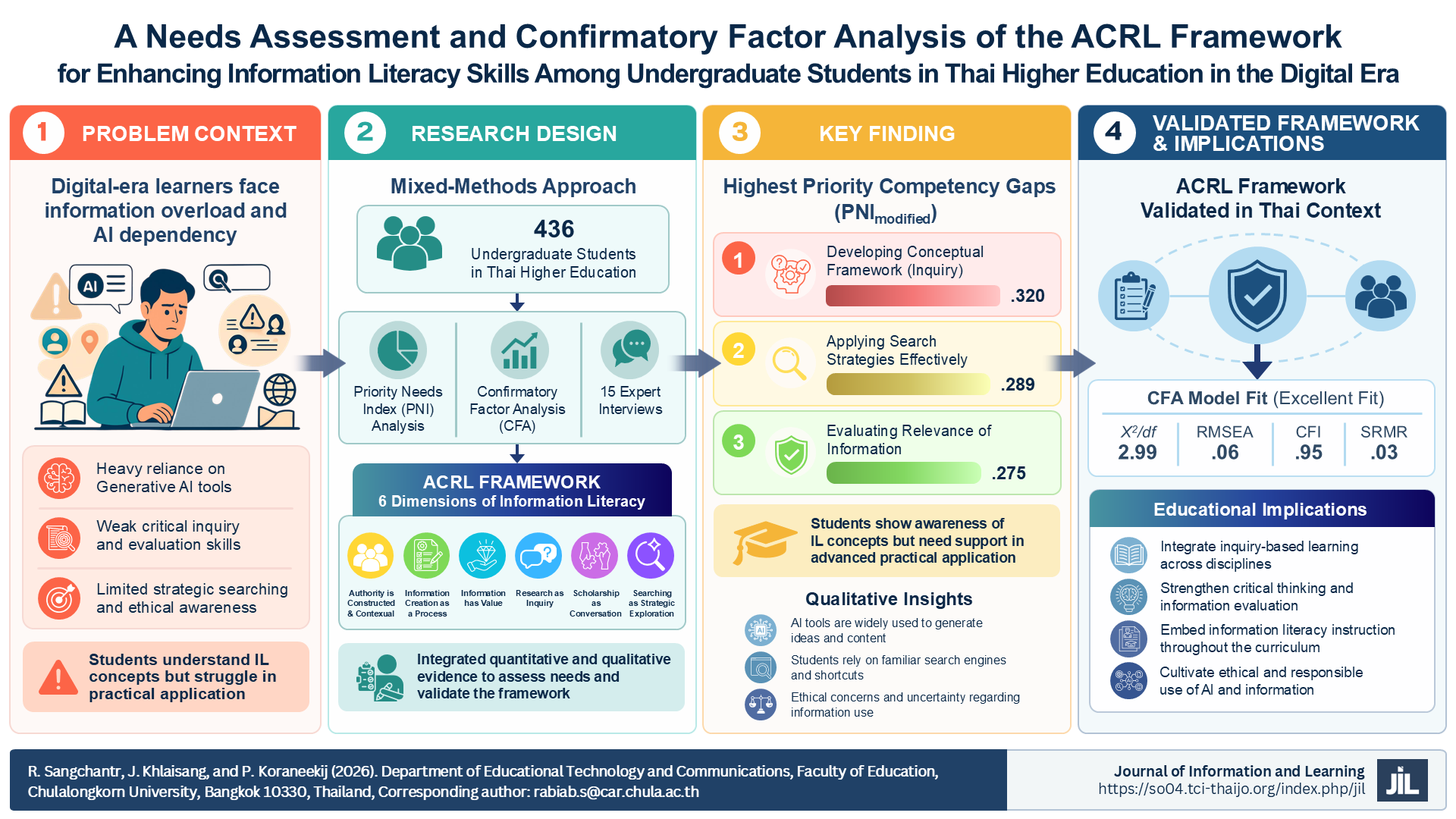
Information literacy (IL) in the digital era has evolved beyond basic search strategies to encompass more complex conceptual frameworks. The purposes of this mixed-methods study were 1) to determine the pri-ority IL competencies that digital-era learners perceived as needing improvement, and 2) to test the struc-tural validity of the Association of College and Research Libraries (ACRL) Framework within the Thai higher education context. In the quantitative phase, a sample of 436 undergraduate students from Thai public and private universities completed an online survey. Participants were recruited using stratified random sampling across five geographic regions of Thailand (Northern, Central, Eastern, Northeastern, and Southern). The reliability and validity of the 32-item, five-point Likert-scale questionnaire were rigorously evaluated to demonstrate strong internal consistency (Cronbach's Alpha) and construct validity confirmed through Con-firmatory Factor Analysis. In addition to the quantitative component of the study, the qualitative aspect was included in semi-structured interviews where there were 15 experts participating. The data were ana-lyzed using the Modified Priority Needs Index (PNImodified) and Confirmatory Factor Analysis (CFA). The results showed that while students felt that they needed to improve many of their IL competencies, par-ticularly developing a conceptual framework (PNImodified = .320), applying search strategies effectively (PNImodified = .289), those skills were used relatively infrequently. Insights gained from the qualitative component of this study revealed several key reasons why that disparity existed. Today's students have difficulty with ethics-related aspects of information literacy, rely heavily on Generative AI tools, and do not possess the physical stamina to engage in extended periods of critical thinking and analysis. While those difficulties are concerned with learners’ behaviors, the CFA supported the structural validity of the theoret-ical model proposed by the ACRL Framework, providing evidence that supports the notion that the ACRL Framework represents a good fit for empirically based data regarding IL (X2/df = 2.99, RMSEA = .06, SRMR = .03, CFI = .95). These findings offer practical guidance for universities to redesign information literacy curricu-la targeting specific behavioral gaps identified in the digital era, particularly in developing research frame-works and applying effective search strategies.
References
American Library Association. (2000). Information literacy competency standards for higher education. The Association of College and Research Libraries. http://hdl.handle.net/11213/7668
American Library Association. (2016, January 11). Framework for information literacy for higher education. American Library Association. https://www.ala.org/acrl/standards/ilframework
Baydoun, S., & Brillat, A. M. (2023). De-colonizing one-shots: Critical pedagogies and the ACRL framework. College and Research Libraries News, 84(3), 110–114. https://doi.org/10.5860/crln.84.3.110
Chen, F., Sousa, K., & West, S. (2005). Teacher's corner: Testing measurement invariance of second-order factor models. Structural Equation Modeling, 12(3), 471–492. https://doi.org/10.1207/s15328007sem1203_7
Condon, P. B., & Pothier, W. G. (2022). Advancing data literacy: Mapping business data literacy competencies to the ACRL Framework. Journal of Business and Finance Librarianship, 27(2), 104–126. https://doi.org/10.1080/08963568.2022.2048168
DeStasio, J. G. (2025). Information literacy and social media: Empowered student engagement with the ACRL Framework. Journal of New Librarianship, 10(2), 46–49. https://doi.org/10.33011/newlibs/19/4
DiNardo, C. O., Jacobs, S. A., & Ariew, S. A. (2026). What do we already have? Mapping asynchronous information literacy workshops to the ACRL Framework and companion documents. Reference Services Review, 54(1), 53–65. https://doi.org/10.1108/RSR-08-2025-0060
Eva, N. C., Rocca, M. S., & MacKay, D. B. (2021). Aha moments and continued confusion: An analysis of threshold concepts through student reflections in the ACRL Framework. College & Research Libraries, 82(2), 199–218. https://doi.org/10.5860/crl.82.2.199
Faix, A. I., & Fyn, A. F. (2023). Six frames, four moves, one habit: Finding ACRL’s Framework within SIFT. College and Research Libraries News, 84(11), 411–416. https://doi.org/10.5860/crln.84.11.411
Hair, J. F., Black, W. C., Babin, B. J., & Anderson, R. E. (2019). Multivariate data analysis (8th ed.). Cengage Learning.
Hair, J. F., Sarstedt, M., Ringle, C. M., & Mena, J. A. (2012). An assessment of the use of partial least squares structural equation modeling in marketing research. Journal of the Academy of Marketing Science, 40(3), 414-433. https://doi.org/10.1007/s11747-011-0261-6
Hair, J., Hult, G. T. M., Ringle, C., Sarstedt, M., Danks, N., & Ray, S. (2021). Partial least squares structural equation modeling (PLS-SEM) using R: A Workbook. Springer. https://link.springer.com/book/10.1007/978-3-030-80519-7
Henseler, J., Ringle, C., & Sarstedt, M. (2015). A new criterion for assessing discriminant validity in variance-based structural equation modeling. Journal of the Academy of Marketing Science, 43, 115–135. https://doi.org/10.1007/s11747-014-0403-8
Hsieh, M. L., Dawson, P. H., & Yang, S. Q. (2021). The ACRL Framework successes and challenges since 2016: A survey. The Journal of Academic Librarianship, 47(2). https://doi.org/10.1016/j.acalib.2020.102306
Hu, L., & Bentler, P. M. (1999). Cutoff criteria for fit indexes in covariance structure analysis: Conventional criteria versus new alternatives. Structural Equation Modeling: A Multidisciplinary Journal, 6(1), 1–55. https://doi.org/10.1080/10705519909540118
Jarson, J., & Hamelers, R. (2022). Is the ACRL Framework a teaching tool? Undergraduates’ interpretations of its language and concepts. Reference Services Review, 50(2), 179–189. https://doi.org/10.1108/RSR-10-2021-0054
Kim, M., Seo, D., & Damas, M. C. (2023). Community college STEM faculty and the ACRL Framework: A pilot study. Issues in Science and Technology Librarianship, 102. https://doi.org/10.29173/istl2714
Kline, R. B. (2016). Principles and practice of structural equation modeling (4th ed.). Guilford Press.
Ko, C. R., & Chiu, M. H. (2024). How can academic librarians support generative AI literacy: An analysis of library guides using the ACRL information literacy framework. Proceedings of the Association for Information Science and Technology, 61(1), 977–979. https://doi.org/10.1002/pra2.1159
Lawson, D., & Benallack, C. (2022). Training tutors in the ACRL Framework: Research as a rhetorical activity. WLN: A Journal of Writing Center Scholarship, 46(5–6), 19–26. https://doi.org/10.37514/WLN-J.2022.46.5.04
Marsh, H. W., & Hocevar, D. (1985). Application of confirmatory factor analysis to the study of self-concept: First- and higher order factor models and their invariance across groups. Psychological Bulletin, 97(3), 562–582. https://doi.org/10.1037/0033-2909.97.3.562
Rindskopf, D., & Rose, T. (1988). Some theory and applications of confirmatory second-order factor analysis. Multivariate Behavioral Research, 23(1), 51–67. https://doi.org/10.1207/s15327906mbr2301_3
Rose-Wiles, L. M. (2024). The framing of authority in the ACRL Framework on information literacy: Multidisciplinary perspectives on truth, authority, expertise and belief. Reference Services Review, 52(2), 202–217. https://doi.org/10.1108/RSR-02-2024-0003
Schmidt, A. G., Beckendorf, A., & Bickley, T. (2025). Performing arts and the ACRL Framework: Using the music companion. Performing Arts Resources, 37, 42–59. https://doi.org/10.3998/par.7441
Vong, S. (2021). From dispositions to positionality: Addressing dispositions of the student researcher in the ACRL Framework. The Journal of Academic Librarianship, 47(6), Article 102457. https://doi.org/10.1016/j.acalib.2021.102457
Voorhees, C., Brady, M., Calantone, R., & Ramirez, E. (2015). Discriminant validity testing in marketing: An analysis, causes for concern, and proposed remedies. Journal of the Academy of Marketing Science, 44, 119–134. https://doi.org/10.1007/s11747-015-0455-4
Downloads
Additional Files
Published
How to Cite
Issue
Section
Categories
License
Copyright (c) 2026 Journal of Information and Learning

This work is licensed under a Creative Commons Attribution-NonCommercial 4.0 International License.
The Journal of Information and Learning is operated by the Office of Academic Resources, Prince of Songkla University. All articles published in the journal are protected by Thailand copyright law. This copyright covers the exclusive rights to share, reproduce and distribute the article, including in electronic forms, reprints, translations, photographic reproductions, or similar. Authors own copyrights in the works they have created as well as the Office of Academic Resources. The Journal reserves the right to edit the language of papers accepted for publication for clarity and correctness, as well as to make formal changes to ensure compliance with the journal's guidelines. All authors must take public responsibility for the content of their paper.


