
ประสิทธิผลของโครงการฝึกอบรมเสริมสร้างทักษะการรู้สารสนเทศของคณะวิทยาศาสตร์ มหาวิทยาลัยมหิดล
คำสำคัญ:
การรู้สารสนเทศ, ประสิทธิผลการฝึกอบรม, การเรียนรู้ออนไลน์, การพัฒนาหลักสูตร, การวิจัยแบบผสมผสานบทคัดย่อ
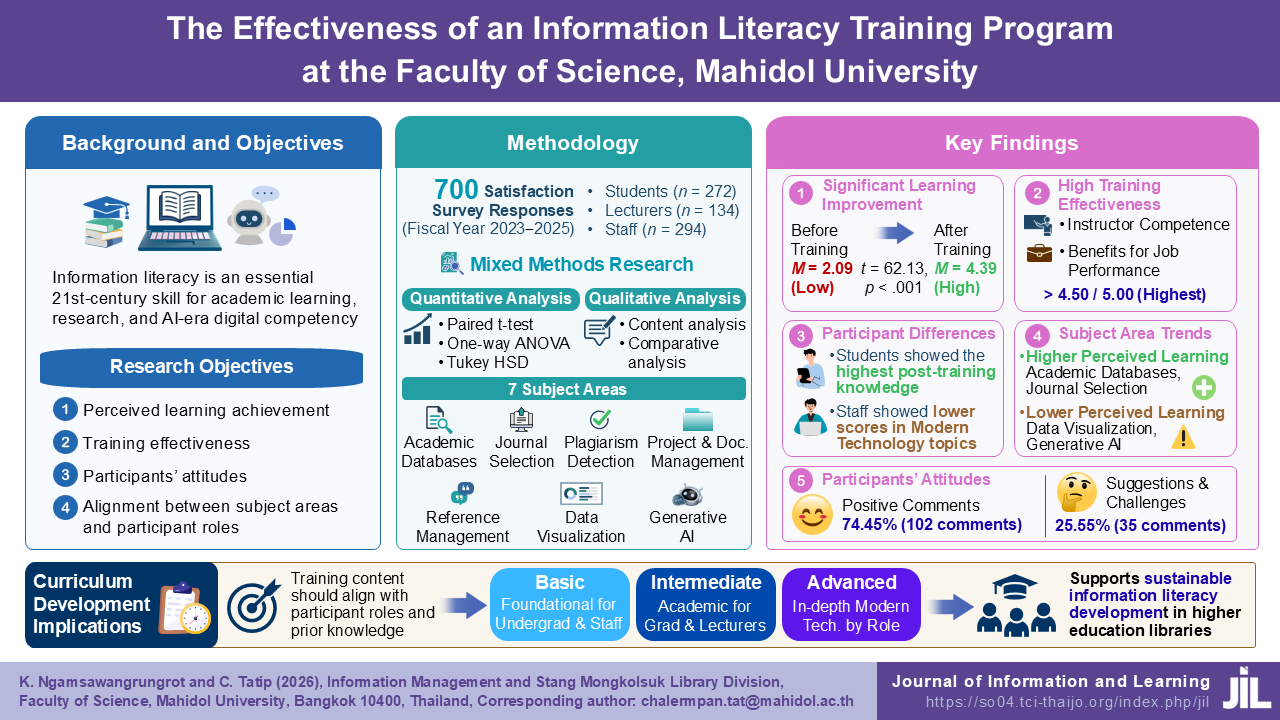
การวิจัยแบบผสมผสานครั้งนี้มีวัตถุประสงค์เพื่อศึกษา 1) การรับรู้ผลสัมฤทธิ์การเรียนรู้ 2) ประสิทธิผลโครงการฝึกอบรม 3) เจตคติของผู้ร่วมอบรม และ 4) ความสอดคล้องระหว่างกลุ่มเนื้อหาและสถานภาพของผู้ร่วมอบรม ต่อโครงการฝึกอบรมเสริมสร้างทักษะการรู้สารสนเทศของคณะวิทยาศาสตร์ มหาวิทยาลัยมหิดล ซึ่งจัดขึ้นในรูปแบบการเรียนรู้ออนไลน์ กลุ่มตัวอย่าง คือ ข้อมูลจากแบบประเมินความพึงพอใจ จำนวน 700 ชุด ในช่วงปีงบประมาณ พ.ศ. 2566–2568 คิดเป็นอัตราการตอบกลับร้อยละ 24.60 สถิติที่ใช้ในการวิเคราะห์ข้อมูลเชิงปริมาณ ได้แก่ ความถี่ ร้อยละ ค่าเฉลี่ย ส่วนเบี่ยงเบนมาตรฐาน Paired t-test การวิเคราะห์ความแปรปรวนแบบทางเดียว และการเปรียบเทียบรายคู่ด้วย Tukey HSD ร่วมกับการวิเคราะห์เนื้อหาสำหรับข้อมูลเชิงคุณภาพ ผลการวิจัย พบว่า 1) ผู้ร่วมอบรมมีการรับรู้ระดับความรู้หลังการอบรม (M = 4.39, SD = 0.61) สูงกว่าก่อนการอบรม (M = 2.09, SD = 1.00) อย่างมีนัยสำคัญทางสถิติที่ระดับ .001 โดยกลุ่มนักศึกษาและเนื้อหาด้านวิชาการ (Academic Databases, Journal Selection) มีค่าเฉลี่ยสูงสุด ขณะที่กลุ่มบุคลากรและเนื้อหาด้านเทคโนโลยีสมัยใหม่ (Data Visualization, Generative AI) มีค่าเฉลี่ยต่ำที่สุด 2) ประสิทธิผลด้านความสามารถของวิทยากรและประโยชน์ต่อการปฏิบัติงานอยู่ในระดับมากที่สุด (ค่าเฉลี่ยเกิน 4.50) โดยด้านประโยชน์มีความแตกต่างอย่างมีนัยสำคัญตามความสอดคล้องของเนื้อหากับบริบทของผู้ร่วมอบรม 3) ความคิดเห็นเชิงบวก ร้อยละ 74.45 จากความคิดเห็นทั้งหมด 137 รายการ พบว่า กิจกรรมน่าสนใจและต้องการเข้าร่วมในครั้งต่อไป ขณะที่ร้อยละ 25.55 เสนอแนะให้เพิ่มระยะเวลา เอกสารประกอบ เนื้อหาเชิงลึก และการปูความรู้พื้นฐาน 4) ผลการวิเคราะห์เปรียบเทียบพบรูปแบบความสอดคล้อง 2 รูปแบบ ระหว่างเนื้อหากับสถานภาพของผู้ร่วมอบรม นำไปสู่ข้อเสนอแนะการพัฒนาหลักสูตร 3 ระดับ (Basic, Intermediate, Advanced) ตามแนวคิด Bloom’s Taxonomy
เอกสารอ้างอิง
Anderson, L. W., & Krathwohl, D. R. (Eds.). (2001). A taxonomy for learning, teaching, and assessing: A revision of Bloom’s taxonomy of educational objectives. Longman.
Association of College and Research Libraries. (1989). Presidential committee on information literacy: Final report. American Library Association. https://www.ala.org/acrl/publications/whitepapers/presidential
Association of College and Research Libraries. (2016). Framework for information literacy for higher education. American Library Association. https://www.ala.org/acrl/standards/ilframework
Baytas, C., & Ruediger, D. (2025). Making AI generative for higher education: Adoption and challenges among instructors and researchers. Ithaka S+R. https://doi.org/10.18665/sr.322677
Bowling, A. (2005). Just one question: If one question works, why ask several? Journal of Epidemiology & Community Health, 59(5), 342–345. https://doi.org/10.1136/jech.2004.021204
Butdisuwan, S. (2019). Kān rū sārasonthēt (Information literacy) samrap naksưksā nai sathāban ʻudomsưksā [Information literacy for higher education students]. T.L.A. Bulletin, 51(2), 73–80. https://so06.tci-thaijo.org/index.php/tla_bulletin/article/view/169321
Chen, C. C., Wang, N. C., Tu, Y. F., & Lin, H. J. (2021). Research trends from a decade (2011–2020) for information literacy in higher education: Content and bibliometric mapping analysis. Proceedings of the Association for Information Science and Technology, 58(1), 48–59. https://doi.org/10.1002/pra2.435
Cohen, J. (1988). Statistical power analysis for the behavioral sciences (2nd ed.). Lawrence Erlbaum Associates.
Creswell, J. W., & Plano Clark, V. L. (2025). Designing and conducting mixed methods research (4th ed.). SAGE Publications.
Eisinga, R., Grotenhuis, M., & Pelzer, B. (2013). The reliability of a two-item scale: Pearson, Cronbach, or Spearman-Brown? International Journal of Public Health, 58(4), 637–642. https://doi.org/10.1007/s00038-012-0416-3
Howard, G. S. (1980). Response-shift bias: A problem in evaluating interventions with pre/post self-reports. Evaluation Review, 4(1), 93–106. https://doi.org/10.1177/0193841x8000400105
Kidder, L. H., & Judd, C. M. (1986). Research methods in social relations (5th ed.). Holt, Rinehart and Winston.
Kirkpatrick Partners. (2024). The Kirkpatrick model. https://www.kirkpatrickpartners.com/the-kirkpatrick-model
Knowles, M. S. (1984). Andragogy in action: Applying modern principles of adult education. Jossey-Bass.
Kolb, D. A. (2014). Experiential learning: Experience as the source of learning and development (2nd ed.). Pearson Education.
Krippendorff, K. (2019). Content analysis: An introduction to its methodology (4th ed.). SAGE Publications.
Lu, R., Shi, F., & Sun, H. (2025). Research on the evaluation of college students’ information literacy under the background of sustainable development: A case study of Yancheng Institute of Technology. Sustainability, 17(21), Article 9389. https://doi.org/10.3390/su17219389
MacCallum, K., Parsons, D., & Mohaghegh, M. (2023). Identifying the components of foundational Artificial Intelligence (AI) literacy - early results from a Delphi study [Conference paper]. ASCILITE 2023: People, Partnerships and Pedagogies, Christchurch, New Zealand. https://doi.org/10.14742/apubs.2023.672
Ngernpoolsap, D., Sanchon, P., & Boonwattanopas, D. (2024). Media and information literacy among higher education students in Thailand: A post Covid-19 pandemic literature synthesis. Thai Reading Journal, 28(1), 62–77. https://so01.tci-thaijo.org/index.php/rdj/article/view/274455
Pelletier, K., McCormack, M., Muscanell, N., Reeves, J., Robert, J., & Arbino, N. (2024). 2024 EDUCAUSE horizon report, teaching and learning edition. EDUCAUSE. https://library.educause.edu/-/media/files/library/2024/5/2024hrteachinglearning.pdf
Pinto, M., Garcia-Marco, J., Caballero, D., Manso, R., Uribe, A., & Gomez, C. (2024). Assessing information, media and data literacy in academic libraries: Approaches and challenges in the research literature on the topic. The Journal of Academic Librarianship, 50(5), Article 102920. https://doi.org/10.1016/j.acalib.2024.102920
Sanches, T., & Chan, E. (2023). Higher education students’ perceptions towards information literacy: A study in Macau. Ibersid, 17(2), 41–48. https://doi.org/10.54886/ibersid.v17i2.4910
Siemens, G. (2005). Connectivism: A learning theory for the digital age. International Journal of Instructional Technology and Distance Learning, 2(1), Article 01. https://www.itdl.org/Journal/Jan_05/article01.htm
Thalheimer, W. (2024). LTEM: The learning-transfer evaluation model. Work-Learning Research. https://www.worklearning.com/ltem
Turner, R. C., & Carlson, L. (2003). Indexes of item-objective congruence for multidimensional items. International Journal of Testing, 3(2), 163–171. https://doi.org/10.1207/s15327574ijt0302_5
UNESCO. (2013). Global media and information literacy assessment framework: Country readiness and competencies. https://unesdoc.unesco.org/ark:/48223/pf0000224655
UNESCO. (2023). Information literacy. https://www.unesco.org/en/ifap/information-literacy
Wanous, J. P., Reichers, A. E., & Hudy, M. J. (1997). Overall job satisfaction: How good are single-item measures? Journal of Applied Psychology, 82(2), 247–252. https://doi.org/10.1037/0021-9010.82.2.247
World Economic Forum. (2023). The future of jobs report 2023. https://www.weforum.org/publications/the-future-of-jobs-report-2023
ดาวน์โหลด
ไฟล์ประกอบ
เผยแพร่แล้ว
รูปแบบการอ้างอิง
ฉบับ
ประเภทบทความ
หมวดหมู่
สัญญาอนุญาต
ลิขสิทธิ์ (c) 2026 Kanokporn Ngamsawangrungrot, Chalermpan Tatip

อนุญาตภายใต้เงื่อนไข Creative Commons Attribution-NonCommercial 4.0 International License.
เข้าถึงบทความได้โดยไม่เสียค่าใช้จ่าย นโยบายสัญญาอนุญาตปัจจุบัน CC BY-NC 4.0 ตั้งแต่ปีที่ 37 ฉบับที่ 2 (2569) สำหรับบทความก่อนหน้านี้ โปรดตรวจเงื่อนไขสิทธิบนหน้าบทความแต่ละเรื่อง ดูนโยบายการเข้าถึงแบบเปิดและสัญญาอนุญาต

