
Using Research-Based Learning to Develop Problem-Solving Thinking Skills in Student Teachers
Keywords:
research-based learning, ability of problem-solving thinking, student teachersAbstract
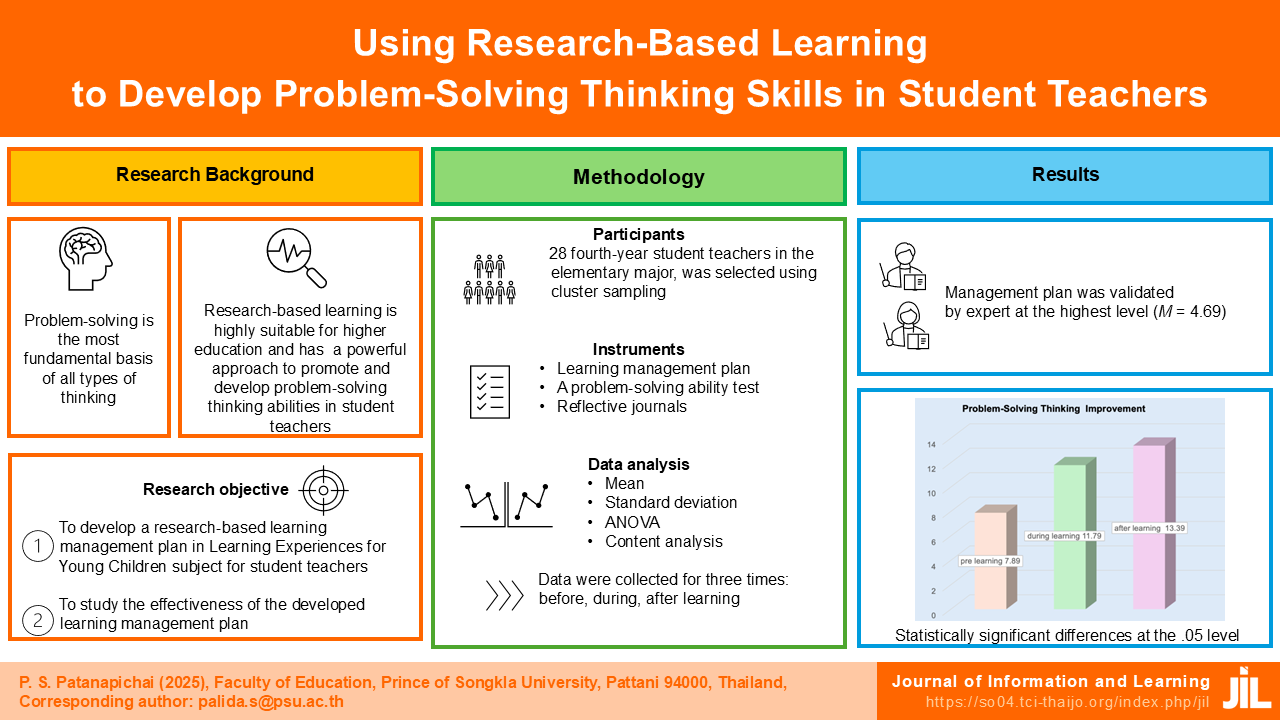
This research aimed 1) to develop a research-based learning management plan in the Learning Experiences for Young Children subject for student teachers, and 2) to study the effectiveness of the developed learning management plan. The sample group consisted of 28 fourth-year student teachers majoring in elementary education at Faculty of Education, Prince of Songkla University, Pattani Campus. The sample was selected using cluster sampling method. The independent variable was research-based learning management, and the dependent variable was the student teachers’ problem-solving ability. Data collection instruments included a learning management plan, a problem-solving ability test, and reflective journals. Data were collected for three times before, during, and after learning. Data analysis involved mean, standard deviation, repeated measures ANOVA, and content analysis. The results showed that the developed research-based learning management plan was validated by experts at the highest level (M = 4.69), and the effectiveness of the plan revealed that the student teachers’ average problem-solving scores after the learning intervention were higher than both before and during the learning process. The average scores were pre-learning (M = 7.89), during learning (M = 11.79), and post-learning (M = 13.39, with statistically significant differences at the .05 level. This indicates that research-based learning management effectively enhances the problem-solving abilities of student teachers.
References
Chareonwongsak, K. (2013). Creative thinking. Success Media.
Demirel, M., Derman, I., & Karagedi, E. (2015). A study on the relationship between reflective thinking skills towards problem solving and attitudes towards mathematics. Procedia-Social and Behavioral Sciences, 197, 2086–2096. https://doi.org/10.1016/j.sbspro.2015.07.326
Dung, T. M., & Bao, P. M. (2017). Vietnamese students' problem solving skills in learning about error of measurements. International Electronic Journal of Mathematics Education, 12(3), 463–474. https://www.iejme.com/article/vietnamese-students-problem-solving-skills-in-learning-about-error-of-measurements
Dutthuyawat, A. (2024). Guidelines for developing problem solving processes in the learning of teacher students, Sakon Nakhon Rajabhat University. Journal of MCU Haripunchai, 7(2), 296–311. https://so04.tci-thaijo.org/index.php/JMHR/article/view/a-020
Good, C. V. (1973). Dictionary of education. McGraw-Hill.
Grossnickle, F. E., Brueckner, L. J., & Merton, E. L. (1959). Winston arithmetics: Seeing thinking doing. John C. Winston.
Kammanee, T. (2024). Sātkānsō̜n [Teaching pedagogy] (23th ed.). Chulalongkorn University Press.
Khamdit, S. (2014). Research based learning (RBL) in higher education. Suthiparithat Journal, 28(85), 10–21. https://so05.tci-thaijo.org/index.php/DPUSuthiparithatJournal/article/view/244944
Larkin, H., & Pepin, G. (2013). Becoming a reflective practitioner. In S. Karen, S. Adrian, & W. Dianne. (Eds.), Clinical and fieldwork placement in the health professions (pp. 31–42). OXFORD University Press.
Muangsong, N., & Doungwilai, D. (2024). The development of problem-solving skills and creative writing skills of grade 5 students using problem learning and flipped classroom. Journal of Liberal Art of Rajamangala University of Technology Suvarnabhumi, 6(3), 772–786. https://so03.tci-thaijo.org/index.php/art/article/view/278606
Nachairit, D. (2019). Teaching and studying development by online lesson with case study approach for enhance solving-problem skill of teacher college students. Rajabhat Maharakham University. https://fulltext.rmu.ac.th/fulltext/2562/M126972/Darunnapa%20Students.pdf
Nogues, J., Neri, L. (2019). Research-based learning: A case study for engineering students. International Journal on Interactive Design and Manufacturing, 13, 1283–1295. https://link.springer.com/article/10.1007/s12008-019-00570-x
Office of the Basic Education Commission. (n.d.). Higher order thinking: Hot. https://cbethailand.com/หลักสูตร/หลักสูตรฐานสมรรถนะ/สมรรถนะหลัก-5-ประการ/สมรรถนะการคิดขั้นสูง
Office of the National Education Commission. (2002). Phrarātchabanyat kānsưksā hǣng chāt Phutthasakkarāt sō̜ngphansīrō̜ihāsipsō̜ng læ thī kǣkhai phœ̄mtœ̄m (chabap thī sō̜ng) B.E. 2542 [National education act A.D. 1999) And Amendments (Second national education act A.D. 2002)]. https://www.moe.go.th/พรบ-การศึกษาแห่งชาติ-พ-ศ-2542
Pakdee, K. (2022). Research based learning management to promote problem-solving and achievement capabilities in early childhood education innovation course. Journal of Education Mahasarakham University, 16(2), 45–55. https://so09.tci-thaijo.org/index.php/JOEMSU/article/view/247
Paweenbampen, P. (2017). Research based learning. Journal of Inclusive and Innavative Education, 1(2), 62–71. https://so01.tci-thaijo.org/index.php/cmujedu/article/view/166369
Pengsook, A. (2022). The development of problem solving skill for professional teaching student through the simulation method. Valaya Alongkorn Review Journal, 12(3), 103–114. https://so06.tci-thaijo.org/index.php/var/article/view/253168
Phajan, T. (2017). The development of instructional model using research based learning For enhancing, analyzing and planning competencies to solve health problems among undergraduate students in community public health program, Sirindhorn College of Public Health, KhonKaen Province. Thai Dental Nurse Journal, 28(1), 47–59. https://he02.tci-thaijo.org/index.php/TDNJ/article/view/90164
Pokum, P., Wannapaisan, C., & Mangkhang, C. (2021). Problem based learning management on 21st century global issues to promote problem solving skills of Assumpion College Lampang students. Nakhon Lampang Buddhist College’s Journal, 10(1), 101–113. https://so04.tci-thaijo.org/index.php/NBJ/article/view/251552
Pongphoka, S., & Songserm, U. (2015). The development of problem solving thinking ability of mutthayomsuksa 6 Students by future problem solving technique and mind mappin. Veridian E-Journal, Slipakorn University, 8(2), 1223–1237. https://he02.tci-thaijo.org/index.php/Veridian-E-Journal/article/view/40311
Secretariat Office of the Teachers Council of Thailand. (2019). Sārānukrom wichāchīp khrū chalœ̄m phra kīat phra bāt somdet phračhaoyūhūa nư̄ang nai ʻōkāt mahā mongkhon chalœ̄m phra chonma phat pǣtsip phansā [Encyclopedia of the teaching profession in honor of His Majesty the King on the Auspicious Occasion of His Majesty's 80th Anniversary]. https://elibrary.ksp.or.th/index.php?lvl=notice_display&id=15532
Seif, E. (2021, September 17). Research based learning: A lifelong learning necessity. Solution Tree Blog. https://www.solutiontree.com/blog/research-based-learning-a-lifelong-learning-necessity
Sinlarat, P. (2014). Lak læ theknik kānsō̜n radap ʻudomsưksā [Principles and techniques of teaching at the higher education level] (4th ed.). V. PRINT (1991).
Sricharoenpramong, N., & Thanomcha, W. (2019). The development of thinking skills using by problem based learning to promote democratic citizenship of teacher profession students. Rajabhat Rambhai Barni Research Journal, 13(3), 182–190. https://so05.tci-thaijo.org/index.php/RRBR/article/view/240298
Sritha, S. (2019). Tœ̄m tem sakkayaphāp dūai krabūankān kǣ panhā ʻanākhot [Fulfilling potential through future problem-solving]. Laboratory School for Education Research and Development, Faculty of Education, Kasetsart University.
Stroulia, E., & Goel, A. K. (1994, April 5–8). Learning problem-solving conceptsby reflecting on problem solving. The 7th European Conference on Machine Learning. Sicily, Italy. https://citeseerx.ist.psu.edu/document?repid=rep1&type=pdf&doi=94fca66b1e9abcb5cf22886460ac09663b71dd17
Sungrugsa, N., & Thammapipon, S. (2020). Learning reflection: perspective in order to construct the body of knowledge in educational research. Silpakorn Educational Research Journal, 12(2), 1–15. https://so05.tcithaijo.org/index.php/suedureasearchjournal/article/view/247048
Sunsee, J., Saksuparb, K., & Haemaprasith, S. (2022). Effects of research based learning on science awearness and achievement of tenth grade students. Silpakorn Educational Research Journal, 14(2), 217–232. https://so05.tci-thaijo.org/index.php/suedureasearchjournal/article/view/259408
Suwanvapee, P., & Kanjug, I. (2020). The development of gamification learning environment to enhance problem-solving thinking skills in computing science courses on problem-solving topic for mathayomsuksa 1 students at nongwuasorpittayahhom school. Journal of Graduate Research, 11(1), 15–27. https://so02.tci-thaijo.org/index.php/banditvijai/article/view/240997
Timroon, S., & Linjalern, A. (2021). The delvelopmemt of research based learning activity. In unit “life in environment” to promote critical thinking skills of grade 10 students. Journal of Faculty of Education Pibulsongkram Rajabhat University, 8(2), 240–252. https://so02.tci-thaijo.org/index.php/edupsru/article/view/248185
Worayos, T., & Doungwilai, D. (2025). The development of problem-solving thinking and systems thinking skills in eleventh-grade students using brain-based learning management with board games. Journal of Buddhist Psychology, 10(1), 141–154. https://so03.tci-thaijo.org/index.php/jbp/article/view/278696
Yamareng, U. (2017). The instruction by research-based learning (RBl) on curriculum and instruction in islamic education coursein master of education program in teaching islamic Education B.E. 2559. YRU Wisdom Bank. https://wb.yru.ac.th/xmlui/handle/yru/5043
Downloads
Additional Files
Published
How to Cite
Issue
Section
Categories
License
Copyright (c) 2025 Journal of Information and Learning [JIL]

This work is licensed under a Creative Commons Attribution-NonCommercial-NoDerivatives 4.0 International License.
The Journal of Information and Learning is operated by the Office of Academic Resources, Prince of Songkla University. All articles published in the journal are protected by Thailand copyright law. This copyright covers the exclusive rights to share, reproduce and distribute the article, including in electronic forms, reprints, translations, photographic reproductions, or similar. Authors own copyrights in the works they have created as well as the Office of Academic Resources. The Journal reserves the right to edit the language of papers accepted for publication for clarity and correctness, as well as to make formal changes to ensure compliance with the journal's guidelines. All authors must take public responsibility for the content of their paper.


